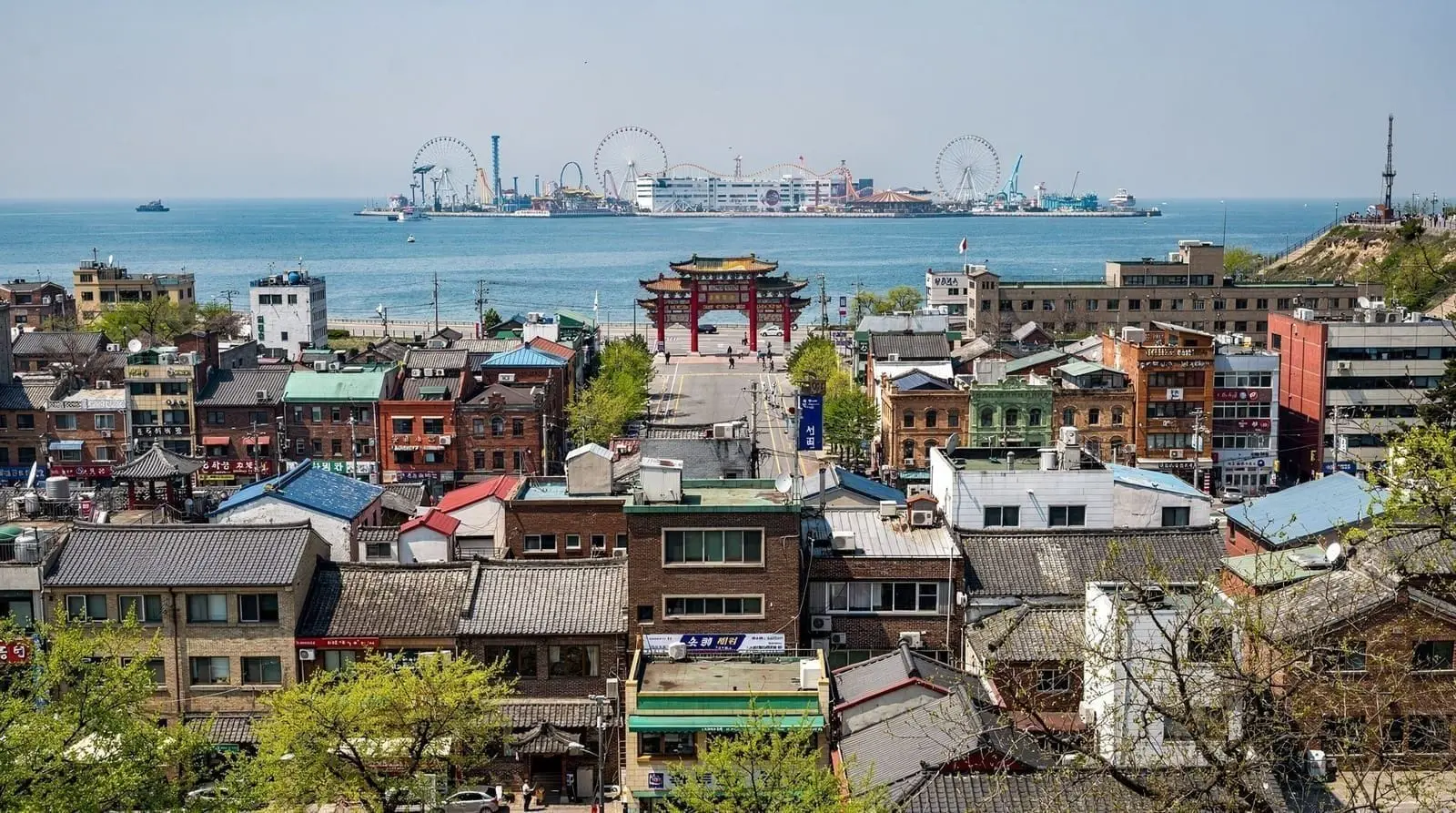
Incheon in one day — the perfect 1-day itinerary
One day in Incheon is enough to cover three very different neighbourhoods: a 140-year-old Chinatown and treaty-port district, a purpose-built smart city with a canal park, and a coastal island famous for seafood and sunsets. The three areas are connected by metro and taxi, and the route runs roughly west to east in the morning, then doubles back to the coast by evening — which is how you catch the best light at each stop.
This itinerary works for day-trippers arriving from Seoul by metro, for stopover travellers with a free afternoon, and for anyone who wants to see more of Incheon than just the airport transit zone. Total walking is moderate. No car is needed.
| Where | Chinatown/Open Port, Songdo Central Park, Wolmido |
| Cost | around 60,000-90,000 won per person |
| Time needed | 1 full day, 9am to 7pm or later |
| Getting there | Metro line 1 from Seoul, then taxi/bus between areas |
| Best time | Start by 9am; sunset at Wolmido is the natural finish |
Morning: Incheon Chinatown and the Open Port area (9 am – 12 pm)
Arrive at Incheon Station (metro line 1, the final stop) by 9 am. From Seoul Station the journey takes about 55 minutes and costs around 1,650 won on a T-money card. Use exit 1. The red Chinese gate marking the entrance to Incheon Chinatown is a three-minute walk straight ahead.
Incheon Chinatown is Korea’s only officially designated Chinatown, established in 1884 when the area was opened to Chinese merchants following the port treaty. It is compact — you can walk its main lanes in 30 to 40 minutes — but worth doing slowly. The painted wall murals along the main street illustrate the history of Chinese immigration, and several of the original merchant buildings from the early 1900s are still standing.
What to eat for breakfast or early lunch: Jjajangmyeon, the thick black bean noodle dish, was popularised in Incheon’s Chinatown and this is the most authentic place to eat it in Korea. Most restaurants open by 9 or 10 am. A bowl costs 8,000 to 12,000 won. The dish at Gonghwachun, the oldest restaurant in the area, runs on the higher end of that range but the building dates to 1905 and is worth seeing. If you want a wider introduction to the neighbourhood’s food scene, see where to eat in Incheon Chinatown.
After eating, walk through the Songwol-dong Fairytale Village, a short uphill from the main Chinatown gate. The village is a cluster of painted murals covering walls, rooftops and staircases — it takes about 20 minutes to wander through. It can get crowded on weekends by mid-morning, so earlier is better.
From Songwol-dong, walk ten minutes uphill to Jayu Park. The park sits on a hill above the port and has the best elevated views of the waterfront and the container terminals. There is a statue of General MacArthur here marking the 1950 Incheon Landing — the park is a genuinely significant historical site, not just a lookout.
Come back down toward the waterfront and spend 30 to 45 minutes in the Open Port heritage area. This small grid of streets immediately east of Chinatown contains the original 1880s concession buildings — Japanese customs houses, the Chinese consulate, the former Daebul Hotel (Korea’s first Western-style hotel, now a museum). Entry to the Incheon Open Port Modern History Museum costs 2,000 won, which is roughly 1.50 US dollars. The Incheon Chinatown walking tour guide covers both areas in detail if you want more context on individual buildings.
If you are short on time: Skip Jayu Park and go directly from Chinatown to the Open Port museums. You will still get a full sense of the neighbourhood.
Incheon: Walk and Eat with Local Walking BuddyAfternoon: Songdo Central Park and G-Tower (12 pm – 4 pm)
From Incheon Station, take metro line 1 toward Seoul and get off at Dongchun Station (동춘역). The journey is about 25 minutes. From Dongchun, Songdo Central Park is a 15-minute walk or a short taxi ride (roughly 4,000 to 5,000 won).
Songdo is the opposite of Chinatown in almost every sense. It was built from scratch on reclaimed land starting in the early 2000s and designed as a model smart city with fibre connectivity, pneumatic waste collection and car-free zones. Whether you find it impressive or sterile depends on your taste, but Songdo Central Park is legitimately pleasant: a long seawater canal runs through the middle, flanked by grass and walking paths, with kayaks and paddle boats available to hire from the canal dock area. Rental is typically around 10,000 to 15,000 won for 30 minutes.
The G-Tower stands at the south end of the park. Take the elevator to the 33rd floor observation deck — entry is free. The views cover the full arc of Songdo, the port, and on clear days the Yellow Sea. There is a café on the observation floor if you want to sit down. The G-Tower observation deck guide has opening hours and tips for the best time to visit.
After G-Tower, walk the canal back north and stop at the Tri-bowl cultural centre if it is open. The building is the architectural landmark of Songdo — three interlocking bowls of white concrete — and worth a photo even from the outside.
For a light lunch or afternoon snack around Songdo, the Songdo shopping and dining guide covers the main options near the park. The NCNC mall at the north end of Central Park has a basement food court with Korean fast food options starting around 7,000 won.
If you are short on time: Skip the canal kayak and go directly from Dongchun to G-Tower, then walk the park on your way back. You can cover the essentials in 90 minutes.
Incheon: One Day Guided City Tour with Hotel PickupLate afternoon and evening: Wolmido island (4 pm – 7 pm or later)
From Songdo, the fastest way to Wolmido is by taxi, which takes about 20 minutes and costs around 12,000 to 15,000 won. If you prefer bus, route 517 connects Songdo to Wolmido in roughly 35 minutes. Alternatively, if you return to Incheon Station first, buses 2, 12 and 23 reach Wolmido in about 15 minutes, or a taxi from Incheon Station costs around 5,000 won.
Wolmido is a small island connected to the mainland by a causeway. The west-facing coastline makes it the best place in Incheon — arguably in the entire metropolitan area — to watch the sunset over the Yellow Sea.
Start with the Wolmi Sea Train, a narrow-gauge monorail that runs along the coast of the island on a track built over the water. The journey loops around the island’s perimeter and takes about 42 minutes. Tickets cost 11,000 won for adults on weekdays and 14,000 won on weekends (non-residents of Incheon). Hours vary by season and the train is closed on Mondays, so check the operator’s official site (ictr.or.kr) for the day’s schedule; boarding queues can be long on weekend evenings, so arrive before 5 pm if possible.
After the sea train, walk Culture Street — the main promenade along the eastern side of the island. There are small amusement park rides here (the Viking ship and drop tower are the most popular), carnival food stalls, and the usual seaside souvenir shops. It is unashamedly touristy and lively in a way that Songdo is not.
For dinner, Wolmido seafood is the reason most Koreans come to the island. The restaurants along the causeway and the north end of the island serve grilled fish, steamed blue crab, raw fish (hoe), and nakji bokkeum (spicy stir-fried octopus). Budget around 20,000 to 40,000 won per person for a proper seafood meal. For full sunset views, choose a table with a west-facing window or ask for the roof terrace if the weather is good. Sunset in summer is around 7:30 to 8 pm; in winter it drops to around 5:30 pm.
A full guide to Wolmido island covers the sea train, amusement rides, and restaurant recommendations in detail.
Incheon: Sunset Beach & China/Japan Town & Inspire ResortHow this compares to spending the day in Seoul instead
Travellers based in Seoul sometimes weigh an Incheon day trip against simply staying in the capital, and the honest comparison is that Incheon offers something Seoul’s core districts do not: a working port history, an entirely purpose-built city, and a genuine seaside sunset, all within roughly an hour’s metro ride.
Seoul has more depth in any single category — bigger palaces, denser markets, more nightlife — but Incheon compresses three distinct atmospheres into a single day without the crowds that come with Seoul’s headline sights. If you have already spent several days in Seoul and want a change of pace rather than more of the same, this itinerary earns its place. If it is your only day in the country, Seoul’s palace district or Gangnam probably serves a first-time visitor better; save Incheon for a second visit or a longer stay.
Getting around between the three areas
Seoul to Incheon: Metro line 1 (dark blue), direction Incheon. Trains run from around 5:30 am to midnight. Buy a T-money card at any metro station convenience store for 2,500 won; load enough credit for the day (each metro journey costs 1,250 to 1,650 won depending on distance, with free transfers within 30 minutes).
Chinatown to Songdo: Metro line 1 from Incheon Station to Dongchun Station, about 25 minutes. Then walk 15 minutes or take a taxi (4,000 to 5,000 won) to Central Park.
Songdo to Wolmido: Taxi is the most direct option — about 20 minutes and 12,000 to 15,000 won. Bus route 517 takes roughly 35 minutes but requires no transfers.
Wolmido back to Seoul: Bus or taxi to Incheon Station, then metro line 1 direct to Seoul. The last metro from Incheon Station is around midnight. Check the Kakao Metro or Naver Map app for live schedules.
Full transit overview: The getting around Incheon guide covers all transit options including airport buses, the AREX express, and bike-share options along the waterfront.
Taxi costs to expect. Korean taxis are metered and generally reasonable by international standards, but plan for base fares around 4,800 won plus distance and time charges. The two taxi legs on this route — Songdo to Wolmido, and any shorter hops within a district — rarely exceed 15,000 won each, and splitting a taxi between two or more people often works out cheaper than separate metro fares for the same trip.
A T-money card is the simplest way to handle all transit in and around Incheon. If you are arriving directly from Incheon Airport, you can pick up a T-money card or a combined SIM and T-money at the airport arrivals hall. See the layover itinerary for notes on the airport transit links.
Practical tips
Start early. Chinatown gets crowded by 11 am on weekends. Being at Incheon Station by 9 am gives you the morning neighbourhood to yourself, especially in Songwol-dong.
Seasonal notes. Cherry blossom season (late March to early April) makes Jayu Park and Incheon Grand Park worth adding if you are visiting in spring — see the cherry blossom itinerary. Autumn (October to November) brings good hiking weather and foliage; the autumn foliage itinerary covers the best routes. Summer evenings at Wolmido are warm and lively but busy. Winter visits are quieter everywhere except Wolmido on weekends.
Budget guidance. A comfortable day with jjajangmyeon lunch, museum entry, G-Tower (free), canal kayak, sea train, and a seafood dinner will run roughly 60,000 to 90,000 won (45 to 70 US dollars) per person, including transit from Seoul. See the Incheon on a budget guide for lower-cost options at each stop.
If you have more time. This itinerary fills a full day comfortably. If you want to add a second day, Muuido Island or Ganghwado make excellent day trips from Incheon. The 2-3 day Seoul and Incheon itinerary covers how to combine both cities efficiently. Travellers who arrive with just a layover instead of a full day should use the dedicated 6-hour layover itinerary, which is built around the tighter airport-return timing this longer route does not need to account for.
Guided option. If you prefer to have transport and navigation handled, a guided day tour covers the major Incheon sites with a local guide.
Incheon Stopover: City Highlights Tour for K-culture FansWhat this itinerary deliberately leaves out
A single day forces choices, and this route makes them on purpose. It skips Ganghwado’s temples and dolmens (too far for a same-day add without dropping one of the three core stops), Nami Island’s cherry blossom or foliage avenues (a half-day trip on its own), and the Incheon Grand Park cherry blossom grounds (worth a dedicated visit in season rather than a rushed detour). None of these are lesser destinations — they simply do not fit the geography of a Chinatown-to-Songdo-to-Wolmido day without turning it into a transit marathon. If any of them matter more to you than Songdo, swap Songdo out; it is the most skippable of the three stops if your interests lean historical or coastal rather than architectural.
Frequently asked questions about Incheon in one day
How do I get from Seoul to Incheon for a day trip?
Take metro line 1 (the dark blue line) from Seoul Station toward Incheon. The journey to Incheon Station, the final stop, takes about 55 minutes and costs around 1,650 won with a T-money card. Trains run frequently throughout the day. Avoid the AREX airport express for this trip — it goes to the airport, not to Chinatown or the city centre.
Is one day enough for Incheon?
One day is enough to cover the three main neighbourhoods — Chinatown with the Open Port area, Songdo, and Wolmido — without rushing. You will not see everything in depth, but you will get a clear picture of what Incheon offers. If you want to add Muuido Island, the coastal rail bike at Yeongjongdo, or Ganghwado, plan for at least two days.
What is the best order to visit Chinatown, Songdo and Wolmido?
Morning in Chinatown, afternoon in Songdo, evening in Wolmido. This order follows the metro line logically (Incheon Station to Dongchun, then back west to Wolmido), avoids the weekend crowds in Chinatown mid-day, and puts you at Wolmido in time for the sunset, which faces west over the Yellow Sea.
Do I need to book anything in advance for an Incheon day trip?
Nothing strictly requires advance booking. G-Tower is free and walk-in. Museum entry at the Open Port area is cheap and always available. The Wolmi Sea Train and canal kayaks in Songdo are first-come, first-served. On busy weekend afternoons the sea train queue can be 30 to 45 minutes — arriving before 5 pm helps. Seafood restaurants at Wolmido do not typically take reservations; arrive by 6 pm to avoid a wait.
How much does a day trip to Incheon cost?
Budget roughly 60,000 to 90,000 won per person (45 to 70 US dollars) for a comfortable day including return metro from Seoul, museum entries, G-Tower observation deck (free), sea train, a jjajangmyeon lunch, and a seafood dinner at Wolmido. You can reduce this to around 40,000 won by skipping the canal kayak and eating more casually. See the Incheon on a budget guide for a breakdown.
Is Incheon Chinatown worth visiting?
Yes, particularly if you have not been before. It is Korea’s only official Chinatown, and the history of the Open Port area immediately adjacent is genuinely interesting — this is where Korea’s first modern treaties were signed and where the country’s first Western-style hotel stood. The food is good and the lanes are walkable in under an hour. It is not large enough to occupy a full day on its own, which is why it works well as the morning stop on a three-area itinerary.
Can I do this itinerary without a car?
Yes. The entire route works by metro, bus and taxi. Metro line 1 connects Seoul to Incheon Station (Chinatown) and to Dongchun Station (Songdo). The only leg without a direct metro connection is Songdo to Wolmido, which is best done by taxi (around 12,000 to 15,000 won) or bus route 517. A car is not needed and would actually slow you down given parking constraints in Chinatown and Wolmido on weekends.
Incheon city experiences on GetYourGuide
Top-rated tours and activities


