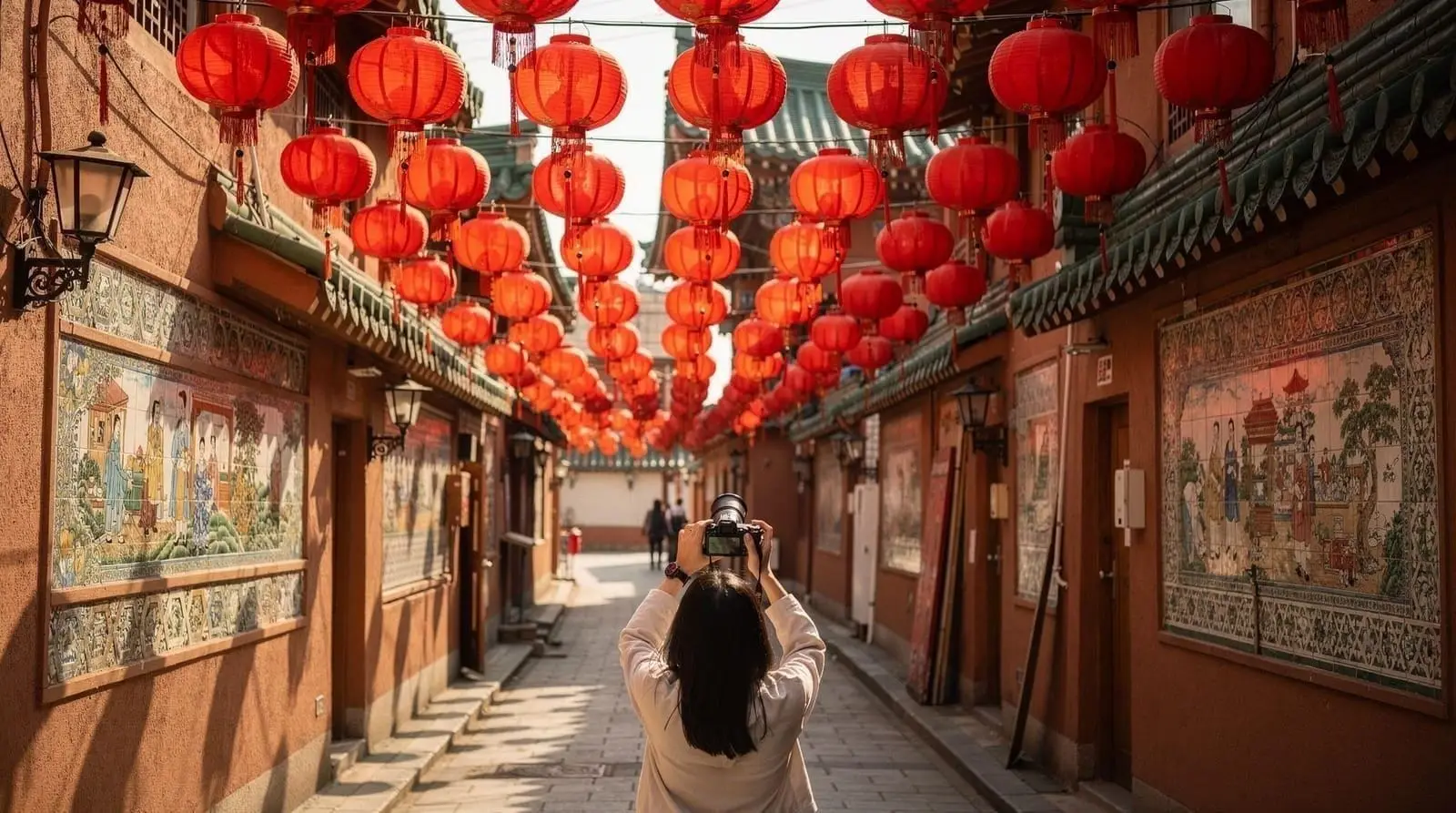
Incheon Chinatown walking tour: the complete 2-hour self-guided route
How long does the Incheon Chinatown walking tour take?
The core route takes about 2 hours at a relaxed pace, covering the main gate, Chinatown Main Street, the jjajangmyeon museum, murals, and historic boundary markers. Add 30–45 minutes if you continue to Songwol-dong Fairytale Village.
What makes Incheon Chinatown worth the trip
Incheon Chinatown is not a themed attraction built for tourists. It is Korea’s only officially designated Chinatown, and it has been here since 1884, when the Qing dynasty established a formal concession following Korea’s treaty port opening the previous year. That makes it genuinely old by Korean standards — most of the peninsula’s older urban fabric was destroyed during the Korean War or the rapid modernisation that followed.
The district sits a 3-minute walk from Incheon Station on metro line 1. You arrive in central Seoul, step onto a train, and forty minutes later you are eating a bowl of jjajangmyeon — the black bean noodle dish that was invented here, or at least popularised here to the point where Koreans consider it a national comfort food — at a restaurant that has occupied the same street for over a century.
That is the short case for visiting. The longer case involves ornate ceremonial gates, hand-painted history murals, a hilltop cemetery with views of the port, and a compact neighbourhood that you can cover properly in two hours without feeling rushed. Budget an extra half hour if you want to continue uphill to Songwol-dong Fairytale Village, which pairs well with this route and is covered in detail in the Songwol-dong Fairytale Village guide.
| Where | Incheon Chinatown, 3-minute walk from Incheon Station exit 1 |
| Cost | Free to walk; Jjajangmyeon museum around 500 won; lunch around 7,000–10,000 won |
| Time needed | About 2 hours for the core route, 2.5–3 hours with Songwol-dong |
| Getting there | Metro line 1 to Incheon Station (about 55 min from Seoul Station) |
| Best time | Weekday mid-morning, from around 10:30am, to beat lunch crowds |
Practical information before you start
Getting there: Take metro line 1 (dark blue) to Incheon Station, the final stop on the line. Use exit 1. The Chinatown gate is a 3-minute walk straight ahead. Journey time from Seoul Station is about 55 minutes; from Hongik University station, allow 70 minutes. The T-money card works throughout.
When to go: Restaurants in Chinatown mostly open at 10am or 11am. If you arrive before 10am you will find shuttered kitchens and empty streets — the district is not an early-morning destination. The sweet spot is 10:30am on a weekday, which lets you beat weekend crowds and eat lunch without queuing. Weekend afternoons in spring and autumn can be very busy, particularly on the main restaurant street. If you are visiting on a Saturday, aim to start before 11am.
Cost: Entry to the Chinatown district is free. The jjajangmyeon museum at Gonghwachun charges 500 won — roughly 40 US cents. Everything else on this route is free to walk around.
Weather and clothing: The route is mostly flat with one moderate uphill section toward the mural street and cemetery area. Comfortable walking shoes are sufficient. In summer (June–August) the streets are humid and exposed; carry water.
The walking route: eight stops in two hours
Use this time budget to pace yourself if you are working around a train or a lunch reservation elsewhere in the city.
| Stop | Suggested time | Highlight |
|---|---|---|
| 1. Incheon Station | 2 min | Orientation, the shift from metro to Chinatown streetscape |
| 2. Paeruijang Gate | 10 min | Photos, best light in the morning |
| 3. Chinatown Main Street | 25 min | Browsing, snacks, first look at restaurant menus |
| 4. Gonghwachun & Jjajangmyeon Museum | 30 min | Lunch plus the museum |
| 5. Hualian Church | 5 min | Quick stop, viewed from the street |
| 6. Concession boundary markers | 10 min | Easy to miss — look for bilingual signs |
| 7. Mural Street | 20 min | Photography, reading the history panels |
| 8. Songwol-dong or return | 20–40 min | Optional uphill extension |
Stop 1 — Incheon Station (starting point)
Exit through gate 1 and walk straight out. You will see the red and gold Chinatown arch in front of you almost immediately. This is one of the more disorienting moments in Korean travel: you step off a Seoul metro train and the streetscape shifts abruptly to Chinese architectural signage, red lanterns, and the smell of char siu pork from restaurant exhaust vents. It is genuinely jarring in a good way.
Incheon Station itself opened in 1899 and was the terminal of Korea’s first railway line, which ran between here and Noryangjin in Seoul. The current building is not the original, but the station is worth a glance as a historic endpoint.
Stop 2 — Paeruijang Gate (패루이장문)
The ornate ceremonial gate marks the formal entrance to Chinatown. These gates — called paeru in Korean, pailou in Chinese — are traditional Chinese archway structures built to mark significant civic and religious spaces. The Chinatown gate was erected in 1988 and restored since, and while it is not an antique, it is elaborately built: two stories, green-glazed ceramic roof tiles, dragons worked into the eave brackets, and red columns with gold calligraphy.
This is your first photograph stop. The gate faces south and gets better light in the morning. Stand back far enough to include the full roofline and both flanking columns, and arrive before the lunch crowd fills the street in front of it.
Beyond the gate, the main commercial street begins.
Stop 3 — Chinatown Main Street
The main street of Chinatown is lined on both sides with Chinese restaurants, souvenir shops selling preserved egg products and Chinese ceramics, and street vendors. The souvenir offer is genuine rather than manufactured: dried seafood, jarred pickles, and tea-smoked snacks are the things people actually buy and take home, not plastic pagoda figurines.
The restaurant density here is high, and the competition keeps quality reasonable. A bowl of jjajangmyeon — the defining dish — costs 7,000 to 10,000 won (roughly 5.50 to 8 USD) depending on the establishment. Most places also serve jjamppong (짬뽕), a spicy seafood noodle soup that arrived via the same Chinese-Korean culinary exchange. Order both and split them if you are with someone.
Tanghulu — sugar-coated fruit skewers, a northern Chinese street food that became a Korean trend — are sold from carts for 3,000 to 5,000 won. The strawberry version is the most popular; the grape version is underrated.
The best eating options in Incheon Chinatown covers specific restaurant picks and what to order at each, including which establishments on this block have maintained consistent quality.
Stop 4 — Gonghwachun (공화춘) and the Jjajangmyeon Museum
Gonghwachun is the most visited single spot in Chinatown, and the claims around it are worth handling carefully. The restaurant building dates to 1905 and was originally a restaurant catering to Chinese merchants. The story told in most guides is that jjajangmyeon was invented here. The more accurate version is that jjajangmyeon as a Korean adaptation of zhajiangmian developed across multiple Chinese-run restaurants in Incheon in the early twentieth century, with Gonghwachun being among the most prominent of them.
Whether or not it is strictly the birthplace, the building has been converted into the Jjajangmyeon Museum (짜장면 박물관), which is operated by the city and covers the dish’s history, the Chinese migrant community that brought it here, and the role it played in postwar Korean culture when it became an affordable everyday meal. Admission is 500 won. The museum takes about 30 minutes to move through and is genuinely informative — the section on how jjajangmyeon was priced relative to daily wages in the 1950s and 1960s is particularly interesting.
Open Tuesday through Sunday, 9am to 6pm. Closed Mondays.
Incheon Chinatown, Rail Bike, and Eco Park from SeoulStop 5 — Hualian Church (화리안 교회)
A 4-minute walk from Gonghwachun brings you to Hualian Church, the oldest Chinese church in Korea, founded in 1891. The current building is not the original structure, but the congregation has been continuous since the nineteenth century. The church serves the Korean-Chinese community that has lived in this district for over a century.
It is not a tourist attraction in the formal sense — there is no visitor admission or guided tour — but the building is freely visible from the street and worth pausing at. The architecture is a hybrid of Chinese decorative elements and Western Protestant church form, which tells you something about the community that built it: immigrants who brought their religious practice from China but worked within a context shaped by Western missionaries already active in Korea.
Stop 6 — Chinese Concession Boundary Markers (청국조계지 경계 비석)
As you continue south and slightly uphill, look for the stone boundary markers that delineate the original Chinese concession. These are modest granite posts, not dramatic monuments, but they mark a real historical edge: the line beyond which Qing dynasty jurisdictional rights applied in 1884. The concession system meant that Chinese nationals living within this zone were governed by Chinese law and administered by Chinese consular officials, not Korean authorities.
The markers are easy to miss if you are not looking for them. They are typically mentioned on small bilingual signs in the surrounding area. The broader context of the concession system and how it shaped the Open Port district is covered in the Incheon Open Port heritage guide.
Stop 7 — Chinatown Mural Street
The mural street is the most photographed section of the route. A series of large-format painted murals covers the walls along the upper lane of Chinatown, depicting scenes from Korean-Chinese history: the port opening, the Chinese merchant community, diplomatic missions, and everyday life in the concession during the late Joseon period.
The murals are not folk art — they were commissioned by the city and painted by professional artists — but they are well-executed and genuinely informative if you take time to read the accompanying text panels. Each mural has a caption in Korean and English explaining what is depicted.
This section of the route also gets you away from the main restaurant street and into the quieter residential lanes. The streets are narrow enough that you are walking in the middle of the road, which is perfectly normal and safe given the minimal traffic.
Stop 8 — Transition point: Songwol-dong Fairytale Village or return
From the top of the mural street, you have two options. The first is to retrace downhill to Incheon Station and finish the tour. The second is to continue uphill for about 10 minutes to Songwol-dong Fairytale Village, a neighbourhood of painted houses and mural alleyways that became popular on social media and has since become a standard add-on to this route.
The village is worth the uphill walk if you have the time. The painted house streets are compact — you can cover the main areas in 30 minutes — and the views back toward the port from the upper lanes are good. The Songwol-dong guide has the specific route and what to look for.
If you continue past Songwol-dong, a further 10 minutes uphill reaches Jayu Park, which has statues related to the 1950 Incheon Landing Operation and views over the port. The Jayu Park and Korean War history guide covers this in detail.
The Korean-Chinese community today
Chinatown is a living neighbourhood, not a preserved museum piece. The Korean-Chinese community here, descended largely from Shandong province migrants who arrived after the 1884 concession was established, still runs most of the restaurants and shops along the main street, and several families have operated the same address for three or four generations. That continuity is part of why the food tastes the way it does rather than reading as a tourist reconstruction — recipes for jjajangmyeon, jjamppong and tangsuyuk (sweet and sour pork, 탕수육) have been passed down rather than standardised for visitors.
The community shrank considerably after Korea restricted Chinese immigration and business ownership through much of the twentieth century, and many Korean-Chinese families emigrated to Taiwan or the United States as a result. What remains today is smaller than the original concession population but has stabilised, helped by the district’s popularity as a food destination since the 2000s. Local shopkeepers are generally happy to chat if you show interest in the food or the history, and a handful speak enough English or Mandarin to explain what is on offer beyond the picture menus.
Combining this route with the Open Port district
The Incheon Chinatown walk and the Open Port heritage district are best done on the same day. The two areas are adjacent — the Open Port district begins effectively where Chinatown’s commercial streets end — and together they make a coherent half-day of walking history that covers Korea’s encounter with the outside world in the 1880s from two angles: the Chinese merchant community that settled here, and the Japanese and Western commercial presence that developed around the port.
The Incheon Open Port heritage guide covers that second route, including the 1883 Japanese bank building that now houses the Open Port Museum and the Incheon Art Platform complex in the former Japanese warehouse district.
Incheon: One Day Guided City Tour with Hotel PickupWhat to eat and drink on the route
Jjajangmyeon is the non-negotiable meal on this walk. Every Chinese restaurant on the main street serves it, and the quality range between establishments is narrower than you might expect. The standard bowl costs 7,000 to 10,000 won. If you want to eat at one of the longer-established restaurants, look for places with laminated menus in multiple languages displayed at the entrance — these have been operating long enough to have built a tourist clientele without pandering entirely to it.
Tanghulu from street carts is a good snack option between stops. The sugar coating is applied to order and the fruit inside is fresh. At 3,000 to 5,000 won per skewer it is an affordable walk-and-eat option.
Chinese pastries and baked goods are available from several bakeries on the main street. The pineapple cakes (a Taiwanese influence) and lotus paste buns are worth trying.
If you want coffee or tea, several Korean cafés have opened in the lanes adjacent to the main Chinatown street, particularly as you move toward the Open Port area. Prices are standard Seoul café rates — 5,000 to 7,000 won for an Americano.
Getting the most out of the visit
Trip traps to avoid:
The most common mistake is arriving before 10am. The district does not function in the early morning — kitchens are not open, vendors are setting up, and the streets are quiet in a way that makes the place feel less interesting than it is. Save this walk for mid-morning.
Weekend afternoons, particularly in spring (March–May) and autumn (September–November), see heavy domestic tourism. The main restaurant street gets genuinely crowded and queue times at popular spots can reach 30–45 minutes. If you are visiting on a weekend in peak season, start at 10am to stay ahead of the crowds.
Photography notes:
The gate and mural street are best photographed without crowds in the frame, which means early weekday visits. The murals face various directions, so light conditions vary throughout the day.
If you are connecting to other Incheon sights:
From Chinatown, the Wolmido Island guide is a 15-minute bus ride to the west, with rides, seafood restaurants, and sea views. Wolmido is a reasonable afternoon addition if you have finished the Chinatown route by 1pm.
For a longer day combining Chinatown with a waterfront area, the Incheon in one day itinerary has a structured plan that sequences these neighbourhoods without backtracking.
If you are visiting from Seoul and want to plan the full trip, the getting around Incheon guide covers transit options, T-money card use, and which areas require buses versus metro.
Budget-conscious visitors should read Incheon on a budget before finalising plans — the Chinatown area is one of the more affordable parts of the city, but there are still ways to spend more than necessary without meaning to.
Frequently asked questions about Incheon Chinatown walking tour
Is Incheon Chinatown worth visiting if I have only one day in Incheon?
Yes. The Chinatown walk takes two hours and pairs naturally with the Open Port district next door, making it a logical anchor for a morning. If you are spending one day in Incheon, combining Chinatown with the Open Port district in the morning and either Wolmido or Songdo in the afternoon is a well-paced structure.
Do I need to book any restaurants in advance?
No restaurant in Chinatown requires advance booking for lunch on a weekday. On weekend afternoons during spring and autumn, popular spots on the main street can have queues of 20–40 minutes. In that case, walking one block off the main street usually turns up equivalent food with no wait.
Is the jjajangmyeon in Incheon better than what I can get in Seoul?
The dish originated in Incheon and the concentration of Chinese-run restaurants here is higher than in Seoul neighbourhoods. Whether the quality is meaningfully better depends on where you compare it to. The best Incheon versions are excellent; the average Incheon version is roughly equivalent to a good Seoul Chinese restaurant. The experience of eating it in the neighbourhood where the dish developed is part of the appeal.
How do I get from Incheon Chinatown to Songdo?
Take metro line 1 back toward Seoul from Incheon Station to Bupyeong, then transfer to line 7 heading toward Incheon City Office and Songdo. The journey takes around 40 minutes. Alternatively, some city buses connect the Old Town area with Songdo directly, but the metro is simpler.
Can I visit Incheon Chinatown on a day trip from Seoul?
Easily. The metro journey from Seoul Station to Incheon Station is about 55 minutes on the direct line 1 service. Allow half a day for Chinatown and the Open Port district, and you can be back in Seoul in time for dinner. The Incheon Seoul 2-3 days itinerary has options if you want to extend the trip.
Is there anything to see in Incheon Chinatown at night?
The district is lively in the early evening on weekends, with restaurants open until 9pm or 10pm and street vendors selling tanghulu and roasted chestnuts. It is not a nightlife area, but the gate and main street are lit and pleasant after dark. Most of the photo spots are better in daytime.
Is the Jjajangmyeon Museum appropriate for children?
Yes. The museum is small, well-organised, and has clear English signage. The subject matter — the history of a noodle dish and the community that created it — is accessible at most ages. The 500-won entry fee makes it low-risk to add to the route. Children who are interested in food history or who have encountered jjajangmyeon as a dish will get more from it than those who have not.
What is the best way to combine Chinatown with Incheon Airport?
If you have a layover of six hours or more, the Chinatown route is feasible from the airport. The Incheon airport layover itinerary and the 6-hour layover itinerary both address this, including transit times and which route to take from the airport to Incheon Station.
Is Incheon Chinatown crowded on public holidays?
Yes, more so than a typical weekend. Korean national holidays such as Chuseok and Lunar New Year bring heavy domestic tourism to the district, and some family-run restaurants close entirely to observe the holiday with their own families. If you are visiting during a major holiday period, check ahead whether your target restaurant is open, and expect longer queues than the weekend estimates above.
Can I do the Chinatown walk in the rain?
Yes, though the murals and gate photography are less rewarding under grey skies. The route is mostly flat with covered arcades along parts of the main street, so a light rain will not stop you, but the uphill section toward Songwol-dong gets slippery on wet stone steps — wear shoes with grip if you plan to continue that far.
Incheon city experiences on GetYourGuide
Top-rated tours and activities


