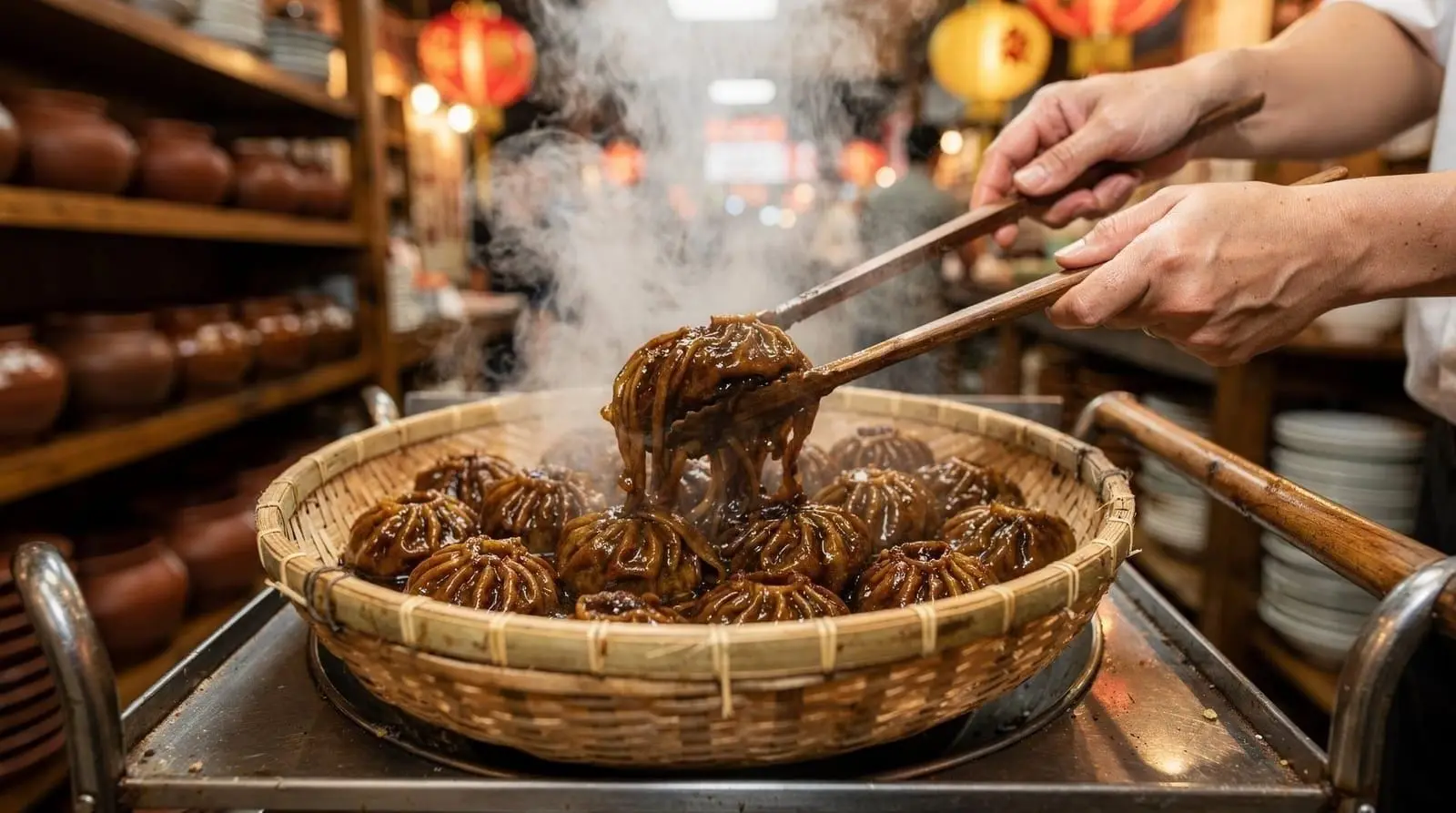
Where to eat in Incheon Chinatown: jjajangmyeon, dim sum, and street food
What is the must-eat dish in Incheon Chinatown?
Jjajangmyeon — thick wheat noodles in savory black bean paste — was invented here around 1905. A bowl costs 7,000–10,000 KRW (about $5.50–8). Gonghwachun on the main street occupies the original site.
Food is the primary reason most visitors come to Incheon Chinatown, and it largely delivers on that premise. The neighborhood is the birthplace of jjajangmyeon, a Korean-Chinese fusion noodle dish that has become one of Korea’s most beloved comfort foods — something not actually found in China in its Korean form. Beyond noodles, the short blocks between the red Paeruimun Gate and the uphill stairs toward Jayu Park are packed with dim sum counters, street stalls selling tanghulu, Chinese bakeries, and restaurants that have been open for decades. Getting lost here on purpose is easy and inexpensive.
This guide covers what to eat, where to eat it, realistic prices in KRW and USD, and a few things worth knowing before you queue.
| Where | Incheon Chinatown, near Incheon Station Exit 1 |
| Cost | Around 31,000–44,500 KRW for a full food day |
| Time needed | 2–4 hours for a proper eating circuit |
| Getting there | Metro line 1 to Incheon Station, 2–3 min walk to the gate |
| Best time | 11:30am sharp on weekends, or weekday 2:30–5pm |
A short history of jjajangmyeon — and why Incheon claims it
The dish exists because of labor migration. In the late 19th century, Chinese workers — primarily from Shandong province — arrived in Incheon to build the port and railways. They brought with them zhájiàngmiàn, a Beijing noodle dish made with ground pork and fermented soybean paste. Korean ingredients and Korean palates changed it substantially. The sauce became darker, sweeter, and more viscous, made with chunjang (a roasted black bean paste unique to Korea), stir-fried with pork belly and diced onion and zucchini. The noodles got thicker. The resulting dish bore only a family resemblance to its ancestor.
Around 1905, a restaurant called Gonghwachun in Incheon’s Chinatown began serving what’s recognized as the first commercial version of jjajangmyeon in Korea. The dish spread across the country through the 20th century and is now eaten by millions of Koreans on moving days, exam results days, and ordinary Tuesdays. Incheon’s claim to origin is legitimate, and eating a bowl here, in the neighborhood where it started, is genuinely different from eating it anywhere else.
The core dishes and what they cost
Jjajangmyeon (짜장면) — Thick wheat noodles served in a mound, topped with a glossy black sauce made from chunjang, pork, onion, and vegetables, cooked over high heat. The sauce arrives on top; you mix it in yourself. The standard price in Chinatown restaurants is 7,000–10,000 KRW (about $5.50–8). Some restaurants charge a bit more for a “premium” version with extra pork or seafood, running up to 12,000 KRW. Do not order before mixing — the noodles clump fast.
Jjamppong (짬뽕) — The spicy counterpart to jjajangmyeon, a deep-red seafood noodle soup made with shrimp, squid, mussels, and vegetables in a broth that’s been hit with chili oil and gochugaru. It’s intensely savory and genuinely spicy. Prices run 8,000–12,000 KRW ($6–9). If you can’t decide between jjajangmyeon and jjamppong, most restaurants sell a half-and-half combo (짬짜면, jjamjjamyeon) for about 11,000–13,000 KRW.
Tangsuyuk (탕수육) — Sweet-and-sour pork or beef, the meat battered and fried until crispy, then served with a thick translucent sauce made with vinegar, sugar, and fruit. Order it to share — a small plate costs 15,000–25,000 KRW ($12–19) and feeds two alongside noodles. The sauce comes either poured over or on the side (ask for 소스 따로, “sauce separate,” if you want to dip rather than pour, which keeps the crust crunchier longer).
Dim sum (딤섬) — Several restaurants in Chinatown serve proper steamed and fried dumplings: shrimp har gow, pork siu mai, glutinous rice in lotus leaf, and fried taro. Quality varies significantly. Budget 8,000–15,000 KRW per person for a shared dim sum spread, more if you order multiple baskets.
Tanghulu (탕후루) — Street stalls outside the main gate and along the main corridor sell tanghulu: fresh strawberries or grapes threaded on a bamboo skewer, dipped in hot sugar syrup, and left to harden into a glassy shell. The crunch-to-fruit ratio is excellent when done right. Stalls outside the Paeruijang gate area sell them for 3,000–5,000 KRW ($2.50–4). Eat immediately — the coating softens within 20–30 minutes.
Chinese bakery goods — Several small bakeries on the side streets sell cocktail buns (奶油包, soft rolls filled with butter and sugar), red bean paste buns, and pineapple buns. Prices are 2,000–4,000 KRW per item. These are not artisanal products, but they’re cheap, fresh, and good as a walking snack between the gate and Jayu Park.
Fried street snacks — Vendors near the main corridor sell fried squid (오징어튀김, 5,000–7,000 KRW), hotteok (호떡, sweet pancakes with brown sugar filling, 2,000 KRW), and scallion pancakes (파전, 5,000–8,000 KRW for a small one).
Restaurants worth knowing
Gonghwachun (공화춘) is the historic anchor. The building at 12 Chinatown-ro 26beon-gil dates to 1905 — or rather, a building on this site does; the current structure is a reconstruction. The ground floor serves jjajangmyeon and the other Chinatown staples. The basement holds a small museum on the history of jjajangmyeon and Incheon’s Chinese community, with period photographs and kitchen equipment. Entry to the museum is free. Gonghwachun opens at 11:30am; weekend queues form by noon. The food is decent and the historical significance is real, but longtime Incheon eaters will tell you the noodles are not the neighborhood’s best — you’re also paying for the name. That’s fine if the story matters to you, which it should.
Chunghwaru (중화루) has been open since the 1960s, which gives it a different kind of claim: this is where older Incheon residents ate before anyone thought to market Chinatown to tourists. The tangsuyuk is particularly good — properly crunchy, not soggy. Sits on one of the side streets rather than the main pedestrian corridor, which means slightly less foot traffic and marginally shorter waits at peak hours.
Hyangmi Shikdang (향미식당) is the least tourist-facing of the three. Signage is minimal and the menu board is Korean-only, but the jjajangmyeon and jjamppong are often cited by Korean food writers as more consistent than the famous-name spots. Prices are slightly lower: jjajangmyeon at 7,000 KRW versus 9,000–10,000 at the marquee restaurants. Worth the minor effort of pointing at neighboring tables’ bowls to order.
When choosing between restaurants, avoid places with laminated English menus propped outside showing photos of celebrities who visited. That’s a reliable tourist-trap indicator across Korean food markets generally. The side streets one block off the main corridor consistently outperform the main strip in value-to-quality ratio.
Incheon: Walk and Eat with Local Walking BuddySinpo International Market: a different food culture nearby
Five minutes on foot east of Chinatown, Sinpo International Market (신포국제시장) serves a completely different range of food — Korean snack staples rather than Chinese-Korean fusion. This is where you go for:
- Tteokbokki (떡볶이): spicy rice cakes in gochujang sauce, 4,000–6,000 KRW for a portion.
- Sundae (순대): blood sausage stuffed with glass noodles and vegetables, steamed, eaten with dipping salt. ₩5,000 for a small plate.
- Kimbap (김밥): rice rolls wrapped in seaweed with fillings of egg, pickled radish, carrot, and various proteins. ₩3,000–5,000 per roll.
- Fried chicken (닭강정): Sinpo is actually famous within Incheon for its spicy glazed fried chicken bites, sold from stalls that have been running for decades.
The market has a cover and runs indoors, so it’s a good option on rainy days when the outdoor Chinatown vendors pack up. It’s more local-facing than Chinatown proper, cheaper on average, and worth the short detour for anyone interested in everyday Korean market food rather than just the Chinese-Korean fusion angle. More on the market in the Sinpo International Market guide.
For broader budget context on eating across Incheon, the Incheon on a budget guide breaks down daily food spend across the neighborhoods.
Vegetarian and vegan eating in Chinatown
This is the hardest dietary context to navigate here. The short version: it’s possible but requires active communication and some skepticism.
Jjajangmyeon appears vegetable-heavy but the sauce base is almost always cooked with pork fat or pork pieces. Ask directly for “야채 짜장면” (vegetable jjajangmyeon) and confirm “돼지고기 없이” (without pork). Some restaurants will accommodate this; others won’t. Tangsuyuk is pork or beef. Jjamppong contains shellfish and seafood in the broth itself, not just as toppings.
Dim sum baskets are a safer bet for variety — steamed vegetable dumplings (야채만두) are common and widely available. Chinese bakery goods are generally vegetarian (confirm with the staff that no lard is used in the dough, which varies by bakery).
Tanghulu and most street snacks are naturally animal-product-free.
The phrase “고기 없이 해주세요” (please make it without meat) will get you part of the way. Following it with “해산물도 없이” (without seafood also) covers the full scope if you’re vegan. Shrimp paste appears as a background ingredient in some sauces without being listed; if you have a shellfish allergy, say so clearly and confirm twice.
Timing and practical notes
Chinatown restaurants open between 10:30am and 11:30am. Not earlier — if you arrive before 11am expecting to eat, most kitchens are still prepping. Gonghwachun opens at 11:30am specifically.
The lunch peak runs from noon to 2pm and creates real queues at the famous spots on weekends. If you want to eat at Gonghwachun or Chunghwaru on a Saturday without waiting 30–45 minutes, arrive at 11:30am sharp. Alternatively, come on a weekday afternoon between 2:30pm and 5pm when the tourist traffic drops significantly.
Most restaurants close for a short break between 3pm and 5pm (브레이크 타임) on weekdays. Street stalls operate longer hours.
Cash is accepted everywhere; cards work at the sit-down restaurants but not at most street stalls. There is a GS25 convenience store near the Chinatown gate with an ATM.
Incheon Chinatown, Rail Bike, and Eco Park from SeoulPairing food with the rest of the neighborhood
Eating in Chinatown pairs naturally with a walk through the surrounding area. The Incheon Chinatown walking tour guide lays out a logical order: start at the Paeruimun Gate, eat jjajangmyeon early before the queue builds, walk north through the Open Port heritage buildings, then climb to Jayu Park for the harbor view before coming back down for street snacks. Budget 4–5 hours for the full circuit.
If your main interest is food rather than history, the shorter version is: arrive at 11:30am, eat at one of the main restaurants, graze the street stalls, walk up to Songwol-dong Fairytale Village for coffee and bakery snacks, then descend back to the market area.
For seafood specifically, Wolmido Island is 15 minutes from Incheon Station by bus and serves fresh crab, grilled fish, and raw fish (hoe) in a waterfront setting that’s completely different from the enclosed Chinatown streets.
The Gaehang Market guide covers the small covered market adjacent to the Open Port zone — it’s less frequently mentioned in tourist guides but worth 20 minutes for fresh produce, dried goods, and a look at how Incheon residents actually shop.
What to drink in and around Chinatown
Food gets all the attention, but the drink options in Chinatown and its immediate surroundings are worth knowing before you end up at a convenience store out of default.
Chinese tea at the restaurants: Most sit-down restaurants serve complimentary barley tea or chrysanthemum tea while you wait. If you want something proper, a few restaurants offer jasmine or pu-erh tea by the pot for 3,000–5,000 KRW. Ask — it’s often not on the English menu even if it’s available.
Bubble tea and dessert drinks: Several storefronts along the main corridor sell boba tea (버블티) — milk tea with tapioca pearls, 4,000–6,000 KRW. Quality varies. The chains (Gong Cha, ChaTime) are consistent; the small independent spots are sometimes better, sometimes worse. If tanghulu has been your sugar hit, skip the bubble tea; the combination is aggressively sweet.
Coffee: There is no specialty coffee culture in Chinatown itself. The narrow lanes have a few small cafes with basic espresso drinks at 3,500–5,000 KRW. For better coffee, walk toward Songwol-dong Fairytale Village — the cafes on and near that hill cater to the younger visitors who come for photos and tend to have better equipment and sourcing.
Convenience stores: The GS25 near the Paeruimun Gate stocks canned beer, iced coffee, and all the usual Korean convenience store drink staples. If you want a cold drink without committing to a cafe, this is reliable and cheap (canned beer from 1,800 KRW, iced Americano from 2,000 KRW).
Water: Tap water in Incheon is safe to drink but most Koreans don’t drink it directly. Bottled water at restaurants is sometimes charged (500–1,000 KRW) and sometimes free. At street stalls there is no water service — bring a bottle or buy from a convenience store before you start eating.
Budget breakdown
A realistic food budget for a full visit to Chinatown:
- Street snacks on the walk in (tanghulu + one bakery item): 5,000–7,000 KRW
- Sit-down lunch for one (jjajangmyeon + small shared tangsuyuk): 15,000–22,000 KRW
- Afternoon snacks at Sinpo Market (tteokbokki + kimbap): 7,000–10,000 KRW
- Coffee at a small cafe near Jayu Park: 4,000–5,500 KRW
Total for a full food day in the neighborhood: 31,000–44,500 KRW per person (roughly $24–34). It is one of the more affordable full-day food experiences in the Seoul metro area, and the variety is genuinely broad for a small geographic footprint.
Seoul: Gwangjang Market Street Food Tasting Walking TourIf you are visiting Incheon as part of a broader Seoul trip, the Incheon and Seoul 2–3 day itinerary places Chinatown within a logical multi-day route that also covers Songdo’s central park and Wolmido Island.
For those arriving from the airport with a short window, the Incheon airport layover itinerary explains how much you can realistically do in Chinatown with 4, 6, or 8 hours before a connecting flight — and how long the AREX connection actually takes. The getting around Incheon guide has metro line details and bus numbers from Incheon Station to Wolmido and beyond.
Which restaurant should you actually choose?
If you only have time for one sit-down meal, here’s the honest comparison of Chinatown’s three best-known jjajangmyeon spots:
| Restaurant | Best for | Price (jjajangmyeon) | Trade-off |
|---|---|---|---|
| Gonghwachun | History, museum basement | 9,000–10,000 KRW | Longer queues, food is decent not exceptional |
| Chunghwaru | Better tangsuyuk, since 1960s | Similar to Gonghwachun | Slightly off the main corridor, shorter waits |
| Hyangmi Shikdang | Best value, local favourite | 7,000 KRW | Korean-only menu, minimal English signage |
If the history matters to you, choose Gonghwachun and accept the queue. If you just want the best bowl for the price, Hyangmi Shikdang is the local pick — bring a translation app and point at neighboring tables if the menu is unclear.
A practical ordering tip that applies at all three: portion sizes are generous by Western standards, and a single bowl of jjajangmyeon or jjamppong is usually enough for one adult unless you are also sharing tangsuyuk. Ordering one noodle dish per person plus a shared plate of tangsuyuk between two or three diners avoids over-ordering, which is an easy mistake to make when the menu photos look tempting and the prices are low.
A realistic seasonal note on eating in Chinatown
Food availability in Chinatown doesn’t change dramatically by season, but comfort and crowd levels do:
Spring and autumn (Mar–May, Sep–Nov) bring the heaviest weekend crowds, tied to good weather and cherry blossom or foliage season at nearby Jayu Park. Expect the longest queues at Gonghwachun on Saturdays.
Summer (Jun–Aug) is hot for standing in street-stall queues; the covered, indoor Sinpo Market becomes the more comfortable option for a chunk of your food circuit.
Winter (Dec–Feb) is the quietest season with the shortest waits, and hot dishes like jjamppong and tangsuyuk feel especially good against the cold. Lunar New Year (Jan/Feb) is the exception — jjajangmyeon is a traditional holiday food and Chinatown gets genuinely packed.
Frequently asked questions about eating in Incheon Chinatown
Where was jjajangmyeon invented?
At Gonghwachun restaurant in Incheon Chinatown, around 1905. Chinese immigrant workers adapted a Beijing noodle dish called zhájiàngmiàn using Korean ingredients — particularly chunjang, a roasted black bean paste — creating a dish that bears a family resemblance to its ancestor but is now distinctly Korean.
How much does a meal in Incheon Chinatown cost?
A sit-down meal of jjajangmyeon or jjamppong costs 7,000–12,000 KRW per person (roughly $5.50–9). Adding a shared plate of tangsuyuk brings a meal for two to about 25,000–35,000 KRW total ($19–27). Street snacks are 2,000–5,000 KRW each.
Is Gonghwachun worth the wait?
It depends on what you want. Gonghwachun is historically significant — the building is on the original site of Korea’s first jjajangmyeon restaurant, and the basement museum is worth seeing. The food is solid but not exceptional for the price. If you care about the history, go. If you just want the best bowl in the neighborhood, Hyangmi Shikdang or Chunghwaru offer better value with shorter queues on weekends.
Can vegetarians eat in Incheon Chinatown?
Yes, but with effort. Ask for vegetable jjajangmyeon (야채 짜장면) and confirm no pork is used in the sauce base. Vegetable dumplings (야채만두) at dim sum spots are a reliable choice. Street snacks like tanghulu and Chinese bakery goods are generally safe. Jjamppong and tangsuyuk are meat-based and harder to modify.
What time do restaurants in Chinatown open?
Most kitchens open between 10:30am and 11:30am. Gonghwachun opens at 11:30am. Street stalls tend to set up earlier, from around 10am. The lunch rush peaks between noon and 2pm; arriving at opening time avoids most queues.
What is tanghulu and where do I get it?
Tanghulu is fresh fruit — usually strawberries or grapes — skewered on bamboo, dipped in hot sugar syrup, and cooled until the coating hardens into a glassy shell. It’s a snack sold from street stalls near the Paeruimun Gate and along the main corridor. Expect to pay 3,000–5,000 KRW. Eat it quickly: the coating softens within 20–30 minutes.
Is Sinpo International Market different from Chinatown?
Yes, entirely. Sinpo International Market, a five-minute walk east, serves Korean street food staples — tteokbokki, sundae, kimbap, and glazed fried chicken — rather than Chinese-Korean fusion food. It is cheaper on average, less touristy, and covered, making it a better option in rainy weather. Worth visiting as an add-on rather than a replacement for Chinatown.
Do restaurants in Chinatown take credit cards?
Sit-down restaurants accept cards; street stalls and bakeries typically expect cash. There is an ATM inside the GS25 convenience store near the main Chinatown gate. Carrying 20,000–30,000 KRW in cash covers most contingencies.
What is the best time to avoid queues in Chinatown?
Weekday afternoons between 2:30pm and 5pm are the quietest window — the lunch rush is over and dinner hasn’t started. If you must go on a weekend, arriving at 11:30am when kitchens first open is the next-best option, ahead of the noon-to-2pm peak.
Should I eat in Chinatown or wait to eat in Sinpo Market instead?
They serve genuinely different food, so the better question is how to combine them rather than choose one. Eat jjajangmyeon or jjamppong at a Chinatown sit-down restaurant first, since that dish is the neighborhood’s signature, then walk five minutes to Sinpo Market for street snacks like tteokbokki and dakgangjeong afterward.
Incheon city experiences on GetYourGuide
Top-rated tours and activities


