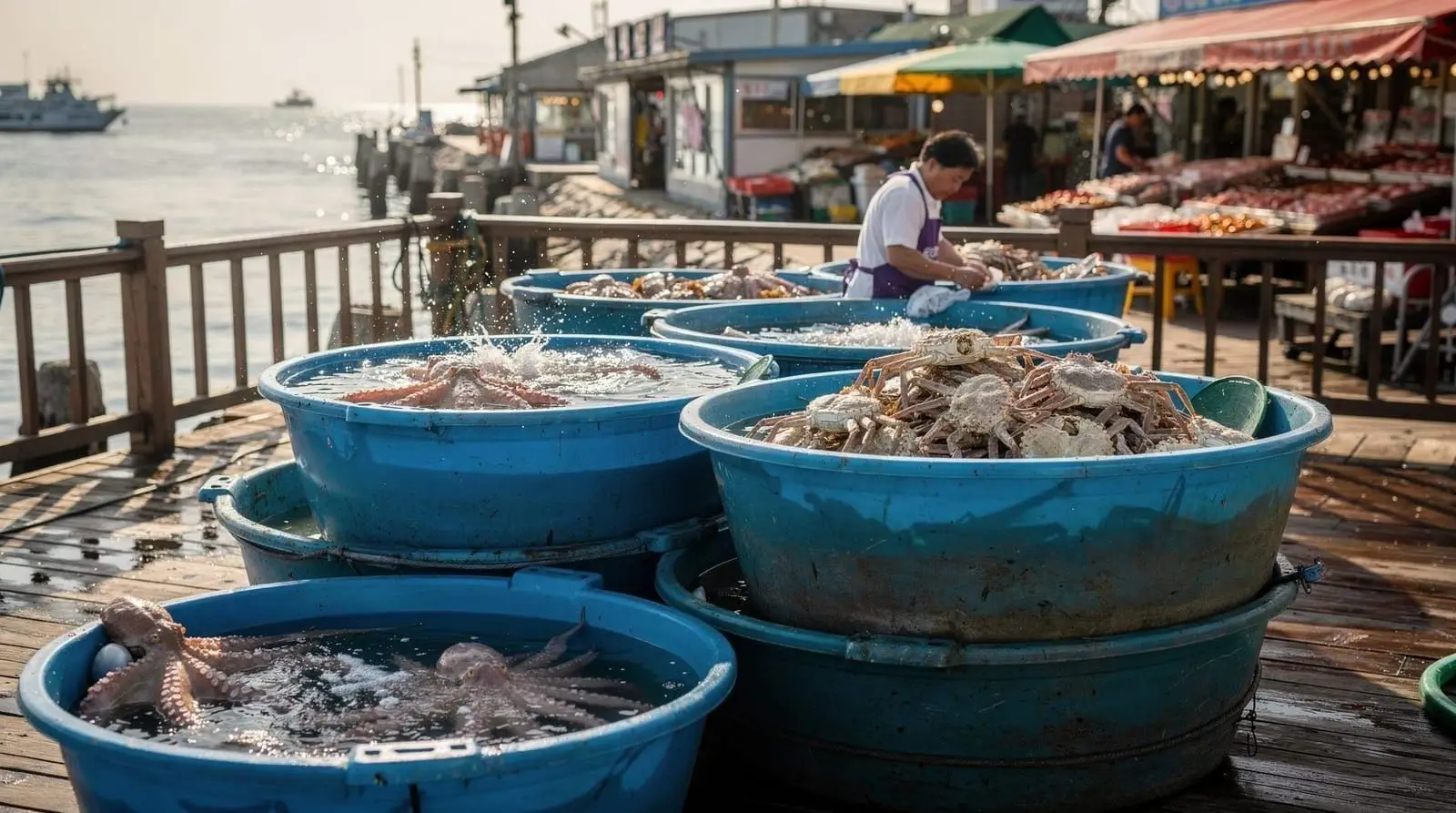
Wolmido seafood dining: fresh catches, grilled shellfish, and harbor views
The eastern shore of Wolmido has been one of Incheon’s most popular seafood dining destinations for decades, and its reputation among Korean diners from across the metropolitan area is well earned. On weekend evenings, the 500-meter stretch of restaurants on the harbor side fills with families, couples, and groups who have come specifically to eat — not to see the Ferris wheel or ride the Sea Train, but to sit at a table facing the water and work through a platter of raw fish and grilled shellfish with cold soju. This is Korean seaside eating in its most direct form, and understanding what to order, what to pay, and what to avoid makes the difference between a meal that feels like discovery and one that feels like a tourist trap.
| Where | Wolmido Seafood Street, eastern shore of Wolmido, Incheon |
| Cost | Around ₩70,000–100,000 for two, standard dinner |
| Time needed | 1.5–2 hours for a full sit-down meal |
| Getting there | 20-minute walk from Incheon Station, or short taxi from Chinatown |
| Best time | Weekday evenings, 6:00–8:30pm |
The seafood strip: what you are looking at
The Wolmido Seafood Street (월미도 해산물거리) runs along the eastern side of Wolmido, closest to the causeway connecting the peninsula to central Incheon. The concentration of restaurants here is dense — more than 30 establishments in a short walk — and most are family-owned operations that have been running for 10–20 years.
Every restaurant displays its live seafood tanks at the entrance: tanks of flounder (광어, gwang-eo), tanks of octopus (낙지, nakji), tanks of live shellfish, and typically a display case showing the day’s fish at posted prices. This is the first thing to check when choosing where to sit. Busy tanks with active fish indicate turnover and freshness. Empty or sluggish tanks are a less promising sign.
Hours run from approximately noon to 10pm on weekdays, with many restaurants extending to midnight or 1am on Friday and Saturday evenings. The strip is busiest from 6pm onward on any day.
What to order: the essential dishes
Sashimi platter (모둠회, modeum-hoe) is the centerpiece of most Wolmido meals. A mixed platter typically includes several types of raw fish, sliced thin and arranged on a plate or wooden board. Common components are flounder (광어, the standard; mild, slightly chewy), sea bream (참돔, cham-dom; richer flavor), octopus (문어, mun-eo; firmer texture), and whatever else the kitchen decided that day.
The platter arrives with accompaniments: ssamjang (쌈장, a thick paste of fermented soybean and chili), perilla leaves (깻잎, kkaennip), sliced garlic, green chili, and sesame salt. The eating method: wrap a slice of fish in a perilla leaf with a small amount of ssamjang, add garlic if you want, and eat in one bite. You can also dip fish directly into the sesame salt without the wrap for a cleaner taste.
Pricing for sashimi platters: ₩30,000–45,000 for a small portion (serves 1–2 people), ₩50,000–70,000 for a larger portion (serves 3–4). Specify “small” (소, so) or “large” (대, dae) when ordering. Price varies by fish type — flounder is cheaper; sea bream and premium whole fish cost more.
Grilled shellfish (조개구이, joegae-gui) is Wolmido’s other signature experience. A charcoal or gas grill sits in the center of the table, and shellfish — clams (바지락, bajilak), mussels (홍합, honghap), oysters (굴, gul), scallops (가리비, garibi), and sometimes abalone (전복, jeonbok) — are piled on and cooked at the table. When a shell opens fully, it is ready to eat. Scallops are often dressed with a little butter or garlic as they cook. Pricing: ₩20,000–35,000 per portion, sharable for two people.
Snow crab (대게, daege) is the prize when in season, roughly November through April. Whole crabs are steamed and served with a vinegar dipping sauce. The flavor when fresh is sweet and clean with no fishy heaviness. Pricing runs ₩25,000–40,000 per crab depending on size and season. Out-of-season, the quality drops and prices rise — unless you see live crabs in the tank, it is not worth ordering.
Haemul pajeon (해물파전) is a thick seafood scallion pancake: crispy on the outside, chewy in the center, loaded with squid, shrimp, and clams. It is excellent with makgeolli (막걸리, Korean rice wine) and costs ₩12,000–18,000. A good order while waiting for sashimi to be prepared.
Ganjang gejang (간장게장) — raw crab marinated in soy sauce — is an acquired taste but genuinely extraordinary when done right. The crab is soft, the meat barely firm, with an intense saline depth from the soy marinade. It is eaten by sucking the sauce out of the claw joints and mixing the body cavity contents with steamed rice. Called “rice thief” (밥도둑) in Korean because you end up eating far more rice than planned. Pricing: ₩15,000–25,000 per portion.
Maeuntang (매운탕) — spicy fish stew — is typically offered after a sashimi platter, made from the bones and scraps of the fish just eaten. Many restaurants include it for free or for a nominal charge (₩3,000–5,000) as part of the sashimi order. If offered, accept it: a bowl of red, spicy broth with fish and vegetables is a fitting conclusion to a raw fish meal.
Named restaurants worth knowing
The Wolmido strip does not have any one restaurant that dramatically outperforms the others on quality — the catch quality at any given time depends more on the day’s boats than the kitchen. That said, a few names are consistently cited by Korean regulars:
Haengsang Hoetjip (행상 횟집) is a reliable local anchor with clearly priced menus and active live tanks. It is consistently busy, which is generally a good sign. The menu is Korean only, but a translation app pointed at the menu board handles the basics. Pointing at the tank fish and gesturing “I want this one” works too — the staff are accustomed to it.
Wolmido Daege (월미도 대게) specializes in snow crab during the November–April season. If you are visiting in winter specifically for crab, this is the name to look for on the signboards.
Most of the 30+ restaurants have nearly identical menus and similar price ranges. The most reliable guide to quality is foot traffic: a restaurant with occupied tables and active service in the 6–8pm window on any weeknight is doing something right.
Prices, reality, and what you should know about value
Wolmido is not the cheapest place to eat seafood near Incheon. You are paying a view premium — the harbor-facing tables, the Ferris wheel lit up above you, the foot traffic and energy of the strip. If raw cost efficiency is your priority, Sorae Ecology Park area markets or the Sinpo International Market offer similar ingredients at lower prices in less atmospheric surroundings.
That said, the prices here are not unreasonable by Korean dining-out standards. Always confirm prices before ordering — this is a firm rule at Korean seafood restaurants anywhere. Menus display prices, but seasonal variations and the specific fish in the tank on that day can affect what you are quoted. Say “얼마예요?” (eolmayeyo? — how much is this?) before agreeing to an order.
Service charges are included in Korean restaurant pricing. Tipping is not expected and, in most traditional Korean restaurants, is politely declined or returned. Drinks are charged separately from food — you will be asked what you want to drink at the start of the meal.
Drinking alongside the seafood
Soju (소주) is the default pairing for raw fish at Wolmido. A standard 360ml bottle costs ₩5,000–7,000 at restaurant prices. The alcohol softens the intensity of the fish flavors while the clean burn of the spirit acts as a palate reset between bites. Jinro and Chamisul are the standard brands; Hallasan from Jeju is sometimes available and slightly sweeter.
Korean beer (맥주) — Hite, Cass, or Terra — costs ₩4,000–6,000 per bottle. Beer pairs well with grilled shellfish and pajeon and is a gentler option if you are eating a large spread over several hours.
Makgeolli (막걸리) is the traditional choice with haemul pajeon and deserves more attention than it typically gets from visitors. It is a lightly fermented, milky rice wine with a slightly sweet, sour, fizzy character. It is served in a carafe or traditional pottery bowl and poured into small shallow cups. Carafe prices: ₩5,000–8,000. If you order pajeon, order makgeolli alongside it.
Non-drinkers can always request plain barley tea (보리차, boricha) or water, both typically complimentary.
Vegetarians and allergies
Wolmido’s seafood strip is essentially a dead end for vegetarians. There is no restaurant on the strip that centers non-seafood cooking. Kimchi, rice, and a few vegetable side dishes (banchan) are available at any table, but the banchan are often prepared with fish sauce or fermented shrimp paste, meaning they are technically not vegetarian even when they appear to be.
For vegetarian options in the broader Incheon area, Incheon Chinatown has Chinese vegetarian tofu dishes, and the wider city has Buddhist-style Korean restaurants (사찰음식, sachal eumsik) that serve genuinely plant-based food.
Shellfish allergies are a serious concern at Wolmido — cross-contamination is essentially certain given that grilled shellfish is cooked table-side and the kitchens process shellfish continuously. Alert staff clearly to any seafood allergy; they will generally be honest about whether a particular dish can be prepared safely.
Incheon: Walk and Eat with Local Walking BuddyReading a Korean seafood restaurant: what to expect inside
First-time visitors to a Korean seafood restaurant sometimes feel disoriented by the format, which differs from Western restaurant conventions. Here is what to expect.
Upon entry, you will be directed to a table by a staff member or shown to a self-select seating area. Remove your shoes if there are low-floor table seating options (you sit on cushions on a raised wooden platform). Chair seating is also available at most Wolmido restaurants and does not require removing shoes.
Menus are typically laminated, posted on the wall, or both. At Wolmido, most restaurants also have live seafood displayed in tanks at the entrance — you can point at the fish or shellfish you want and staff will confirm the price before anything is prepared. This point-and-confirm method works even without language overlap.
Banchan (side dishes) arrive automatically and at no extra charge — these are small plates of kimchi, pickled radish, seasoned seaweed, and similar items. They are refillable on request at no additional cost. Say “더 주세요” (deo juseyo — please give me more) and point at the empty plate.
Water and barley tea are typically provided in a self-serve jug on the table or brought automatically. You do not pay for these.
The grill, if you order grilled shellfish, sits in the center of the table. Staff will light it and manage the heat level. Do not touch the grill surface — it is hotter than it looks. Staff will often help transfer food from grill to plate, especially if they see you looking uncertain about timing.
Bill and payment come at the end of the meal. Call for the bill with “계산해 주세요” (gyesan-hae juseyo) or simply catch a staff member’s eye and make a writing motion with your hand. Most Wolmido restaurants accept Korean and international credit cards, but cash is often preferred and sometimes required for small orders. Confirm payment method when seated if you only have a foreign card.
How Wolmido seafood compares to other Incheon options
Wolmido is not the only seafood option in Incheon, and understanding where it sits in the wider dining landscape helps you decide whether it fits your priorities.
The Sinpo International Market in central Incheon is more of a street food and covered market experience than a sit-down seafood restaurant zone. It is cheaper and more casual — good for snacks, fried foods, and quick meals, not for a long grilled shellfish dinner.
The Gaehang Market near the open port area is a working local market with fish stalls, dried seafood, and some raw fish vendors. It is primarily a retail market for local shoppers rather than a dining destination. The atmosphere is authentic and the prices lower than Wolmido, but the restaurant seating is very limited.
The Sorae Pojang Macha (소래포구) area, further south in Incheon, is often cited by locals as having better-value seafood than Wolmido at lower prices. The catch is that it requires a longer journey (about 40 minutes from central Incheon by bus or metro) and lacks Wolmido’s harbor ambience and Ferris wheel views.
Wolmido wins on atmosphere, convenience, and the specific pleasure of eating with a harbor view and a lit Ferris wheel overhead. If you are coming to Incheon for a day from Seoul and want to combine sightseeing and seafood dining in a single location, Wolmido remains the practical choice.
| Option | Price level | Atmosphere | Best for |
|---|---|---|---|
| Wolmido Seafood Street | Mid–high | Harbor view, Ferris wheel, lively | Sit-down dinner with a view |
| Sinpo International Market | Low | Covered market, street food | Quick snacks, fried foods |
| Gaehang Market | Low | Working local market | Retail fish, not dining |
| Sorae Pojang Macha | Low–mid | Working fishing port | Value, longer journey required |
Getting to Wolmido and the seafood street
Wolmido is a short trip from central Incheon rather than a remote destination, which is part of why it works so well as an evening plan. From Incheon Station (Incheon Line 1, the terminus), it is roughly a 20-minute walk west along the causeway road, or a 5-minute taxi ride costing around ₩5,000. Local buses also run the route from the station forecourt, though walking or taking a taxi is more reliable for an evening arrival when you do not want to check a bus schedule.
If you are combining seafood with the rest of a Wolmido visit, the Wolmido island guide covers the causeway, the Ferris wheel, and the boardwalk in detail — most visitors arrive via that route and drift toward the seafood strip as evening falls. From Chinatown, the walk along the causeway takes about 20–25 minutes and is mapped in the Chinatown walking guide.
Coming from Seoul, the subway to Incheon Station takes roughly 70–90 minutes depending on your starting point, making Wolmido dinner a realistic capstone to a full day trip rather than a separate outing.
Best time to eat at Wolmido
Weekday evenings from 6:00–8:30pm hit the sweet spot: restaurants are active and staffed at full capacity, but the tables are not overflowing the way they are on Saturday nights. The Ferris wheel is lit above you, the harbor lights come on, and the atmosphere matches what you hoped for without the 30-minute wait for a table.
Snow crab season (November–April) is the time to plan a dedicated Wolmido dinner if you are a crab enthusiast. Prices are reasonable, quality is at its peak, and the colder weather makes the hot steam of a freshly cracked crab particularly satisfying.
Avoid peak summer weekends (July–August Saturday evenings) unless you are prepared to wait 30–60 minutes for a harbor-view table and pay slightly elevated prices driven by demand.
Early afternoon visits (noon–3pm) are calm, sometimes offer slightly lower prices on set lunch menus, and let you eat without the weekend crowd. The trade-off is that the Ferris wheel is not lit up and the atmosphere is quieter.
Incheon: Sunset Beach & China/Japan Town & Inspire ResortBudget planning for a Wolmido dinner
The cost of a Wolmido seafood dinner varies widely depending on what you order and how many people you are with. Seafood is more economical in groups — a large sashimi platter at ₩60,000 feeds four people at ₩15,000 each, while ordering individual portions for two people costs more per head.
- Light dinner for one (small sashimi portion, one drink): ₩35,000–50,000
- Standard dinner for two (medium sashimi platter + grilled shellfish + drinks): ₩70,000–100,000
- Full spread for two (sashimi + shellfish + pajeon + snow crab + drinks): ₩120,000–160,000
- Group of four (large platter, multiple dishes, drinks): ₩30,000–50,000 per person
The Incheon budget guide has more context on how Wolmido dining costs compare with other Incheon food options including Sinpo International Market and Gaehang Market.
Combining dinner with the rest of a Wolmido visit
Wolmido dinner works best as the final act of an afternoon that starts with the island walking and Ferris wheel. The natural sequence is: arrive by 3:30–4pm, walk the sea trail, queue for the Ferris wheel at 5:30–6pm, watch the sunset from the gondola, then walk 10 minutes to the seafood strip for dinner starting around 7pm. By 9pm you are done and can catch the 20-minute walk back to Incheon Station and the metro to Seoul.
If you started the day in Chinatown, the Chinatown walking guide maps the route between the two areas — it is walkable in 20–25 minutes via the causeway road.
Sample meal plans by group size
Solo diner: A solo visit works, though Wolmido restaurants are built around shared platters more than single-serving menus. The most practical solo order is a small sashimi platter (₩30,000, more than one person can finish) taken as a late lunch, or a single-serving haemul pajeon with a beer at a counter seat. Staff are used to solo diners and will not push back on a modest order, but expect to eat family-style leftovers as takeaway if you order the smallest sashimi option.
Couple: The classic Wolmido date-night order is a medium sashimi platter (₩50,000) shared, followed by grilled shellfish (₩25,000) if there is room, with soju or makgeolli. Total runs roughly ₩70,000–90,000 including drinks — squarely in the “standard dinner for two” range above.
Family with children: Grilled shellfish and haemul pajeon tend to work better for families than raw sashimi, since children often prefer cooked food. A grill order plus a pancake plus soft drinks for a family of four runs around ₩50,000–70,000, and the tableside grilling is genuinely entertaining for kids who have not seen it before.
Group of four or more: Order a large sashimi platter (₩60,000–70,000) as the centerpiece, add grilled shellfish and a pancake to fill out the table, and split the cost — this is where Wolmido’s per-person value improves substantially, often landing near ₩30,000–40,000 per person for a genuinely full spread.
Etiquette notes specific to Wolmido
A few customs are worth knowing beyond the general Korean dining etiquette covered elsewhere. Do not flip fish or shellfish on the grill without asking — staff generally prefer to manage the grill themselves, especially with unfamiliar shellfish like abalone that can be easy to overcook. Pouring drinks for others rather than yourself is standard practice at a shared table; if someone pours for you, hold your glass with both hands as a small gesture of respect, particularly with older diners.
Leaving food on the table is normal — Korean seafood spreads are meant to be generous, and finishing every last scrap is not expected the way it might be at a set-menu restaurant. Finally, loud conversation and drinking late into the evening is part of the culture here, not a disturbance — Wolmido’s seafood strip is built for exactly that kind of unhurried, noisy, multi-course evening.
Frequently asked questions about Wolmido seafood dining
Do Wolmido restaurants have English menus?
Most do not have English-language menus. A small number of restaurants near the main strip entrance have picture menus or limited English descriptions. A phone translation app pointed at a Korean menu board handles the basics effectively. Pointing at the live seafood tanks is universally understood.
Is it normal to bargain over prices at Wolmido seafood restaurants?
No. Haggling was more common in earlier decades but most Wolmido restaurants now post fixed prices and do not negotiate. Confirm prices before ordering, but expect the quoted price to be the actual price.
How fresh is the seafood?
Freshness varies by day. The reliable indicators are: active live fish in clear water tanks, a busy restaurant with table turnover, and fish that is firm and odorless when your platter arrives. If a restaurant’s tanks are cloudy or nearly empty, try the next one. Weekend evenings typically mean faster turnover and fresher stock than quiet Tuesday lunches.
What is the correct way to eat ganjang gejang?
The soy-marinated raw crab is typically eaten cold. Break open the body of the crab, scoop out the soft interior into your rice bowl, and mix thoroughly — the soy sauce and crab juices absorb into the rice and create a savory slurry that is the whole point of the dish. Crack the claws and suck the marinade from inside them. It is messier than almost anything else in Korean cuisine, and restaurants provide disposable gloves on request.
Can I visit Wolmido seafood restaurants without ordering sashimi?
Yes. Many diners at Wolmido order only grilled shellfish and pajeon without raw fish. The restaurants do not pressure you to order sashimi as the centerpiece. A grilled shellfish plate, a pancake, and drinks for two people is a perfectly valid and satisfying Wolmido meal at around ₩40,000–55,000.
Is there parking at Wolmido for drivers?
There is street parking and a paid car park near the Wolmido entrance causeway. Weekend evenings see significant traffic congestion on the approach road. Public transit from Incheon Station (walk or bus) is far more practical for an evening dinner visit.
Do I need a reservation for a table at Wolmido?
Most Wolmido restaurants do not take formal reservations — the strip runs on a walk-in basis. Large groups (six or more) can sometimes call ahead to confirm space, especially on weekend evenings, but a phone call in Korean is generally required, so a hotel concierge or a Korean-speaking contact is the practical way to arrange it. For most travelers, arriving before 6pm on a weekday secures a table without any advance planning.
Korean street food tours on GetYourGuide
Top-rated tours and activities


