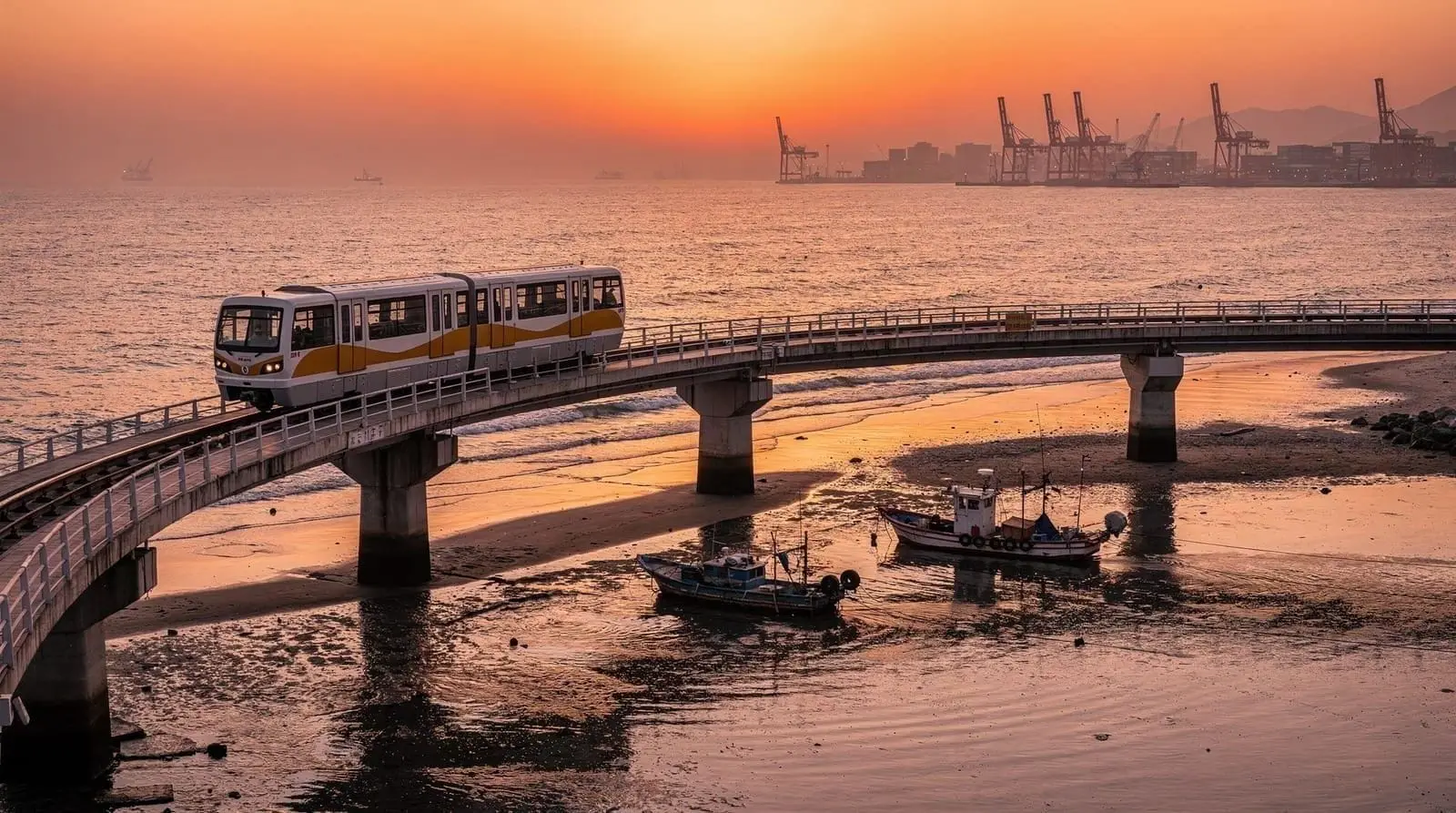
Wolmi Sea Train: riding Incheon's scenic monorail around the waterfront
| Where | Incheon Station, loops through Wolmido |
| Cost | ₩11,000 adult on weekdays, ₩14,000 on weekends (non-Incheon residents); child and senior fares: see the official site |
| Time needed | 42–45 minutes for the full loop |
| Getting there | Metro line 1 to Incheon Station, ticket booth at ground level |
| Best time | Late afternoon for warm light over the harbor, depending on season and the day’s schedule; closed Mondays |
The Wolmi Sea Train is not transport. Visitors who show up at Incheon Station expecting a monorail that will ferry them efficiently around the waterfront and drop them at Wolmido’s doorstep will be mildly confused. The train makes a 6.1km loop and returns to its start — you board and disembark at the same station. What it offers instead is a 42-minute elevated circuit above a stretch of Incheon’s working harbor and coastal road, with views you genuinely cannot get on foot. Whether that is worth ₩11,000–14,000 of your afternoon depends on your travel pace and what you expect from it.
What the Wolmi Sea Train is
The Wolmi Sea Train (월미바다열차) is an urban light rail (monorail) line operated by Incheon Transit Corporation as a tourist attraction. It opened in 2019 after years of delays from its previous incarnation as the Wolmi Eunha Rail, a now-demolished miniature railway. The current elevated system runs on a dedicated single track loop starting and ending at Incheon Station (인천역).
The route passes through four stations on the loop: Incheon Station → Wolmi Cultural Street Station (월미문화의거리역) → Wolmi Park Station (월미공원역) → Museum Station (박물관역) → back to Incheon Station. The elevated track rises above street level and the harbor road, giving riders an aerial perspective of the Wolmido causeway, the Incheon Port container terminal, the Ferris wheel up close, and the coastline north toward Chinatown.
Route length: 6.1km round trip loop Ride duration: approximately 42–45 minutes for the full circuit Adult fare (non-Incheon residents): ₩11,000 on weekdays, ₩14,000 on weekends (₩8,000 applies only to Incheon residents) Child, teen and senior fares: check the official operator site (ictr.or.kr)
The carriages are small — think of a two-car tram on an elevated track rather than a conventional metro train. Seats face forward in the direction of travel. Large windows on both sides provide unobstructed views. The train travels slowly and smoothly; there are no sharp turns or steep grades.
Getting tickets
The ticket booth is located at Incheon Station (인천역), ground level, immediately outside the metro station exit. You cannot buy tickets in advance online through any English-language platform; purchase is in person on the day.
The booth accepts credit and debit cards as well as cash. T-money transit cards are not valid for the Sea Train — it operates on a separate fare system from the metro and bus network.
On weekdays and outside peak season, you can typically walk up and board the next available departure with no wait. On weekend afternoons and evenings in spring and autumn, queues develop. The most popular departures are the late afternoon ones that time the ride with sunset views over Wolmido. Arriving at the booth 20–30 minutes before your target departure on a busy weekend is prudent.
There are no refunds on purchased tickets. Printed schedules at the booth show departure times; the train runs at roughly 15–20 minute intervals throughout operating hours. The train is closed on Mondays. Operating hours and the last departure vary by season and by day (longer on weekends in high season), so check the official operator site (Incheon Transportation Corporation, ictr.or.kr) or the schedule posted at the booth.
The ride: what you see and where to sit
The train departs from Incheon Station’s ground-level platform and climbs onto the elevated track heading southwest. The first section runs above the harbor road, and within two minutes you are high enough to see the working port to the north — container cranes, ship terminals, and the inlet connecting Incheon’s inner and outer harbors. This view is industrial rather than scenic in the traditional sense, but it communicates Incheon’s identity as a port city in a way that no ground-level walk quite does.
As the train curves around to Wolmido, you pass the Ferris wheel at close range — close enough to appreciate its scale and see the gondolas clearly. The coastal section south of Wolmido passes over the causeway road with water on both sides, and on clear days the Incheon Bridge is visible to the south. The return leg swings east back toward the museum and Chinatown area before completing the loop at Incheon Station.
Seating strategy: Sit on the left side facing the direction of travel on the outbound leg for harbor and sea views. The right side gives better views of the elevated Chinatown and Songwol-dong area on the return. If you are unsure which direction the train is heading, ask the booth staff — they will point you toward the best side for the time of day.
Photography through the windows is straightforward; the glass is clear and large. In bright afternoon sun, reflections can be distracting. Late-afternoon rides (depending on season and the day’s schedule) give warmer light and the best combination of harbor, Ferris wheel, and sea color.
Incheon: Sunset Beach & China/Japan Town & Inspire ResortAn honest assessment
The Wolmi Sea Train is a pleasant novelty, and it is fairly priced for what it delivers. At ₩11,000–14,000 for a 42-minute elevated circuit with decent harbor views, it is not a rip-off. But let’s be clear about what it is not:
It is not a world-class attraction. Seoul’s Namsan Cable Car, Busan’s Haeundae Beach, Jeju’s crater rim — these are destinations in their own right. The Sea Train is a bonus activity, something to do while in Incheon rather than a reason to come to Incheon.
It does not take you to Wolmido in the sense that matters. You cannot step off the train at Wolmido, spend the afternoon, and reboard later. You disembark back at Incheon Station. If you want to actually visit Wolmido’s Ferris wheel, seafood restaurants, and sea trail, you need to walk or take a bus from Incheon Station after the ride — the Sea Train is an appetizer, not a vehicle for exploring the peninsula.
It is best for families with young children who will genuinely enjoy riding an elevated train, and for visitors who want an aerial orientation to Incheon’s waterfront geography before exploring on foot. It is skip-worthy if you are short on time — 42 minutes is a non-trivial chunk of a one-day Incheon itinerary.
How to combine the Sea Train with a Wolmido visit
The most efficient sequence for combining both is:
- Arrive at Incheon Station on an early afternoon train from Seoul
- Board the Sea Train for the 42-minute aerial orientation loop (depart ~1:30pm)
- Walk from Incheon Station to Chinatown (10 minutes) for lunch
- Walk from Chinatown through Songwol-dong Fairytale Village toward Wolmido (free, 30 minutes walking)
- Arrive at Wolmido by 4pm, walk the sea trail, visit the theme park if desired
- Ride the Ferris wheel at sunset (5:30–7pm)
- Dinner at the seafood restaurants
This uses the Sea Train as a front-end orientation rather than the main event, which is exactly the right way to slot it into a full Incheon day. For lunch, the Incheon Chinatown walking tour and the where to eat in Incheon Chinatown guide help you pick a spot, and once you reach the island, the Wolmido seafood dining guide covers the dinner end of the day. The Incheon in one day itinerary follows a version of this sequence.
For visitors interested in the Incheon Open Port Heritage area, the Museum Station stop on the Sea Train loop is adjacent to the Immigration History Museum — you can note the location from above and return on foot after disembarking.
Incheon: One Day Guided City Tour with Hotel PickupThe history behind the Sea Train
The Wolmi Sea Train has a somewhat convoluted history that explains why it feels slightly unusual for a Korean transit system. The original attraction on this alignment was the Wolmi Eunha Rail (은하레일, “Galaxy Rail”), a miniature railway that opened in 2009 but was closed almost immediately due to safety concerns and spent most of the subsequent decade decommissioned. The current elevated monorail system opened in August 2019 after a full redesign and reconstruction of the infrastructure, reusing the elevated guideway alignment but replacing the vehicle and systems entirely.
The result is a modern, smooth-running monorail that feels slightly over-engineered for a 6.1km tourist loop — which is partly why the fare seems reasonable and the ride quality is notably better than you might expect from a small-city tourist railway. Incheon Transit Corporation operates it alongside the metro, but it does not integrate with metro fare systems by design.
Understanding this background also explains the slight disconnect in signage: older maps and some tourist materials still reference the Eunha Rail or show the alignment as something it no longer is. The current operating name at all points of sale and on official signage is 월미바다열차 (Wolmi Barada Yeolja), which translates loosely as the Wolmi Sea Train.
What you see from the elevated track: a section-by-section breakdown
The 42-minute loop is not uniformly interesting throughout. Breaking it into sections helps you know where to look and when.
Incheon Station departure to the harbor section (minutes 0–8): The train lifts off the ground-level platform and reaches elevation within the first 200 meters. The immediate view north is of the Incheon Old Port terminal — a working cargo facility with cranes, vehicle lots, and ferry terminals. On the south side, the old immigration history museum building (박물관) is visible below. This section is functionally informative about Incheon’s port geography, though not visually spectacular.
Wolmido approach (minutes 8–18): As the train swings southwest toward the causeway, water appears on both sides. This is the most scenic section — the channel between the mainland and Wolmido, with the Yellow Sea visible ahead and the industrial port receding behind. The Ferris wheel comes into view from this angle and grows as the train approaches. On clear afternoons, the Incheon Bridge appears at roughly the 2 o’clock position to the south.
Wolmido loop (minutes 18–28): The train circles around the Wolmido peninsula. You pass the Ferris wheel at close range on the right side — close enough to make eye contact with passengers in gondolas if both happen to be at the right height simultaneously. The theme park rides are visible below. The western coastal section gives open sea views toward the horizon.
Return to Incheon Station (minutes 28–42): The return leg covers similar geography from a slightly different angle. The Songwol-dong area appears to the right, and on clear days the green-roofed buildings of Chinatown’s Chinese temple district are identifiable. The train descends back to platform level in the final two minutes.
Rain, cancellations, and practical notes
The Sea Train runs in light rain with no changes to normal operation. In heavy rain, strong crosswinds, or lightning, the service may be suspended or delayed. The booth staff will advise when you arrive; if conditions are borderline, they may offer a wait or suggest checking back in 30 minutes.
There is no English-language app or real-time alert system for cancellations — you simply go to the booth and ask, or check the display board. Given that the train is a tourist attraction rather than a commuter service, operational suspension means simply not running on that day.
The carriages are air-conditioned in summer and heated in winter. Accessibility: the Incheon Station platform has step-free access from the street. At the loop stations, access is via staircase only. Passengers requiring step-free access throughout should confirm with booth staff before boarding.
Comparing the Sea Train to other elevated views in Incheon
Wolmido has two elevated view options: the Sea Train and the Ferris wheel. They serve different purposes and are not in competition.
The Sea Train gives you a moving aerial perspective across a wide geographic area — 6.1km of coastline, harbor, and urban waterfront in a single sweep. You cannot stop and dwell on any particular view; the train moves at its own pace. The experience is about the journey and the changing composition of what you see, not a single panoramic vista.
The Ferris wheel gives you a stationary elevated experience — you rise slowly to 72 meters, pause briefly at the top, and descend. The view is spectacular but focused: the harbor directly below, the Yellow Sea to the west, the bridge to the south. You can photograph from that fixed vantage point as long as the gondola lingers at the top.
For most visitors doing a full Wolmido day, the sequence that makes most sense is Sea Train first (aerial orientation) and Ferris wheel second (sunset). Reversed, the Ferris wheel at noon before a Sea Train ride works too, but loses the sunset-to-nightfall visual progression that makes the Ferris wheel most memorable.
The G-Tower observation deck in Songdo, if you are combining Wolmido with a Songdo visit, offers a third elevated perspective — an indoor observation floor at 305m looking south over Songdo’s waterfront. It is a very different aesthetic from Wolmido’s industrial harbor views.
Getting to and from Incheon Station
Incheon Station (인천역) is the terminus of Seoul Metro Line 1 (subway line 1, the dark blue line). From Seoul Station, the direct all-stop service takes approximately 55 minutes and costs around ₩1,700–2,100 depending on zone. Do not confuse this with the AREX airport express — the AREX terminates at Incheon Airport, not Incheon Station.
From Incheon Airport, the AREX all-stop service runs to Gyeyang, where you change to Incheon Metro Line 1 for Incheon Station (check Naver Map or Kakao Map for live journey times). This is one of Incheon’s useful quirks: the airport and the city center train station are connected by a single rail line that most visitors use only one end of.
For more on getting around the city, the Incheon transport guide covers metro, bus, and taxi options in detail.
If you are arriving on a stopover, the Incheon airport layover itinerary shows how to fit a harbor outing around your flights, and a shorter version lives in the 6-hour layover itinerary. Travelers watching their spending will find more ideas in Incheon on a budget, and anyone still choosing a base can read where to stay in Incheon.
Once the ride is over, the wider Wolmido destination page and the Wolmido island guide are the natural next reads for exploring the peninsula on foot, and the best time to visit Incheon page helps you choose the season for the clearest views.
Is it worth the money? A value comparison
At ₩11,000–14,000 for 42 minutes, the Sea Train sits in an odd middle ground between a cheap novelty and a real attraction. Here’s how it stacks up against Wolmido’s other elevated view options on cost-per-minute value:
| Attraction | Cost | Duration | Value |
|---|---|---|---|
| Wolmi Sea Train | ₩11,000–14,000 | 42–45 min | Moderate — wide geographic sweep, not a fixed vista |
| Wolmido Ferris wheel | ₩8,000 | ~15 min | High — lower price, spectacular fixed harbor view |
| G-Tower observation deck | Free | Self-paced | Highest — same elevated views at no cost; open Tuesday to Friday (closed Monday, reduced hours at weekends) |
The honest read: if you can only pick one elevated experience and budget is a factor, the Ferris wheel delivers more visual impact per won. The Sea Train’s advantage is breadth — you see far more of Incheon’s geography in one sitting — which makes it worth choosing if orientation matters more to you than a single dramatic view.
Weather and seasonal riding conditions
The Sea Train runs year-round, but the experience shifts with the seasons. In spring (March–May), the ride is at its most comfortable, with mild temperatures and clear views over the harbor before summer haze sets in. Summer (June–August) brings Incheon’s monsoon season, so check conditions before heading to the booth — the ride is smooth but visibility drops in heavy rain, and service can pause during storms.
Autumn (September–November) offers the clearest skies of the year and the best chance of seeing the Incheon Bridge distinctly from the Wolmido approach section. Winter (December–February) is cold on the open-air platform while waiting, but the enclosed, heated carriages make the ride itself comfortable, and the low winter sun angle gives a different, softer light than summer’s harsher midday glare.
Frequently asked questions about the Wolmi Sea Train
Does the Sea Train actually stop at Wolmido so I can get off?
No. The Sea Train is a loop that begins and ends at Incheon Station. While it passes through Wolmido on the circuit, riders must complete the full loop and disembark at Incheon Station. To visit Wolmido’s attractions, you walk or take a bus from Incheon Station after disembarking from the train.
Can I buy Sea Train tickets with a T-money card or transit pass?
No. The Sea Train operates on a separate fare system from Incheon’s subway and bus network. T-money cards and the Incheon Metro pass are not accepted. Pay at the ticket booth with cash or a standard debit or credit card.
How long is the full Sea Train ride?
The full loop from Incheon Station and back takes approximately 42–45 minutes. If you want to spend longer on a particular section, there is currently no way to do so — the train runs the loop continuously and does not permit mid-loop boarding or extended stops at intermediate stations.
Is the Sea Train suitable for people with motion sickness?
The ride is very smooth and slow, with no sudden accelerations or sharp turns. Most people who experience motion sickness on buses or boats report no problems on the Sea Train. The carriages are well-ventilated and air-conditioned.
What is the last Sea Train departure?
The last departure depends on the season and the day (later on weekends in high season), and the train is closed on Mondays. Check the official operator site (ictr.or.kr) or the schedule board at the Incheon Station ticket booth. Arriving late in the day may mean you miss the last train.
Is the Sea Train worth it for adults without children?
It is worth it if you have 42 spare minutes, are not trying to cram many attractions into a short visit, and find aerial harbor views inherently interesting. If your Incheon day is already full with Chinatown, Wolmido, and seafood dinner, the Sea Train can safely be skipped without missing anything irreplaceable.
Can the train experience be combined with the Ferris wheel ride?
Yes, and they complement each other well — the Sea Train shows you Wolmido from above and at a distance, while the Ferris wheel puts you directly over the water with 360-degree views of the harbor and Yellow Sea. Doing both on the same afternoon costs about ₩19,000–22,000 total (Sea Train ₩11,000–14,000 plus Ferris wheel ₩8,000) and takes about two hours combined.
Is the Wolmi Sea Train accessible for wheelchair users?
Partially. Incheon Station’s platform has step-free access from street level, but the three loop stations (Wolmi Cultural Street, Wolmi Park, Museum) are accessible only via staircase. Wheelchair users who plan to board and disembark only at Incheon Station without needing the intermediate stations can ride the full loop without issue; confirm current accessibility with booth staff before boarding.
How does the Sea Train compare to just walking to Wolmido?
Walking from Incheon Station to Wolmido takes about 20–25 minutes and is free, following the same harbor road the Sea Train’s early section overlooks from above. The Sea Train doesn’t save time or replace the walk — it’s a separate 42-minute activity that shows you a wider aerial view than the ground-level walk offers. Think of it as a bonus experience rather than a practical way to reach Wolmido.
Incheon islands on GetYourGuide
Top-rated tours and activities


