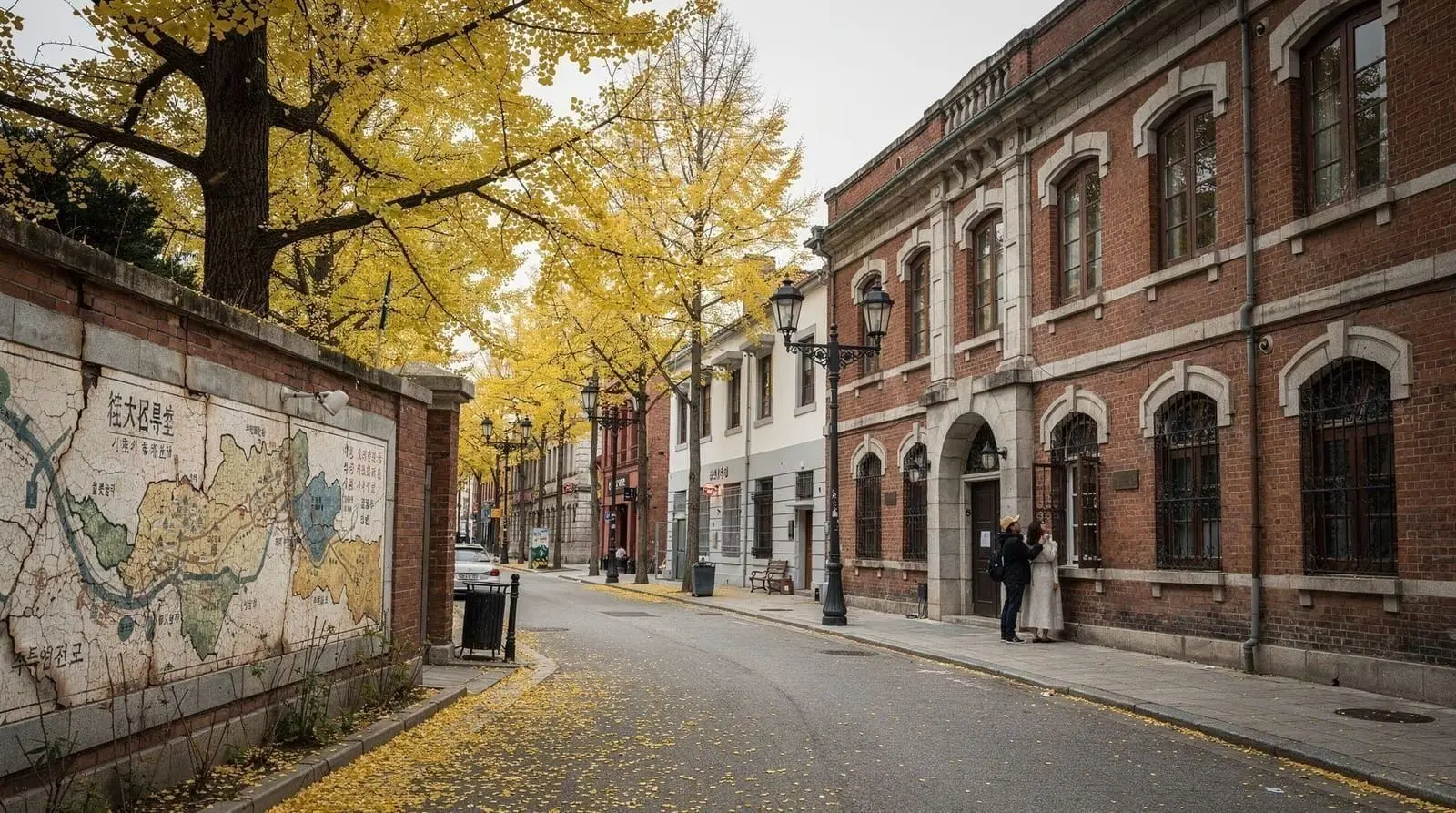
Incheon Open Port heritage district: colonial architecture walking guide
What is the Incheon Open Port district?
The Open Port district (개항장) is a compact area of preserved 1880s–1930s colonial-era architecture around Incheon's historic treaty port, walkable from Incheon Station. It includes Korea's first foreign bank building, restored Japanese concession streets, and a contemporary art complex in former warehouses.
Why the Open Port district matters
In 1883, the Joseon dynasty signed the Treaty of Jemulpo under pressure from Japan, opening the port of Incheon to foreign trade. It was one of the defining moments of modern Korean history. Within a decade, the port district had Japanese, Chinese, and Western concession zones, each governed by different rules, each building in different architectural styles, and each operating within what was essentially a foreign-administered enclave on Korean soil.
What makes Incheon’s Open Port district unusual is that a significant portion of that built environment survived. Korea’s twentieth century was not kind to old buildings. The Japanese colonial period, the Korean War, and fifty years of rapid economic development erased most of the country’s historical urban fabric. But in this compact area around the old port — roughly a 600-metre radius from Incheon Station — something like 8 original concession-era structures remain standing, some in their original use, others converted to galleries and cafés.
The result is a neighbourhood that rewards slow walking. You are not looking at reconstructions or heritage theme parks. You are looking at the actual buildings where Korea’s first foreign banks operated, where foreign merchants stored goods in bonded warehouses, and where the commercial and diplomatic machinery of treaty-port Korea functioned day to day.
This guide covers the main sites on a roughly 2.5-hour walking route. It pairs naturally with the Incheon Chinatown walking tour, since the two districts are adjacent and together give you the full picture of Incheon’s nineteenth-century international zone.
| Where | Open Port district, 5-min walk west from Incheon Station |
| Cost | Nearly free; museum around 500 won, everything else free |
| Time needed | 2.5 hours core route, 3–4 hours with Sinpo Market and Jayu Park |
| Getting there | Metro line 1 to Incheon Station (about 55 min from Seoul Station) |
| Best time | Weekday morning for the museum/Art Platform; weekend afternoon for the café scene |
The historical context in brief
The term “treaty port” describes a system that operated across East Asia in the nineteenth century, in which Asian governments — under pressure from Western powers and Japan — agreed to open specific ports to foreign trade and to grant foreign nationals legal protections not available to locals. The foreign residents of these ports lived in “concessions,” zones where their home country’s law applied, not the law of the country they were living in.
In Incheon, the system worked like this: the Japanese concession occupied the area immediately south of the port; the Chinese concession (what is now Chinatown) was to its north; smaller Western concessions existed further along the waterfront. Each zone had its own governance, its own infrastructure, and its own architecture.
The Japanese buildings were built in the Meiji era style that the Japanese government promoted for official and commercial buildings: brick or stone construction, Western classical elements (columns, cornices, pediments), but with Japanese proportions and detailing. These are the buildings you see on the main Open Port Road today. The Chinese buildings were built in southern Chinese commercial styles, with elaborate facades and colour. Most of those survive in what is now Chinatown.
The Western concession buildings are largely gone. What remains is primarily the Japanese and Chinese built environment — which means that walking through this district today is walking through a landscape shaped by two forms of foreign presence, both of which had profound and contested effects on Korea.
That context matters. It turns what might otherwise be a pleasant architectural walk into something more historically specific and, if you are inclined to think about it, more interesting.
Practical information
Getting there: Incheon Station, metro line 1 (dark blue), final stop. Journey from Seoul Station is approximately 55 minutes. From the station, the Open Port Museum is a 5-minute walk west along the waterfront-facing road.
When to go: Weekday mornings are quietest for the museum and Art Platform. The café culture that has taken over several former bank buildings on Open Port Road is liveliest on weekend afternoons, when the neighbourhood functions more as a leisure destination than a heritage site. Both versions of the district are worth experiencing; choose based on preference.
Budget: The walk is nearly free. The Open Port Museum charges 500 won entry. The Art Platform and all outdoor architectural sites are free. Sinpo International Market requires no entry fee. The main cost is food and coffee.
Duration: Allow 2.5 hours for the core route, or 3 hours if you spend time in the Art Platform galleries or linger at Sinpo Market.
The walking route: seven stops
Stop 1 — Incheon Open Port Museum (인천개항박물관)
The museum building is itself the primary exhibit. This is the original 1883 building of the First National Bank of Japan — the first foreign bank to operate in Korea — built in a restrained Western classical style with a two-story brick facade and arched windows. It is the oldest surviving Western-influenced commercial building in Korea.
The museum inside covers the Joseon-era port opening, the foreign concession system, trade patterns, and the social life of the international port community. Exhibits include period photographs, scale models of the concession zones, trade goods from the period, and documents from the treaty negotiations. Korean and English captions are both present, though the English translations are occasionally awkward.
Admission is 500 won. Opening hours are Tuesday through Sunday, 9am to 6pm; closed Mondays. Allow 45 minutes to move through properly.
One thing the museum handles well is the economic data: it shows what was exported from Incheon (primarily rice), what was imported (primarily manufactured goods), and how the trade balance functioned. If you have any background in economic history, this section is genuinely informative about how the treaty port system operated as an extraction mechanism.
Incheon: One Day Guided City Tour with Hotel PickupStop 2 — Japanese Concession Cultural Street (일본 조계지 문화의 거리)
From the museum, walk north along what is now called Open Port Road. This is the main spine of the former Japanese concession. The buildings on both sides of the street are restored 1920s Japanese-era bank and commercial buildings, now housing cafés, design studios, galleries, and small restaurants.
The architectural character is consistent: two-story brick buildings, classical cornices, symmetrical facades with central entrance bays. Several have been very carefully restored, with the exterior stonework cleaned and pointed and the original window proportions maintained. Others have been more liberally modified inside while keeping the exterior intact.
The street has been explicitly developed as a café and culture destination, which is both its strength and its limitation as a heritage experience. The buildings are well-maintained precisely because people want to drink coffee in them. That commercial incentive has done more for their preservation than any government conservation budget alone could have. But it also means the street is busy on weekends, and the interior experience of the buildings is now primarily about the café rather than the building.
Visit on a weekday morning if you want to photograph the architecture without the weekend crowd. Visit on a weekend afternoon if you want to experience the street as the local leisure scene it has become.
Stop 3 — Incheon Art Platform (인천아트플랫폼)
The Art Platform is the most architecturally significant complex on the route. In the 1930s, the Japanese colonial government built a series of warehouse and storage buildings here to handle the port’s bonded cargo. The buildings are large-scale industrial structures: steel frames, brick cladding, corrugated iron roofing, high ceilings. After the colonial period ended in 1945, they passed through various uses and eventually fell into disuse.
The city of Incheon converted the complex into a contemporary arts hub in 2009. The warehouse buildings now contain artists’ studios, gallery spaces, a small theatre, and event facilities. Entry to the compound and the galleries is free.
From a visitor perspective, the Art Platform rewards a 30-minute walk-through even if you have no specific interest in contemporary art. The industrial scale of the buildings is striking — these are not modest storage sheds but serious commercial infrastructure from a period when Incheon was the most significant port in Korea. The contrast between the nineteenth-century Japanese bank buildings on Open Port Road and these 1930s industrial structures gives you a sense of how the port economy evolved over fifty years of Japanese control.
The gallery program changes regularly. Check what is showing before you visit; the program sometimes includes work that directly engages with the history of the site.
Photogenic from multiple angles, particularly from the central courtyard at mid-morning when the light comes in at a low angle across the brick facades.
Stop 4 — Sinpo International Market (신포시장)
A 5-minute walk north brings you to Sinpo International Market, one of Incheon’s oldest covered markets. The market predates the formal district redevelopment and has operated continuously through the colonial period, the Korean War, and the decades since.
It is called an “international” market because of its historical connection to the port: foreign goods arrived at Incheon and were sold through markets like this one before distribution inland. Today the market is a standard Korean covered market selling clothing, dried goods, fresh produce, seafood, and street food.
The street food is the main draw for visitors. Galmaegisal (갈매기살, pork skirt steak) grilled on charcoal is a market speciality; look for the smoke coming from stalls in the inner lanes. Dak-gangjeong (닭강정, sweet and spicy fried chicken pieces) is another Sinpo speciality — this market is sometimes credited as one of the places where the dish was popularised. Prices are market-level: 5,000 to 8,000 won for a serving.
The market connects to a broader discussion of food options in the area covered by the where to eat in Incheon Chinatown guide, which includes market-adjacent restaurants and what to order.
Stop 5 — Open Port Road (개항로) — café and architecture corridor
Return to the main street and walk its full length, from the Art Platform end back toward the museum. This is the stretch where the former bank buildings have been most thoroughly converted to cafés and lifestyle businesses.
Several of the buildings are worth pausing in front of even without entering. The former 58th Bank of Japan building (now a café) has one of the better-preserved facades on the street, with original decorative stonework at the cornice and entrance lintel intact. The building that now houses a design studio about two-thirds of the way down the block has unusually large windows for a bank building of its period, which suggests it may have had a different original function — possibly a trading house rather than a strictly financial institution.
The street functions as evidence of a broader tension in Korean heritage policy: these buildings were preserved because the city invested in their restoration, but they have been preserved as shells for new commercial uses rather than as museums of their original function. Whether that represents a pragmatic and successful form of conservation or an erasure of historical meaning in favour of gentrified tourism is a question worth holding as you walk.
Incheon Landing Operation: History Tour with Col VINCEROStop 6 — Chinese Concession Boundary Markers
Near the boundary between the Open Port district and Chinatown, look for the stone markers that delineate the original Chinese concession. These are the same markers described in the Chinatown walking tour; from this side, you approach them from the Japanese concession direction, which gives you a clearer sense of how the two zones related to each other spatially.
The markers are modest — granite posts rather than formal monuments — but they mark a real jurisdictional line. Standing between the two concession zones and looking at these posts is one of the more genuinely historical moments available on either walk: you are standing at the physical boundary of two foreign administrative zones on Korean soil in the 1880s.
Stop 7 — Jayu Park approach (optional extension)
From the boundary markers, the road north climbs toward Jayu Park, a 10-minute uphill walk. The park sits on the hill above Chinatown and the Open Port district and offers views over the port. It is best known for the statue of General Douglas MacArthur commemorating the 1950 Incheon Landing Operation, but the park itself is a pleasant green space with mature trees.
The Jayu Park and Korean War history guide covers the park and its significance in detail. The landing operation that MacArthur commanded in September 1950 — a large-scale amphibious assault that turned the course of the Korean War — was staged in the waters visible from this hillside, which gives the park an unusual historical layering: a nineteenth-century colonial port viewed from a hill commemorating a mid-twentieth-century battle.
Open Port district vs Chinatown: what each side actually offers
Visitors often assume the two adjacent districts are interchangeable, but they reward different interests.
| Open Port district | Chinatown | |
|---|---|---|
| Character | Japanese concession architecture, museums, cafés | Chinese concession, restaurants, murals |
| Pace | Slower, more contemplative | Livelier, food-focused |
| Best for | Architecture and colonial history | Food and photography |
| Crowds | Lighter, even on weekends | Heavier on weekend lunches |
| Standout stop | Incheon Art Platform | Gonghwachun / Jjajangmyeon Museum |
Doing both back to back, as most visitors do, gives you the fuller picture — the Chinese and Japanese concessions operating side by side in the same treaty port. Neither district alone tells the complete story.
Restoration debate: preservation or gentrification?
The conversion of Open Port Road’s former bank buildings into cafés is not universally welcomed by heritage scholars. Critics point out that a building’s interior — its original teller counters, vaults, and office layouts — is usually stripped out entirely to make way for espresso machines and seating, meaning what survives is really only the facade. Supporters counter that facade preservation funded by commercial rent is more durable than a government-run museum model, which in Korea has a mixed record of long-term maintenance once initial funding dries up. Both positions have merit, and walking the street with this tension in mind adds a layer of critical thinking that a purely architectural tour would miss.
How the Open Port district fits into a broader Incheon day
The Open Port district and Chinatown together form a coherent morning. Add Jayu Park and you have a half-day of walking history that covers roughly 70 years of Korean engagement with foreign powers — the treaty port opening of 1883, the Japanese colonial period through 1945, and the Korean War in 1950.
The Incheon in one day itinerary sequences these areas with afternoon options, including Wolmido to the west or Songdo to the south, depending on your interests. If you want the modern counterpoint to this historical walk, the Songdo Central Park guide covers a neighbourhood that represents everything the treaty port era was not: planned, domestically built, and oriented toward a Korean-led future.
The Incheon Seoul 2-3 days itinerary is useful if you want to work the Open Port district into a longer stay that also covers Seoul properly.
For visitors coming directly from the airport, the Incheon airport layover itinerary addresses whether the Open Port district is feasible within a layover, including transit times from the airport to Incheon Station and back.
What the district reveals about contemporary Korea
Walking the Open Port district in 2026 is a layered experience. On the surface it is pleasant: old buildings, good coffee, a few interesting museums, a market with good food. But the district is also a site where Koreans have chosen to preserve the physical remnants of foreign domination — the Japanese bank buildings, the concession structures — and convert them into leisure space rather than memorial space.
That choice is meaningful. It is different from what happened in other parts of Korea, where colonial-era buildings were demolished as symbols of Japanese imperialism. In Incheon, the pragmatic decision was made that the buildings were worth keeping, that the heritage value of the architecture outweighed the symbolic weight of what the buildings represented. The result is a neighbourhood that is genuinely interesting to walk through but also genuinely complicated to think about.
Visitors who want to go deeper into this history will find the Open Port Museum’s explanatory panels more useful than most tourist sites in the country. The city has not tried to simplify the colonial period into a straightforward narrative of victimhood and liberation; the museum presents the economic and political mechanics of the concession system with a degree of analytical nuance that is not always present in Korean heritage interpretation.
For context on the Korean War-era history that followed the colonial period, the DMZ day tour from Seoul and the Incheon landing operation content provide the wider arc.
Planning your visit: key logistics
The getting around Incheon guide covers transit from all major points of arrival. For the Open Port district specifically: metro line 1 to Incheon Station is the correct approach. Do not take a taxi from central Incheon expecting to save time; the metro is direct and the station puts you at the front door of the district.
If you are arriving from Incheon Airport rather than Seoul, line 1 connects the airport to Incheon Station via multiple stops; allow about 75 minutes from the airport terminal. The K-ETA and visa guide for Korea is useful background if you are entering Korea for the first time.
The where to stay in Incheon guide has options in the Old Town area for visitors who want to base themselves near the heritage district rather than near the airport.
Frequently asked questions about Incheon Open Port heritage district
How long should I spend in the Open Port district?
The core route takes 2.5 hours at a comfortable pace, including the Open Port Museum and Art Platform. If you add Sinpo Market and spend time in the café buildings on Open Port Road, allow 3 hours. Adding Jayu Park at the end brings the total to around 3.5 to 4 hours.
Is the Open Port Museum worth the admission fee?
At 500 won — roughly 40 US cents — it is essentially free. The building alone is worth seeing. The exhibits are informative if you have any interest in the treaty port period; less engaging if you are primarily there for the architecture. It is worth at least 20 to 30 minutes regardless.
Can I visit the Art Platform without a ticket?
Yes. The Incheon Art Platform is free to enter and free to walk through. The gallery spaces are open during business hours (typically 10am to 6pm, Tuesday through Sunday) and require no ticket or registration. Some special events or exhibition openings may have entry requirements, but the permanent gallery and studio spaces are open access.
Is the Open Port district accessible for visitors with mobility limitations?
The main streets are flat and paved. The approach to Jayu Park involves a significant uphill walk that is not accessible. The museum building is a historic structure and may have limited accessibility inside. The Art Platform complex is largely accessible at ground level. If mobility is a concern, the flat section of the route — museum, Open Port Road, Art Platform, and Sinpo Market — is fully walkable without significant elevation change.
What is the best food option near the Open Port district?
Sinpo International Market is the most convenient and most interesting food stop on the route. For a sit-down meal, the where to eat in Incheon Chinatown guide covers the restaurants a short walk away in the Chinatown area, including specific dishes to order. The cafés on Open Port Road are good for coffee and light snacks; full meals are harder to find on the street itself.
How does the Open Port district compare to similar sites in other Korean cities?
Gunsan, a smaller port city on Korea’s west coast, has a comparable Japanese concession heritage district that is arguably better preserved and less heavily touristed. Mokpo on the south coast has a similar character. Within the greater Seoul metropolitan area, Incheon’s Open Port district is the most significant remaining example of the treaty port built environment. It is not as large or as dramatic as the Bund in Shanghai, which developed under similar historical circumstances, but it is the most intact version of this kind of heritage that Korea has.
What happened to the Western concession buildings?
The Western concession, located further along the waterfront from the Japanese and Chinese zones, has largely disappeared. A small number of missionary-era buildings survive in scattered locations, but there is no coherent Western concession streetscape comparable to what exists in the Japanese concession. The Western presence in Incheon was commercially significant but architecturally less concentrated, and the buildings did not survive in the same density.
Is it appropriate to visit a site that includes Japanese colonial-era buildings?
This is a question individual visitors need to answer for themselves, but it is worth noting that the site has been preserved and interpreted by the Korean city government, which has made an explicit decision that these buildings are worth keeping as part of Incheon’s heritage. The Open Port Museum, which occupies a former Japanese bank building, presents the colonial period critically and honestly. Visiting the district is not an endorsement of the colonial system; it is an engagement with the historical evidence that remains.
Should I visit the Open Port district or Chinatown first if I only have time for one?
If food and photography matter most, start with Chinatown. If architecture and history matter most, start with the Open Port district — it’s quieter in the morning and the museum benefits from a fresher, less rushed visit. Most visitors find the two work best in sequence rather than as a forced choice, since the walk between them takes only a few minutes.
Are there guided tours of the Open Port district, or is self-guided better?
Both work well. The Incheon Tourism Organisation runs occasional free or donation-based guided walks covering this district, usually on weekends — check the tourism information centre near Incheon Station for the current schedule. A self-guided visit using this route is equally viable, since the museum and Art Platform both have adequate English signage to fill in context without a guide.
Incheon city experiences on GetYourGuide
Top-rated tours and activities


