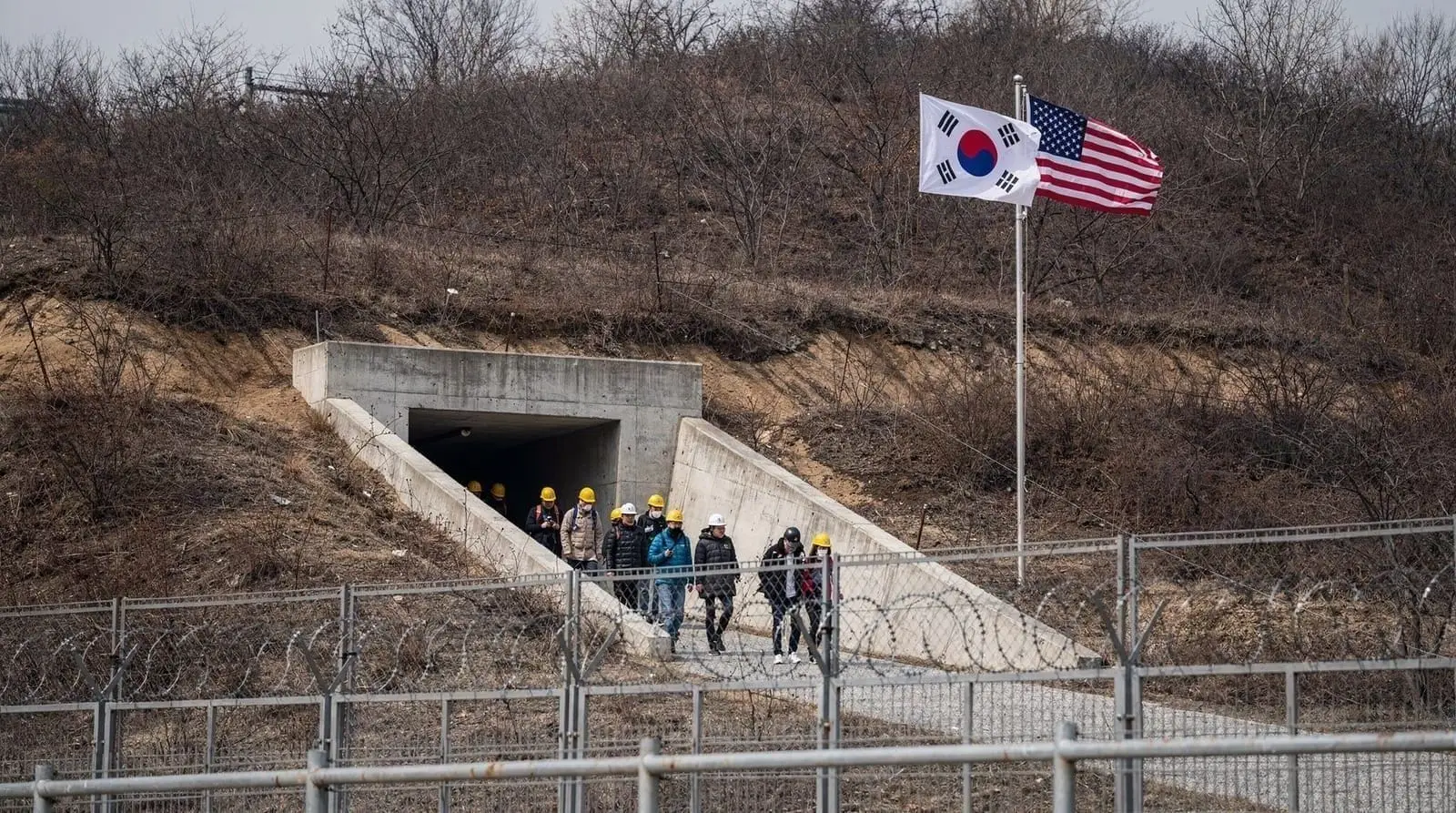
DMZ day tour from Seoul and Incheon: what to expect and how to book
Can you visit the DMZ on a day trip from Incheon?
Yes. The DMZ is about 50–60 km north of central Seoul and accessible by guided tour from both Seoul and Incheon. Most tours depart from central Seoul meeting points, reachable from Incheon in 45–60 minutes by metro. Full-day DMZ tours run 8–10 hours including travel; half-day tours run 4–5 hours.
| Where | Paju area, ~50–60 km north of Seoul |
| Cost | Tours vary by operator and inclusions; JSA tours cost more |
| Time needed | 4–5 hours (half-day) to 9–10 hours (JSA combined) |
| Getting there | Tour pickup in central Seoul; 45–65 min from Incheon |
| Booking | Passport required; book several days ahead, more for JSA |
The DMZ: why it draws 1.5 million visitors a year
The Demilitarized Zone (DMZ) is the 4 km-wide buffer strip that stretches 250 km across the Korean Peninsula, dividing North and South Korea since the 1953 Armistice Agreement that ended active fighting in the Korean War. It is one of the most heavily armed borders on earth — and paradoxically, one of the most ecologically rich, since 70 years of human exclusion have allowed wildlife to flourish undisturbed in the buffer zone.
For visitors, the DMZ is a place of layered significance. It is the endpoint of a war that divided families and is still technically unresolved — no formal peace treaty has ever been signed. It is a site of active military tension with watchtowers, fencing, and minefields. And it is one of the few places on earth where you can stand at the edge of a functioning totalitarian state and look across at a country most of the world’s citizens will never enter.
Day tours from Seoul and Incheon offer controlled access to several sites along and near the southern boundary, including the Joint Security Area (JSA) at Panmunjom where inter-Korean meetings take place, the Third Tunnel discovered in 1978 (dug by North Korea toward Seoul), Dora Observatory (which faces north into North Korean territory), and Dorasan Station (the southernmost railway station on a line intended to connect Seoul to Pyongyang).
Korea DMZ Tour from SeoulWhat a standard DMZ tour includes
Most guided DMZ day tours from Seoul cover the following sites, though specific combinations vary by operator:
Imjingak Pavilion (임진각)
A large park and memorial complex near Munsan, approximately 7 km south of the border. This is the closest publicly accessible point to the DMZ that does not require a military permit. The site includes the Bridge of Freedom (over which Korean War POWs crossed south in 1953), a rusting steam train destroyed during the Korean War (a popular photo subject), and a small amusement park that feels incongruously cheerful against the context. Most tours stop here briefly on arrival.
The Third Tunnel of Aggression (제3땅굴)
Discovered in 1978, this is one of four known tunnels dug by North Korea under the DMZ toward Seoul. The accessible tunnel is approximately 73 m below ground at its deepest point and runs 1.7 km in total length, reaching a narrow section 437 m into North Korean territory before being sealed with concrete barriers. Visitors walk into the tunnel via a sloped passage (wear layers — it is 11°C inside year-round), reaching the concrete barriers where you are as close as civilian access permits to North Korean territory underground.
Note: cameras are not permitted inside the tunnel.
Dora Observatory (도라산전망대)
An elevated observation platform with binoculars and a line-of-sight view north into North Korean territory. On clear days you can see North Korean propaganda village, the northern portion of the DMZ’s no-man’s-land, and forested hills beyond. Signage explains the geography and landmarks visible. Photography of North Korean territory from the observation deck is permitted from designated zones.
Dorasan Station (도라산역)
The southernmost railway station on the Gyeongui Line — built during a period of inter-Korean engagement in the early 2000s with the hope of eventually connecting Seoul to Pyongyang and beyond. The station is complete but sees no passenger service north of the border. It has become a symbol of both Korean hopes for eventual reunification and the gap between those hopes and the current political reality. Visitors can receive a passport stamp here.
Joint Security Area (JSA) at Panmunjom
The JSA is the only point in the DMZ where North and South Korean soldiers stand in direct proximity. It is where the Korean War armistice was signed and where all inter-Korean diplomatic contacts have historically taken place. Access requires a separate permit process (managed by tour operators) and this segment of the DMZ experience is available only on specific JSA-approved tours — not all standard DMZ day tours include it.
JSA access may be suspended at times due to diplomatic or security conditions. Check with your tour operator for current availability.
From Seoul: DMZ & JSA Museum with Optional NK Defector TalkTypes of tours available
Standard DMZ day tour
Covers Imjingak, the Third Tunnel, Dora Observatory, and Dorasan Station. Departs from central Seoul (typically near Hongik University or City Hall area). Duration: approximately 8–9 hours including travel. Suitable for most visitors; does not include JSA.
DMZ and JSA combined tour
Includes all the above plus the Joint Security Area at Panmunjom. Requires advance booking as numbers are limited and permits must be arranged. Passport required (all visitors). Duration: 9–10 hours. Not available to all nationalities — check with the operator.
DMZ tour with North Korean defector perspective
Some tours include a meeting or presentation with North Korean defectors (탈북자), adding a personal dimension to the geopolitical context. These tours are particularly highly regarded for the depth of insight they provide. Generally full-day formats.
DMZ: NK Defector, 3rd Tunnel, Suspension Bridge, Hotel PickupHalf-day DMZ tour
Some operators offer shorter morning tours covering Imjingak and limited other stops. These run approximately 4–5 hours and return to Seoul by mid-afternoon, making them combinable with an afternoon in central Seoul or Incheon. Check availability as not all operators run half-day formats.
Seoul: DMZ Tour with Optional Bridge & Exhibition HallGetting to the tour from Incheon
All major DMZ tours depart from central Seoul meeting points — typically near City Hall station, Hongik University station, or hotels in Myeongdong/Jongno. From Incheon, travel time to these meeting points is approximately:
- From Incheon Station: 55–65 minutes by metro line 1 to Seoul Station or City Hall, then a short walk or metro transfer to the tour pick-up point.
- From Incheon Airport: 43 minutes by AREX express (₩9,500) to Seoul Station; or about 59 minutes on the all-stop service (₩4,150). From Seoul Station, most tour pick-up points are 1–2 metro stops away.
Most DMZ tours depart between 7:30am and 8:30am, meaning you need to leave Incheon or the airport by 6:30–7:00am to arrive on time. Factor this into overnight accommodation planning.
Comparing the tour types
| Tour type | Duration | Includes JSA | Best for |
|---|---|---|---|
| Standard DMZ day tour | 8–9 hours | No | First-time visitors wanting the core sites |
| DMZ and JSA combined | 9–10 hours | Yes | Visitors prioritising the closest border access |
| DMZ with defector talk | Full day | Varies | Deeper personal/historical context |
| Half-day DMZ tour | 4–5 hours | No | Combining with an afternoon elsewhere |
Combining a DMZ day with the rest of your trip
Because most tours return to central Seoul by mid-to-late afternoon, a half-day format leaves room to pair the DMZ with something lighter afterward. If you’re staying in or near Incheon, the getting around Incheon guide explains how to connect back from Seoul efficiently by metro. Travellers on a tight schedule sometimes stack the DMZ against an Incheon Airport layover on departure day — this only works with a half-day tour and a late flight, given the early pickup times and return travel.
For visitors weighing the DMZ against other day trips from the Incheon/Seoul area, it sits in a different category from scenic options like Nami Island or the historical walking route at Suwon Hwaseong Fortress — those are relaxed, photogenic outings, while the DMZ is a structured, security-controlled visit with a heavier historical weight. Many visitors do one DMZ day and one lighter day trip during a longer stay rather than both in the same visit.
Seoul: Half-Day DMZ Tour Led by a Retired Military OfficerPlanning the night before an early pickup
Because the pickup is early, where you sleep matters more than usual. Our where to stay in Incheon guide helps you pick a base, and if you would rather sleep in the capital the night before, the Seoul destination page gives a sense of the neighbourhoods near the usual meeting points. The Incheon vs Seoul comparison is useful if you are still deciding which city to base yourself in.
If you are watching your spending, the Incheon on a budget guide covers ways to keep the rest of the trip affordable so you can put more of your budget toward a good tour. Visitors who are new to the country may also appreciate the safety and language tips before heading to a military-controlled area, since a few basic phrases and some awareness of local etiquette make the day smoother.
Where the DMZ fits in a longer itinerary
The DMZ area around Paju has its own page in the Paju and DMZ destination guide, which places the sites in their wider geographical context. If you are building a multi-day plan, the Incheon and Seoul in 2–3 days itinerary shows how a full-day tour can slot between lighter days, and the Incheon in one day itinerary is a good companion for the day you spend back in the city. Whichever combination you choose, leave a quiet evening after the DMZ: most visitors want time to take in what they have seen.
Practical requirements
Passport: Mandatory for all DMZ tours. Your actual passport (not a copy) is required for entry to the JSA and Third Tunnel sections. Keep it accessible throughout the day.
Dress code: The JSA in particular has a dress code that excludes certain military-pattern clothing, shorts above the knee, and revealing tops. For standard DMZ tour sections, normal tourist dress is appropriate, but layers are recommended (the tunnel is cold).
Photography restrictions: No photography inside the Third Tunnel. At Dora Observatory, photography is permitted from designated zones only. At the JSA, detailed instructions are given on arrival. Follow all photography rules — they are enforced by military personnel.
Physical requirements: The Third Tunnel involves a steep downslope (about 11 degrees) of approximately 350 m on the way in and out. Visitors with limited mobility should check with the operator in advance; a monorail assists descent in the tunnel for those who cannot walk the full slope.
Minimum age: Most tours accept visitors of all ages, but the JSA segment typically requires visitors to be over 10 years old. Check with the specific operator.
What to expect emotionally and historically
The DMZ is not a comfortable experience. The presentation of geopolitical history — the Korean War, the division of families, the ongoing nature of the military confrontation — is handled differently by different tour operators, from matter-of-fact historical briefings to more emotionally charged narratives from South Korean guides with personal family connections to the division.
Most visitors find the day heavier than expected. The juxtaposition of tourist infrastructure (gift shops, passport stamps, observation decks) with the genuine weight of what the site represents can feel jarring. This is part of the experience rather than a flaw in it.
The Jayu Park and Korean War history guide in Incheon provides useful context before or after the DMZ visit, connecting the Korean War history to the city that served as a key landing site in the conflict’s pivotal Incheon Landing of September 1950.
Frequently asked questions about DMZ day tours
Can I visit the DMZ independently without a tour?
Most of the DMZ’s visitor sites require passing through military checkpoints that only organised tours can access. Imjingak Pavilion can be reached independently by train from Seoul’s Susaek station, but the main sites (Third Tunnel, Dora Observatory, JSA) require booking through an authorised tour operator. There is no self-drive or walk-in access.
How close do you get to North Korea?
At the Third Tunnel, you stand within 437 metres of North Korean territory underground (at the concrete barriers). At Dora Observatory, you observe North Korea from approximately 2 km away by line of sight. At the JSA (if included), you stand within metres of the Military Demarcation Line and may briefly step into the meeting room that straddles the line.
Is it safe to visit the DMZ?
Yes. The DMZ has been open to international tourists for decades and is actively managed by the South Korean military. Incidents are extremely rare. The security briefings and protocols are thorough. North Korea’s history of unpredictable provocations means the experience always carries a degree of political uncertainty, but tour cancellations due to security concerns are uncommon.
Do I need a Korea visa to visit the DMZ?
You need a valid entry to South Korea, which for citizens of the 25 countries and regions on the official K-ETA exemption list (e.g. US, Canada, UK, Germany, France, Italy, Spain, Netherlands, Poland; not Portugal or Ireland) does not require a K-ETA through December 31, 2026 — other nationalities must get a K-ETA before boarding. Exempt stays up to 90 days are permitted with only the mandatory e-Arrival Card. From January 1, 2027, K-ETA will be required. See the K-ETA and visa guide for details.
What is the best time of year to visit the DMZ?
Spring and autumn are the most comfortable seasons. Summer is hot and humid. Winter is cold but the landscape has a stark quality. The DMZ visit is primarily a historical and geopolitical experience rather than a scenic one, so weather matters less than for other day trips.
Can I take photos at the DMZ?
Photography rules vary by site. Imjingak is fully open. Dora Observatory has designated photography zones. Inside the Third Tunnel, no photography. At the JSA, strict rules apply and are enforced. Follow all instructions from your guide and military personnel.
DMZ tours from Incheon on GetYourGuide
Top-rated tours and activities


