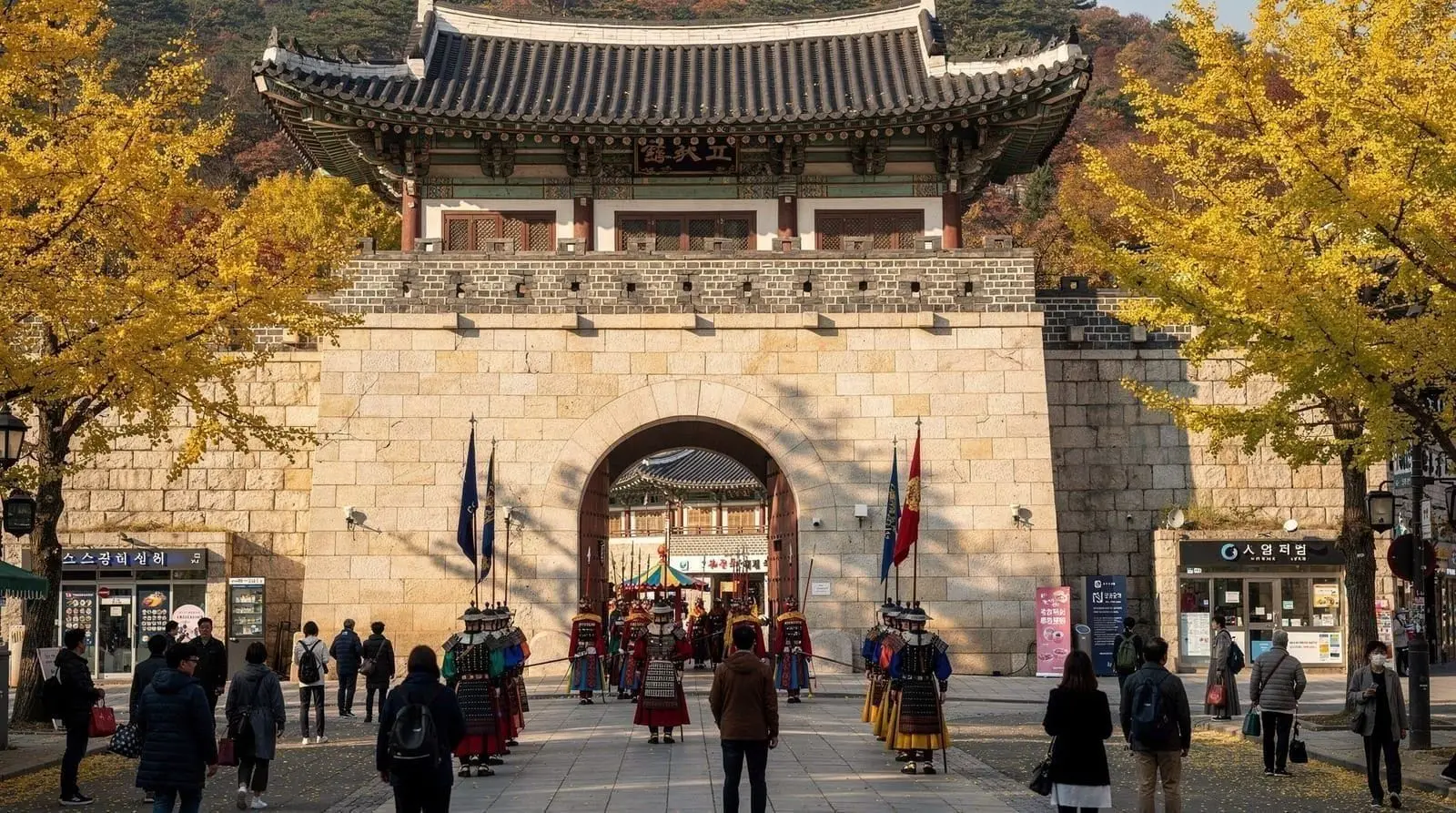
Suwon Hwaseong Fortress day trip from Incheon and Seoul
How long does it take to get from Incheon to Suwon Hwaseong Fortress?
From Incheon Station, take metro line 1 south to Suwon Station — approximately 60 to 70 minutes, with no transfer needed on line 1. The fortress walls are a 15-minute walk from Suwon Station's exit 2 or a short taxi ride. Total door-to-gate time: about 75 to 85 minutes.
| Where | Suwon, about 60–70 min south of Incheon on metro line 1 |
| Cost | ₩1,000 fortress admission; ~₩2,800–3,200 metro fare |
| Time needed | 2.5–3 hours for the wall circuit; full day with Folk Village |
| Getting there | Metro line 1 direct, no transfer from Incheon Station |
| Best time | Spring or autumn; early morning or late afternoon in summer |
Why Hwaseong Fortress is worth the journey from Incheon
Suwon Hwaseong Fortress is one of the best-preserved and most dramatic fortified complexes in Korea. Built between 1794 and 1796 during the reign of King Jeongjo of the Joseon dynasty, the walls stretch 5.7 km around the city of Suwon and incorporate four main gates, two observation platforms, numerous watchtowers, cannon emplacements, and a functioning wall walk that you can do in its entirety. UNESCO added it to the World Heritage List in 1997, citing both its architectural ambition and its exceptional state of preservation.
What sets Hwaseong apart from other Korean palace complexes is its scale and the extent to which you can actually engage with it physically. Unlike the palaces of Seoul — Gyeongbokgung, Changdeokgung — where you walk through courtyards behind rope barriers, Hwaseong lets you climb the walls, walk the full battlements, look out from cannon ports, and feel the engineering of a late Joseon military complex in a visceral way. The fortress walls circle a still-living city, and the contrast between the 18th-century ramparts and the modern streets below is stark and interesting.
From Incheon, the train journey on metro line 1 is direct, uncomplicated, and inexpensive. This is one of the most accessible UNESCO World Heritage Sites from Incheon Airport.
From Seoul: Suwon Hwaseong Fortress TourIf you are still shaping your trip, the Suwon destination page gives the wider picture of the city, and the Incheon and Seoul 2–3 day itinerary shows where a fortress day fits between city time and coastal stops. Pair it with the best time to visit Incheon if you are choosing dates around the weather, since the walls are fully exposed.
Getting from Incheon to Suwon
By metro (recommended)
Metro line 1 (dark blue) runs directly from Incheon Station south through Bupyeong, Guro, Anyang, and into central Suwon. There is no transfer required — board at Incheon Station heading toward Suwon (or Seoul direction), stay on line 1, and exit at Suwon Station after approximately 60–70 minutes.
The T-money card covers the full journey. Fare from Incheon Station to Suwon Station is approximately ₩2,800–3,200 ($2.20–2.50) depending on your exact boarding point.
From Seoul Station: Also line 1, approximately 30 minutes south to Suwon. If coming from central Seoul, Seoul Station is a convenient starting point.
From Incheon Airport
Take the AREX (Airport Railroad Express) all-stop service toward Seoul Station, then transfer to metro line 1 southbound to Suwon. Total journey time from the airport: approximately 90–100 minutes. Alternatively, the AREX express to Seoul Station (43 minutes, ₩9,500) and then line 1 to Suwon (30 minutes) is faster in total. A direct bus from Incheon Airport to Suwon also exists (bus 1007 or similar) but takes longer due to road traffic.
Getting from Suwon Station to the fortress
On foot: Exit 2 from Suwon Station; the walk to Paldalmun Gate (the main south gate of the fortress) takes approximately 12–15 minutes through central Suwon. Signs in both Korean and English point the way.
By bus: Local buses 11, 13, 36, and 39 pass the fortress area; ask the driver for Paldalmun (팔달문). Fare ₩1,200–1,350 with T-money.
By taxi: ₩4,000–6,000 ($3–4.50) from Suwon Station to Paldalmun gate.
If the T-money card, line changes or station exits are new to you, the getting around Incheon guide explains how the system works before you set off. Travellers arriving by air who would rather skip the transfers can read the Incheon airport layover itinerary and the 6-hour layover itinerary to judge honestly whether a fortress trip fits their time, and those with a new visa situation should check the K-ETA guide before travelling.
The fortress circuit: five sections on foot
The full perimeter walk is 5.7 km and takes 2.5–3 hours at a comfortable pace, with pauses at the main gates and towers. You can start at any gate; most visitors begin at Janganmun (the north gate) or Paldalmun (the south gate, nearest the station).
Paldalmun Gate (팔달문)
The south gate is the most easily reached from Suwon Station and serves as the practical starting point for many visitors. The gate itself is a two-tiered pavilion on a stone drum base, similar in form to Seoul’s Namdaemun gate. The surrounding area has been pedestrianised, and a market extends south from the gate — this is the traditional commercial centre of Suwon and worth a brief wander.
The east wall and Dongbonuri
Climbing from Paldalmun north along the east wall brings you to Dongbonuri, an observation pavilion that provides the first major elevated view of the fortress and city. The wall here follows the ridgeline above the eastern commercial district, and the contrast between the 18th-century stonework and the apartment towers beyond is consistently striking.
Hwahongmun Water Gate (화홍문)
On the north side of the circuit, the Hwahongmun Water Gate spans the stream that was channelled through the fortress walls via a series of seven arch sluices. The gate is one of the most elegant structures on the circuit — a low stone arch bridge with a wooden pavilion on top, designed both to control water flow and serve as an artillery platform. The stream below creates a scenic reflecting pool that is particularly photogenic in morning light.
Banghwasuryujeong Pavilion (방화수류정)
Adjacent to the water gate, this octagonal pavilion perches above a cliff overlooking the stream and northeast pond. It is widely considered the most beautiful individual structure in the fortress complex — asymmetric, curved-roofed, and set at an angle that makes it photograph beautifully from several directions. Allow extra time here.
Janganmun Gate (장안문)
The north gate is the largest of the four, built on a more imposing scale than Namdaemun in Seoul. The half-moon defensive enclosure (ongseong) in front of the gate adds to its mass; you can walk through the gate structure itself and look back at the city framed by its arch.
The west wall
The western section of the wall faces the commercial and residential city to the west. It is the least dramatic section visually, but the Seojangdae command platform on the western ridge provides excellent panoramic views and marks the highest point of the circuit.
Fortress admission
Admission to walk the walls is ₩1,000 for adults (approximately $0.80) — one of the most remarkable value cultural admissions in Korea. The inner areas of the main gate structures charge ₩500 per gate in some cases. Overall, the fortress costs almost nothing to experience in full.
Opening hours: Daily from 9am to 6pm (last entry 5:30pm); some gates and sections close slightly earlier.
Korean Folk Village
The Korean Folk Village (한국민속촌) is located approximately 15 km south of Suwon centre, accessible by shuttle bus from Suwon Station (about 20 minutes). It is a large outdoor museum of traditional Korean architecture — farmhouses, aristocratic estates, markets, workshops — with regular performances of traditional arts and demonstrations of crafts.
The Folk Village is a separate destination from Hwaseong Fortress and adding it makes for a long day. Budget 2–3 hours for the Folk Village alone. Combined admission packages are available through GYG and other platforms.
Seoul: Suwon Hwaseong Fortress & Korean Folk Village TourHwaseong at night
The fortress walls and main gates are illuminated at night, and the effect on the stone walls and tiled gate roofs is genuinely spectacular. The evening light show at Hwahongmun is particularly well-regarded. Evening tours are available if you want the guided interpretation alongside the illuminated circuit.
From Seoul: Suwon Hwaseong Fortress Night TourBecause the return journey after dark is long, think about your route back to the coast in advance; the Incheon safety and language tips cover practical points for travelling in the evening, and the Incheon on a budget guide helps if you want to keep transport and meal costs down across the whole day.
Food near the fortress
Tongdak (통닭) alley: Just inside Paldalmun, a covered alley of fried chicken stalls has operated since the 1970s. Whole fried chickens served with pickled radish and beer — a Suwon institution that predates the Korean fried chicken boom that swept the world. Prices: ₩18,000–22,000 ($14–17) per whole chicken.
Traditional market: The market extending south from Paldalmun has hot food stalls, Korean fast food options (tteokbokki, odeng, pajeon), and fresh produce. Good for a cheap lunch (₩5,000–8,000 per person).
Galbi (갈비) restaurants: Suwon is nationally famous for its Suwon-style beef galbi (short ribs), sold at specialized restaurants outside the fortress south wall. A full galbi dinner runs ₩25,000–40,000 per person — excellent quality and worth seeking out if you stay for dinner.
Practical tips
Wear comfortable shoes: 5.7 km on stone walls and cobbled paths requires good footwear. The walls involve some steep sections on stone steps.
Bring water: There are a few small cafes and vending machines on the circuit, but the wall section has long stretches without facilities. Carry water, particularly in summer.
Plan for weather: The fortress walls are entirely exposed. In summer heat (July–August), start the circuit early morning or late afternoon. In rain, the stone paths become slippery. Spring and autumn are ideal conditions.
If you enjoy eating your way through a place, the same spirit runs through what to eat in Incheon and the where to eat guide for Incheon Chinatown, which are good ideas for dinner once you are back on the coast.
The fortress’s engineering story
Hwaseong is often described in guidebooks as simply “well-preserved,” which undersells what makes it historically significant. King Jeongjo commissioned the fortress partly as a memorial to his father, Crown Prince Sado, and partly as a genuine feat of Joseon-era military and civil engineering. The chief architect, Jeong Yak-yong, incorporated pulley systems and cranes — documented in the surviving construction manual, the Hwaseong Seongyeok Uigwe — that allowed the fortress to be built in under three years, remarkably fast for its scale at the time.
That construction manual is a large part of why the fortress earned UNESCO status: it survived largely intact, allowing near-exact reconstruction of sections damaged during the Korean War. What you walk today is not a modern replica dressed up as history — most of the wall is original 18th-century stonework, with reconstructed sections built to the original specifications documented in the manual.
Value comparison: Hwaseong vs. Seoul’s palaces
If you are deciding whether Hwaseong is worth the extra travel time compared to staying in Seoul for palace-hopping, here’s the honest trade-off:
| Hwaseong Fortress | Gyeongbokgung / Changdeokgung (Seoul) | |
|---|---|---|
| Admission | ₩1,000 | ₩3,000 |
| Physical engagement | Walk the full wall, climb towers | Walk courtyards, ropes restrict access |
| Travel from Incheon | 60–70 min direct | 55 min direct |
| Crowds | Moderate | Heavy, especially with hanbok rental crowds |
| Best for | Active exploration, engineering interest | Formal palace architecture, royal history |
Hwaseong wins for visitors who want to physically engage with a historic structure rather than view it from behind rope barriers — a meaningfully different kind of visit.
If you are still weighing where to base yourself, Incheon vs Seoul and where to stay in Incheon lay out the options, and the Seoul destination page covers the palaces mentioned above.
Other day trips to combine with Hwaseong
Hwaseong rewards a slow day, so most travellers do not stack it with another long excursion on the same date. Over a longer stay, though, it pairs well with other outings. The Nami Island day trip and the DMZ day tour from Seoul suit travellers who want more history and scenery, while the island hopping itinerary and the Incheon in one day itinerary cover the coast and the city itself. For a gentler, closer-to-home contrast, the Incheon Chinatown walking tour and the open port heritage guide give you another layer of Korean modern history without a long train ride.
Frequently asked questions about the Suwon Hwaseong Fortress day trip
How much time should I allow for the full fortress circuit?
The 5.7 km circuit takes 2.5–3 hours at a leisurely pace with time at the main gates and towers. Add 30–45 minutes at Paldalmun market. For a visit including the Korean Folk Village, allow a full day (6–8 hours total including travel from Incheon).
Is the fortress accessible for visitors with limited mobility?
Partially. The main gates can be viewed from ground level without climbing. However, the wall walk itself involves significant stone staircases and uneven terrain that is not wheelchair-accessible. The inner courtyards of the gate structures are accessible.
Can I visit Suwon Hwaseong Fortress and the Korean Folk Village in one day from Incheon?
Yes, but it is a long day. Start by 9am from Incheon, arrive at the fortress by 10:30am, complete the wall circuit by 1:30pm, then shuttle to the Folk Village and spend 2–3 hours there, returning to Incheon by 7–8pm. It is manageable but tiring.
Is the fortress worth visiting in winter?
Yes. The fortress walls and gate structures look excellent in winter light and against snow when it falls. Crowds are much smaller than in spring or autumn, and the stone and tile architecture photographs crisply in cold clear air.
Are there English audio guides available?
Audio guide rental (Korean, English, Chinese, Japanese) is available at the main information centre near Janganmun or Paldalmun gates. Cost approximately ₩2,000–3,000. The English-language interpretation boards at each major site are also comprehensive.
What is the best gate to start the circuit at?
Most guides recommend starting at Janganmun (north gate) and proceeding counterclockwise, reaching Hwahongmun and Banghwasuryujeong (the most scenic sections) about halfway through, then ending at Paldalmun for the market and lunch. Starting at Paldalmun (nearer Suwon Station) and going clockwise reaches the same sequence in reverse.
Can I visit Hwaseong Fortress on a day trip from Incheon Airport?
It is possible but tight. The AREX and metro line 1 combination takes about 90–100 minutes from the airport, and the full fortress circuit needs 2.5–3 hours. Budget at least 6–7 hours total for a comfortable round trip without rushing, plus time for food. It works best as part of a longer Incheon stay rather than a same-day layover.
Is there an entrance fee for the Korean Folk Village separate from the fortress?
Yes — the Korean Folk Village charges its own admission, separate from the ₩1,000 Hwaseong wall fee. Combined ticket packages covering transport and both admissions are available through GYG and similar platforms, which can be more convenient than arranging the shuttle bus and tickets separately.
Seoul experiences on GetYourGuide
Top-rated tours and activities


