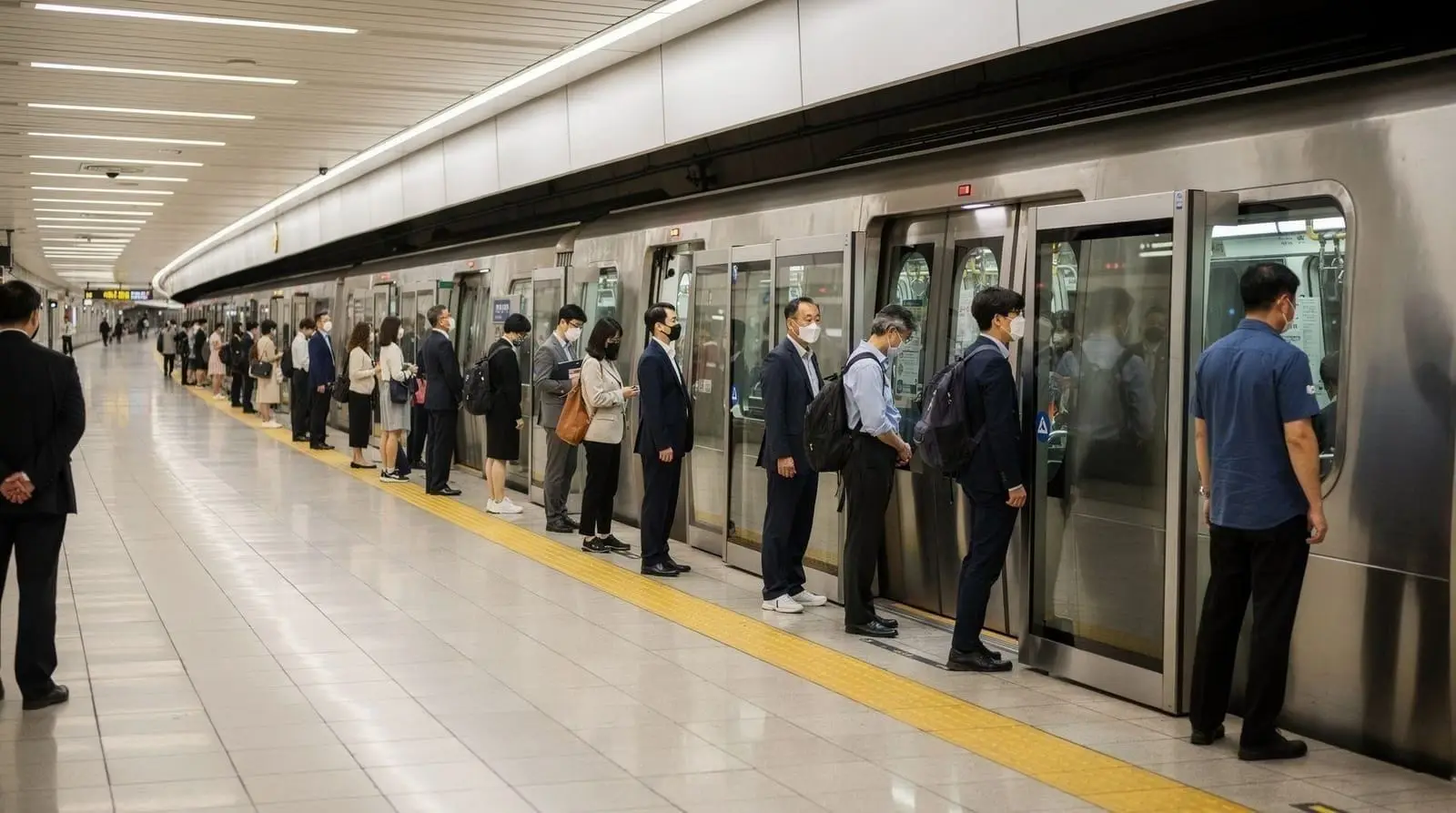
Getting around Incheon: AREX, metro, buses, and the T-money card
What is the fastest way from Incheon Airport to Incheon city?
To Seoul Station, the AREX Express from Terminal 1 takes 43 minutes and costs ₩9,500 (about $7.30), while the all-stop train takes about 59 minutes and costs ₩4,150 (about $3.20). AREX does not run to Incheon Station: for Chinatown and the city centre, take the all-stop to Gyeyang, then transfer to Incheon Metro Line 1.
| Best card | T-money, works across AREX, metro, and buses |
| Fastest airport link | AREX Express, 43 min to Seoul Station (all-stop: about 59 min) |
| Cost to expect | ₩1,200–4,750 for most single journeys |
| App to install | Naver Map or Kakao Map (both in English) |
| Taxi option | Kakao T for cashless, English-friendly booking |
The transport network that makes Incheon work
Incheon International Airport is one of the best-connected airports in the world by surface transport. Two rail lines, direct buses to Seoul and dozens of regional destinations, and a full metro network connecting to Seoul’s sprawling subway system mean that almost anywhere in the Seoul Capital Area is reachable without a taxi.
This guide covers every transport option from and within Incheon — specifically the AREX airport train (with exact timings and costs), the T-money card system, Incheon’s local metro and bus network, and when taxis are the right call.
Getting the basics right in the first 20 minutes after landing — buying a T-money card, choosing the right AREX service, and knowing which app to open — saves far more time over a trip than any single routing decision later on. Everything below is organised to front-load exactly that.
If you are arriving from abroad, check the entry rules in the K-ETA guide before you fly, so nothing slows you down between the plane and the train platform. And if your time in Korea is only a stopover, the airport layover itinerary and the 6-hour layover plan show how to turn these transport options into a realistic outing.
Incheon Airport: Traveler SIM & T-money Transportation CardThe T-money card: start here
The T-money card is a rechargeable contactless transit card that works across:
- Seoul Metropolitan Subway (all lines)
- Incheon Metro (lines 1 and 2)
- AREX all-stop service
- City buses in Seoul, Incheon, Gyeonggi Province
- Intercity buses (many routes)
- Some convenience stores (GS25, CU, 7-Eleven) for small purchases
Where to get one: T-money cards are sold at AREX ticket machines in the arrival halls, subway station ticket machines, and convenience stores throughout the airport. Cost: ₩4,000 including an initial charge, or ₩3,000 for the card alone.
How to load credit: At any subway station machine (select “T-money recharge”) or at convenience store registers. Minimum top-up is ₩1,000; there is no maximum balance limit. Cards sold at GS25, CU, and 7-Eleven are also rechargeable at those stores.
How to use it: Tap on entry to any bus or subway gate, tap again on exit (subway transfers within the system are discounted). The card deducts fare automatically. If your balance goes below zero, you can still exit — you will owe the difference on your next top-up.
T-money discount: Using T-money gives a ₩100 discount per journey on metro and buses compared to single-use tickets. Over a week this accumulates meaningfully.
Returning or keeping the card: T-money cards do not expire and unused credit stays on them. Many visitors keep their card for return trips. Credit can be refunded (minus a small processing fee) at subway station service desks.
South Korea: Unlimited Data SIM + Voice (Free T-money)AREX: Incheon Airport to the city
The AREX (Airport Railroad Express) connects both Incheon Airport terminals to Incheon city and Seoul on two overlapping service types:
AREX all-stop service
The standard service makes every station stop between Incheon Airport and Seoul Station.
| Route | Time | Cost (T-money) |
|---|---|---|
| T1 to Seoul Station | about 59 min | ₩4,150 (~$3.20) |
| T2 to Seoul Station | about 66 min | ₩4,750 (~$3.65) |
Trains run approximately every 6–12 minutes during peak hours, every 12–20 minutes at night. First train from T1 is around 5:20am; last train to T1 from Seoul Station is around midnight.
Key intermediate stops: Gyeyang, Gimpo Airport, Digital Media City, Hongik Univ.
AREX does not go to Incheon Station. For Chinatown, the historic Incheon Station area, Bupyeong or Open Port, take the all-stop AREX to Gyeyang and transfer to Incheon Metro Line 1 (transfer within 30 minutes of leaving the fare gate, 1 hour after 9pm). Check the live journey time in Naver Map or Kakao Map.
AREX Express service
A non-stop direct service between Incheon Airport (both terminals, in sequence) and Seoul Station. No intermediate stops.
| Route | Time | Cost |
|---|---|---|
| T1 to Seoul Station | 43 min | ₩9,500 (~$7.30) |
| T2 to Seoul Station | 51 min | ₩9,500 (~$7.30) |
The express is about 16 minutes faster than the all-stop on the T1–Seoul Station route (43 min against about 59 min). The price premium of about ₩5,000 also buys dedicated seating (all seats assigned, no standing passengers) and luggage compartments — worth it if you have large bags and want guaranteed seating, less so otherwise.
Trains run approximately every 30–40 minutes. Booking AREX Express seats in advance on the AREX website or app is possible and recommended during peak travel periods (April, October, Lunar New Year).
T-money does not work for the Express. You must buy an Express ticket separately at the AREX machine or app.
Incheon International Airport (ICN): Private Seoul TransferIncheon Metro
Beyond the AREX, Incheon has its own independent metro system with two lines that connect the city’s key districts:
Line 1 (dark blue — connects to Seoul Metro line 1)
Runs from Gyeyang in the north through central Incheon (Bupyeong, Dongincheon) to Incheon Station at the south terminus, and continues south to Suin-Bundang Line connections. This is the backbone line for visiting Chinatown (Incheon Station stop), Bupyeong Underground Market (Bupyeong stop), and historic Incheon.
Line 1 operates as a through-service with Seoul’s Metropolitan Subway line 1 — you can board in Incheon and ride the same train all the way to Seoul without changing. The journey from Incheon Station to Seoul Station (Korail/Seoul) takes approximately 55 minutes.
Line 2 (orange)
Runs east–west across southern Incheon, connecting Gyeyang (airport area connection) in the west through Bupyeong and into the southern coastal districts, including Sorae Wetland (for Sorae Ecology Park) and Juan. This line is essential for reaching:
- Sorae Wetland station (for Sorae Ecology Park and Sorae Fish Market)
- Incheon Grand Park station (at the east end of a cross-city route)
Transfers between line 1 and line 2 at Bupyeong are straightforward. Bupyeong is also the natural stop for the Bupyeong Underground Market, so it is easy to combine a transfer with a browse through the arcades.
Incheon Metro fares
Base fare: ₩1,250–1,650 depending on distance, paid with T-money. Adding transfers to Seoul metro lines, fares integrate — you pay a single fare based on total distance travelled, with transfer discounts applied automatically.
Buses in Incheon
Incheon has an extensive bus network that connects districts not served by metro lines. Buses are:
- Cheaper than metro for short distances (₩1,200–1,400 with T-money)
- Often more convenient for destinations between metro stops
- Clearly numbered, with stops displayed in Korean and English at major stops
- Real-time bus tracking available via the Naver Map or Kakao Map apps (both work in English)
Key bus routes for tourists:
- Route 9: Wolmido Island from Incheon Station area
- Route 784: Ara West Lock (Ara Waterway) from Gyeyang metro area
- Routes 66, 790: Sorae Ecology Park area
Airport buses: Multiple KAL Limousine Bus routes connect Incheon Airport to districts across Seoul and major Gyeonggi cities. These are comfortable, faster than the subway in off-peak periods, and priced approximately ₩8,000–18,000 depending on destination. A useful option for travellers staying far from the AREX line.
Getting to key destinations from the airport
| Destination | Transport | Time | Cost |
|---|---|---|---|
| Incheon Station (Chinatown) | AREX all-stop to Gyeyang + Incheon Metro Line 1 | Check live (Naver Map) | See official fares |
| Bupyeong (Underground Market) | AREX all-stop to Gyeyang + Incheon Metro Line 1 | Check live (Naver Map) | See official fares |
| Songdo | Bus 6770 from airport | 25 min | ₩3,500 |
| Wolmido Island | AREX + bus | ~55 min | ₩5,000–6,000 |
| Seoul Station | AREX all-stop | about 59 min | ₩4,150 |
| Seoul Station | AREX Express | 43 min | ₩9,500 |
| Suwon Station | AREX + line 1 south | ~100 min | ₩11,000 |
| Nami Island (Gapyeong) | AREX + metro + ITX | ~2.5 hr | ₩20,000–22,000 |
Each of these destinations has its own guide with more on what to do once you arrive: Songdo shopping and dining for the Songdo bus route, the Wolmi Sea Train and Wolmido seafood dining for the island, the Suwon Hwaseong Fortress day trip, and the Nami Island day trip. For the wider picture, the Incheon in one day and island hopping itineraries show how these journeys link together.
Taxis in Incheon
Taxis are metered, safe, and generally inexpensive for short trips within the city. Korean taxis do not require a tip.
Starting fare: ₩3,800–4,800 for regular taxis (varies slightly by operator); medium-distance city fares typically ₩6,000–12,000. Night fares (midnight–4am) add approximately 20%.
From the airport: Standard meter taxis are available from the taxi rank in the arrivals area. The fare to central Incheon (Chinatown area) is approximately ₩15,000–22,000 ($11.50–17) depending on traffic. Deluxe (grey) taxis are more expensive.
International Taxi: Incheon operates a dedicated international taxi service with English-speaking drivers, bookable from the airport information desk or by phone. These charge a higher flat rate but guarantee a driver who can communicate in English.
Taxi apps: KakaoTaxi (now Kakao T) works in English and allows you to book and pay cashlessly. It functions similarly to Uber. Set pickup and destination before requesting — it shows the estimated fare in advance.
When taxis make sense: For destinations off the metro network (Wolmido Island in the early morning, Sorae from the metro station, or when carrying heavy luggage). For most sightseeing in central Incheon, the metro is faster and much cheaper.
A note on accessibility
Incheon’s metro stations generally have elevator access, though older stations on Line 1’s southern stretch can have longer walks between the elevator and the platform than newer stations. AREX stations at both airport terminals are fully step-free, as is Incheon Station. Buses vary — most modern city buses have low-floor access, but not all, and boarding assistance from drivers is inconsistent. If mobility is a significant concern, taxis via Kakao T are the most reliable option citywide, and the airport’s information desks can advise on which specific routes have the most consistently accessible buses on a given day.
Cycling in Incheon
Incheon has dedicated cycle paths along the Ara Waterway and in Songdo Central Park, and a growing network of urban bike lanes. The Gyeong-in Ara Waterway bike tour guide covers the main cycling route in detail.
Rental bikes are available at the Ara Waterway (near the West Lock), in Songdo near the park, and at some parks. The Seoul Bike sharing scheme (Ttareungyi) has limited coverage in Incheon proper but Songdo and Gyeyang districts have some stations.
Choosing the right mode for common trips
| You want to reach | Best mode | Why |
|---|---|---|
| Chinatown from the airport | AREX all-stop to Gyeyang, then Incheon Metro Line 1 | One transfer; check the live route |
| Songdo from the airport | Bus 6770 | Faster than rail for this route |
| Wolmido Island | AREX + bus, or taxi | No direct metro; taxi is faster if in a group |
| Nami Island / Gapyeong | AREX + metro + ITX train | Book ITX via Korail app in advance |
| Somewhere off the metro grid | Taxi via Kakao T | Cashless, English interface, upfront fare estimate |
If you’re staying near Chinatown or Songdo, most of your daily movement will run through line 1 or the AREX corridor and rarely require a taxi. If your base is Wolmido or somewhere further from a metro stop, budget more for taxis or bus connections and check routes in advance with Naver Map. Budget travellers should also see the Incheon on a budget guide, which covers how transport costs fit into a wider daily spending plan, and the where to stay in Incheon guide for how neighbourhood choice affects your daily commute to the sights.
Language is rarely a barrier on public transport, since station signs and announcements include English, but the safety and language tips guide has useful phrases and etiquette for the moments when an app or a sign isn’t enough.
Key transport apps and tools
Naver Map: The most comprehensive navigation app for Korea. Covers transit, walking, driving, and cycling routes. Available in English. Better than Google Maps for Korean transit routing.
Kakao Map: Alternative to Naver. Also strong for transit and walking directions. English available.
Kakao T: Taxi booking and payment. The standard app for hailing taxis in Korea.
AREX official app: For booking Express seats in advance.
Korail app: For booking ITX and KTX train tickets (Nami Island day trip requires ITX booking through Korail).
Korea Tourism Helpline 1330: 24/7 multilingual helpline. Call 1330 from any Korean phone (or +82-2-1330 from abroad) for directions, transport questions, emergency assistance, and tourist information in English, Chinese, Japanese, and other languages.
Frequently asked questions about getting around Incheon
Do I need to validate my ticket on the metro?
No separate validation — you tap in at the entry gate and tap out at the exit gate with your T-money card. The fare is automatically calculated and deducted. Do not forget to tap out, as you will be charged a maximum fare if you exit without tapping.
Can I take the AREX all-stop service and transfer to Seoul metro lines?
Yes. The AREX all-stop integrates with Seoul metro line 1 at Seoul Station and at several intermediate stations. Your T-money fare is calculated as a continuous journey. Transfer at Gyeyang station (Incheon metro to AREX) or at Seoul Station (AREX to Seoul metro lines 1, 4).
How do I get from Terminal 1 to Terminal 2 at Incheon Airport?
Free shuttle buses run between T1 and T2 approximately every 5–7 minutes around the clock. The ride takes about 15 minutes. Signs in both terminals clearly indicate the shuttle departure points.
Is there a direct metro from Incheon to Gangnam (Seoul)?
Yes, but it takes approximately 1.5 hours. Take AREX to Seoul Station, transfer to metro line 1 to Sindorim or Guro, transfer to line 2 toward Gangnam. A faster option is AREX to Seoul Station and then line 9 or KTX if you have a connecting ticket. For a Gangnam day trip from Incheon, factor in a minimum 90 minutes each way.
What is the latest AREX train from Seoul Station to the airport?
The last AREX all-stop train from Seoul Station toward Incheon Airport Terminal 1 departs around midnight. Check the current timetable on the AREX official website for exact last train times, as they can shift. For late-night flights, take a taxi or book an airport hotel if the last train doesn’t fit your departure time.
Can I pay cash on the metro?
Yes. Single-use tickets can be purchased with cash at metro station machines. However, the machines are in Korean with limited English support; using a T-money card is significantly easier.
Incheon city experiences on GetYourGuide
Top-rated tours and activities


