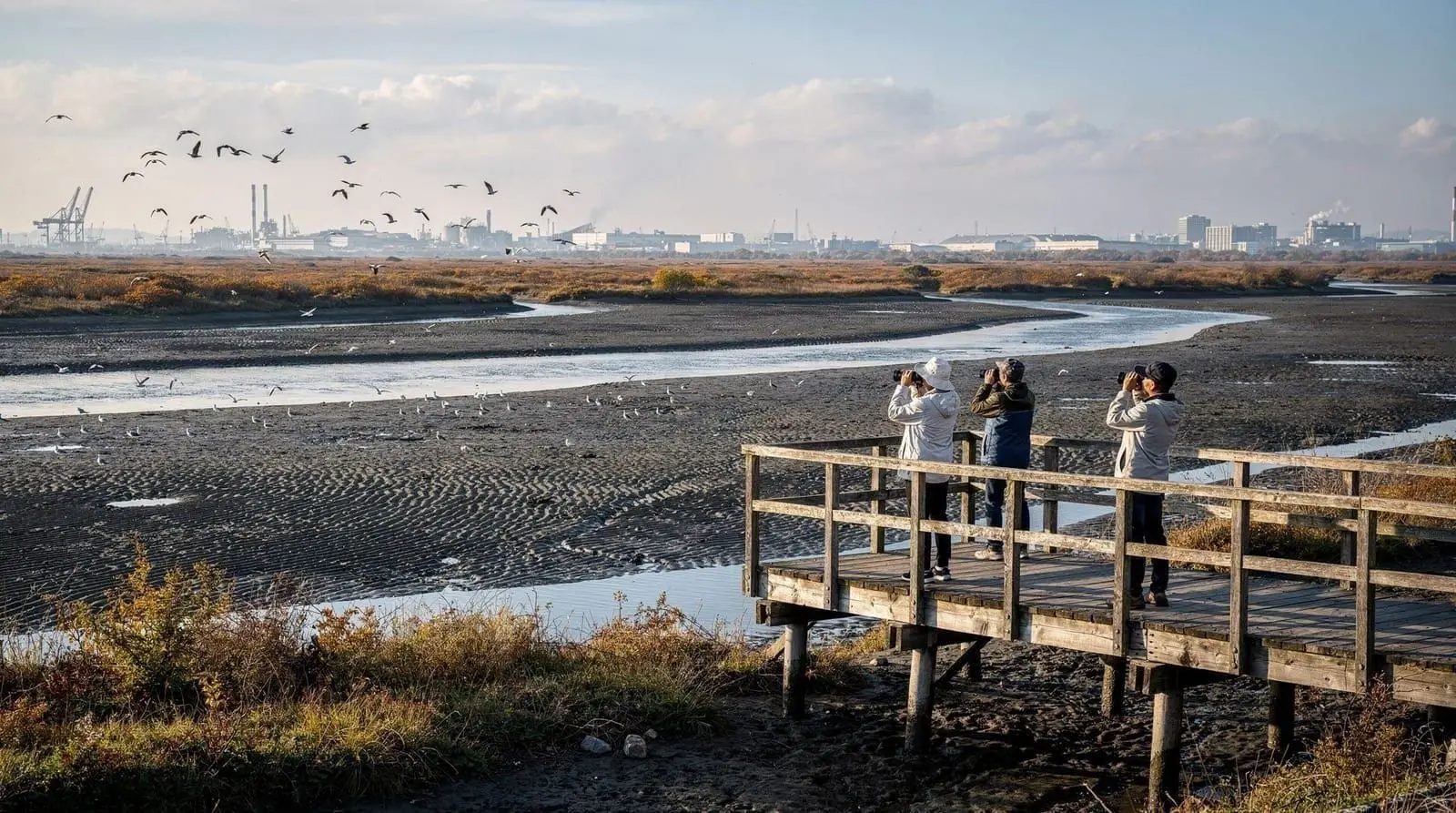
Sorae Ecology Park: birdwatching and nature trails in Incheon
What is Sorae Ecology Park best known for?
Sorae Ecology Park is a restored salt marsh and coastal wetland in southwestern Incheon, best known for birdwatching — particularly migratory shorebirds in spring and autumn — and its peaceful wooden boardwalks through reed beds. It is one of the few remaining tidal wetland areas accessible by metro in the Seoul metropolitan area.
| Where | Sorae Wetland metro station, southwestern Incheon |
| Cost | Free entry |
| Time needed | 1.5–2 hours (2.5–3 with the fish market) |
| Getting there | Incheon Metro Line 2 to Sorae Wetland Station, Exit 1 |
| Best time | Late April–May or September–October for migration |
A wetland that survived Incheon’s development wave
Incheon has spent decades reclaiming land from the Yellow Sea — Songdo International Business District is built entirely on reclaimed tidal flats, and large coastal areas that were once rich saltmarsh and mudflat habitat have been converted to industrial or urban uses. Sorae Ecology Park (소래생태공원) survives as a remnant of what much of this coastline looked like before large-scale development.
The park covers approximately 157 hectares of salt marsh, reed beds, and restored wetland along the Sorae inlet, adjacent to the historically significant Sorae Salt Pond area. A former narrow-gauge salt railway used to run through this landscape; its route is now part of the park’s path network. The salt ponds themselves are no longer commercially active but remain as shallow-water habitat that attracts large numbers of wading birds and waterfowl.
This is not a theme park. There is no entrance fee, no gift shop, and no queue. It is a working ecological site with public access paths, birdwatching hides, and interpretation signage. It rewards visitors who move slowly and who are interested in what is actually there rather than what they came to photograph.
What to see
Migratory shorebirds
The Yellow Sea coast is a globally significant flyway for migratory birds, and Sorae’s tidal wetlands provide a refuelling stop for shorebirds moving between Australian wintering grounds and Siberian breeding areas. The key spring migration window is April to early June, when species including black-tailed godwit, spotted redshank, grey plover, and multiple sandpiper species pass through. Autumn migration (August to October) brings a second, often larger pulse of movement.
Year-round residents include common kingfisher, little egret, great egret, grey heron, black-crowned night heron, and various duck species in winter. The reed beds hold reed buntings and, in summer, reed warblers.
For non-birders, the egrets and herons are reliably photogenic — they are large, white, and slow enough to photograph without telephoto equipment.
The boardwalk through the reed beds
The park’s signature feature is a 1.5 km wooden boardwalk that threads through dense reed beds (Phragmites australis) on elevated decking, keeping your feet dry while giving you eye-level access to the marsh. The reeds reach 2–3 metres in height by summer, creating an enclosed corridor that feels surprisingly remote given that you are technically inside a metropolitan area with 15 million people.
Walk slowly on the boardwalk. The creak of boards and the occasional splash give away what is hiding in the reeds more reliably than looking.
Sorae Salt Pond (소래염전)
The historic salt pond area adjacent to the ecology park gives context to the landscape. Salt has been produced on this coast since the early 20th century; the Sorae ponds were among the most productive in the region before industrial production methods displaced traditional tidal evaporation. Some of the old dikes and partition walls between evaporation pans are still visible and now serve as the elevated paths between sections of the park.
An interpretive centre near the Sorae Bridge provides information about salt production history and the ecological restoration programme that converted parts of the commercial salt pond to wildlife habitat.
The Sorae traditional market
The Sorae Fish Market (소래포구 어시장) is located immediately adjacent to the park at the harbour. It is a genuine working fish market with fresh catch from Yellow Sea trawlers — not a food hall created for tourists, but a busy early-morning wholesale and retail market that is also accessible to the public throughout the day. If you arrive in the morning, the market is lively and aromatic. Grilled clams, raw fish (sashimi), and various dried seafood make it a good lunch stop after the ecology park walk.
Getting to Sorae Ecology Park
By metro: The easiest access is via Sorae Wetland metro station (소래습지역) on Incheon metro line 2. The park entrance is a 5-minute walk from exit 1. Line 2 connects to Incheon City Hall and the main Incheon metro network; connections from Seoul typically involve a transfer at Bupyeong station from line 1 to line 2.
Journey time from Seoul Station: Approximately 60–70 minutes by metro, including the transfer.
Journey time from Incheon Station: Approximately 40 minutes by metro.
From Incheon Airport: Approximately 60 minutes by bus and metro, or 30–40 minutes by taxi (₩25,000–35,000, around $20–28). The park does not warrant a taxi from the airport unless combining with other nearby destinations.
By bus: Incheon city bus routes 66 and 790 stop near the park. Check current schedules as routes may vary.
If you land at Incheon Airport and want to reach the park without juggling the metro with luggage, a private transfer from the airport is a straightforward way to start, though most visitors will find public transport perfectly adequate. For a wider view of buses, metro lines and cards, see our guide to getting around Incheon, and if you only have a short stopover, the airport layover itinerary will help you judge whether a wetland visit fits your time.
When to visit
Spring (April–May): The best season for birdwatching, with peak shorebird migration in late April to mid-May. The reed beds begin green growth after winter dormancy, and water levels in the ponds are often at the right depth to attract waders close to the observation hides.
Autumn (September–October): The second migration window brings many of the same species back south. Autumn provides different light and the reed beds turn golden, which makes for better photography than green summer reeds.
Winter (December–February): Cold but worthwhile for waterfowl — large numbers of ducks and geese winter on the ponds. The bare reed beds make birds easier to see but the walk is cold. Dress in layers.
Summer (June–August): The park is genuinely beautiful in its own humid, lush way — the reeds are fully grown, amphibians are active, dragonflies are everywhere. But shorebird diversity is low and the boardwalk can feel airless on still days. Bring insect repellent.
Practical information
Opening hours: The park is accessible daily. The main interpretive centre keeps regular hours (approximately 9am–6pm in summer, closing earlier in winter). Individual sections of the park are always accessible.
Admission: Free.
Binoculars: Highly recommended. Even basic compact binoculars (8x30 or 10x25) transform the birdwatching experience dramatically. Several of the observation hides have scope mounts for digiscoping.
Walking shoes: The boardwalk is solid, but the approach paths in some sections can be muddy after rain. Waterproof walking shoes or wellies are advisable in wet season.
Photography: The park is excellent for bird photography if you have a telephoto lens (200mm minimum, 400mm or more for shorebirds). The observation hides allow close approaches without disturbing birds. No flash photography within the hides.
Duration: A thorough walk of the main boardwalk and salt pond area takes 1.5–2 hours. A longer loop including the fish market adds another hour.
Incheon: Coastal Rail Bike, Sorae Park and Fairytale VillageCombining with other Incheon nature destinations
Sorae Ecology Park works well as part of a broader Incheon nature day:
With the Ara Waterway: The Gyeong-in Ara Waterway bike route is approximately 5 km north of Sorae by bus or taxi. A morning bike ride followed by an afternoon at Sorae gives you two contrasting nature experiences — active cycling on a canal and slow walking in a wetland.
With Incheon Grand Park: The Incheon Grand Park requires a metro transfer but is reachable within 40–50 minutes. Best combined with cherry blossom season in early April when both destinations are at their most rewarding.
With Muuido Island: Muuido Island offers coastal mudflats and beach — a different scale of coastal experience, requiring the ferry from Eurwangni Beach on Yeongjongdo. This combination requires an early start but is achievable in a long summer day.
On a budget: Because entry is free and the metro reaches the gate, this is one of the cheapest full mornings you can spend in the region; our Incheon on a budget guide shows how to pair it with other low-cost stops. If you prefer to see more of the coast by bike, the Yeongjongdo seaside rail bike offers a livelier alternative, and a visit to the Sinpo International Market makes a good indoor option if rain closes in. Those with a single day can also fold the park into the Incheon in one day itinerary, and the best time to visit Incheon page helps you line up the weather with migration season.
A basic guide to what you’ll actually see, month by month
Birdwatching rewards visitors who know roughly what to expect at different times of year rather than showing up hoping for the best. Here’s a realistic month-by-month value table:
| Period | What’s present | Worth the trip? |
|---|---|---|
| Late Apr–May | Peak spring shorebird migration (godwit, redshank, plover) | Yes — best window of the year |
| Jun–Aug | Reed warblers, dragonflies, low shorebird diversity | Only for the wetland scenery, not birds |
| Sep–Oct | Second migration pulse, golden reed beds | Yes — best photography light |
| Nov–Feb | Wintering ducks and geese | Yes for waterfowl, but cold |
A practical note on gear: if you don’t own binoculars, the visit is still worthwhile for the egrets and herons, which are large and slow enough to see with the naked eye — but the shorebirds that make spring and autumn special are genuinely hard to appreciate without at least basic 8x magnification.
Etiquette in the observation hides
The hides are shared, quiet spaces, and a few unwritten rules keep them functional for everyone:
Keep voices low and movements slow — sudden noise or motion is what actually scares birds away, more than your presence itself. Do not use flash photography, which is both ineffective at range and disruptive to birds and other visitors. If a hide is occupied by dedicated photographers with tripods set up, ask before squeezing in rather than crowding an existing setup. Pack out anything you bring in; there are no bins inside the hides themselves.
What the park is not
Sorae Ecology Park is not a manicured botanical garden or an entertainment-focused nature venue. The path surfaces vary, some sections have minor flood damage in wet years, and interpretation signage is predominantly in Korean. The ecology park is managed for ecological function as much as visitor experience.
This is a strength for the right visitor — the absence of commercial overlay is what makes it feel genuine. But if you need a curated visitor experience, you may find it underwhelming. Come as an observer rather than a consumer.
Frequently asked questions about Sorae Ecology Park
Do I need to book in advance?
No. The park is free and open access. No reservation is required.
Are there guided tours?
The park’s interpretive centre occasionally runs Korean-language guided walks, particularly during peak migration windows. English-language guided tours are not regularly scheduled but may be available through Incheon city tourism programmes — check with the 1330 Korea Tourism Helpline for current options.
Can I go birdwatching here without experience?
Yes. Even without birdwatching experience, the large wading birds (egrets, herons) are easy to spot and photograph. The observation hides are set up so that quiet presence is enough — you do not need specialist knowledge to enjoy the experience. A bird identification app for Korean species helps if you want to name what you’re seeing.
Is Sorae Ecology Park suitable for families with children?
Yes, with caveats. The boardwalk is engaging for children who can walk without running on wooden slats above water, and the birds are naturally interesting. The mudflats and reed beds add sensory interest. However, there are no play facilities, and the park is not designed for young children who need constant stimulation. Ages 6 and above typically find it interesting.
Is the fish market at Sorae worth visiting?
Very much so, particularly in the morning. The Sorae Fish Market (소래포구 어시장) is a genuine local market. Prices are cheaper than tourist-facing fish restaurants in the city, and the range of fresh seafood is excellent. Look for clam grills (조개구이), steamed king crab, and various raw fish options. Most vendors can communicate basic pricing in gestures and numbers even without Korean.
How does Sorae compare to other nature spots near Incheon?
Sorae is unique in the area for its wetland and migratory bird focus. The Incheon Grand Park is larger and better suited for a family day out with facilities. The Ara Waterway is better for active cycling. Sorae is the best option specifically for birdwatching and quiet nature immersion.
What is the closest accommodation to Sorae Ecology Park?
Most visitors base themselves in central Incheon or in Songdo and make Sorae a day trip. Budget accommodation options near Sorae Wetland metro station are limited; staying near Bupyeong or Incheon Station gives better access to the full city and is approximately 30–40 minutes from the park. See the where to stay guide for recommendations.
Do I need my own binoculars, or can I rent them at the park?
There is no rental service at the park itself, so bring your own if birdwatching is a priority. Even a basic compact pair (8x30 or similar) makes a substantial difference. Without binoculars, you can still enjoy the boardwalk and the larger, closer birds like egrets and herons.
Is Sorae Ecology Park included in typical Incheon guided tours?
Rarely as a standalone stop — most commercial Incheon tours focus on Chinatown, Wolmido, or Songdo. Sorae tends to attract independent travelers and dedicated birdwatchers who plan their own visit around migration timing. If you want a guided nature experience, check with the park’s interpretive centre for occasional Korean-language walks during peak migration windows.
Incheon islands on GetYourGuide
Top-rated tours and activities


