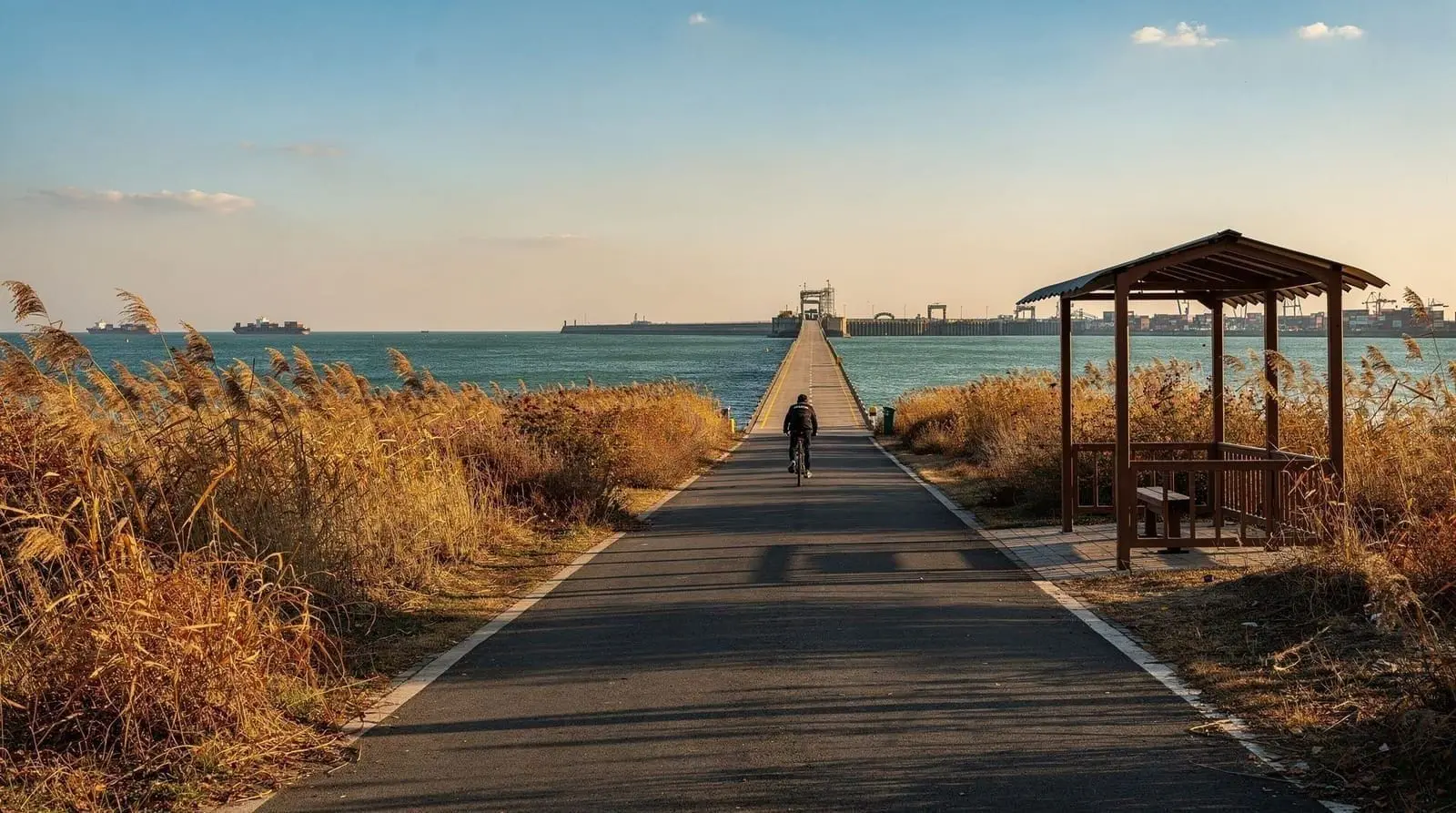
Gyeong-in Ara Waterway bike tour: the 18 km canal route
How long does the Ara Waterway bike tour take?
The one-way route from Incheon's Ara West Lock to the Gimpo end covers 18 km and takes 1.5 to 2 hours by bike at a relaxed pace, not counting stops. Most visitors do a partial loop of 8–12 km and return, which takes 2–3 hours total including the Ara Maru Observatory stop.
The Ara Waterway is the flattest, easiest long-distance ride in the Incheon area — a paved canal path with almost no traffic, a dramatic skywalk at one end, and the option to keep going all the way into Seoul. It suits casual cyclists as well as committed ones, and a half-day loop needs no advance planning beyond checking rental hours.
| Where | Ara West Lock, Incheon (near Gyeyang station) |
| Cost | Free path + around ₩6,000–9,000 bike rental for 2–3 hrs |
| Time needed | 2–3 hours for a partial loop, 4–5 hours for the full 18 km |
| Getting there | Metro line 1 to Gyeyang, then bus/taxi to West Lock |
| Best time | Spring or autumn; avoid midday in summer |
What is the Gyeong-in Ara Waterway
The Gyeong-in Ara Waterway is a 18 km artificial canal that runs east–west between Incheon’s west coast and the Han River in Gimpo. Completed in 2012, it is both a functional shipping channel and a recreation corridor: a wide flat cycling path runs the entire length of both banks, linked by bridges and interrupted by rest pavilions, parks, and two observation platforms.
For cyclists in the Greater Seoul area, the Ara Waterway is where you go for a flat, long, uncrowded route with water on one side and views of reclaimed-land Incheon on the other. For visitors, it is a different kind of Incheon experience — industrial infrastructure repurposed as leisure space, with the Ara Maru Observatory skywalk at the western end offering the most vertigo-inducing canal views in the metropolitan area.
The route connects with Seoul’s Hangang Park cycling path at its eastern end, meaning dedicated cyclists can complete a single corridor from the Yellow Sea coast to the centre of Seoul entirely by bike. Most day visitors do a shorter section and return — the canal and its amenities are the point, not just the distance.
Incheon: Coastal Rail Bike, Sorae Park and Fairytale VillageThe Ara Maru Observatory
The Ara Maru Observatory (아라마루 전망대) sits at the western terminus of the waterway, near the Ara West Lock (아라서해갑문) where the canal meets the sea. The skywalk extends 45 metres above the lock, offering unobstructed views west over the Yellow Sea, east along the canal corridor, and down at the lock mechanism itself — the largest manually operated ship lift in Korea.
Admission is free. The observatory opens daily from 9am to 6pm (last entry 5:30pm); it closes on Mondays. The walk up takes about 10 minutes from the base, and the skywalk itself is a glass-bottomed cantilevered platform — notable enough that most visitors pause here for 20–30 minutes.
Getting to Ara Maru: The nearest metro station is Gyeyang station (line 1, Incheon metro). From there, local bus 784 or taxi (approximately ₩6,000–8,000, around $5–6) reaches the West Lock area in 10–15 minutes. If you’re cycling the whole route, you reach it after approximately 1 km from the Incheon west entrance.
Starting points and bike rental
Incheon western entrance (recommended start for visitors)
Starting at the Ara West Lock gives you the observatory as a first stop, then a long flat east-facing ride along the canal. Bike rental stalls operate near the lock area during warmer months (April–October). Rental is typically ₩3,000–5,000/hour for a standard bike, or ₩8,000–12,000 for a half-day. Tandems and children’s bikes are also available at some stations.
Gimpo eastern entrance
If arriving from Seoul direction by metro (Gimpo Airport station, line 5 or Airport Line), you can enter from the eastern Hangang-side entrance and ride west. This works well if you want to end at the sea rather than return inland.
What kind of bike
The path is paved and flat throughout, making almost any bike suitable. If you have a foldable bike, it is allowed on metro line 1 during off-peak hours (folded and in a bag), so you can ride one-way and metro back. A standard rental bike handles the route perfectly.
The route in sections
Section 1: West Lock to Gyeyang Bridge (4 km)
This is the most scenic and most visited section. After the observatory, the path runs east along the southern bank, with the canal on your left and a mix of riverside park and light industrial uses on your right. There are benches, rest areas, and a small cafe pavilion about 2 km from the start. The path is wide enough for cyclists and pedestrians without conflict.
Section 2: Gyeyang Bridge to Gimpo Ara Bridge (7 km)
The path continues east, becoming slightly less landscaped and more functional-feeling. However, the scale of the canal itself — 100 metres wide — keeps the views interesting. Several small parks and rest stations break the route. You cross under a succession of road bridges, each framing a different long view east or west.
Section 3: Gimpo Ara Bridge to Hangang confluence (7 km)
The eastern section transitions from the Ara canal to the approach to the Han River. This section is used primarily by committed cyclists continuing to Seoul’s Hangang Park network rather than visitors on a day trip. The path quality remains consistent.
Best season for the bike tour
Spring (April–May): The surrounding parks and riverside areas bloom with cherry blossoms and azaleas, particularly around the western lock area and Gyeyang area parks. Late April azalea festivals are sometimes held near the waterway. This is the most visually rewarding cycling season.
Autumn (September–October): Cool, clear weather and autumn foliage along the treeline sections make this the most comfortable cycling season. Wind from the Yellow Sea is less intense than in winter.
Summer (June–August): The route is flat and exposed; summer heat (up to 28°C with high humidity) makes the midday ride uncomfortable. Start before 8am in July–August or go in the late afternoon.
Winter (November–March): The path remains open but cold coastal winds make cycling challenging. The observatory closes slightly earlier. Rental availability decreases significantly.
| Season | Conditions | Rental availability |
|---|---|---|
| Spring (Apr–May) | Cherry blossoms and azaleas, mild temperatures | Full, sometimes busy on weekends |
| Summer (Jun–Aug) | Hot and humid, up to 28°C, little shade | Full, ride early morning |
| Autumn (Sep–Oct) | Cool, clear, comfortable for long rides | Full, best overall conditions |
| Winter (Nov–Mar) | Cold coastal wind, observatory hours reduced | Limited, some stalls close |
If you don’t want to cycle the full route
Not everyone wants an 18 km round trip. Two easier alternatives cover similar ground without the distance: the Yeongjongdo seaside rail bike is a shorter, guided pedal-cart ride near the airport island, and a walk around Songdo Central Park offers flat waterside scenery with none of the cycling commitment. Either works well as a lower-effort substitute if the canal’s length feels like too much for your day.
Pairing the ride with other island and coast outings
If the canal leaves you wanting more water and open sky, the Yeongjongdo area is the natural next step, and the Incheon island-hopping itinerary shows how to string several coastal stops together over a longer stay. Visitors who prefer an easier pace can also look at the Wolmi sea train as a relaxed way to see the waterfront without any pedalling.
Photography and rest stops
The Ara Maru Observatory skywalk is the single best photo spot on the route, particularly in the hour before sunset when the Yellow Sea catches the light. Along Section 1, the small cafe pavilion around the 2 km mark makes a natural break point with canal views in both directions; it is also the last obviously comfortable rest stop before the route becomes more industrial-feeling further east.
If you are combining the ride with a wider Incheon day, see the one-day Incheon itinerary for how a morning on the waterway can fit around Chinatown or Songdo in the afternoon, and check getting around Incheon for how the metro and bus network connects the West Lock area to the rest of the city.
Practical information
Food and water: Carry water, especially in summer and spring. The canal path has convenience store stops approximately every 4–5 km, but they are not always obvious. Rest pavilions with vending machines appear at intervals. For a proper meal, the area around Gyeyang station has several Korean restaurants within a 5-minute walk.
Restrooms: Located at the West Lock, the main rest pavilions at km 4 and km 8, and at the Gimpo entrance. More than adequate for a day trip.
Safety: The path has clearly separated pedestrian and cycling lanes in most sections. Keep to the cycling side and use your bell when passing. Helmet use is recommended but not legally required for adults; helmets are usually available alongside rental bikes.
Combined visit with Sorae Ecology Park: The Sorae Ecology Park is located roughly 5 km south of the West Lock, accessible by bus or taxi. Combining the two in a morning–afternoon pairing gives you both active cycling and quieter birdwatching in a single Incheon nature day.
Combined visit with Incheon Grand Park: The Incheon Grand Park is one metro stop east of Gyeyang (Incheon Grand Park station). A half-day Ara Waterway ride followed by an afternoon in the park — especially during cherry blossom season — is a strong combination.
What the Ara Waterway is not
It is worth managing expectations: this is a canal cycling route, not a mountain trail or a scenic wilderness path. The western section is genuinely attractive — water views, well-maintained paths, the skywalk. But the eastern sections become progressively more urban and industrial in character. If you come expecting dramatic landscape, adjust your frame of reference toward “productive urban infrastructure that happens to have a good bike path attached.” That recalibration usually results in an enjoyable day.
The path also lacks shade in most sections, which matters significantly in summer. Trees have been planted along parts of the route but have not yet reached full maturity.
Incheon: Luge & Railbike & Purple Azalea FestivalTiming the ride matters more than most visitors expect. Check the best time to visit Incheon before you commit to a date, since season changes both comfort on the path and how much rental choice you will have. If your plans are tight on money, the Incheon on a budget guide shows how a free path and a simple rental fit into a low-cost trip, and the Incheon and Seoul 2–3 day itinerary places a canal morning alongside the bigger sights.
Budget for the Ara Waterway bike tour
- Metro to/from Gyeyang or West Lock area: ₩1,400–3,000 (~$1.10–2.50) each way
- Bike rental (2–3 hours): ₩6,000–9,000 (~$5–7)
- Ara Maru Observatory: free
- Food and drinks: ₩8,000–15,000 (~$6–12)
- Total typical visit: ₩20,000–35,000 (~$16–28)
The Ara Waterway is one of the more affordable half-days available anywhere in the Seoul metropolitan area.
Getting there
From Seoul: Take metro line 5 or Airport Subway Line to Gimpo Airport station for the east entrance, or metro line 1 (Incheon direction) to Gyeyang station for a central access point, then local bus or taxi to the West Lock.
From Incheon Station/Chinatown: Take metro line 1 east 3 stops to Gyeyang station. Local bus or taxi to the West Lock is approximately 10–15 minutes. Total from Incheon Station: 30–40 minutes.
From Incheon Airport: Take AREX or bus toward Incheon; the West Lock area is accessible from the airport by local bus, approximately 30–40 minutes. Alternatively, taxi from the airport is approximately ₩15,000–20,000 ($12–16).
Frequently asked questions about the Ara Waterway bike tour
Do I need to bring my own bike?
No. Rental bikes are available at the West Lock and at several points along the route during spring through autumn. If you have a foldable bike you can bring it on the metro (off-peak, folded and covered).
Is the route suitable for children?
Yes, the path is flat, paved, and wide throughout. It is one of the more family-friendly cycling routes in the Incheon area. Children’s bikes and tandems are available at rental stations near the West Lock.
Can I walk the route instead of cycling?
You can walk the path, and many visitors do for the western section near the observatory. Walking the full 18 km one-way would take approximately 4–5 hours, which is more than most visitors allocate. A 3–4 km walk around the West Lock and observatory is very manageable.
Is there a fee to access the waterway path?
No. The cycling and walking path is free to use. The Ara Maru Observatory is also free.
What is the best way to return if I ride one-way?
If you ride from west (Incheon) to east (Gimpo), Gimpo Airport metro station is near the eastern endpoint and connects to Seoul’s airport line and line 5. If you ride partway and return, simply retrace the route — it is perfectly flat in both directions.
Are there lockers or storage near the West Lock?
Small luggage storage options exist at Gyeyang metro station. Near the West Lock itself, storage is limited — travel light for this day trip, or leave bags at your accommodation.
What happens to the path in typhoon season?
The path remains technically accessible during the monsoon season (mid-July to mid-August) but can be slippery and is often waterlogged after heavy rain. Rental operations may be suspended during severe weather. The route is best avoided during active rainfall.
Incheon islands on GetYourGuide
Top-rated tours and activities


