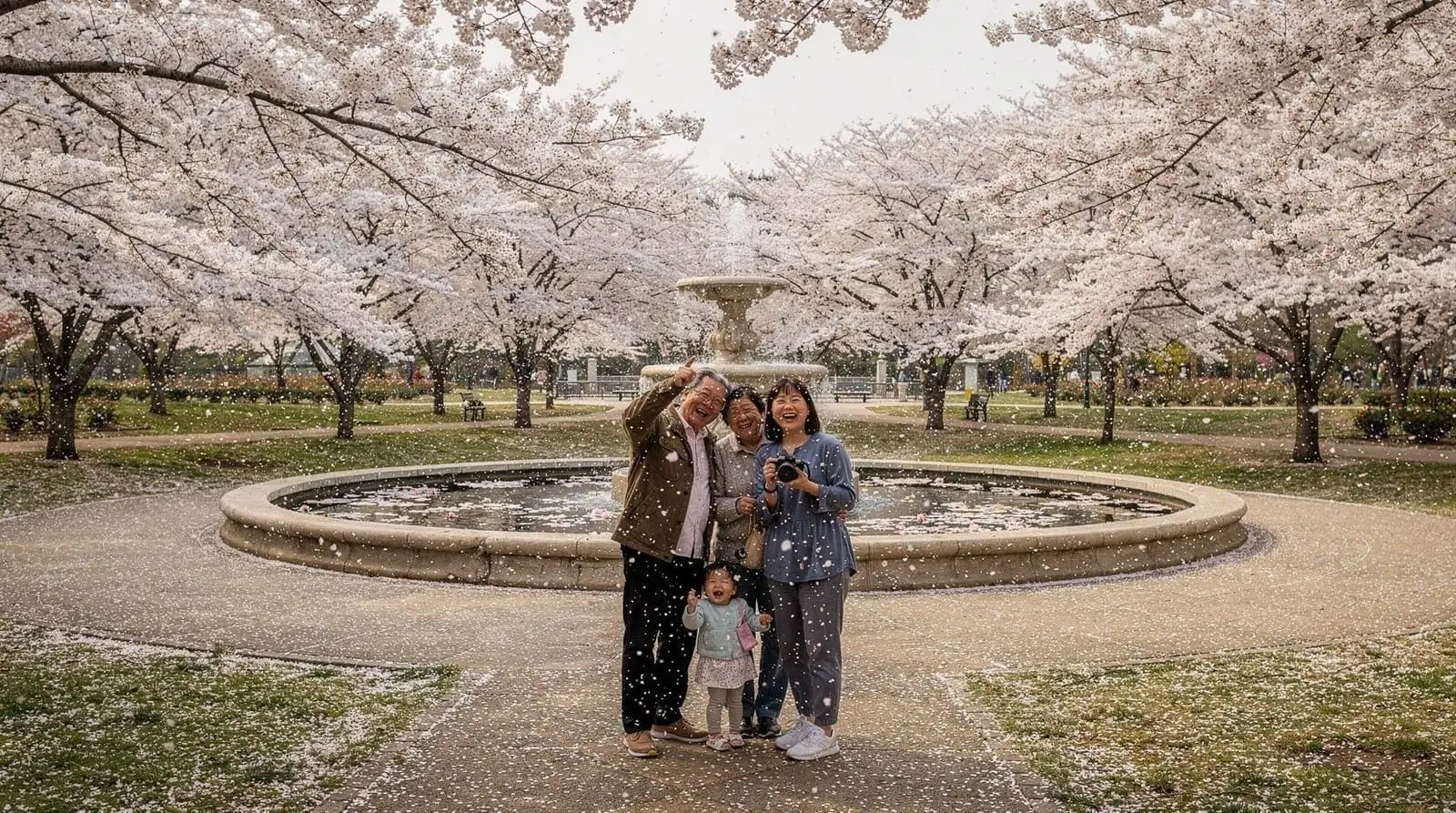
Incheon Grand Park cherry blossoms: the best spots and timing
When do cherry blossoms peak at Incheon Grand Park?
Cherry blossoms typically peak in the first week of April, usually between April 3 and April 10. The park's 2,000-plus cherry trees line the main promenade and surround the central lake, making early April the most visited window of the year.
Why Incheon Grand Park deserves more attention in cherry blossom season
Seoul gets most of the spring credit — Yeouido, Gyeongbok Palace, Namsan — but Incheon Grand Park offers something those places rarely can: space. The 727-acre park opened in 1986 and has grown into a genuine urban forest, with botanical gardens, a zoo, a lake, multiple hiking trails, and yes, more than 2,000 cherry trees that turn the main promenade into a pale pink corridor every April.
The park draws a largely local crowd. On peak weekday mornings you can walk the full blossom path without the shoulder-to-shoulder density that makes Yeouido feel less like a nature experience and more like a crowd event. If you are visiting Korea in early April and want cherry blossoms without the chaos, Incheon Grand Park is the answer — and it pairs naturally with other destinations in the area, including the Gyeong-in Ara Waterway bike route and the Sorae Ecology Park nature trail.
| Where | Incheon Grand Park, eastern Incheon, metro line 1 |
| Cost | Free to enter; zoo around ₩3,000; typical day ₩25,000–35,000 |
| Time needed | 2 hours minimum, half a day comfortable |
| Getting there | Metro line 1 to Incheon Grand Park station, exit 1, 5-min walk |
| Best time | Weekday mornings before 10am, first week of April |
Understanding the blossom calendar
Cherry trees (specifically Yoshino cherry, Prunus × yedoensis) are responsive to temperature rather than the calendar. In Incheon, which sits on the coast and experiences slightly more maritime influence than inner Seoul, blossoms typically open 1–3 days later than central Seoul.
Rough timeline:
- Late March: buds swell, leaf tips just beginning to show colour in warm years
- April 1–3: blossoms open in earnest; 20–30% coverage on leading trees
- April 3–10: peak bloom; most trees at 70–100% coverage; the main promenade turns pink
- April 10–17: petals begin to fall; “flower snow” effect at its most photogenic, though coverage drops rapidly
- After April 15: green leaves replace blossoms; regular park season resumes
The Korea Meteorological Administration publishes cherry blossom forecasts starting in late February. Check their site or the Visit Korea official tourism portal close to your travel date — peak varies by two to three weeks across years.
| Period | Bloom stage | What to expect |
|---|---|---|
| Late March | Buds swelling | Green-pink tips, quiet park, no crowds |
| April 1–3 | Opening | 20–30% coverage on leading trees, first photographers arrive |
| April 3–10 | Peak bloom | 70–100% coverage, busiest window, weekends crowded by 11am |
| April 10–17 | Petal fall | ”Flower snow” effect, thinning canopy, still very photogenic |
| After April 15 | Green leaf | Blossoms gone, park reverts to normal spring scenery |
How Incheon compares to Seoul’s better-known blossom spots
Visitors choosing between Yeouido, Namsan, and Incheon Grand Park are usually weighing crowd size against convenience. Yeouido’s Yunjungno road is arguably more famous and hosts the annual cherry blossom festival, but the crowds on peak weekends are dense enough that photography and simply walking become difficult. Namsan’s blossoms are scattered rather than concentrated, making for a pleasant walk but not the dense floral tunnel that draws people to a dedicated blossom trip.
Incheon Grand Park trades a small amount of big-city buzz for a longer, denser promenade with roughly a third of the foot traffic on an equivalent weekday. If your priority is photographs without strangers in every frame, or a slower walk rather than a festival atmosphere, Incheon Grand Park is the better choice; if you want the festival energy and food stalls of a major event, Yeouido wins.
If you would rather see how the whole city celebrates the season, the Incheon cherry blossom festival write-up covers the wider picture, and the spring itinerary shows how to string several blossom stops together. The park’s own page under Incheon Grand Park gives the year-round overview.
The main blossom areas inside the park
The main entrance promenade
The stretch from the main south gate (Gongwon-daero entrance, near Incheon Grand Park metro station exit 1) toward the central lake is the most heavily planted section. Both sides of the paved path are lined with mature cherry trees whose canopies arch overhead, creating a tunnel effect on calm days and a snowstorm of petals on breezy ones. This is where most photos are taken and where most visitors spend their time.
Walk this route in the morning (before 10am) if you want empty frames. The park opens at sunrise and sees its first real crowds arrive around 10:30am on weekdays, and from 9am on weekends in peak season.
The lakeside circuit
The reservoir at the park’s centre is surrounded by a 3.5km walking loop. Cherry trees are interspersed with pines and maples along this route, so the visual contrast is different — you see blossom reflected in the water rather than forming a dense canopy overhead. This loop is less crowded than the promenade and is better suited to visitors who want a longer walk at a slower pace.
The north side of the lake, away from the main visitor facilities, tends to have more mature trees and fewer people. Allow 1–1.5 hours for the full circuit at a relaxed pace.
The rose garden and arboretum paths
The botanical garden section in the park’s northeast quadrant includes an arboretum with flowering trees beyond just cherries: Korean plum, magnolia, forsythia, and weeping cherry (Prunus pendula) that bloom slightly earlier than the standard Yoshino variety. The weeping cherries near the arboretum entrance sometimes peak 4–5 days before the main promenade trees, making this a useful destination if you arrive slightly early in the season.
Entry to the rose garden section is free during cherry blossom season; some facilities inside may charge a small admission (₩1,000–2,000, roughly under $2).
The zoo perimeter
The park’s zoo (admission separate: around ₩3,000 for adults, roughly $2.50) is flanked by mature cherry trees along its outer fence. You do not need to enter the zoo to walk this section, and the trees here tend to be older and taller than elsewhere in the park, producing a more canopy-like effect.
Getting to Incheon Grand Park
By metro: Take metro line 1 (dark blue) from Seoul Station toward Incheon. Exit at Incheon Grand Park station (인천대공원역). The main south gate is a 5-minute walk from exit 1. From Seoul Station, the journey takes approximately 55 minutes; from Incheon Station, about 20 minutes.
T-money card is the easiest way to pay — the same card used across Seoul’s metro, Incheon’s buses, and the AREX Airport Express. Load it at any subway station or convenience store.
If you are flying in and want to fit blossoms around a long stopover, the airport layover itinerary and the 6-hour layover plan help you judge how much time you really have. For fares, passes and local buses in general, see getting around Incheon.
By bus: Several local Incheon bus routes stop at the park entrance, but the metro is faster and simpler for most visitors.
Parking: Large lots are available if arriving by car. During cherry blossom peak weekends, the parking areas fill by 9am. Public transport is strongly recommended.
What else to do in the park
The park’s scale means you can fill a full day here even without cherry blossoms as your sole motivation:
Zoo: Incheon Grand Park Zoo covers a wide range of species and has been expanded in recent years. It is well maintained by Korean public park standards and worth 1–2 hours for families or animal enthusiasts. Admission is modest (around ₩3,000 for adults).
Rose garden: Peak rose season is late May through early June — a return visit after cherry blossom season reveals a completely different spectacle.
Cycling: Bikes are available for hire near the main entrance. The park’s internal paths are mostly flat and wide, making them accessible to casual cyclists. Rentals run approximately ₩3,000–5,000/hour (around $2.50–4).
Hiking trails: The park backs onto forested hills to the north. Two marked hiking trails climb through pine forest and connect to adjacent mountain paths; the shorter loop takes about 90 minutes.
Picnicking: This is probably the main activity for the majority of Korean visitors during cherry blossom season. The central lawn areas are used for picnics from mid-morning on. Bring a mat or rent one from the facilities near the main gate.
Practical tips for the blossom visit
Arrive early on weekends: Peak weekends in early April see large crowds by 11am. Arriving at 8–9am gives you two quiet hours before the families and groups fill the promenade.
Weekdays are significantly calmer: If your schedule allows any flexibility, a Monday to Thursday visit during blossom week will feel like a different park from the same location on a Saturday.
Photography timing: Overcast mornings produce the best light for cherry blossom photography — soft shadows, saturated pinks, no harsh sunlight washing out the colours. Bright sunny afternoons can look washed out in photos. The “golden hour” just after sunrise is excellent if you can manage it.
Food and drinks: A convenience store and several food stalls operate near the main gate during spring season. There is a cafe by the lakeside. For a full meal, the area around Incheon Grand Park metro station has several Korean restaurants within a short walk.
Petal snow: If you visit during the falling phase (typically April 10–17), stand under a large tree in a light breeze and let the petals fall around you. This is the most cinematically beautiful moment of the Korean spring and is frequently more photogenic than the peak bloom itself.
Incheon: One Day Guided City Tour with Hotel PickupFor composition ideas beyond the promenade, the Instagram photo spots in Incheon list is a good companion, and travelling with children is covered in Incheon with kids, which pairs well with the zoo and open lawns here.
Combining Incheon Grand Park with other destinations
Incheon Grand Park sits in the eastern part of Incheon, roughly 20 minutes by metro from Incheon Station and about 45 minutes from Incheon International Airport. Its position makes it a natural addition to several itinerary combinations:
With the Ara Waterway: The Gyeong-in Ara Waterway bike tour starts near Ara Maru Observatory, which is accessible from Gyeyang metro station — one stop from Incheon Grand Park station on line 1. You can combine a morning blossom walk with an afternoon bike ride.
With Sorae Ecology Park: The Sorae Ecology Park is a quieter nature experience further west along the coast. Its marshland birdwatching season overlaps with cherry blossom season, making a same-day combination viable by taxi or bus.
With Chinatown: If you have a full day, Incheon Grand Park in the morning and Incheon Chinatown in the afternoon covers both green space and cultural history in one loop. Return to Seoul via Incheon Station.
If a blossom day is only one part of a longer plan, Incheon on a budget shows where else the savings come from, and Incheon and Seoul in 2–3 days places this park within a wider trip. Timing the whole visit around the seasons is easier with the best time to visit Incheon guide.
Budget breakdown
- Park entry: free
- Zoo (optional): ₩3,000 (~$2.50)
- Bike hire (optional): ₩3,000–5,000/hour (~$2.50–4)
- Metro from Seoul Station (round trip): ₩9,000–10,000 (~$7–8)
- Food (convenience store lunch + coffee): ₩10,000–15,000 (~$8–12)
- Total typical day: ₩25,000–35,000 (~$20–28)
Frequently asked questions about Incheon Grand Park cherry blossoms
How long should I spend at Incheon Grand Park during cherry blossom season?
Allow a minimum of 2 hours for the promenade and lakeside loop combined. A full morning (3–4 hours) covers the main areas comfortably, including the arboretum and time for a picnic. If you add the zoo and a hiking trail, a full day is reasonable.
Is Incheon Grand Park free to enter?
The park itself is free. The zoo inside the park charges a small admission fee (around ₩3,000 for adults). Some special seasonal facilities may have a nominal fee of ₩1,000–2,000.
How do I get to Incheon Grand Park from Incheon Airport?
Take the AREX (Airport Railroad Express) all-stop train from Incheon Airport Terminal 1 or Terminal 2 toward Seoul. Get off at Gyeyang station and transfer to Incheon Metro Line 1 toward Incheon. Alternatively, take a direct bus from the airport. Check the live journey time in Naver Map or Kakao Map.
Are there food stalls and restaurants inside the park?
Yes. During cherry blossom season, food stalls set up near the main entrance selling tteokbokki, hotteok, corn dogs, and drinks. There is a cafe near the lake. The area outside the main gate also has several Korean restaurants. For a wider choice, the Incheon Grand Park station area has supermarkets and lunch spots.
What should I wear for a cherry blossom visit?
Early April in Incheon averages 10–15°C. Mornings can be cold (below 10°C) while afternoons reach up to 18°C on warm days. Layering is the standard approach — a light jacket you can remove mid-morning. Comfortable walking shoes are essential; the park paths are paved but the lakeside loop has some gravel sections.
Can I bring a picnic?
Yes, and it is actively encouraged. Picnicking is the main activity for most Korean visitors. There are designated picnic lawn areas near the promenade and around the lake. Bring a mat; some visitors bring small foldable chairs and full picnic spreads.
Are dogs allowed in the park?
Dogs are allowed in the park on a lead but are not permitted inside the zoo or most enclosed garden areas. The main promenade and lake circuit are accessible with pets.
What happens if I visit and the blossoms haven’t peaked yet?
If you arrive a few days early, the park is still pleasant — you’ll see the anticipation of spring, and the forsythia and magnolias often bloom just before cherry season. If you’re mid-fall, the trees start dropping petals and the “flower snow” phase begins, which many photographers prefer to full bloom for its dynamic quality.
Is Incheon Grand Park better than Yeouido for cherry blossoms?
It depends on what you want. Yeouido has the bigger festival, more food stalls, and a denser social atmosphere, but also far heavier crowds on peak weekends. Incheon Grand Park has a longer, quieter promenade and a genuine urban forest around it, making it the better choice for photography and a relaxed walk rather than a festival experience.
Can I combine Incheon Grand Park with Songdo or Chinatown in one day?
Yes, though it makes for a full day. Incheon Grand Park in the morning pairs well with Incheon Chinatown in the afternoon; Songdo is a further metro ride and better saved for a separate outing unless you are comfortable with a long day of transit between all three areas.
Incheon islands on GetYourGuide
Top-rated tours and activities


