Incheon on a budget: how to travel for $30–50 per day
How much does it cost to travel Incheon on a budget?
A budget traveller can comfortably manage $30–40 per day in Incheon — around $15–20 for a hostel dorm, $5–8 per street food meal, and $1–3 for metro rides. Mid-range spending runs $50–100 per day with private rooms and restaurant meals.
Why Incheon is one of the better-value cities in Northeast Asia
Korea sits in a useful price bracket for international travellers — cheaper than Japan, more expensive than Southeast Asia, roughly comparable to southern Europe at the budget end of the spectrum. Incheon specifically benefits from being slightly less touristic than Seoul, meaning accommodation and food prices in the city’s residential areas and markets are closer to what locals pay than what international visitors typically encounter in Seoul’s hotel districts.
The Korean Won (KRW) exchange rate in 2026 sits around 1,200–1,300 KRW per USD. Every figure in this guide is given in both KRW and approximate USD to make the arithmetic straightforward.
| Where | Incheon Station, Bupyeong, and Songdo areas |
| Cost | ₩50,000–65,000/day budget ($39–50); ₩100,000+ mid-range |
| Time needed | Ongoing daily budget, not a single visit |
| Getting there | T-money card covers metro, bus, and AREX from day one |
| Best time | Any season; peak weekends (April, October) push prices up |
Accommodation: the biggest cost lever
Hostel dorms: ₩15,000–25,000/night ($12–20)
Hostel dorm accommodation in Incheon is well-priced and reasonable quality. The main concentrations are in the areas near Incheon Station (convenient for Chinatown and Open Port heritage) and near Bupyeong. A 6–8 bed dorm typically costs ₩18,000–22,000/night ($14–17) including free breakfast in many cases. Wi-Fi and luggage storage are standard.
Quality hostels in Incheon tend to be clean and well-maintained by international backpacker standards. Check reviews for the specifics — the better hostels have communal kitchens, small bars, and staff who speak functional English.
Budget guesthouses: ₩30,000–50,000/night ($23–38)
Korean-style guesthouses (called minbak or often marketed simply as “guesthouse” in English) offer private rooms with en-suite or shared bathroom. These are notably more private than dorms but still inexpensive. Many small guesthouses near the Chinatown area have been renovated and offer good value, with Korean breakfast sometimes included.
For Songdo stays, budget options are fewer — the district is primarily modern hotels. Where to stay in Incheon covers the neighbourhood trade-offs in detail.
Mid-range: ₩60,000–120,000/night ($46–92)
This range covers business hotels and well-branded mid-range properties. In Incheon, you can access genuinely comfortable mid-range options — separate rooms, decent breakfast, good service — at prices significantly below equivalent Seoul stays.
Food: eating well for almost nothing
Korean food culture tilts strongly toward affordable eating. Most Korean meals are designed to be filling, complete, and quick — not expensive. Budget eating in Incheon is genuinely enjoyable rather than a compromise.
Convenience stores: ₩2,000–5,000 ($1.50–4)
GS25, CU, and 7-Eleven convenience stores are on virtually every block in Incheon. Triangle kimbap (rice balls with various fillings) cost ₩1,200–1,500. Cup ramen (hot water at the counter) is ₩1,200–1,500. Packed sandwiches and hot snacks run ₩2,000–3,500. For the earliest breakfasts or late-night snacks, convenience stores are the infrastructure of Korean budget eating.
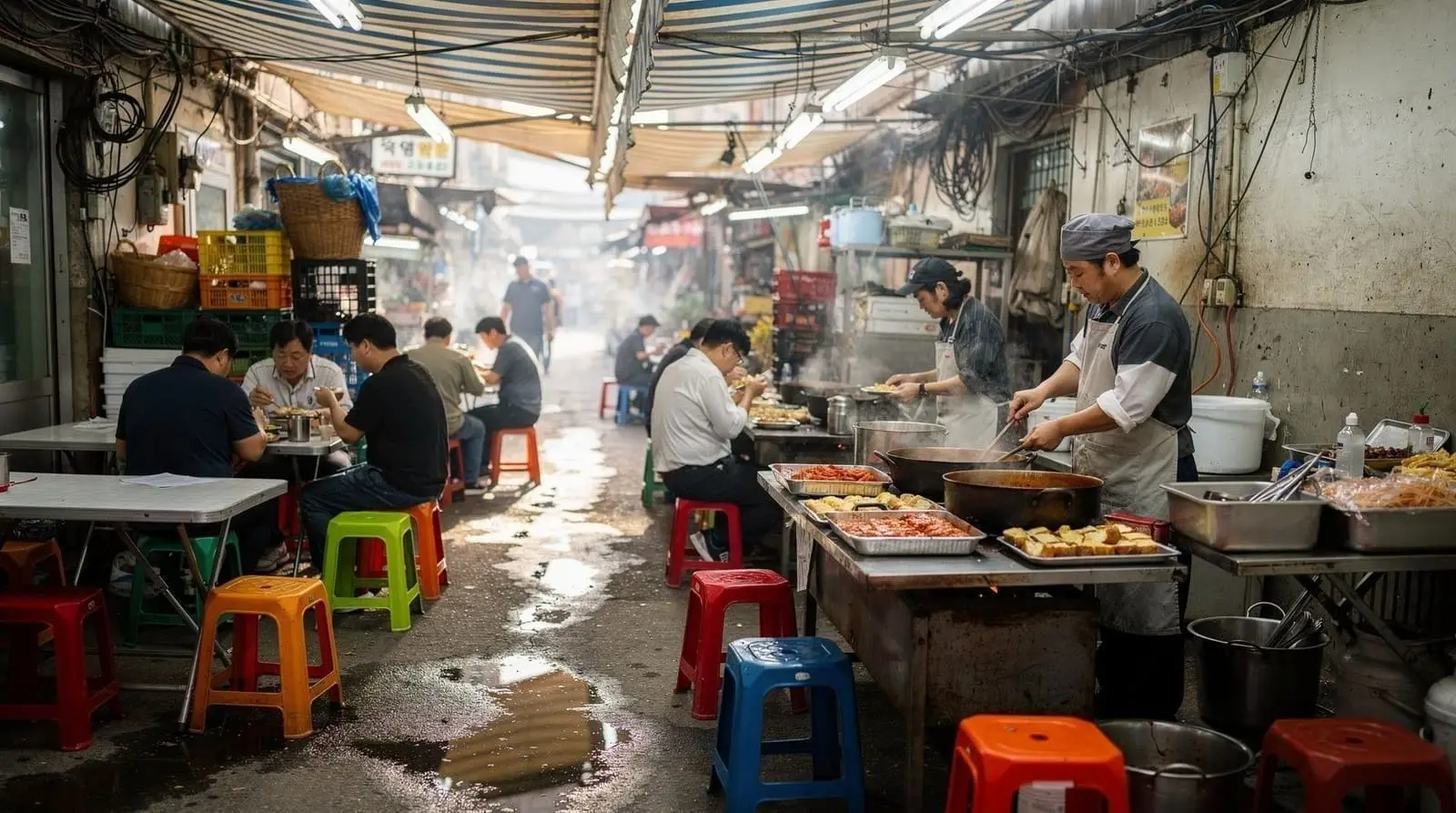
Street food from Sinpo and Gaehang markets: ₩3,000–6,000 ($2.30–4.60)
Sinpo International Market is the best single destination for budget street food in Incheon. Dakgangjeong (fried chicken with sauce) at Sinpo is ₩4,000–6,000 for a generous portion. Tteokbokki (spicy rice cakes) is ₩3,000–4,000. Hotteok (sweet pancakes) is ₩1,500. You can eat a complete and satisfying Sinpo market meal for under ₩10,000 ($7.70).
Gaehang Market adds fresh seafood and local produce to the mix at genuine wholesale prices rather than tourist rates.
Sit-down local restaurants: ₩8,000–13,000 ($6–10)
Korean set meals (백반, baekban) at neighbourhood restaurants are astonishing value. A full meal of rice, soup, grilled meat or fish, and five or six small side dishes (banchan) typically costs ₩11,000–14,000. These are not tourist restaurants — they are where office workers and local families eat daily. Signs may be Korean-only; point at what others are eating or show a photo.
Jjajangmyeon (black bean noodles) in Incheon Chinatown starts at ₩8,000. Haemultang (spicy seafood stew) on Wolmido Island runs ₩15,000–20,000 and serves 2 people.
Coffee and drinks: ₩2,500–5,000 ($1.90–3.80)
Korea’s cafe culture is extensive and coffee quality is high. A standard americano at a local cafe (not Starbucks) runs ₩2,500–3,500. Chain cafes like Ediya and Paik’s Coffee offer espresso drinks from ₩1,500–2,500. Convenience store bottled coffee is ₩1,200–2,000.
Alcohol note: Convenience store cans of Korean beer (Cass, Terra, Kloud) are ₩1,500–2,500 — significantly cheaper than bar prices (₩4,000–7,000). Makgeolli (rice wine) from convenience stores costs ₩1,500–2,000 for a 750ml bottle.
Transport: the T-money advantage
The T-money card is the single most important budget tool in Korea. A rechargeable card that covers metro (Seoul and Incheon), buses, and AREX trains, it costs ₩4,000 to buy and can be loaded at metro stations or convenience stores.
Key transport costs
- AREX from Incheon Airport to Incheon Station: AREX all-stop to Gyeyang, then Incheon Metro Line 1 (check Naver Map or Kakao Map for the live route and fare)
- AREX from Incheon Airport to Seoul Station: ₩4,150 (
$3.20) all-stop from Terminal 1, about 59 minutes; or ₩9,500 ($7.30) express, 43 minutes - Metro single journey in Incheon: ₩1,250–1,600 (~$1–1.25) depending on distance
- Metro from Incheon Station to Bupyeong: ₩1,250 (~$0.95)
- Bus in Incheon: ₩1,200–1,350 (~$0.90–1.05)
- Taxi, short trip within Incheon city: ₩3,500–7,000 (~$2.70–5.40) starting fare, most city trips under ₩10,000
T-money discount: Using T-money on metro and buses gives a ₩100 discount per journey compared to single-use tickets. Over a week of daily travel, this saves approximately ₩1,400–2,000 — modest but genuine.
For the day trip to Nami Island from Incheon (metro + ITX train + ferry), allow ₩35,000–40,000 round trip ($27–31). For Suwon Hwaseong Fortress, metro round trip is ₩6,000–7,000 ($4.60–5.40).
Attractions: most of the best things are free
This is Incheon’s strongest budget advantage. The city’s most compelling attractions charge little or nothing:
| Attraction | Cost |
|---|---|
| Incheon Chinatown and Open Port district | Free (Chinatown gate: free; jjajangmyeon museum: ₩500) |
| Jayu Park and Korean War monument | Free |
| Songdo Central Park | Free |
| G Tower observation deck | Free |
| Sorae Ecology Park | Free |
| Ara Waterway walking/cycling | Free (bike hire: ₩3,000–5,000/hr) |
| Incheon Grand Park | Free (zoo: ₩3,000) |
| Wolmido Island sea walk | Free (amusement rides: ₩3,000–8,000 each) |
| Songwol-dong Fairytale Village | Free |
Where you do pay:
- Wolmi Sea Train: approximately ₩11,000–14,000
- Yeongjongdo Seaside Rail Bike: approximately ₩15,000–20,000/person
- Ganghwado temple entry: ₩1,000–2,000.
Budget day breakdown (budget traveller)
| Item | Cost |
|---|---|
| Hostel dorm | ₩20,000 ($15.40) |
| Breakfast (convenience store) | ₩3,000 ($2.30) |
| Morning sightseeing (free attractions) | ₩0 |
| Lunch (market street food) | ₩7,000 ($5.40) |
| Afternoon metro travel | ₩2,500 ($1.90) |
| Dinner (local restaurant) | ₩10,000 ($7.70) |
| Coffee x2 | ₩5,000 ($3.85) |
| Miscellaneous (snacks, etc.) | ₩3,000 ($2.30) |
| Total | ₩50,500 (~$39) |
This is a real, comfortable day — not a deprivation exercise. The free attraction inventory in Incheon is genuinely extensive.
To fill the free morning, the Incheon Chinatown walking tour and the wider Open Port heritage district make an easy loop on foot. For a full plan that strings the free sights together, Incheon in one day shows how to sequence them without spending on transport.
Budget tips specific to Incheon
Arrive on the AREX all-stop service, not the express. At ₩4,150 vs. ₩9,500 to Seoul Station from Terminal 1, the express costs ₩5,350 (~$4.10) more and saves about 16 minutes (43 minutes vs. about 59). The all-stop is the budget choice; take the express only if time is tight.
Note: the AREX does not run to Incheon Station. Take the all-stop to Gyeyang, then Incheon Metro Line 1.
Eat where there are only Korean menus. Restaurants targeting foreign visitors often price 20–40% above local equivalents. If the menu has large English photos and inflated prices, walk one block further.
Use convenience store lunch runs. Between the triangle kimbap, onigiri, steamed corn, and hot snacks, a satisfying lunch can cost ₩3,000–4,000. Bring it to a park bench.
Chinatown jjajangmyeon: The base price of a bowl of jjajangmyeon in Incheon Chinatown starts at ₩8,000. This is a genuine Korean cultural experience, filling, cheap, and worth every won.
Day trip savings: The Suwon Hwaseong Fortress admission is only ₩1,000. A full day there including round-trip metro, lunch in the market, and fortress entry costs approximately ₩20,000–25,000 ($15–19) — one of the best-value UNESCO World Heritage experiences in Asia.
Incheon: Walk and Eat with Local Walking BuddyThree spending tiers, side by side
| Budget | Mid-range | Comfortable | |
|---|---|---|---|
| Sleep | Hostel dorm ₩18,000–22,000 | Guesthouse/business hotel ₩60,000–90,000 | Branded hotel ₩120,000+ |
| Eat | Market street food, convenience store | Sit-down local restaurants | Restaurants + occasional splurge meal |
| Move | Metro/bus with T-money | Metro/bus + occasional taxi | Taxis for convenience |
| See | Free attractions only | Free + 1–2 paid activities/day | Free + paid activities + guided tours |
| Daily total | ₩50,000–65,000 ($39–50) | ₩100,000–150,000 ($77–115) | ₩200,000+ ($154+) |
Most travellers land somewhere between budget and mid-range — a hostel dorm with one or two restaurant meals and a paid activity is a comfortable middle ground that still keeps daily spend under ₩80,000 ($62).
If you are deciding where the savings matter most, Incheon vs Seoul compares the two bases, and getting around Incheon explains how the T-money card fits into daily movement. Travelling through on a stopover? The Incheon airport layover itinerary keeps spending low while still seeing something of the city.
Useful apps and tools for saving money
Naver Map or KakaoMap, not Google Maps, for transit directions — Google Maps has limited public transport data in Korea, while these local apps give accurate bus and metro routing with real-time arrivals. Papago (Naver’s translation app) handles Korean menus and signage better than Google Translate in most travellers’ experience, particularly for handwritten or stylised text. Money exchange: airport exchange counters offer worse rates than city exchange booths in Myeongdong or the ones near Bupyeong; if you must exchange at the airport, change only what you need for the first day and do the rest in the city.
Incheon Airport transfer to Seoul city, fixed-price alternative to a metered taxiWhat you cannot do cheaply in Incheon
Accommodation on Muuido Island in August: Peak summer beach season drives prices for the limited accommodation on the island significantly above city rates. Budget trips to Muuido work best as day trips rather than overnight stays.
Fine galbi in Suwon: Suwon’s celebrated beef galbi restaurants are a genuine experience but cost ₩25,000–40,000 per person. Worth it, but save it for a splurge day.
Seasonal peak accommodation: April and October weekends in central Incheon see hostel dorms selling out rather than getting cheaper. Budget trips in peak season require earlier booking, not just lower expectations.
Frequently asked questions about budget travel in Incheon
Is Incheon cheaper than Seoul for accommodation?
Generally yes. The same standard of hostel or guesthouse costs 15–25% less in central Incheon compared to central Seoul (Hongdae, Myeongdong areas). This makes Incheon a strong base if you plan to do day trips to Seoul rather than staying in the capital itself.
How much should I budget for a week in Incheon?
A week at the budget level (dorm, street food, public transport, free attractions) costs approximately ₩350,000–420,000 ($270–320), excluding flights. Budget ₩100,000–150,000 ($77–115) for day trips to Nami Island, Suwon, and the DMZ. Total for a week with day trips: approximately ₩450,000–600,000 ($346–462).
Can I pay with a credit card everywhere in Incheon?
Card acceptance is extremely widespread in Korea — restaurants, convenience stores, taxis, and metro all accept debit and credit cards. Cash is mainly needed for very small market vendors and some traditional stalls. Withdraw cash at convenience store ATMs (often lower fees than bank ATMs for international cards). T-money card requires cash or domestic card for recharging at machines.
Is it possible to eat well in Incheon without speaking Korean?
Yes. Point-and-order works at most market stalls. Photo menus are standard at most local restaurants. Google Translate’s camera mode handles most Korean menus adequately. The Korea Tourism Helpline at 1330 can provide phone translation assistance if needed.
Are there free walking tours in Incheon?
Yes. The Incheon Tourism Organisation operates free-or-donation walking tours of the Chinatown and Open Port district, typically on weekends. Check with the Incheon Tourism Information Centre near Incheon Station for current schedule. These provide excellent historical context for the district.
Is it cheaper to base yourself in Incheon or Seoul for a Korea trip?
Incheon works out cheaper on accommodation alone, and it also cuts your airport transfer time and cost since you skip the trip into central Seoul. The trade-off is that Seoul’s nightlife and shopping districts require a 45–60 minute metro ride each way. For a trip weighted toward day trips and a calmer evening routine, basing in Incheon saves real money; for a trip centred on Seoul nightlife, the daily commute may outweigh the accommodation savings.
What’s the single best money-saving move for a short Incheon trip?
Buy a T-money card on arrival and use it for every metro, bus, and AREX ride — the per-journey discount is modest, but the bigger saving is avoiding single-ticket machines and the time they cost. Pair that with one market-food meal per day (Sinpo or Gaehang) instead of a sit-down restaurant, and a 3-day trip can realistically save ₩20,000–30,000 ($15–23) without feeling like a compromise.
Incheon city experiences on GetYourGuide
Top-rated tours and activities


