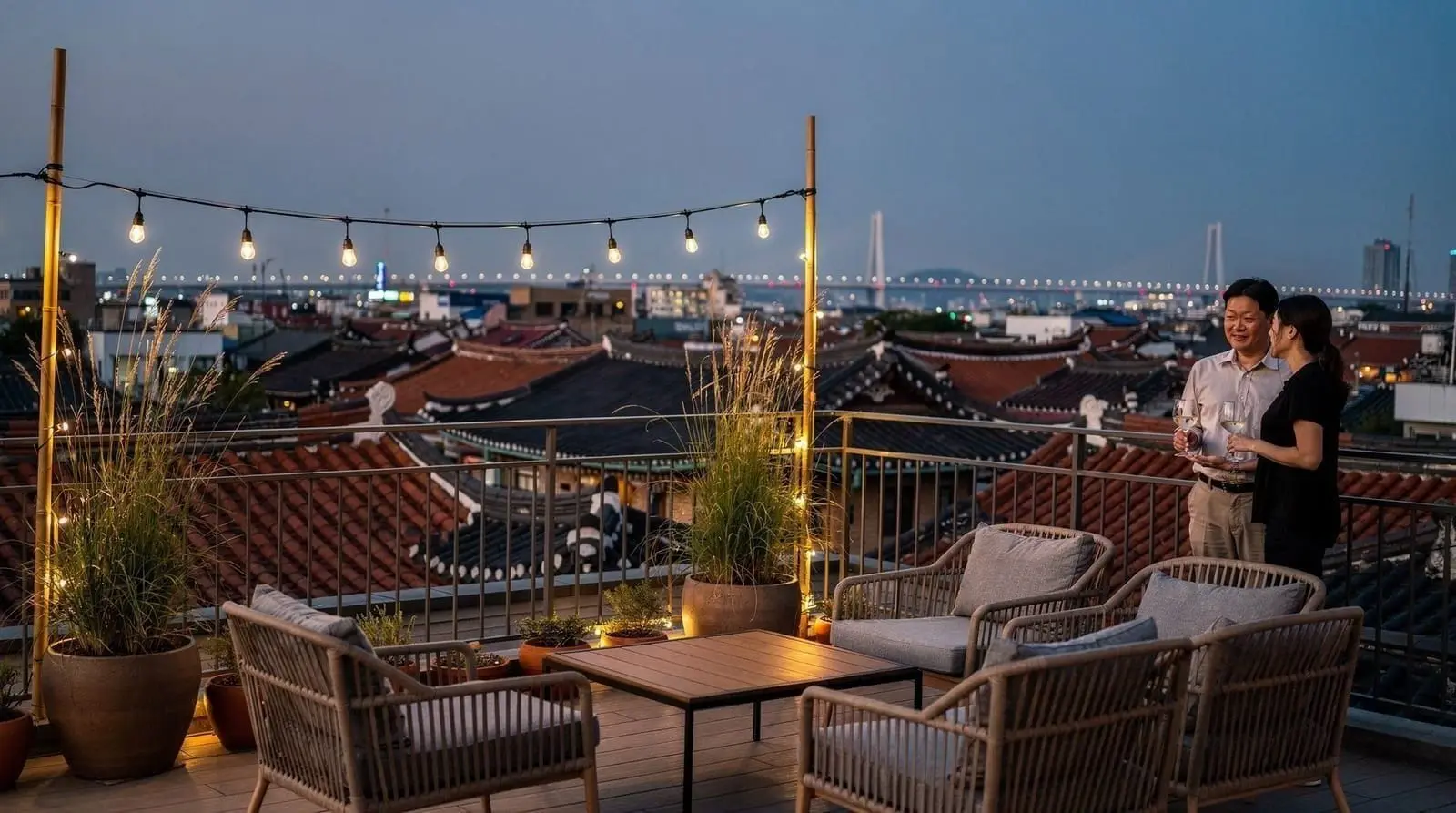
Where to stay in Incheon: the best neighbourhoods and hotels by budget
Where is the best place to stay in Incheon?
For first-time visitors and backpackers, staying near Incheon Station gives immediate access to Chinatown, Wolmido, and the metro. For modern comfort and Songdo Central Park, the Songdo district is excellent. For airport proximity with quick morning departures, the airport hotel cluster on Yeongjongdo Island is the right call.
How to pick an Incheon base
Incheon covers a large geographic area — the airport is on Yeongjongdo Island, the historic city centre is 30 km southeast, and Songdo’s modern district sits further south again. Unlike Seoul, where Myeongdong or Hongdae are obvious central hubs for first-timers, Incheon requires a choice between genuinely different kinds of stay.
This guide breaks down the four main accommodation zones: Incheon Station and Chinatown, Bupyeong (central Incheon), Songdo, and the Yeongjongdo airport area. Each has distinct transport implications, atmosphere, and price range.
| Zones | Incheon Station/Chinatown, Bupyeong, Songdo, Yeongjongdo airport |
| Budget range | ₩18,000–250,000/night depending on zone and comfort level |
| Best for first-timers | Incheon Station/Chinatown |
| Best for comfort | Songdo |
| Best for layovers | Yeongjongdo airport hotel cluster |
Before choosing, it helps to read getting around Incheon and, if your dates are still open, the best time to visit Incheon, since the season changes both prices and which zone feels right. Travellers on a tight budget will also find Incheon on a budget useful alongside the zone breakdown below.
Zone 1: Incheon Station and Chinatown area
Best for: First-time visitors to Incheon, Chinatown fans, budget travellers, anyone who wants to be within walking distance of the Open Port heritage district and Wolmido Island bus stops.
Character: The oldest and most characterful part of Incheon. The area around Incheon Station (metro line 1, final stop) has a genuine local neighbourhood feel — fish markets, dumpling restaurants, traditional guesthouses, and the distinctive atmosphere of Korea’s only official Chinatown beginning a 3-minute walk from the station. Tourists visit during the day, but the evenings are local.
Transport: Incheon Station is the terminus of metro line 1, meaning you can reach Seoul Station in approximately 55 minutes and transfer anywhere in Seoul’s metro network. AREX connection requires travelling to Bupyeong or Gyeyang. Wolmido Island is accessible by bus 9 from near the station (about 15 minutes).
Staying here makes the sights on foot easy: the Incheon Chinatown walking tour, the Open Port heritage district, and the food streets covered in where to eat in Incheon Chinatown all start close to your door, and Wolmido Island is a short bus ride away. If you arrive late from the airport with luggage, a pre-booked ride such as a private airport transfer saves you from working out connections after a long flight.
Budget accommodation (₩18,000–30,000/night, $14–23): Hostels in the Incheon Station area offer standard dorm beds in clean facilities. Look for guesthouses on the hill streets between the station and Chinatown that offer private rooms with shared bathrooms at the lower end of the budget range.
Mid-range (₩70,000–120,000/night, $54–92): Several renovated guesthouses and small boutique hotels have opened in the Chinatown area in recent years, offering private rooms with modern bathrooms in traditional-influenced buildings. These fill up in April and October — book ahead.
Higher-end options: The Incheon Station area does not have large international hotel properties. Visitors wanting full-service hotel amenities are better positioned in Songdo or Bupyeong.
Downside: The street noise and early-morning market activity near the waterfront can disturb light sleepers. Accommodation quality varies more widely than in Songdo’s newer stock.
Zone 2: Bupyeong (central Incheon)
Best for: Shoppers, transit-oriented visitors, those wanting maximum transport connections, business travellers.
Character: Bupyeong (부평) is Incheon’s busiest commercial district and its most connected transport hub. Bupyeong station is on metro line 1 and connects to the AREX airport line. The Bupyeong Underground Market is directly below the station. Above ground, department stores, chain restaurants, and the standard Korean urban commercial landscape dominate.
It lacks the character of the Chinatown area and the modernity of Songdo, but it is the most central point in Incheon for reaching multiple destinations. A 15-minute metro ride reaches Incheon Station; a 10-minute AREX ride reaches the airport direction.
Accommodation range: Business hotels (₩80,000–150,000/night, $61–115) and budget guesthouses (₩30,000–50,000/night, $23–38). Chain hotels from local brands like Lotte City and regional business hotels are common here.
Downside: Not atmospherically interesting as a base. The underground market is a functional attraction, not a reason to base yourself here unless you’re shopping extensively.
Zone 3: Songdo International Business District
Best for: Modern hotel seekers, families, visitors who want a quieter and cleaner environment, anyone here for business or conferences, travellers who enjoy walking in a planned urban environment.
Character: Songdo (송도) is built on reclaimed land and designed from the ground up as a “smart city.” The result is wide boulevards, a 100-acre central park with a seawater canal, glass towers, shopping malls, and an absence of the organic chaos that characterises older Korean urban districts. It photographs beautifully. It feels somewhat soulless at 11pm on a Tuesday.
That is a fair trade-off if what you want is a comfortable modern base with excellent transport. Songdo is 10–15 minutes from the airport by direct bus, and the Songdo Central Park guide covers the main attractions within walking distance of most hotels.
For evenings out, Songdo shopping and dining covers what is within easy reach, and the Songdo destination page gives a wider picture of the district if you are weighing it as a base.
Accommodation range: Songdo has Incheon’s most concentrated stock of international brand hotels — Holiday Inn Express, Best Western, smaller local premium brands. Rates run ₩100,000–200,000/night ($77–154) for mid-range, ₩200,000+ for premium options. Budget accommodation in Songdo is limited; it is not a backpacker area.
Transport: Songdo is served by Incheon metro line 1 (Incheon Grand Park station is at the metro boundary) and by direct airport buses (route 6770 or similar, approximately 25 minutes to T1). The Songdo area does not have an AREX station — metro connections to Seoul line 1 require a transfer at Bupyeong or Guwol.
Downside: Distance from the historic Incheon centre. Getting to Chinatown from Songdo by metro takes 35–45 minutes with at least one transfer. Fewer cheap eating options than central Incheon.
Zone 4: Yeongjongdo Island / Airport area
Best for: Very early or very late departures, transit passengers, visitors who want to minimise airport travel time, anyone doing an airport layover day trip.
Character: Incheon International Airport occupies most of Yeongjongdo Island. The area immediately surrounding the airport has a dense cluster of airport hotels — standard transit-style properties designed for passengers who need a bed between flights. A handful of longer-stay options exist further on the island near Eulwangni Beach.
Airport hotels: Major international brands (Hyatt, Grand Hyatt, Novotel) and budget transit options are available within walking distance or shuttle distance of both terminals. Rates for transit hotels range from ₩60,000–80,000 ($46–62) for a 5-hour rest room to ₩150,000–250,000 ($115–192) for overnight full stays. The Grand Hyatt Incheon is the most prominent full-service airport hotel.
The Grand Hyatt trade-off: The large resort-style hotels near the airport are well-appointed and convenient for early flights, but they are not positioned for exploring Incheon city. Allow extra travel time each way for all city activities (AREX to Gyeyang, then Incheon metro line 1; check Naver Map or Kakao Map for live timings).
Eulwangni Beach area: For a beach-adjacent stay on Yeongjongdo, a small cluster of hotels and guesthouses near Eulwangni and Wangsan beaches offers proximity to Yeongjongdo’s beaches at lower rates than the airport hotels. Bus connections to the airport take 30–40 minutes.
Whichever zone you choose, staying connected from the moment you land makes the first day smoother. Many visitors sort out data and transit before leaving the arrivals hall, for example with a SIM card bundled with a transit card, which is handy when you are checking in at a guesthouse and need to confirm directions or messages with the host.
For more on the island side of the airport zone, see the Yeongjongdo destination page, and for a longer stopover plan, the 6-hour layover itinerary shows how to fit a short stay around a flight.
Accommodation for specific trip types
Layover of 6–12 hours: Stay in Zone 4 (airport hotel) — access city attractions in the morning, sleep and catch your onward flight. The math works for transit passengers.
3-day Incheon-only visit: Zone 1 (Incheon Station/Chinatown). Walk to most of the historic city’s highlights; metro or bus for islands and parks.
Incheon as Seoul day-trip base: Zone 2 (Bupyeong) or Zone 1 for cheapest options. Seoul is 55 minutes by metro either way. Budget travellers staying in Incheon and day-tripping to Seoul save 20–30% on accommodation vs. Seoul’s tourist areas.
Beach and island focus (summer): Yeongjongdo Island beach area. Close to ferry points for Muuido and within bus distance of Eulwangni beach. Requires bus to airport and AREX for city access.
If you plan to combine Incheon with the capital, the Incheon and Seoul in 2–3 days itinerary shows how a base in Incheon works with day trips, and Incheon vs Seoul compares the two cities as places to sleep. Visitors with just one day can see how the zones fit into Incheon in one day.
What accommodation typically includes
Korean hotels and guesthouses at all levels typically provide:
- Free Wi-Fi (almost universal)
- Kimchi and sometimes hot food at breakfast in mid-range/above properties
- Air conditioning (essential in summer)
- 24-hour convenience stores within 1–2 minutes in any urban area
Korean hostels often include:
- Free breakfast (toast, eggs, coffee)
- Free ramen vending machine
- Common area with Netflix/board games
- Luggage storage before check-in and after checkout
Booking tips
April and October weekends: Book 4–6 weeks in advance. These are peak months across the Seoul area and both quality accommodation and budget options fill quickly, particularly in Zone 1 near Chinatown.
Platform choice: Korean accommodation is well-covered by Booking.com and Agoda (strong Asia Pacific inventory). Some local guesthouses near Chinatown list only on Korean platforms (Naver Hotel, Yanolja) with lower prices — worth checking if you have time to browse Korean apps.
Cancellation policy: Reserve refundable rates when possible for April/October visits — Korean weather can affect outdoor plans significantly. Most international booking platforms offer free cancellation up to 24–48 hours before check-in.
Zone comparison at a glance
If you’re weighing the four zones against each other, this table summarises the trade-offs:
| Zone | Atmosphere | Mid-range price/night | Best for |
|---|---|---|---|
| Incheon Station/Chinatown | Historic, local, characterful | ₩70,000–120,000 | First-timers, budget travellers, Chinatown/Wolmido access |
| Bupyeong | Busy commercial hub, best transit | ₩80,000–150,000 | Transit connections, shopping, business trips |
| Songdo | Modern, planned, quiet | ₩100,000–200,000+ | Comfort, families, Central Park access |
| Yeongjongdo airport | Transit-focused, functional | ₩60,000–250,000 | Early/late flights, short layovers |
What experienced travellers get wrong about Incheon accommodation
A few misconceptions come up repeatedly among first-time visitors planning where to stay:
Assuming “Incheon” means one compact area. It doesn’t — the city spans a geography closer to a small province than a single downtown. Picking a zone based on your actual itinerary (Chinatown vs. Songdo vs. airport transit) matters more than picking a generically “central” location, because there isn’t one.
Underestimating Songdo-to-Chinatown travel time. At 35–45 minutes with a transfer, this is a genuine daily cost if you plan to bounce between the historic city centre and Songdo’s attractions more than once. If your itinerary needs both areas heavily, consider splitting your stay across two zones rather than commuting daily.
Overpaying for an airport hotel when a full Incheon stay would serve better. For visitors staying more than two nights, only using Zone 4 for the first or last night — and basing the middle of the trip in Zone 1 or Zone 3 — usually works out both cheaper and more interesting than a full stay near the airport.
Frequently asked questions about where to stay in Incheon
Should I stay in Incheon or Seoul?
If your flight is through Incheon Airport and you are spending 2–4 days in the area, staying in Incheon saves significant accommodation cost while keeping Seoul accessible by metro. If Seoul is your primary destination, stay in Seoul. If you want an Incheon experience specifically, the Chinatown area base is the most rewarding.
Is Songdo suitable for families?
Yes. Songdo’s wide paths, large park, and clean modern environment make it one of the more family-friendly urban areas in Korea. The park has bike rentals, open space, and a seawater canal. International brand hotels in Songdo often have family rooms and pools.
Are there any guesthouses near Wolmido Island?
Limited. Wolmido Island has a few small guesthouses near the main street. Most visitors stay in central Incheon (Zone 1) and take the bus to Wolmido. The bus journey is about 15 minutes from the Incheon Station area.
How far is Incheon accommodation from the main subway stations?
In Zone 1, most guesthouses are within 5–10 minutes walk of Incheon Station. In Zone 2, Bupyeong hotels are mostly within the same walking distance. In Songdo, the nearest metro station (Dongchun) is 10–15 minutes walk from many properties. Check individual property maps.
Is English spoken at Incheon hotels?
At international brand hotels and larger properties, yes — front desk staff speak functional to fluent English. At smaller local guesthouses and traditional Korean inns, English may be limited. Google Translate and basic check-in phrases work well at smaller properties, which are otherwise fully functional.
What is the best area for nightlife in Incheon?
The Bupyeong area and the Songdo district both have evening bar scenes, though neither rivals Seoul’s Hongdae or Itaewon. Incheon Chinatown has evening restaurants and a few bars but is primarily active during daytime hours.
Can I split my stay across two zones during one trip?
Yes, and it’s a reasonable strategy for longer visits. A common pattern is a night or two near the airport at the start or end of the trip, combined with a few nights in Zone 1 (Chinatown) or Zone 3 (Songdo) for the main part of your stay. This avoids daily long commutes while still keeping airport transfers simple.
Is it cheaper to stay in Incheon than Seoul?
Generally yes, especially in Zone 1 and Zone 2. Comparable mid-range accommodation in Incheon runs 20–30% less than similar quality in Seoul’s tourist-facing neighbourhoods (Myeongdong, Hongdae). The trade-off is a 55-minute metro commute if Seoul is your main destination — for an Incheon-focused trip, the savings come with no downside.
Incheon city experiences on GetYourGuide
Top-rated tours and activities


