K-ETA and visa for Korea 2026: what EU and US travellers need to know
Do I need a K-ETA to visit South Korea in 2026?
It depends on your passport. K-ETA is waived through December 31, 2026 only for 25 listed countries and regions (e.g. US, Canada, UK, Germany, France, Italy, Spain, Netherlands, Poland, Australia, Japan); Portugal, Ireland and other nationalities must already apply for K-ETA. The e-Arrival Card is mandatory for all arrivals. From January 1, 2027, K-ETA becomes required for the listed countries too.
The short version for travellers in 2026
If you hold a passport from one of the 25 countries and regions on the official exemption list (including the United States, United Kingdom, Canada, Australia, Germany, France, Italy, Spain, the Netherlands and Poland), here is the current position:
- K-ETA: Waived until December 31, 2026 for those 25 countries and regions only. Other nationalities, including EU travellers from countries not on the list such as Portugal or Ireland, must already obtain a K-ETA before boarding.
- Visa: Not required for tourist stays up to 90 days for nationals of visa-free countries.
- e-Arrival Card: Mandatory for all international arrivals, regardless of nationality. Complete it online before landing.
- 2027 change: K-ETA becomes required from January 1, 2027.
This guide explains each element in detail, covers what happens if you’re travelling in 2027 or later, and addresses common questions about the process.
| Cost | Free through 2026 (e-Arrival Card); ~₩10,000 K-ETA fee (already due now if your country is not on the exemption list; from 2027 for everyone) |
| Time needed | e-Arrival Card takes 5–10 minutes online |
| When to do it | Up to 3 days before arrival, and before departure if possible |
| Where | www.e-arrivalcard.go.kr (2026); www.k-eta.go.kr for K-ETA |
| Best time | Complete it at home — do not leave it for the airport |
K-ETA: what it is and why it exists
K-ETA (Korea Electronic Travel Authorisation) is South Korea’s electronic entry pre-clearance system, similar to the US ESTA or Australia’s ETA. It was introduced in 2021 as a way to pre-screen visitors from visa-exempt countries before they board flights to Korea.
Under a standard K-ETA regime, nationals of visa-exempt countries would need to obtain a K-ETA approval before travelling. The application is online, costs approximately ₩10,000 (around $7.70), and approval generally takes up to 72 hours, so apply several days before departure.
However, South Korea has extended a temporary exemption multiple times since 2022, allowing nationals of major tourism-source countries to enter without K-ETA pre-clearance. As of this writing (June 2026), the exemption runs through December 31, 2026.
Who is covered by the 2026 exemption
The K-ETA exemption currently covers nationals of exactly 25 countries and regions:
- Asia: Japan, Taiwan, Hong Kong, Singapore, Macao
- Americas: Canada, United States (including Guam)
- Europe: United Kingdom, Germany, France, Italy, Netherlands, Spain, Poland, Sweden, Finland, Norway, Belgium, Denmark, Austria, Switzerland, Liechtenstein
- Oceania: Australia, New Zealand
Not every EU passport is covered: Portugal, Ireland, Greece, Czechia and other countries are not on the list, and their citizens must already apply for a K-ETA today.
If your country is among the 25 exempted, you can board your flight to Korea and pass through immigration in Incheon without K-ETA pre-clearance, provided you:
- Hold a valid return ticket
- Have a passport valid for at least 6 months beyond your intended stay (some airlines and immigration officers apply this rule; check before travel)
- Have no prior immigration violations in Korea
- Have completed the mandatory e-Arrival Card
If your country is not among the exempted, you must obtain a K-ETA before boarding, even during the exemption period (some nationalities require a full visa instead). Check the Korean Embassy website for your country of residence.
The e-Arrival Card: mandatory for everyone
Regardless of nationality and regardless of K-ETA status, South Korea requires all arriving international travellers to complete an e-Arrival Card (also called the Electronic Arrival Card or EAC) before landing.
Website: www.e-arrivalcard.go.kr
When to complete it: Up to 3 days before your arrival date. Do not complete it too far in advance as it is trip-specific.
What it asks: Basic personal information (name, passport number, nationality), flight details (flight number, date of arrival), Korean address during your stay (hotel name and address is sufficient), and health questions.
Cost: Free.
What you get: A QR code that you show to immigration officers on arrival. Some airlines may check it during boarding; many do not.
Paper alternative: Paper arrival cards are no longer standard procedure in Korean airports. The electronic system has replaced the paper card that long-term travellers may remember filling in on the plane.
If you forget: Immigration officers at Incheon Airport have provisions for passengers who arrive without completing the e-Arrival Card, but it may slow your processing. Complete it before departure to avoid delays.
What changes on January 1, 2027
From January 1, 2027, the K-ETA exemption ends and the standard system resumes. This means:
- Nationals of the 25 exempted countries travelling to Korea in 2027 or later will need to obtain a K-ETA before departure.
- The K-ETA application is online at www.k-eta.go.kr (or the “K-ETA” mobile app)
- Cost: approximately ₩10,000 ($7.70)
- Processing time: generally within 72 hours, so apply several days before departure
- Validity: 3 years, multiple entries
- The e-Arrival Card remains mandatory alongside K-ETA
If you are planning a trip to Korea in early 2027: Apply for K-ETA before departure. Do not leave it to the airport — K-ETA is a pre-travel requirement and cannot be obtained at the border.
If you are planning a trip straddling 2026–2027 (arriving in December 2026, departing in January 2027): You enter without K-ETA under the 2026 exemption (your stay begins before the deadline). Check with Korean immigration authorities if any uncertainty arises regarding your specific dates.
Standard visa-free rules (separate from K-ETA)
K-ETA exemption and visa exemption are different layers of the same entry system. Even without K-ETA, nationals of visa-free countries remain under existing bilateral visa-free agreements that allow stays up to 90 days for tourism or business purposes without applying for a traditional visa through a Korean Embassy.
90-day rule: You may stay in Korea for up to 90 consecutive days under the visa-free arrangement. This is per entry, not per year. If you leave Korea and re-enter, the 90 days reset.
What visa exemption covers: Tourism, visiting family, short business trips, transit.
What it does not cover: Long-term residency, employment, studying for longer than permitted under tourist entry, or activities requiring a specific visa category.
For stays beyond 90 days, you need a D-category (student) or E-category (employment) visa from a Korean Embassy in your home country. This is entirely separate from K-ETA and beyond the scope of this guide.
Incheon Airport immigration process (step by step)
-
On the plane (before landing): Complete your e-Arrival Card at www.e-arrivalcard.go.kr if you haven’t done so before departure. You will receive a QR code.
-
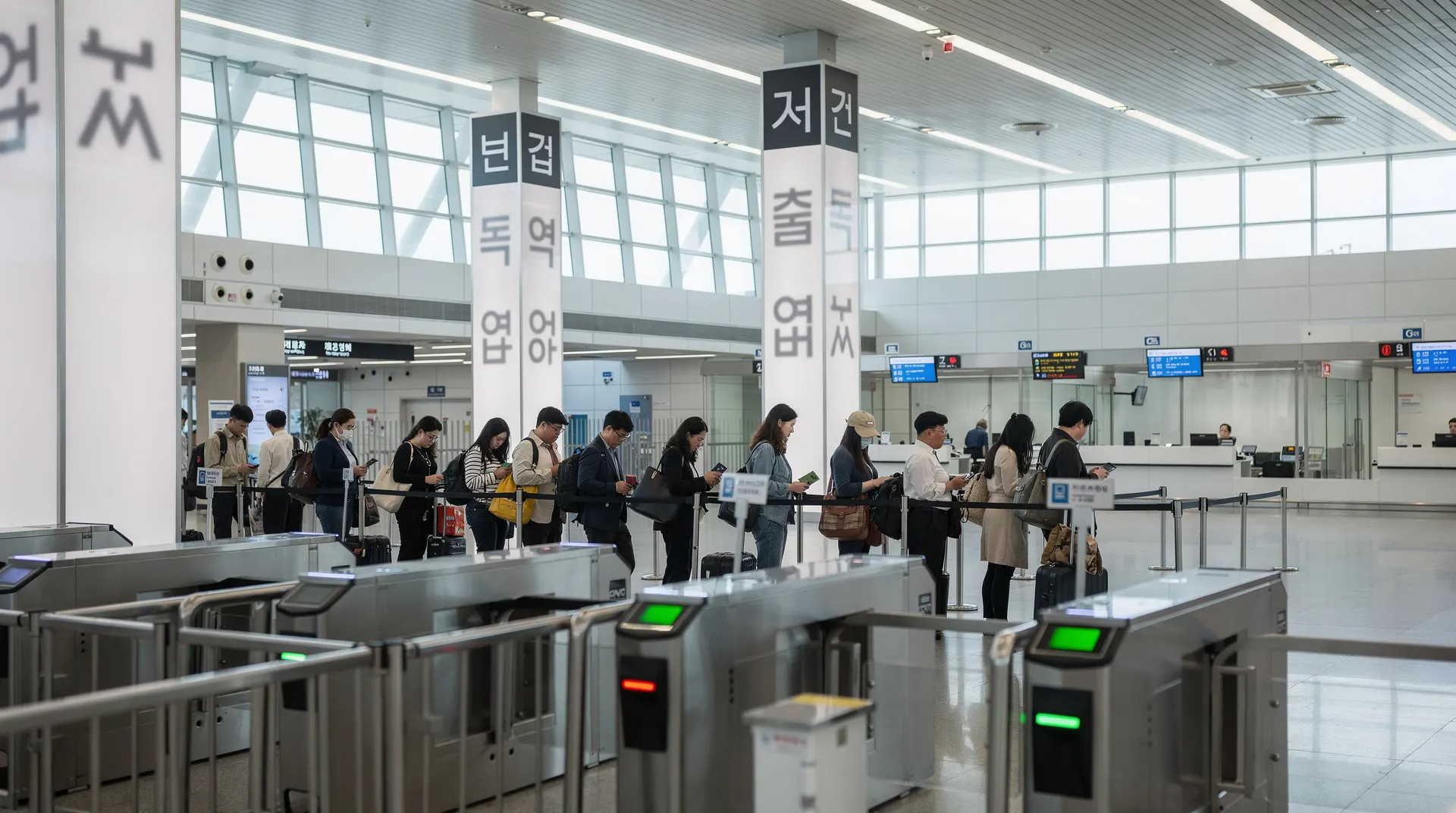
At Incheon Airport (Terminal 1 or 2): Follow signs to Immigration/Passport Control after disembarking. The queues are divided by Korean nationals and foreigners; use the “Foreigners” lane.
-
At the immigration counter: Present your passport and e-Arrival Card QR code (on phone or printed). The officer may ask standard questions (purpose of visit, where you’re staying, return ticket). This is routine.
-
Biometrics: First-time visitors to Korea have fingerprints and a photo taken at the immigration counter. This is standard and quick.
-
Entry stamp: Your passport is stamped with the entry date and permitted stay period (typically 90 days for visa-exempt nationalities).
-
Baggage collection: Collect checked luggage, pass through customs (green channel for nothing to declare, red for declarations).
-
AREX or transport onward: Follow signs to the AREX station inside the arrivals hall for train connections to Incheon city or Seoul. For full transport details, see the getting around guide.
Transit passengers
If you are transiting through Incheon Airport without entering South Korea (airside transit, remaining in the international departure area), you do not need a visa, K-ETA, or e-Arrival Card. This applies only if you never pass through passport control into South Korea.
If you exit the terminal to visit the city during a layover (see the layover itinerary guide), you are entering South Korea and all entry requirements apply.
After immigration: first steps in Incheon
Once the stamp is in your passport, most people want a data connection before anything else, to open maps and message the hotel. Setting up a data eSIM for your stay before you fly means you can connect the moment you land. If you would rather skip the train with luggage after a long flight, a pre-booked airport transfer is the simplest way to reach your hotel.
For a first visit, the Incheon in one day itinerary and the Incheon and Seoul in 2–3 days itinerary give you a ready-made plan so the paperwork is the only thing you need to organise in advance. The best time to visit Incheon guide helps you decide when to go, which matters here because your travel dates determine whether K-ETA applies at all.
Planning around the 2027 change
If your trip is flexible, the dates you choose decide how much paperwork you face. Travelling before the end of 2026 keeps things simple, while a 2027 trip adds one extra online step that is easy to handle if you start early. Either way, the Incheon on a budget guide is a useful companion, since the K-ETA fee is small compared with the rest of your trip costs and is best treated as one more line in your budget.
Many travellers pair Incheon with a day out of the city. The DMZ day tour from Seoul and the Nami Island day trip both depart from the capital, and the Paju and DMZ destination page explains the area. Border-area tours check passports at the start, so carry your actual passport rather than a copy. If this is your plan, a guided tour to the demilitarised zone is worth booking once your entry paperwork is settled.
Travellers arriving on a long layover can also read the Incheon safety and language tips before landing, and those staying a few days can look at Songdo or the Wolmido island guide for easy first-day ideas close to the airport.
K-ETA exemption vs standard K-ETA, side by side
| 2026 exemption period | Standard K-ETA (from 2027) | |
|---|---|---|
| Who it applies to | 25 exempted countries/regions (e.g. US, UK, Canada, Australia, Germany, France); other nationalities already need K-ETA | Same nationalities, exemption ends |
| Cost | None (K-ETA not required) | ~₩10,000 ($7.70) |
| When to apply | Not applicable | Before departure, days ahead |
| Processing time | Not applicable | Up to 72 hours (generally) |
| e-Arrival Card | Still mandatory | Still mandatory, alongside K-ETA |
Once you land, the practicalities of getting from the airport into Incheon or Seoul matter more than the paperwork did. The getting around Incheon guide covers AREX, taxis, and buses from Terminal 1 and 2, and the where to stay in Incheon guide helps you pick a neighbourhood if you’re basing yourself here rather than continuing straight to Seoul. If you’re only passing through, the 6-hour layover itinerary shows what’s realistically possible without risking your connection.
Common questions and edge cases
I have dual nationality including a Korean passport. Enter on your Korean passport; no K-ETA or visa processing required as a Korean citizen.
My passport has less than 6 months validity. Airlines may refuse boarding, and some immigration officers decline entry on passports with under 6 months validity relative to your departure date. Renew your passport before travel if this is relevant.
I am travelling from a third country, not my home country. Your K-ETA/visa eligibility is determined by your passport nationality, not where you’re travelling from.
I was denied entry to Korea previously. A prior denial of entry significantly complicates future entry attempts. Consult the Korean Embassy in your home country before planning another trip.
Incheon Airport: Pick-up & Drop-off ServicePractical tips before departure
-
Save the e-Arrival Card QR code offline. Airport Wi-Fi is reliable, but having the QR saved in your phone gallery means you don’t need to open a browser at the counter.
-
Know your Korean address. You need to provide an address on the e-Arrival Card. Your first hotel’s name and address is sufficient. Look it up before submitting the form.
-
Carry your onward ticket. Immigration officers occasionally ask to see proof of onward travel. A screenshot of your return or onward booking is sufficient.
-
Declare if necessary. The customs declaration applies to amounts over $10,000 USD in cash equivalents, certain agricultural products, and specific controlled items. Most tourist travellers have nothing to declare.
-
Emergency contact: The Korea Tourism Helpline at 1330 is available 24/7 in English, Chinese, Japanese, and other languages. If you have questions about entry requirements at the airport, they can assist by phone.
Frequently asked questions about Korea K-ETA and visa
Can I get K-ETA at Incheon Airport?
No. K-ETA is a pre-travel electronic authorisation that must be obtained before departure. It cannot be processed at the airport. (Note: K-ETA is waived through December 31, 2026 for the 25 listed countries and regions only; other nationalities must already apply before departure.)
Is the e-Arrival Card the same as the K-ETA?
No. They are separate documents. The e-Arrival Card (EAC) replaces the old paper arrival card that all passengers filled in on the plane. K-ETA is an advance authorisation (similar to ESTA) for visa-exempt nationals. Currently (2026), nationals of the 25 exempted countries need the e-Arrival Card but not K-ETA; from 2027 they will need both. Other nationalities already need both.
Do children need to complete the e-Arrival Card?
Yes, minors travelling to South Korea also require an e-Arrival Card. For children who cannot complete it themselves, a parent or guardian can complete it on their behalf.
What is the current K-ETA fee for 2027 and beyond?
The standard K-ETA fee is approximately ₩10,000 (around $7.70 at current rates). Fees may change — check the official website at www.k-eta.go.kr for current prices when applying.
How long does K-ETA approval take?
Generally within 72 hours. Apply several days before departure to avoid last-minute issues.
Do I need travel insurance for South Korea?
Travel insurance is strongly recommended but not legally required for tourist entry. South Korea has excellent medical facilities, but treatment costs for serious illness or injury can be very high without insurance. Standard travel insurance covering medical evacuation and emergency treatment is advisable.
Can I extend my 90-day stay once in Korea?
In limited circumstances, an immigration extension (D-9 sojourn status) can be applied for at the Korea Immigration Service while in the country. This is uncommon for tourists and subject to strict criteria. If you need more than 90 days, apply for the appropriate visa at a Korean Embassy before travelling.
What happens if I arrive without completing the e-Arrival Card?
Incheon Airport immigration has a provision for arrivals without a completed e-Arrival Card, but you should expect a slower processing time as staff walk you through the alternative. It is not a reason to be denied entry, just an avoidable delay — complete it online before you fly.
Do I need to print the e-Arrival Card QR code, or is a phone screenshot enough?
A phone screenshot or the confirmation saved in your phone’s photo gallery is accepted at Incheon Airport immigration. Printing is not required, but saving it offline (rather than relying on opening an email or website at the counter) avoids any Wi-Fi-related delay.
Recommended Incheon & Seoul tours on GetYourGuide
Top-rated tours and activities


