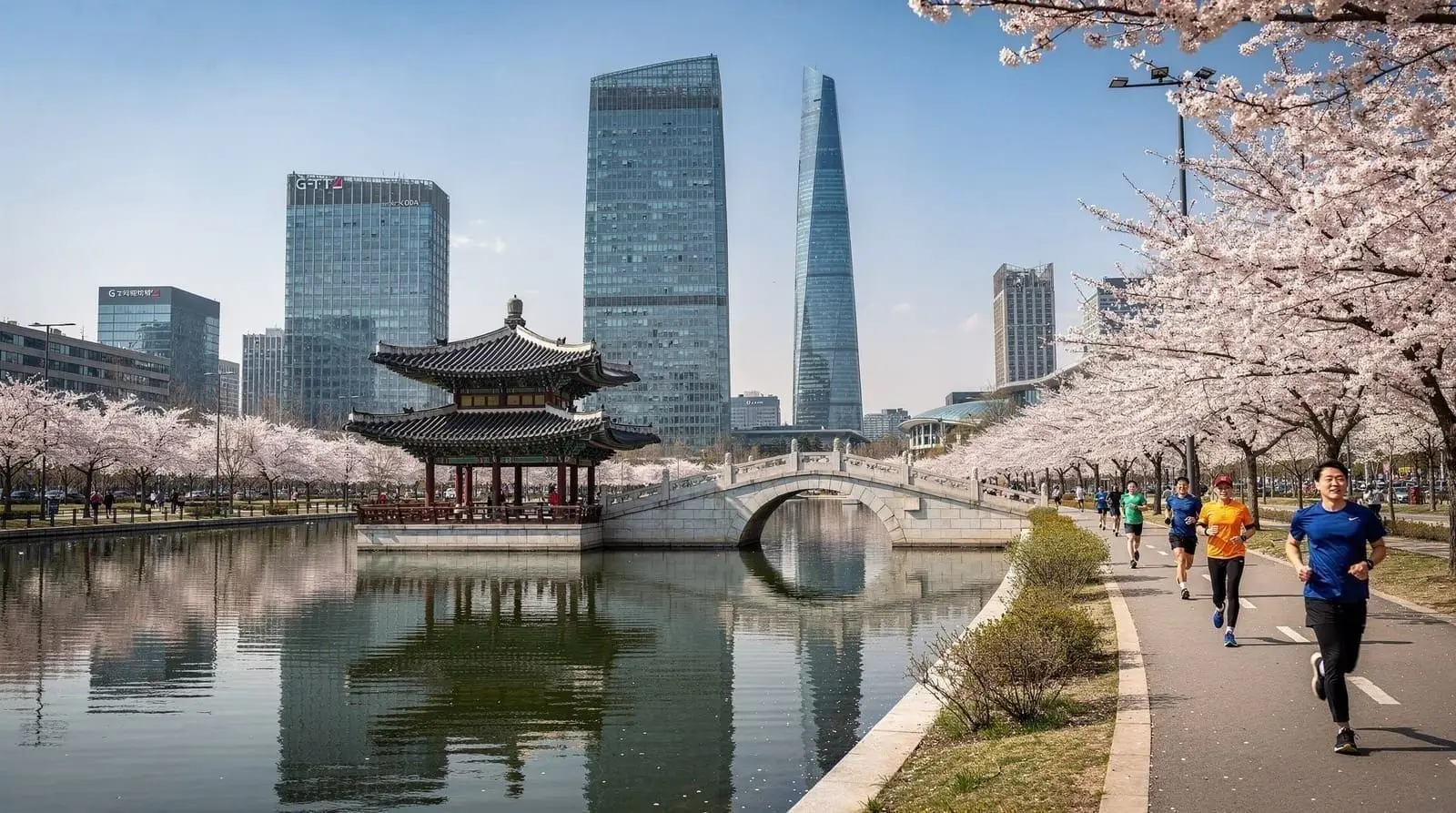
Songdo Central Park: a complete guide to Incheon's urban oasis
Is Songdo Central Park worth visiting?
Yes — it's a free, well-maintained urban park with a genuine seawater canal, good cycling infrastructure, and easy connections from Seoul. Half a day is enough to cover it properly.
| Where | Songdo International Business District, southern Incheon |
| Cost | Free entry; rentals from around ₩3,000/hour |
| Time needed | Half a day (2–5 hours) |
| Getting there | Incheon Metro Line 1 to Incheon National University of Education Station |
| Best time | October for foliage, or weekday mornings for quiet |
What makes Songdo Central Park unusual
Most city parks sit on top of rivers or lakes dug from the earth. Songdo Central Park is different in a way that surprises most visitors once they learn it: the 2.7-kilometre canal running through the park is filled with actual seawater pumped in from the Yellow Sea. Because it is tidal, the water level shifts slightly through the day, and on still mornings you can smell the faint brine that distinguishes it from a conventional urban pond.
The park occupies roughly 40 hectares (about 100 acres) of what was, until about 20 years ago, open sea. Songdo International Business District (SIBD) as a whole was reclaimed from tidal mudflats in the 2000s, and Central Park was designed as the green lung at its centre. The planners drew loose inspiration from New York’s Central Park — hence the name — though the result is distinctly Korean: immaculate lawns, manicured shrub lines, and a general absence of the scruffiness that gives many older parks their charm. That tidiness is also a selling point: the paths are smooth, the facilities work, and the whole place feels engineered to run without friction.
Entry is free. The park has no gates, no tickets, and no restricted zones aside from the rental concession areas. It is open around the clock, though the boats and bikes obviously shut down in the evening.
Getting to Songdo Central Park
The most reliable route from central Incheon is Incheon Metro Line 1 to Incheon National University of Education Station (인천대입구역). Take Exit 1 and walk roughly 10 minutes southwest across the pedestrian bridge that spans one of the canal inlets — the park entrance is visible before you reach the bridge. The walk is straightforward and signposted in English.
From Seoul, the most efficient option is the Incheon metro via a transfer at Bupyeong or Bupyeong-gu Office from the Seoul subway. Plan for around 50 minutes total from Hongik University (Hapjeong) station, and factor in ₩1,900–2,100 for the fare depending on the zone pricing that day.
If you are coming from Incheon Station (near Chinatown), the BRT Bus B1 runs directly to a stop labelled Songdo Central Park and takes about 40 minutes, costing ₩1,200. It is slower than the metro but drops you very close to the southern entrance.
From Incheon International Airport, the fastest option is a taxi (roughly 20–25 minutes, ₩22,000–28,000 depending on traffic). The airport limousine buses that stop at Songdo take longer because of multiple stops. If you are doing a layover visit, see the layover itinerary guide for a timed breakdown that includes Songdo.
Walking the canal — what to expect
The main canal path runs approximately 2.7 kilometres in a rough north-south axis, with a second cross-canal branching east toward the G-Tower. Walking the full perimeter, including the meadow loops, takes about an hour at a relaxed pace. The surface is paved throughout, suitable for strollers and wheelchairs.
A few landmarks to orient yourself:
The main bridge (북쪽 다리, northern bridge): This arched pedestrian crossing sits near the northern end of the canal and is the most photographed single spot in the park. Early morning, when the light is low and the canal surface is calm, the bridge reflects almost perfectly in the water. Most visitors who come for photography arrive before 8am.
The Tri-Bowl (트라이볼): Sitting at the western edge of the park, this trio of interlocking bowl-shaped pavilions is the most architecturally distinctive structure in Songdo. The exterior is worth seeing regardless of whether any event is scheduled inside — the geometry is strange and photogenic. Exhibitions and cultural events take place inside periodically, but the schedule is irregular. Check the Songdo SIBD official website before visiting if you want to catch a specific event. Entry to the exhibitions sometimes carries a small fee (typically ₩3,000–5,000); the exterior and forecourt plaza are always free.
G-Tower (east end): The 33-storey skyscraper visible from most of the park’s eastern path is a five-minute walk from the canal. Its 33rd floor has a free observation deck — the views over the canal from above are genuinely good. Note that the deck is open Tuesday to Friday (closed Mondays, reduced hours at weekends), so check the official IFEZ site before you go. The full details are in the G-Tower observation deck guide.
NC Cube Canal Walk: The shopping and food mall on the park’s southeastern edge is useful if you need a meal or want air conditioning in summer. Food options range from Korean lunch sets around ₩8,000–12,000 to international chains. It is not a reason to visit in itself, but good to know it is there.
Kayaking and paddleboating on the seawater canal
The canal rental concessions operate from May through October and are closed in winter. Hours are typically 9am to 6pm, with the last rental slot around 5:30pm. In high summer (July–August) hours sometimes extend to 7pm on weekends, though this is at the operator’s discretion — do not count on it.
Current rates (as of 2026):
- Single kayak: ₩10,000 per 30 minutes (approximately $7.50–8)
- Double kayak: ₩15,000 per 30 minutes
- Paddleboat: ₩12,000 per 30 minutes
These are cash or card accepted at the main concession booth near the southern canal entrance. The kayaks are plastic sit-on-top style, stable and beginner-friendly. Life jackets are provided and mandatory. No prior experience is needed — the canal is calm, flat, and enclosed, making it suitable for children who meet the minimum height requirement posted at the booth.
The paddleboats are the gentler option for families, and you get the same 30-minute slot on the canal. The seawater is reasonably clean at this stretch (the tidal flow helps) but you should not plan to swim.
One honest note: 30 minutes goes fast. If you want a proper paddle rather than a quick circuit, book two slots back-to-back.
Incheon: Coastal Rail Bike, Sorae Park and Fairytale VillageCycling in and around the park
The park has a 4-kilometre cycling loop that circles the canal and the adjacent meadows. It is flat throughout and well-surfaced. Bike rental stands are positioned inside the park perimeter, usually near the southern and central entrances.
Rental rates:
- Standard single bike: ₩3,000–5,000 per hour
- Tandem bike: ₩8,000 per hour
Tandems are popular with couples and tend to sell out quickly on weekend afternoons. Arrive before noon if you want one on a Saturday.
Helmets are available at the rental stands. The cycling path is shared with pedestrians in some sections, which means you will need to slow down around the meadow areas where families spread out on the grass. The signage marks cycling-priority zones clearly.
For cyclists who want more distance, the Ara Waterway bike trail connects to Songdo and runs all the way to the Han River — a different scale of ride entirely, but the starting point is accessible from Songdo by a short taxi or bus trip.
Picnics and the meadows
The grass areas are genuinely usable — maintained, mowed, and with no rules against sitting or eating. Koreans treat the park exactly as they would a neighbourhood picnicking spot, and on weekend afternoons in spring and autumn the meadows fill with people eating dosirak (도시락, packed lunchboxes bought from convenience stores or prepared at home), playing badminton, and letting children run on the grass.
You are allowed to bring your own food and drink. There is no alcohol prohibition that is enforced in this park, though public intoxication norms apply as they would anywhere in Korea. Convenience stores (GS25, CU) are within a few minutes’ walk of the park perimeter on most sides and sell triangle kimbap, sandwiches, coffee, and snacks at normal Korean convenience-store prices (₩1,000–4,000 for most items).
In spring, particularly from late March through early May, the cherry blossom trees along the canal path bloom and the park becomes noticeably more crowded. The Incheon cherry blossom itinerary covers the best spots and timing in detail.
Best times to visit
Spring (late March to May) is the most popular season. Cherry blossoms appear along the canal path in late March or early April depending on the year, and temperatures in April and May (10–22°C) are comfortable for both cycling and walking. This is the busiest season for the park on weekends.
Summer (June to August) is kayaking and paddleboat season at full swing, but be aware that July and August bring Incheon’s monsoon rains. The humidity is high (often 80%+) and afternoons can see sudden downpours. Morning visits — before 10am — are noticeably more comfortable. The park is greener and lusher in summer than any other time.
Autumn (October to November) is arguably the best all-around season for photography. Foliage colour comes to the park’s trees in October, the air is clear, and the canal reflects the sky well. Skies in October are typically the clearest of the year in Incheon.
Winter (December to February) is quiet. The boat and bike rentals close. The canal does not freeze (seawater has a lower freezing point, and temperatures here rarely drop far enough), but mornings are cold (−5 to 5°C is typical). The park takes on a photogenic grey stillness at this time of year that appeals to some visitors. The G-Tower observation deck is a reason to combine a winter visit with a weekday trip.
Photography spots
These are the four most reliable compositions in the park:
- Northern bridge at dawn: Arrive before sunrise. The canal is glassy at this hour and the arched bridge reflects cleanly. A tripod helps but is not strictly necessary with a modern camera.
- Tri-Bowl exterior from the forecourt: Best in early morning or late afternoon when the curved concrete catches directional light. The structure photographs well from a distance of about 30 metres.
- G-Tower from the canal path: The tower is most dramatically framed from the eastern canal path looking north, with the canal in the foreground. Golden hour gives the glass facade a warm cast.
- Canal looking west at sunset: From the central bridge, looking west toward the Tri-Bowl and the city skyline beyond. Sunset in Songdo tracks roughly toward the Yellow Sea in summer, so evening colour can be strong.
Combining Songdo Central Park with other nearby spots
A full-day Songdo visit might look like this: morning in the park for cycling and photography, a visit to the G-Tower observation deck (Tuesday to Friday; closed Mondays, reduced weekend hours), lunch at NC Cube Canal Walk, and an afternoon at Songdo’s shopping and dining district or a walk to the Tri-Bowl.
If you have more time, Sorae Ecology Park is reachable from Songdo by bus in about 25 minutes and offers a completely different environment — tidal mudflats, migratory birds, and a working fishing village atmosphere rather than manicured urban design.
For a broader view of the Songdo district itself, including accommodation options and the overall neighbourhood layout, the destination overview covers what to expect if you are basing yourself here rather than day-tripping from Seoul.
Incheon: One Day Guided City Tour with Hotel PickupWhat Songdo Central Park is not
It is worth flagging a few things the park is not, so you can calibrate expectations:
It is not a nature reserve. The biodiversity is limited — you will see manicured ornamental trees, some planted reeds along the canal edges, and the occasional migratory bird, but this is a designed urban landscape, not a wild wetland. For tidal ecology, Sorae is the better destination.
It is not especially gritty or characterful. Some visitors expecting the lived-in texture of older Korean neighbourhoods find Songdo a little sterile. The area is new, clean, and orderly to a degree that feels deliberate. That is the point of Songdo as a project, but it is not to everyone’s taste.
It is not connected to Incheon’s historic waterfront in any meaningful way. Chinatown, Jayu Park, and the Open Port area are in a completely different part of Incheon. Combining both in one day is possible — the Incheon one-day itinerary walks through the logistics — but requires a metro or taxi transfer and about 40 minutes of travel between the two areas.
The getting around Incheon guide has the full transit map breakdown, including T-money card setup for people arriving fresh from the airport.
Budget breakdown
A half-day visit to Songdo Central Park can cost almost nothing if you bring your own food and skip the water activities. A realistic mid-range half-day budget:
- Metro from central Seoul: ₩1,900–2,100 (≈ $1.50)
- Bike rental (1 hour): ₩3,000–5,000 (≈ $2.50–4)
- Single kayak (30 min): ₩10,000 (≈ $7.50)
- Lunch at NC Cube: ₩9,000–13,000 (≈ $7–10)
- Coffee from a canal-side café: ₩5,000–7,000 (≈ $4–5.50)
Total: roughly ₩30,000–38,000 (≈ $23–30) for a comfortable half-day with both water activities and a sit-down meal.
Free options exist at every step — the park itself, the canal walk, the meadows, and the G-Tower observation deck (closed Mondays) all cost nothing. If you are visiting Incheon on a tight budget, Songdo Central Park is one of the city’s best value half-days.
Wildlife and quiet corners away from the main path
Away from the canal’s busiest stretches, Songdo Central Park has a handful of quieter corners that reward visitors who wander off the main loop. The meadow area near the park’s eastern edge, closer to G-Tower, sees noticeably less foot traffic than the canal-side path and is a better spot for a still picnic. Reed plantings along some of the canal’s inlet edges attract herons and egrets occasionally, though this is a designed urban landscape rather than genuine wetland habitat — for serious birdwatching, Sorae Ecology Park is the better destination.
Early risers (before 7am) have the park nearly to themselves. Local joggers and a handful of tai chi practitioners are the only regular company at that hour, and the canal is at its stillest for photography before the wind picks up later in the morning.
Comparing Songdo Central Park to Incheon’s other green spaces
If you are deciding between Songdo Central Park and Incheon’s other outdoor options, the honest comparison helps:
| Park | Best for | Entry fee | Time needed |
|---|---|---|---|
| Songdo Central Park | Canal, cycling, urban design, families | Free | 2–5 hours |
| Sorae Ecology Park | Birdwatching, tidal wetlands, quiet | Free | 1.5–2 hours |
| Incheon Grand Park | Larger green space, cherry blossoms, zoo | Free (zoo separate) | Half day |
| Ara Waterway | Long-distance cycling | Free (bike rental extra) | Half day+ |
Songdo Central Park wins on convenience and polish; Sorae wins on genuine nature; Incheon Grand Park wins on scale for families wanting more than a park visit.
Visiting in the rain or off-season
Songdo Central Park stays fully accessible in the rain — the paved paths drain well, and the canal actually looks striking with raindrops disturbing its surface. The bike and boat rentals close in wet weather at the operator’s discretion, so check before heading out if water activities are the point of your visit. Bring an umbrella rather than relying on shelter; tree cover is limited along most of the canal path.
Off-season (November through March) the park is at its quietest. The boat and bike concessions are shut, the meadows are empty of picnickers, and the canal takes on a grey, still character that some photographers specifically seek out. If your main interest is walking and photography rather than activities, winter is a legitimate — if cold — time to visit, and you will have the northern bridge photo spot largely to yourself even at sunrise on a weekend.
Practical information summary
- Entry fee: Free (park open 24/7)
- Boat and bike rentals: May–October, 9am–6pm approx.
- Nearest metro: Incheon National University of Education Station (인천대입구역), Line 1, Exit 1
- Nearest bus: BRT B1 from Incheon Station, Songdo Central Park stop
- Toilets: Multiple clean public restrooms throughout the park
- Parking: Underground parking under the park perimeter (charged)
- Accessibility: Paved paths throughout, accessible for wheelchairs and strollers
Frequently asked questions about Songdo Central Park
Is the water in Songdo Central Park canal clean enough to kayak in?
The canal uses actual seawater pumped in from the Yellow Sea via tidal exchange, which helps maintain reasonable water quality compared to a closed freshwater pond. The authorities monitor water quality regularly. You should not fall in intentionally and you certainly should not swim, but kayaking and paddleboating on the surface is considered safe. The rental operators provide life jackets.
Can I bring my dog to Songdo Central Park?
Dogs are allowed in the park on leads. The park is popular with local residents walking pets, particularly in the early morning. Note that dogs are not permitted on the kayaks or paddleboats. Bring your own water and waste bags — bins are available throughout the park.
How long should I spend at Songdo Central Park?
A minimum of two hours lets you walk the full canal loop and see the main landmarks. If you rent a bike or do water activities, add another hour. Combining the park with the G-Tower observation deck and a lunch stop at NC Cube makes for a comfortable half-day (4–5 hours total).
Is Songdo Central Park accessible from Incheon Airport during a layover?
Yes, and it is one of the more practical layover options. A taxi from ICN Airport takes about 20–25 minutes and costs ₩22,000–28,000. You would want at least a 6-hour layover to visit without feeling rushed — the 6-hour layover itinerary covers a Songdo visit specifically.
Are there cafés inside or near Songdo Central Park?
Several cafés operate along the canal promenade on the park’s edges, typically serving coffee for ₩5,000–7,000 and pastries. The NC Cube Canal Walk mall immediately adjacent to the park’s southeast corner has a wider range of options including Korean chain cafés (Ediya, Mega Coffee at ₩3,000–4,500) as well as sit-down restaurants.
Does Songdo Central Park get crowded?
Weekend afternoons in spring and autumn are the busiest periods — expect the meadow areas to be well-populated and the bike rental queues to be 15–20 minutes long. Weekday mornings are quiet by comparison, with mostly local joggers and dog walkers. Summer mornings before 10am are the best time to visit if you want the canal photography spots largely to yourself.
Is the Tri-Bowl worth going inside?
The exterior architecture is the main draw and always accessible for free. The interior hosts temporary exhibitions and events, but the schedule is irregular and the quality varies. Check the Songdo SIBD or Tri-Bowl official site before visiting if you specifically want to see an exhibition. If nothing is scheduled, the exterior is still worth the 10-minute walk from the park.
What is the best month to visit Songdo Central Park?
October is the consensus best month: autumn foliage, clear skies, comfortable temperatures (15–20°C), and the seawater canal at its most photogenic. Late April is the runner-up for cherry blossoms. July and August are popular but come with heat, humidity, and monsoon rain risk.
Is Songdo Central Park good for birdwatching?
Only lightly. It is a designed urban landscape with limited biodiversity — you may see the occasional heron or egret near the canal edges, but this is not a wildlife destination. For genuine tidal wetland birdwatching, Sorae Ecology Park about 25 minutes away is a much better choice.
Can I combine Songdo Central Park with Songdo’s shopping district in one visit?
Yes, easily — they are within walking distance of each other. A common combination is a morning walk or cycle in the park, then lunch and browsing at Songdo’s shopping and dining district in the afternoon. Together they make a comfortable full day without needing to leave central Songdo.
Incheon islands on GetYourGuide
Top-rated tours and activities


