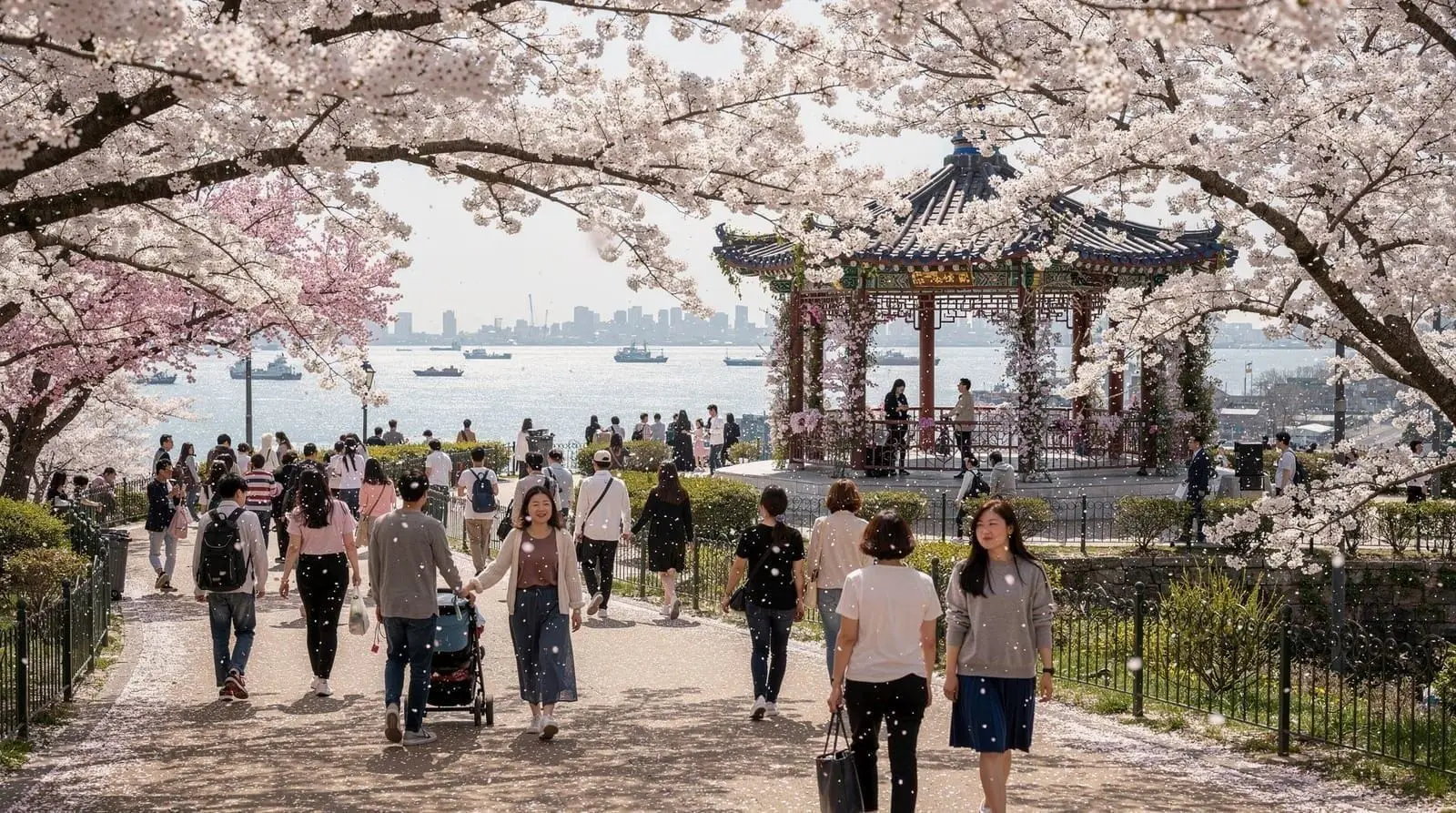
Incheon cherry blossom itinerary — 3 days in spring
Why April in Incheon rewards the early traveller
The Korean spring blossom season is one of the most photographed events in East Asia, and Seoul’s famous spots — Yeouido, Gyeongbokgung, Namsan — attract millions of visitors in that narrow window when the cherry trees are at peak. Incheon offers a different version of the same spectacle: more space, fewer queues, and a sequence of distinct locations that sustain a full three days without ever feeling rushed.
This itinerary builds around the blossom calendar. Day one is centred on Incheon Grand Park, home to more than 2,000 cherry trees and one of the least crowded mass-blossom sites in the metro area. Day two crosses to Nami Island in Gapyeong, where the avenue of cherry trees alongside the island’s central path is one of the most reproduced images in Korean spring photography. Day three moves into Seoul for the palaces and the city’s spring energy before returning to Incheon for the night.
All three days are doable entirely by public transport. A T-money card handles every transit connection.
| Where | Incheon Grand Park, Nami Island (Gapyeong), Seoul palaces |
| Best time | Early April, typically April 3-10 |
| Cost | roughly ₩190,000-290,000 per person for 3 days |
| Getting there | Metro, ITX train, ferry — all public transport |
| Booking | Book the Gapyeong ITX train ahead for weekends in peak week |
When exactly do the blossoms peak?
Cherry trees in Korea (primarily Yoshino cherry, Prunus × yedoensis) respond to temperature rather than the calendar. In a warm year, peak bloom can arrive as early as late March. In a cold year it may be held to mid-April. The average peak window for the Incheon area is the first ten days of April, typically April 3–10, running 1–3 days behind central Seoul due to coastal maritime influence.
The Korea Meteorological Administration (KMA) publishes blossom forecasts from mid-February onward. Check their website or the Visit Korea portal once you have a travel date in mind. Booking flights and accommodation for early April and checking the actual forecast closer to departure is the standard strategy for first-time visitors.
The blossom window is short: full bloom usually lasts 5–8 days before petals begin dropping. But the “petal snow” falling phase (typically April 10–17) is genuinely beautiful and preferred by many photographers. If your dates land in this window, do not be discouraged.
Day 1: Incheon Grand Park — the blossom capital of western Seoul
Morning — arrive early and walk the promenade
Incheon Grand Park is a 727-acre urban forest in the eastern part of Incheon, about 20 minutes by metro from Incheon Station and 55 minutes from Seoul Station on metro line 1. Take line 1 to Incheon Grand Park station and exit through exit 1 — the main south gate is a five-minute walk.
Arrive before 9am on weekdays or before 8:30am on weekends if you want the blossom promenade largely to yourself. The park opens at sunrise, and the stretch of mature cherry trees from the main gate toward the central lake is at its least crowded in the first 90 minutes after opening. Overcast mornings produce the best blossom photography: soft light, no harsh shadows, and pink petals that read true to colour rather than bleaching out in direct sun.
Walk the full promenade to the lake (approximately 1km), then branch left toward the arboretum section in the northeast quadrant. The arboretum includes weeping cherry trees (Prunus pendula) that often peak 4–5 days before the Yoshino variety on the main promenade — if you are visiting slightly early in the season, this is where you will find the most advanced bloom.
Entry to the park is free. The zoo inside charges ₩3,000 (~$2.50) for adults if you want to add it mid-morning.
Afternoon — lakeside circuit and picnic
The reservoir at the park’s centre is surrounded by a 3.5km walking loop. This is the right afternoon pace: slow, with views of blossom reflected in the water and fewer crowds than the entrance promenade. Bring food from the convenience store outside the gate or from one of the seasonal stalls near the main entrance (tteokbokki, hotteok, corn dogs, ramyun from ₩2,000–5,000 each). Picnicking on the lawns near the lake is the standard activity for Korean families here.
If the weather cooperates, the north side of the lake is the quieter half of the circuit, with more mature trees and better light in the late afternoon. Allow 1–1.5 hours for the full loop at a comfortable pace.
After the lake, consider a short detour on a park hiking trail. Two marked trails climb into the forested hills north of the zoo. The shorter loop takes about 90 minutes and rewards you with views over the park canopy — useful context for understanding the scale of what you have been walking through.
Incheon: One Day Guided City Tour with Hotel PickupEvening — Chinatown and dinner
Return to central Incheon via metro line 1 to Incheon Station. The Incheon Chinatown neighbourhood is a five-minute walk from the station. From Chinatown you can also walk five minutes to Jayu Park, where cherry trees line the paths between monuments — a quieter blossom alternative to the Grand Park promenade, and its streets are atmospheric at dusk even without blossom season — the red lanterns strung along the main street take on a warmer tone as the light fades. Dinner here: jajangmyeon (black bean noodles) is the Chinatown staple, or a full Korean-Chinese spread at one of the older sit-down restaurants running from ₩15,000–35,000 per person.
The area around Incheon Station also has several affordable guesthouses and mid-range hotels for the night, putting you close to the next morning’s transport connections.
Day 2: Nami Island and Gapyeong — the iconic spring avenue
Morning — transit to Nami Island
Nami Island sits in the North Han River near Gapyeong, about 2–2.5 hours from Incheon depending on your starting point. The recommended public transport route:
- From Incheon Station, take metro line 1 toward Seoul to Cheongnyangni Station (청량리역) — approximately 70–75 minutes, ₩2,500–3,000
- At Cheongnyangni, board an ITX-Cheongchun intercity train to Gapyeong Station (가평역) — about 50–55 minutes, ₩5,100–5,600
- At Gapyeong Station, take a local taxi or the 33-1 bus to Nami Island Ferry Terminal (남이섬선착장) — 10–15 minutes
- Board the short ferry to Nami Island — ₩22,000 round-trip including island entry
The total transit from Incheon Station to Nami Island takes roughly 2–2.5 hours. Leave Incheon by 8am to arrive before crowds build.
Seoul: Nami Island and Garden of Morning Calm opt RailbikeAfternoon — the island walk and the famous avenue
Nami Island is a small crescent-shaped island (about 430,000 square metres) developed as a recreational and cultural space. The landscapes that made it famous — the arrow-straight lanes lined with metasequoia, birch, and cherry trees — are entirely artificial, planted deliberately as a visual experience. In early April, the cherry blossom avenue running along the island’s central path is genuinely extraordinary: a corridor of interlocking pink canopies several hundred metres long that catches falling petals on a breezy day.
The island is compact enough to walk entirely in 2–3 hours, but it rewards slower exploration. Duck off the main avenues onto smaller paths through gardens, alongside the riverbank, and into quieter corners near the island’s tip. There are art installations, cycling paths (rental bikes available for ₩10,000/hour), and several cafes and restaurants serving Korean meals at reasonable prices (sets from ₩12,000–20,000).
Avoid arriving at noon on a weekend in peak blossom week — the island genuinely crowds. Weekday mornings and late afternoons (after 3pm as day-trippers leave) are significantly more pleasant.
If your schedule allows, the Petite France and Garden of Morning Calm complex near Gapyeong, and the Sindo and Modo islands further west in Incheon’s archipelago, add another dimension to the day — Morning Calm Garden’s spring illumination is a notable experience, though it does add 30–40 minutes of travel.
Evening — return to Incheon or Seoul
The return journey reverses the morning transit. Consider spending the night in Seoul if Day 3 is Seoul-focused; alternatively, return to Incheon via Cheongnyangni and metro line 1 (same route, about 2 hours). If staying in Seoul, Hongdae or Myeongdong areas have high concentrations of accommodation at all price points, and you will be better positioned for the palace visit on Day 3.
Day 3: Seoul — palaces, Bukchon, and spring in the capital
Morning — Gyeongbokgung Palace in hanbok
Seoul in blossom season looks best from inside Gyeongbokgung Palace (경복궁), where stone courtyards are lined with flowering trees and the mountains behind the palace serve as a backdrop. Admission to the palace is ₩3,000 for adults. The palace opens at 9am (closed Tuesdays). Arriving right at opening avoids both the tour-group crush and the harsher midday light, and gives the best chance at photographing the courtyards without a constant stream of people crossing the frame.
Wearing hanbok (traditional Korean dress) is one of the most popular activities at Gyeongbokgung — rental is widely available from shops along the streets approaching the main gate, typically running ₩15,000–20,000 for a few hours including a pin and accessories. Hanbok wearers traditionally received free palace entry; check current policy as it varies.
Seoul: Hanbok Rental with Gyeongbokgung Palace EntryBukchon Hanok Village (북촌한옥마을) is a 15–20 minute walk northeast of the palace. The narrow alleys lined with traditional tile-roofed hanok houses attract large crowds mid-morning; being here by 9:30am or after 4pm keeps it manageable. Cherry trees growing over the hanok rooflines in certain alleyways create the kind of accidental composition that travel photographers plan entire trips around.
Afternoon — Insadong, shopping, and departure prep
Insadong (인사동) is a five-minute walk from the palace area and serves as a useful afternoon — traditional craft shops, tea houses, street food, and a covered market (Ssamziegil) that has several floors of independent shops. It is less photographically intense than the palace but more practical for picking up well-made souvenirs. Budget ₩20,000–40,000 for browsing and lunch.
From central Seoul, the AREX Airport Express back to Incheon Airport runs from Seoul Station (Gyeongui-Jungang Line or walk to Seoul Station on metro line 1 or 4). The express takes 43 minutes (to Terminal 1) for ₩9,500, while the all-stop train takes about 59 minutes for ₩4,150 (Terminal 1). If you are spending the night in Seoul before an early flight, the airport area hotels and a AREX transfer the next morning is the standard approach.
What to do if you cannot make a specific date work
Most travellers cannot shift a flight around a blossom forecast that only firms up a few weeks out, and that is fine — the itinerary is built to work across a two- to three-week window, not a single perfect day. If you land a week early, the Grand Park arboretum’s weeping cherry trees (Prunus pendula) bloom 4-5 days ahead of the main Yoshino promenade and give you something genuinely in bloom while the rest of the park is still budding.
If you land a week late, lean into the petal-snow phase rather than chasing full bloom — Nami Island’s avenue with drifting petals photographs just as well, and crowds thin noticeably once the “peak” headlines have passed. The one date range genuinely worth avoiding is the narrow 2-3 day true-peak window on a weekend, when every major spot in the region is at its most crowded simultaneously; a weekday visit even slightly off-peak beats a weekend visit at the theoretical maximum.
Practical information
Getting around
- Metro line 1 Seoul Station to Incheon Grand Park: 55 min, ₩2,000–2,500
- Metro line 1 Incheon Station to Cheongnyangni: 70–75 min, ₩2,500–3,000
- ITX Cheongnyangni to Gapyeong: 50–55 min, ₩5,100–5,600
- Nami Island ferry + entry: ₩22,000 round-trip
- AREX Express Seoul Station to Incheon Airport: 43 min, ₩9,500
T-money card covers all metro and bus trips. Reload at convenience stores (GS25, CU, 7-Eleven) across the network. The getting around Incheon guide covers all transport options in detail, including bus and taxi tips for reaching less-central destinations. For visa requirements, check the K-ETA and visa guide for Korea in 2026.
Accommodation suggestions
- Incheon Station area (Days 1–2 base): guesthouses and mid-range hotels, ₩50,000–120,000/night
- Seoul, Hongdae or Myeongdong (Day 2 overnight if Nami Island detour): ₩80,000–200,000/night
- Incheon Airport area pensions or transit hotels (if early Day 3 flight out): ₩100,000–250,000/night
Photography tips
- Best light for blossom: overcast mornings, or 30 minutes after sunrise on clear days
- Hanagae Beach has zero blossom but sunrise light over the Yellow Sea on a clear spring morning is exceptional for a Day 1 early extension
- For Nami Island: arrive by 9:30am or after 3:30pm; noon crowds compromise composition completely
- At Gyeongbokgung: the secondary gates (Heungnyemun inner gate, Hyangwonjeong pavilion) have blossom without the bottleneck at the main courtyard
Budget breakdown (per person, 3 days)
- Transit (all connections): ₩40,000–55,000 (~$31–42)
- Incheon Grand Park: free
- Nami Island: ₩22,000 (~$17)
- Gyeongbokgung Palace: ₩3,000 (~$2.50)
- Hanbok rental (optional): ₩15,000–20,000 (~$12–15)
- Accommodation (2 nights shared): ₩50,000–100,000 per person (~$38–77)
- Food (3 days, casual meals): ₩60,000–90,000 (~$46–69)
- Estimated total: ₩190,000–290,000 (~$146–223)
Alternative pacing if you only have two days
Not every traveller has three full spring days to spend in the region. If you need to compress this into two days, the strongest combination is Day 1 (Incheon Grand Park and Chinatown) plus Day 3 (Seoul palaces), dropping the Nami Island excursion — it is the most rewarding single stop but also the most time-intensive at 4-5 hours of round-trip transit. If Nami Island is the priority instead, pair it with a shortened half-day in Seoul rather than the full palace-and-Bukchon circuit. Either version still delivers a genuine blossom experience; it is a question of which single day you are willing to sacrifice, not whether the itinerary works at all.
Rainy-day contingency
Spring showers pass through the region several times in early April, and a wet morning does not have to derail a blossom day. At Incheon Grand Park, the tree canopy over the main promenade offers some shelter, and wet blossom petals on paths actually photograph well against dark, saturated pavement. Nami Island’s cafes and covered walkways near the ferry terminal give a place to wait out a short shower without losing much of the day. Gyeongbokgung’s covered gate structures and Bukchon’s narrow alleys both work reasonably in light rain, though hanbok rental in a downpour is less appealing — check the forecast before committing to that add-on and shift it to a drier block of the day if needed.
Frequently asked questions about Incheon cherry blossoms in spring
What is the peak cherry blossom period in Incheon?
The Incheon area typically peaks in the first week of April, usually between April 3 and April 10. This is 1–3 days later than central Seoul due to the coastal maritime influence. In warm years the window can open as early as late March; in cold years it may be held to mid-April. Check the Korea Meteorological Administration forecast from mid-February onward for year-specific timing.
Can I do this itinerary if cherry blossoms have already started falling?
Yes. The “petal snow” phase — when petals fall on a breeze, covering paths and pond surfaces in white and pink — typically runs from April 10 to April 17 and is arguably more photogenic than full bloom. Many experienced cherry blossom visitors deliberately target this phase. The atmosphere at Grand Park and Nami Island is excellent even slightly past peak.
Is Nami Island worth visiting just for cherry blossoms?
The cherry blossom avenue on Nami Island is genuinely distinctive and worth the journey in the correct season. Outside of blossom season, Nami Island has other attractions — metasequoia lanes, art installations, cycling, riverside views — but the April visit is a qualitative step above. If your travel dates land outside April, see the Incheon autumn foliage itinerary for a Nami Island visit in October’s golden lanes.
How crowded is Incheon Grand Park compared to Seoul blossom spots?
Significantly less crowded than Yeouido or Namsan. On a peak weekday morning, the Grand Park promenade is walkable without shoulder contact. On peak weekends it fills considerably by 11am, but even then it lacks the near-immovable crowd density of Seoul’s most famous spots. The park’s size absorbs visitors well; you will always find a quiet corner along the lakeside circuit even in the busiest periods.
Do I need to book anything in advance for this itinerary?
The ITX train from Cheongnyangni to Gapyeong should be booked in advance via the Korail website or app (코레일), especially for weekend morning departures in blossom season. Nami Island does not require advance booking but buying the ferry ticket online avoids a potential queue. Hanbok rental shops near Gyeongbokgung do not typically require reservations but can run out of sizes in popular styles during peak season — arriving at 9am when they open covers this.
What should I wear for early April in Incheon?
Early April in Incheon averages 10–15°C, with mornings often below 10°C. Layers are essential: a packable down jacket or fleece for mornings, a lighter top for afternoons when temperatures can reach 18°C. Comfortable walking shoes are a baseline — this itinerary involves significant walking on paved and gravel paths over three days. Rain is possible; a compact umbrella or light rain jacket covers this without bulk.
Is the Incheon Grand Park area good for families with young children?
Very well suited. The flat main promenade and lake circuit are fully pram-accessible. The zoo inside the park is popular with children (₩3,000/adult, reduced for children) and the park’s open lawns are excellent for picnicking. The railway to Incheon Grand Park station is straightforward and safe for family travel. Nami Island on Day 2 is also family-friendly; the island has cycling, animals, and short walking distances suitable for children.
If you want an extra family-oriented day in the region, Wolmido Island has amusement rides and seafood along a harbour promenade that children enjoy. The Sinpo International Market is also a favourite for families who want affordable Korean street food in a covered market setting.
Incheon city experiences on GetYourGuide
Top-rated tours and activities


