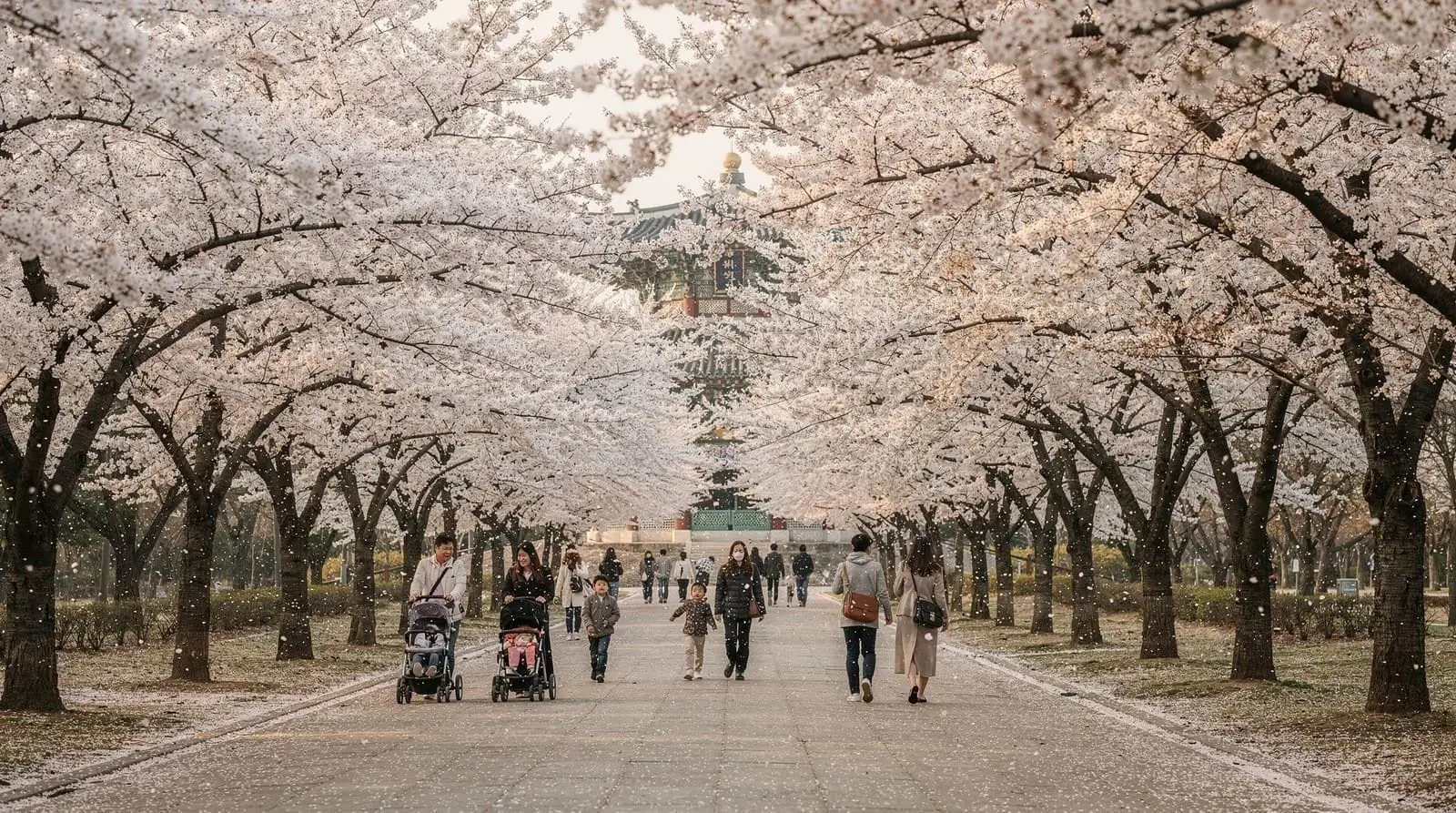
Incheon Grand Park (인천대공원) is a 750-hectare metropolitan forest park in the Juan district, built around a central reservoir in the 1980s. It is not a theme park or an attraction in the conventional sense — it’s a working urban forest used by Incheon residents for morning exercise, family picnics, and cycling. What makes it worth a visitor’s time is a specific combination: one of Korea’s finest cherry blossom avenues in early April, a functional zoo with no entrance fee that’s surprisingly well-maintained, and direct access to the 18 km Ara Waterway cycling path. The park is free to enter, the zoo costs 1,000 KRW, and a T-money card gets you there.
| Where | Juan district, Incheon — near Juan station (Line 1) |
| Cost | Park free; zoo 1,000 KRW adults, 500 KRW children |
| Time needed | Half a day to a full day |
| Getting there | 20 min from Incheon station, 1 hr 30 min from Seoul Station |
| Best time | Early April for cherry blossoms, October for foliage |
Cherry blossom avenue
The main cherry blossom display lines the park’s central promenade (the 4 km road from Juan station to the reservoir). In peak bloom — typically the first week of April — the canopy closes over the road into a white tunnel. The Incheon Grand Park cherry blossoms guide tracks the bloom calendar and recommends the best viewing spots, including the less-crowded side paths around the reservoir edge.
Realistic expectations: early April weekends are extremely crowded — peak visitor counts exceeded 100,000 on a single weekend in recent years. If cherry blossoms are a priority, come on a weekday, arrive before 9 a.m., and avoid the main central path by taking the forest loop around the north shore. The crowds are part of the Korean spring experience, but don’t expect a serene moment.
Incheon Chinatown, Rail Bike, and Eco Park from SeoulThe zoo and botanical garden
Incheon Grand Park Zoo (인천어린이과학관) costs 1,000 KRW for adults, 500 KRW for children. It houses about 250 species including tigers, leopards, bears, elephants, and various domestic Korean species. The zoo is unpretentious and well-suited to children. Feeding times are posted at the entrance in Korean; the elephant feeding at 2 p.m. is the most popular event.
Adjacent to the zoo is the Incheon National Arboretum (무료), with themed garden sections including a Japanese garden, a Korean traditional garden, and a conifer forest. Entry is free. Open 9 a.m. – 6 p.m. (5 p.m. in winter).
Ara Waterway cycling
The Ara Waterway (아라뱃길, also called Gyeongin Ara Waterway) is an 18 km artificial canal connecting the Han River to the Yellow Sea, running parallel to the western edge of Incheon. The cycling path alongside it is flat, paved, and continuous — ideal for casual cyclists. The full one-way route from Seoul’s Hangang River connection to the Yellow Sea coast at Seo-gu takes about 2 hours by bicycle.
Access from Incheon Grand Park: the park’s west side connects to the Ara Waterway path via the Sincheon underpass. Bicycle rentals are available inside the park from the recreation area near the reservoir (around 8,000 KRW/hour for a standard bike, 15,000 KRW for a tandem).
The Ara Waterway bike tour guide maps the full route with rest stops, distance markers, and the location of the Ara Tower lookout midway along.
Sorae Ecology Park nearby
Sorae Ecology Park (소래생태공원) is a 40-minute bus ride from Incheon Grand Park — a coastal wetland reserve known for salt harvesting demonstrations, migratory birds, and the photogenic Sorae Fisheries Market (소래포구). If you combine the park visit with the Sorae trip, budget a full day. The Sorae Ecology Park guide covers the market and the bird-watching blind schedules.
Incheon: Coastal Rail Bike, Sorae Park and Fairytale VillageIncheon Grand Park by season
| Season | What’s on | Crowd level | Notes |
|---|---|---|---|
| Spring (late Mar–May) | Cherry blossoms (peak ~1st week April), fresh greenery | Very high in peak bloom week | Go on a weekday, before 9 a.m. |
| Summer (Jun–Aug) | Full canopy shade, zoo, picnics | Moderate | Humid; early morning or late afternoon best |
| Autumn (Sep–Nov) | Foliage color, comfortable cycling | Moderate | October is the sweet spot for Ara Waterway rides |
| Winter (Dec–Feb) | Quiet forest walks, partial reservoir freeze | Low | Zoo stays open with reduced hours |
Getting to Incheon Grand Park
By metro: Take subway line 1 to Juan station (인주역). From Incheon station, about 20 minutes; from Seoul Station, about 1 hour 30 minutes (direct line 1). The park entrance is a 10-minute walk from Exit 2 of Juan station.
From Wolmido: Take bus from Wolmido Island to Bupyeong station (about 35 minutes), then line 1 to Juan (10 minutes).
From Chinatown: Metro line 1 from Incheon station to Juan, about 20 minutes.
Car: Free parking lots at multiple park entrances. Can fill up on spring weekends.
Combining Grand Park with other Incheon spots
Grand Park works best as a standalone morning activity combined with lunch in the Juan commercial area, then continuing to Incheon Chinatown by metro in the afternoon. In April, the cherry blossom walk + Chinatown combination is one of the most popular Incheon day trips for Seoulites.
The Incheon cherry blossom spring itinerary builds a two-day route around the bloom season, using Grand Park as the anchor.
How to shape a day in the park
Because the park is so large, the biggest mistake is trying to see all of it. Pick one anchor for the morning (the central promenade, the zoo, or the reservoir loop) and let the rest of the day follow from it. Visitors who arrive with a rough order in mind, rather than wandering from one signpost to the next, tend to leave less tired and with better photographs.
A sensible rhythm for most travelers is a slow walk first, while the light is soft and the paths are quiet, then the zoo or arboretum around midday, then a picnic or a simple Korean lunch. The afternoon is for the reservoir edge or a short bike ride. If you prefer to keep things light, simply do the first two and head back to the city; nothing about the park punishes a short visit.
Photography and light
The promenade is photogenic, but the most memorable frames rarely come from the busiest stretch. Look for the quieter side paths, where branches frame the path without a crowd filling the shot. Early morning gives the cleanest light and the fewest people; late afternoon softens the reservoir and warms the trees.
In spring, shoot upward along the avenue so the canopy fills the frame, and keep a wide lens or a phone’s wide mode handy. In autumn, the same trick works with foliage. In winter, the bare branches and any snow turn the forest into a quiet, graphic scene that few visitors bother to photograph. For more spots with a strong visual payoff across the region, see Instagram photo spots in Incheon.
Visiting with children
The park is one of the easiest places in Incheon to spend a day with young children. Paths are wide, there is room to run, and the zoo is small enough that nobody gets worn out. Let children set the pace: a long stop at the playground or by the water is often worth more than ticking off every enclosure.
Bring snacks, water, a hat, and a spare layer, since the forest can feel cooler in the shade. A picnic blanket makes the lawns far more comfortable. For wider ideas on family days, the Incheon with kids article collects options beyond the park, and the top things to do in Incheon list helps if you want to build a longer family itinerary.
Choosing the right season for you
Spring brings the crowds and the headlines, but the park rewards visitors in every season. Travelers who dislike queues and noise should lean toward late spring greenery, early autumn, or a calm winter morning. Those who want the full blossom spectacle should accept the crowds and plan around them, as described above. The best time to visit Incheon guide puts the park’s seasons in the context of the whole city, which helps if your dates are fixed and you are deciding what else to schedule around them.
Getting around before and after
You do not need a car to enjoy the park. The metro covers the main route, and the rest of the journey is on foot or by rented bike. If you plan to link several stops in one day, read the getting around Incheon guide first, since a single transit card and a bit of planning make transfers painless. Keep some flexibility in the afternoon: buses and metro connections are easiest to manage when you are not racing a closing time.
What to pair it with
Grand Park is a quiet counterpoint to the coast. If you want sea air after a day under trees, Wolmido offers a very different atmosphere, with an amusement-park promenade and seafood. For a modern, planned-city feel, Songdo makes a good contrast with its wide avenues and waterfront parks. Cyclists who enjoy the Ara Waterway may also like the Yeongjongdo seaside rail bike for another unusual way to see the coast. If you only have a single day in the city and want a full overview, the Incheon in one day itinerary shows how the main districts fit together.
Etiquette and small courtesies
Like most Korean parks, the grounds are shared by many groups at once: joggers, walkers, families, and cyclists. Keep to the right on shared paths, give pedestrians priority, and slow down near children. Take your rubbish with you or use the bins provided, and keep music at a level that does not disturb others. These small habits are noticed and appreciated, and they make the park pleasant for everyone, including you.
Practical information
- Entry: Park free, zoo 1,000 KRW adults / 500 KRW children. No reservations required.
- Hours: Park open from sunrise to sunset (roughly 5 a.m. – 9 p.m. in summer). Zoo: 9 a.m. – 6 p.m. Closed Mondays.
- Facilities: Rental bikes, picnic areas, restaurants (standard Korean fare, 8,000–15,000 KRW), convenience store near main entrance.
- Language: Signs in Korean and English at major intersections. Zoo animals labeled in Korean and Latin scientific names.
- Best visits: Weekday mornings outside of cherry blossom peak; late afternoon for lighting on the reservoir.
- Tourism helpline: 1330 (English, 24/7).
Frequently asked questions about Incheon Grand Park
When exactly do cherry blossoms bloom at Incheon Grand Park?
Typically between late March and the second week of April, depending on winter temperatures. Peak bloom (when the avenue canopy is at its fullest) usually lasts 5–10 days. Check the Korea Meteorological Administration bloom forecast in late March for the accurate year-specific prediction.
Is Incheon Grand Park the same as Seoul Grand Park (in Gwacheon)?
No. They are separate parks with similar names. Seoul Grand Park (서울대공원) is in Gwacheon, about 30 km south of Seoul, and is much larger with a major zoo, amusement park, and botanical garden. Incheon Grand Park is in Juan-gu, Incheon. Don’t confuse them when navigating.
Can I bring food and have a picnic in Incheon Grand Park?
Yes — picnicking on the lawns is actively encouraged and is how most Korean families use the park. Convenience stores and pojangmacha (covered snack stalls) operate near the main entrance. Disposable barbecue grills are technically permitted in designated areas but check the current rules as regulations change seasonally.
How long is the Ara Waterway cycling route?
The full Ara Waterway is 18 km one way. You can cycle a segment starting from Incheon Grand Park’s west entrance without doing the full route. The nearest turning point with a rest area is at the Ara Tower, about 7 km from the park — a comfortable 45-minute cycle each way.
Is the park accessible for travelers with limited mobility?
The main paved promenade is flat and wheelchair-accessible. The forest loop trails are unpaved and uneven. The zoo has a paved internal path. Restrooms near the main entrance are accessible.
Is Incheon Grand Park good in winter?
The park stays open and is peaceful in winter, especially after snow. The reservoir freezes partially in January. Cherry blossoms and foliage are obviously absent, but the conifer forest sections remain green. The zoo operates year-round with reduced hours.
Can I combine Incheon Grand Park with Sorae Ecology Park in one day?
Yes — Sorae Ecology Park is about 40 minutes away by bus and adds coastal wetland scenery, salt harvesting demonstrations, and the Sorae Fisheries Market. Budget a full day if combining both; either alone fits comfortably in a half-day.
How does Incheon Grand Park compare to Incheon Chinatown for a first-time visitor?
They’re complementary, not competing. Incheon Chinatown offers food, history, and street life; Incheon Grand Park offers free nature and cherry blossoms. First-time visitors with only one free morning usually get more cultural payoff from Chinatown, while repeat or spring visitors should prioritize the park.


