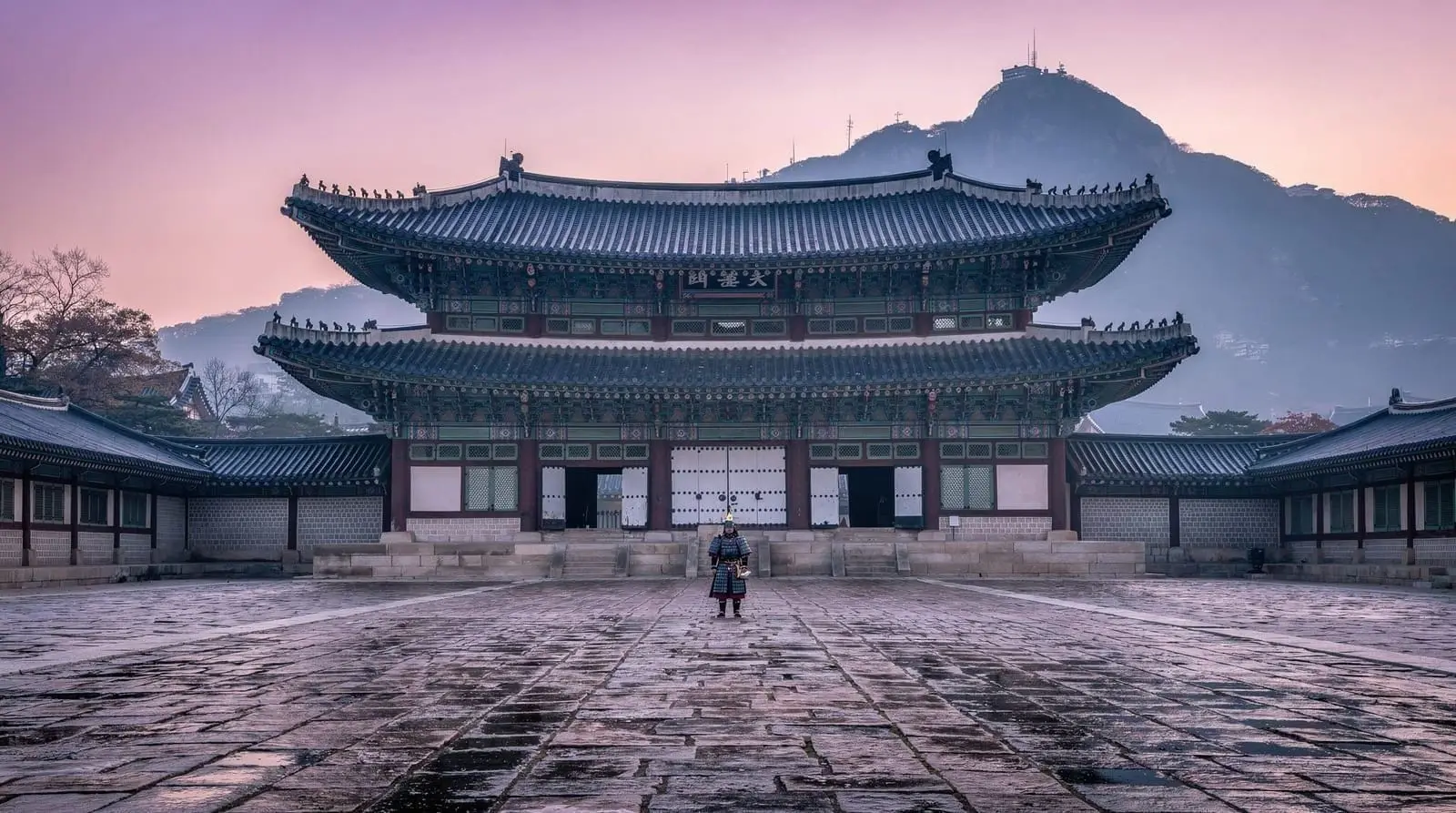
Seoul is 43 minutes from Incheon Airport by express train; from Incheon city center, take the AREX all-stop train to Gyeyang and transfer to Incheon Metro Line 1 (check live journey times on Naver Map or Kakao Map). For most travelers who spend time in Incheon, Seoul is an inevitable companion city — and for good reason. With 10 million residents (25 million in the metro area), Seoul has a density of things to do, eat, and see that rewards even 2–3 days of focused exploration. This guide focuses on what’s most relevant to Incheon visitors: how to get there, what to prioritize, and how to pair it with the rest of your trip.
| Where | 43 min from ICN Airport, 1 hr 10 min from Incheon city |
| Cost | Around 50,000–100,000 KRW/day mid-range |
| Time needed | 1–3 days |
| Getting there | AREX express or all-stop train, or subway line 1 |
| Best time | April for cherry blossoms, October for foliage |
Getting from Incheon to Seoul
From ICN Airport: The Airport Railroad Express (AREX) has two service types. The Express Train (직통) runs non-stop between Incheon Airport Terminal 1 and Seoul Station in 43 minutes; fare 9,500 KRW. The All-Stop Train makes 8 intermediate stops and takes about 59 minutes; fare 4,150 KRW. Both trains depart from the basement level of Terminal 1 and Terminal 2. T-money cards work on the all-stop train; the express train requires a separate ticket or T-money top-up.
From Incheon city center: Take subway line 1 from Incheon station directly to Seoul Station. Journey: about 1 hour 10 minutes, fare around 1,950 KRW. Transfers at Bupyeong or Guro are sometimes required depending on destination within Seoul.
Private transfer: If arriving with luggage or in a group, a private airport transfer to a Seoul hotel is more practical than managing luggage on the AREX. See the getting around Incheon guide for options.
Incheon Airport Transfer Directly to Seoul CityGyeongbokgung Palace and Bukchon
Gyeongbokgung (경복궁) is the largest and most photographed of Seoul’s five Joseon-era palaces. Entry: 3,000 KRW adults (free with traditional hanbok rental). The Changing of the Guard ceremony at the main gate (Gwanghwamun) runs at 10 a.m. and 2 p.m. most days; free to watch. Inside, the National Folk Museum is included with palace entry.
Seoul: Gyeongbokgung Palace Walking TourImmediately northeast of Gyeongbokgung is Bukchon Hanok Village — a hillside neighborhood of 900+ traditional Korean houses (hanok) preserved among narrow alleyways. The most-photographed view is from Gahoe-dong alley, looking down at the tiled rooftops with Namsan Tower in the background. Arrive before 10 a.m. on weekdays to avoid the most intense tour-group congestion. Residents post signs asking visitors to maintain quiet.
Seoul: Gyeongbok Palace, N Tower, & Local Market City TourInsadong, Myeongdong, and Namsan
Insadong: The main antiques, crafts, and traditional goods street. Best in the morning when independent shops open. The Ssamziegil courtyard mall at the center has interesting local design shops. Skip the tourist-facing souvenir stalls near the subway exit.
Myeongdong: Seoul’s main shopping and street food corridor. Dense, loud, and fun — the K-beauty stores are real (Etude House, Innisfree, Sulwhasoo) and the prices are competitive. Street food lane runs parallel: egg bread, tteokbokki, tornado potatoes, corn dogs with mozzarella (3,000–7,000 KRW each). Worth one evening, probably not two.
Namsan and N Seoul Tower: The 262 m Namsan Tower observation deck costs 21,000 KRW; the cable car to the base is 14,000 KRW return. The views at night are excellent but the experience is very tourist-oriented. Alternative: walk up Namsan hill from Itaewon for free views from the park below the tower.
Seoul: Bukchon Hanok Village Walking TourHongdae, Sinchon, and the Han River
Hongdae (홍대) is the university district around Hongik University, packed with bars, live music venues, indie fashion, and street performers (especially on Friday and Saturday nights). Most of the famous clubs are within a 15-minute walk of Hongdae metro exit 9. Entry to clubs: 10,000–20,000 KRW, sometimes including a free drink. Bars are more casual and cheaper.
Seoul: Itaewon Nightlife Tour & Premium Pub CrawlThe Han River is accessed via multiple parks along its 40 km Seoul stretch. Yeouido Hangang Park is the most visited, with convenience store food trucks, bicycle rentals, and a famous picnic culture where groups sit on tarpaulins and eat fried chicken with beer bought at the park 7-Eleven (fried chicken 16,000–18,000 KRW; beer 2,500 KRW). Best on warm evenings.
Seoul: Han River Night Picnic & Games with CruiseGwangjang Market and Bongeunsa Temple
Two further Seoul highlights are easy to miss but worth building into a longer stay:
Gwangjang Market (광장시장), Seoul’s oldest traditional market (opened 1905), is now best known for its street food alley — bindaetteok (mung bean pancakes), mayak gimbap (“addictive” mini rice rolls), and yukhoe (raw beef tartare). Stalls cluster in the market’s center; expect to pay 5,000–10,000 KRW per dish and to eat standing or on a stool.
Bongeunsa Temple (봉은사), an active Buddhist temple in the middle of Gangnam’s skyscraper district, is a striking contrast — traditional wooden halls and a giant stone Buddha statue surrounded by high-rises. Free to enter; templestay programs are available for those wanting a deeper experience.
Seoul: Gwangjang Market Street Food Tasting Walking TourSeoul on a day trip from Incheon
The essential day-trip circuit: AREX to Seoul Station → subway to Gyeongbokgung (line 3, Gyeongbokgung station) → palace + guard change → Bukchon alley → Insadong lunch → Myeongdong afternoon shopping → Namsan or Han River for sunset → AREX back from Seoul Station.
Total transit time in and out: 2–2.5 hours. Active exploring time: 7–8 hours. This is a full day and a packed one. The Incheon–Seoul 2–3 day itinerary maps a more relaxed version over multiple days.
Seoul: Hop-On Hop-Off Bus 1 & 2 Day or Night TourHow to pace your time in Seoul
The most common mistake is treating Seoul as a checklist. The city rewards a slower rhythm: one palace, one neighborhood for wandering, one meal you actually sit down for. If you have only a day, anchor it around the palace and Bukchon in the morning, then let the afternoon follow your appetite rather than a fixed schedule. Seoul’s neighborhoods each have a distinct mood, and moving between them by metro is easy once you are comfortable with the T-money card.
Mornings suit the quieter, traditional side of the city: palace courtyards, hanok alleys, and the craft shops of Insadong. Afternoons suit markets and shopping streets, when everything is open and lively. Evenings belong to the river, the hills above the city, and the student districts, where the energy peaks after dark. Planning along this arc keeps you from fighting crowds and gives each part of the day a clear purpose.
If the weather turns, Seoul has plenty of indoor options: museums inside the palace grounds, covered market alleys, and the large shopping streets. Rain on a palace day is not a disaster either, since wet roof tiles and empty courtyards photograph beautifully.
Combining Seoul with the rest of your Incheon trip
Seoul works best as one chapter of a longer story. Many travelers pair a Seoul day with a slower day on the coast, and the contrast is part of the appeal. Incheon Chinatown and the nearby open port heritage district give you a very different city, with old warehouses, harbor views, and a history that predates much of modern Seoul’s skyline. The Incheon in one day itinerary is a good companion if you want to balance a busy Seoul day with something more relaxed.
If you like modern architecture and wide boulevards, Songdo offers a calmer, planned-city counterpoint, with parks and waterside walks described in the Songdo Central Park guide. For island scenery, the Incheon island-hopping itinerary and the Yeongjongdo coastline are close to the airport and make a gentle first or last day around a flight.
History enthusiasts can extend beyond the city. The Suwon Hwaseong Fortress day trip is a natural follow-up to Seoul’s palaces, and the DMZ day tour from Seoul adds a very different layer of Korean history. For a scenic escape, the Nami Island day trip is a popular choice in any season.
Where to base yourself
Choosing where to sleep shapes how much time you spend on trains. Staying in Seoul makes early palace visits and late evenings easy. Staying in Incheon keeps costs and crowds lower and puts you close to the airport and the coast. Our where to stay in Incheon guide compares the options, and the Incheon on a budget guide shows how to stretch your money if you split nights between the two cities.
For first-time visitors, the question is often whether to commit to a Seoul hotel at all. If your flight is early or late, a night near the airport removes stress. If you want to enjoy Seoul after dark, a hotel in the city saves you from watching the clock for the last train. The Incheon vs Seoul comparison lays out the trade-offs in more detail.
Eating well in Seoul
Food is one of the best reasons to spend more than a few hours in the city. Beyond the street snacks of Myeongdong and the market stalls of Gwangjang, look for small neighborhood restaurants where the menu is short and the dishes are made all day. Pointing at what other diners are eating is a perfectly normal way to order, and many places have photo menus. Eat early or late to avoid lunch and dinner rushes, and always carry a little cash or a card for small stalls.
If you plan to eat your way across the region, the what to eat in Incheon article and the best things to do in Incheon list help you decide what to save for the coast, such as fresh seafood, and what to enjoy in the capital. Traveling with family? The Incheon with kids guide has ideas that also translate well to a Seoul day.
Getting around once you arrive
Seoul’s metro is clean, frequent, and clearly signed in English, which makes independent exploring simple. Plan routes in a navigation app, note the exit number for each destination, and allow extra time for long interchanges, which can feel like a small walk underground. For the wider picture of transport between the airport, Incheon, and the capital, see the getting around Incheon guide. If you are connecting through the airport on a short stopover, the Incheon airport 6-hour layover itinerary shows how much you can realistically fit in.
Practical information
- T-money card: Works on all Seoul metro, bus, and taxi fares. Buy and reload at any convenience store. Minimum reload 1,000 KRW; most journeys within Seoul cost 1,250–1,650 KRW.
- K-ETA: Passport holders from the 25 officially listed countries/regions (e.g. US, Canada, UK, Germany, France, Italy, Spain, Netherlands, Poland; not Portugal or Ireland) are exempt through December 31, 2026; other nationalities must get a K-ETA before boarding. See K-ETA visa guide.
- Taxi: Seoul taxis are honest and metered. Base fare 4,800 KRW; most city journeys are 8,000–15,000 KRW. Use Kakao T app to book (English available).
- Language: More English in Seoul than Incheon — subway announcements, menu photos, and tourist signage are widely bilingual.
- Safety: Seoul is very safe. See Incheon safety and language tips for general Korea safety notes.
- Tourism info: Seoul Tourism Organization at major metro stations; call 1330 for English assistance (24/7).
Frequently asked questions about visiting Seoul from Incheon
Is Seoul too far to visit on a layover at ICN Airport?
A layover visit to Seoul requires at least 6 hours between flights — 45 minutes each way on the AREX, plus customs/immigration time and security buffer. With 8+ hours, a focused circuit (palace + 1 neighborhood) is comfortable. See the Incheon airport layover itinerary for time-specific plans.
What is the cheapest way to get from Incheon Airport to Seoul?
The AREX all-stop train costs 4,150 KRW and takes 59 minutes to Seoul Station — the cheapest option. The express train is 9,500 KRW and saves 16 minutes. Airport limousine buses cost 10,000–12,000 KRW and go directly to hotel clusters (Myeongdong, Hongdae, Gangnam); slower but more convenient with luggage.
Should I buy a T-money card or a Discover Seoul Pass?
For most visitors, a T-money card loaded with 30,000–50,000 KRW handles all transit and is the best value. The Discover Seoul Pass (24h/48h/72h) includes palace entry and selected attractions and makes financial sense if you plan to visit 4+ paid attractions. Compare before buying.
Is Gyeongbokgung Palace worth visiting, or is it just for photos?
Both. The palace grounds are genuinely interesting (the National Folk Museum inside is excellent, free with entry), and the architecture rewards slow walking. The photo opportunity at the main gate with the guard ceremony is spectacular. Allow at least 2 hours for the palace compound and a walk through Bukchon.
What neighborhood should I stay in Seoul?
For day-trip connections to Incheon: Hongdae (line 2, close to AREX at Gimpo Airport station) or Sinchon. For sightseeing focus: Insadong or Jongno-gu (walking distance to palaces). For nightlife: Hongdae or Itaewon. For budget accommodations: Jongno-gu guesthouses from 35,000 KRW/night.
How do I get from Seoul to Suwon, Nami Island, or the DMZ?
- Suwon: subway line 1 from Seoul Station, about 45 minutes, 1,750 KRW.
- Nami Island: ITX-Cheongchun train from Yongsan station to Gapyeong, then shuttle, about 90 minutes total.
- DMZ/Paju: organized tour from Seoul is the most practical option; 3–5 hours including transport.
Is Gwangjang Market worth visiting if I’ve already tried Myeongdong street food?
Yes — they’re different experiences. Myeongdong’s street food is walk-and-eat snacks aimed at tourists; Gwangjang Market is a genuine local food destination with sit-down stalls, raw beef tartare, and dishes you won’t find on Myeongdong’s main strip. Go hungry and try mayak gimbap.
How many days should I spend in Seoul if I’m also visiting Incheon Chinatown, Songdo, and the DMZ?
Plan at least 2 full days in Seoul on top of separate days for Incheon Chinatown, Songdo, and the DMZ — each of those is close to a full day itself. The Incheon–Seoul 2–3 day itinerary builds a realistic combined schedule.


