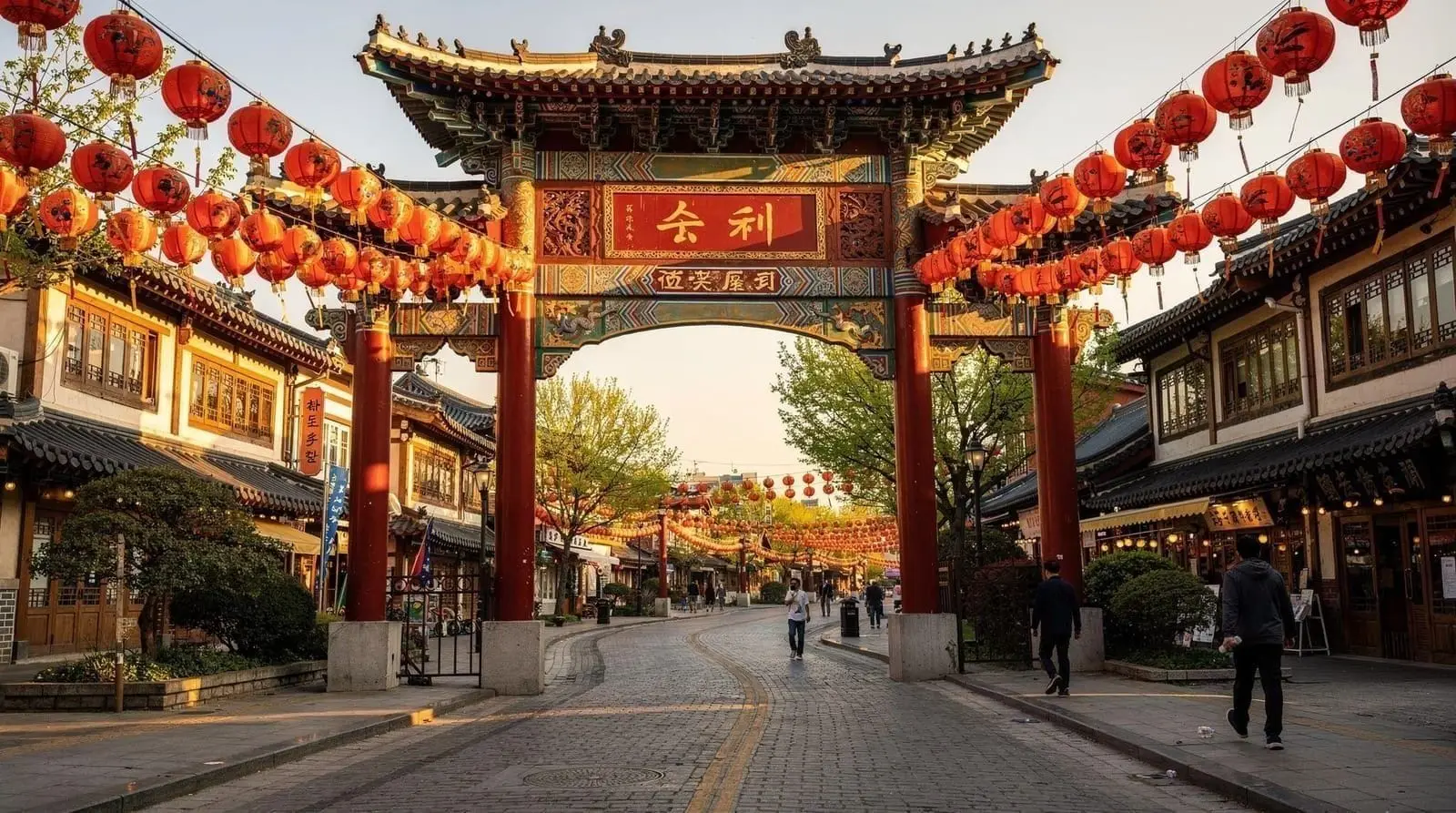
Korea’s only Chinatown sits in a compact grid of painted gates, dumpling kitchens, and century-old trading houses just minutes from Incheon’s main metro station. The Open Port district that surrounds it is where modern Korea began: in 1883 the port was forced open under foreign treaty, and the customs house, Japanese bank buildings, and Chinese consulate that remain are some of the best-preserved examples of late-19th-century colonial architecture on the peninsula. You can walk the entire area without spending a single won on entry fees — but you’ll almost certainly spend money on food.
| Where | Incheon station, Line 1, Exit 1 |
| Cost | Free to walk; around 10,000–20,000 KRW for a meal |
| Time needed | Half a day to a full day |
| Getting there | AREX from ICN Airport to Gyeyang, then Incheon metro line 1, 1 hr 10 min from Seoul Station |
| Best time | Weekday mornings; early April for cherry blossoms in Jayu Park |
What to see in Incheon Chinatown
Incheon’s Chinatown covers roughly six blocks, centered on Paeruimun Gate (the red gate at Exit 1 of Incheon metro station). The street is lined with restaurants competing on jjamppong (spicy seafood noodle soup, around 10,000–13,000 KRW) and jjajangmyeon (black bean noodles, 8,000–10,000 KRW). Both dishes were invented here by Chinese immigrants in the early 1900s and spread nationwide. Ignore any restaurant that posts photos of customers or celebrities at the door — that’s a tourist-trap signal. The best bowls are in plain storefronts on the side streets.
The Songwol-dong Fairy Tale Village is a short walk uphill from the Chinatown gate. Murals covering retaining walls and staircases were painted between 2012 and 2015 to revive a declining residential neighborhood; the effect is cheerful, the crowds manageable on weekday mornings, and the views down toward the port are good. Budget 30–45 minutes here.
For a deeper look at the neighborhood’s food culture and the history behind jjamppong, the Incheon Chinatown walking tour guide covers the best stalls and how to order without Korean.
Incheon: Walk and Eat with Local Walking BuddyThe Open Port heritage trail
The Open Port zone occupies the blocks between Chinatown and the waterfront. Pick up a free map at the Incheon Open Port Museum (free entry, closed Mondays) at 89 Sinpo-ro 23beon-gil. The museum occupies the former Japanese First Bank building (1892) and does a solid job of explaining what forced-open ports meant in 19th-century East Asia without sugarcoating it.
Key stops on the trail:
- Incheon Art Platform — a cluster of 13 restored warehouses from the 1930s now used as artist studios and exhibition spaces. Entry is free; check the schedule online for performances.
- Japanese 18th Bank building (1890, now a cultural space)
- Japanese Customs House (1906, now a small museum)
- Jayu Park — Korea’s first Western-style public park (1888), perched on a hill above the port with a bronze statue of General MacArthur. The park overlooks the bay where the 1950 Incheon Landing took place. Cherry blossoms here in early April are spectacular. Free.
The Incheon Open Port heritage guide walks each building with dates and architectural context. If you want the history of Jayu Park and the MacArthur statue (which is politically loaded in Korea), the Jayu Park and Korean War history guide gives the full story.
Incheon Landing Operation: History Tour with Col VINCEROHow to pace the walk
The district rewards a slow, looping route rather than a straight line. A sensible order is to start at the Chinatown gate before the lunch crowds arrive, drift uphill to the murals of Songwol-dong Fairy Tale Village, then come down toward the old bank and customs buildings and finish at the waterfront side of the Open Port zone. Doing it in this direction keeps the climb early, while your legs are fresh, and leaves the flat, café-lined streets for the end of the day. If you would rather have the route laid out step by step, the Incheon Chinatown walking tour follows the same loop with stops marked.
Leave room in the schedule for doing nothing in particular. Some of the best moments here are unplanned: a bakery window, a courtyard behind a restored warehouse, a bench at Jayu Park with the harbor spread out below. Travelers who tick off every building tend to remember less than those who stop for a coffee in one of the converted houses; the best cafés in the Open Port area are a good place to pick one.
Seasons, weather and what to wear
Most of this visit happens outdoors, so the weather shapes the day more than it does in a museum city. In spring and autumn the streets are comfortable all day and the light on the old facades is at its best for photographs. In high summer the hill up to Jayu Park and the murals feels long, so carry water, wear a hat and plan indoor stops at midday. In winter the wind off the bay can be sharp; a warm layer and a hot bowl of noodles make a good pairing. For a wider view of the calendar, see the best time to visit Incheon, and for the spring flowers specifically, the Incheon cherry blossom spring itinerary.
Comfortable shoes matter more than anything else you pack. Many of the lanes are cobbled or steep, and the mural staircases are uneven. A small day bag is enough; there is no need to carry luggage around, so if you are arriving straight from the airport, sort out your bags first.
Why this district suits different travelers
Families will find the open streets and the colorful gates easy to enjoy with children, and the food is forgiving for picky eaters. Our notes on visiting Incheon with kids cover how to string the stops together without tiring anyone out.
Photographers should come early on a weekday, when the lanes are quiet and the painted gates are free of crowds. The Instagram photo spots in Incheon list pairs well with this area.
Budget travelers have an easy time, since walking the district costs nothing and a single noodle meal can fill the whole afternoon. Incheon on a budget shows where else the savings add up.
Layover passengers can treat this as the most rewarding short excursion from the airport, provided the connection is long enough; the 6-hour layover itinerary explains how to time it safely.
Getting there from Seoul and Incheon Airport
From Seoul Station: Take subway line 1 (Incheon direction) directly to Incheon station. Journey time is about 1 hour 10 minutes; fare is around 1,950 KRW (T-money). The Chinatown gate is 3 minutes on foot from Exit 1.
From Incheon Airport (ICN): Take the AREX all-stop train to Gyeyang, then change to Incheon metro line 1 to Incheon. Journey time depends on connections; check the live duration on Naver Map or Kakao Map. A private transfer is faster if you’re with 2+ people and have luggage.
Within Incheon: Subway line 1 connects Incheon station to Bupyeong (10 min) for the underground shopping market, and to Juan (20 min) for Incheon Grand Park. Wolmido Island is a 20-minute bus ride (bus 2, 23, or 45) or a 6,000 KRW taxi from Incheon station.
Where to eat: honest picks
Jjamppong: Gonghwachun (1912-founded, queue after 11 a.m.) and Junghwaru are the most cited originals. Expect 10,000–12,000 KRW per bowl.
Tanghulu: Candied strawberry or grape skewers appear on every corner; 2,000–4,000 KRW each. Quality varies. Buy from stalls with high turnover.
Korean Chinese fusion: The Sinpo International Market (see our Sinpo guide) is 10 minutes’ walk from Chinatown and offers dakgangjeong (sweet fried chicken) that’s now arguably more famous than Chinatown’s noodles — the original stall has been there since the 1980s.
For a full eating itinerary combining Chinatown, Sinpo Market, and the Open Port cafes, see Where to eat in Incheon Chinatown.
Incheon Chinatown, Rail Bike, and Eco Park from SeoulChinatown vs Sinpo Market vs Bupyeong Market
Incheon has three distinct market/food districts, and first-time visitors often confuse them:
| Area | Character | Signature food | Time needed |
|---|---|---|---|
| Incheon Chinatown | Historic, touristy, colorful gates | Jjajangmyeon, jjamppong | 3–4 hours |
| Sinpo International Market | Local covered market, 10 min walk away | Dakgangjeong (sweet fried chicken) | 1–1.5 hours |
| Bupyeong Underground Market | Massive underground shopping arcade | Street food stalls, fashion | 1–2 hours |
All three can be combined in one day if you start early — Chinatown and Sinpo Market are close enough to walk between, while Bupyeong requires a short metro ride.
Combining Chinatown with other Incheon zones
The natural sequence for a full-day Incheon visit is: Chinatown + Open Port in the morning → Wolmido Island lunch (20 min by bus) → seafood by the sea. Alternatively, pair it with Songdo for a contrast between 19th-century port history and ultra-modern smart city (40 min by subway).
If you have more time, a 1-day Incheon + Seoul itinerary slots Chinatown at the start before heading to Seoul in the afternoon.
Where to go next
Once the walk is done, you have several easy ways to extend the day. Seafood and sea air are close at hand on Wolmido Island, and the Wolmi Sea Train gives a relaxed loop over the water. If you prefer to stay with the history, the Incheon in one day itinerary links this district with other stops, and where to stay in Incheon helps if you decide to turn a day trip into an overnight visit. For getting between districts without stress, getting around Incheon explains the transit options in plain terms.
Practical information
- Opening hours: Streets and Jayu Park are open 24/7. Incheon Open Port Museum: 9 a.m. – 6 p.m., closed Mondays. Incheon Art Platform: check schedule.
- Admission: Everything outdoors is free. The Incheon Open Port Museum is free.
- Toilets: Public restrooms at Jayu Park entrance and near the Chinatown gate.
- Language: Restaurant menus usually have photos. Most restaurants lack English menus, but pointing at the Korean-Chinese standard dishes (jjajangmyeon, jjamppong) works everywhere.
- Tourist info: Incheon Tourism Information Center is at Incheon station, Exit 2. Staffed in English during daytime hours. Tourism hotline 1330 (24/7, English).
- Best days: Weekday mornings are least crowded. Weekends bring Korean day-trippers from Seoul; arrive before noon to avoid long restaurant queues.
Frequently asked questions about Incheon Chinatown and the Open Port
How long does it take to walk through Incheon Chinatown?
The Chinatown streets themselves take 30–45 minutes at a relaxed pace. Add Jayu Park (30 min), the Fairy Tale Village mural trail (30 min), and the Open Port heritage trail (1–1.5 hours) and you’re looking at a 3–4 hour circuit, not counting meal time.
Is Incheon Chinatown tourist-trappy?
Some restaurants targeting tour groups exist, but the core of the neighborhood is still a working restaurant district serving Korean-Chinese food to local visitors. Stick to side streets and storefronts without big English signage and you’ll eat authentically. Prices are fair by Seoul standards.
Can I visit Incheon Chinatown during a layover at ICN Airport?
Yes, but plan carefully. Budget 1 hour 20 minutes travel each way, plus 3–4 hours in the neighborhood — so you need at least 6 hours between flights (more comfortably 8). The Incheon airport layover itinerary guide covers this scenario in detail.
What is the Open Port district?
The Open Port district (개항장) refers to the area around Incheon’s original commercial harbor, which was opened to foreign trade in 1883 under the Korea-US Treaty of Peace, Amity, Commerce and Navigation. It contains the highest concentration of late 19th- and early 20th-century Western and Japanese colonial architecture in Korea.
Are there entrance fees in the Open Port heritage zone?
The streets and exteriors are free to walk. The Incheon Open Port Museum (inside the former First Bank building) has no entry fee. The Incheon Art Platform is also free for most exhibitions; ticketed performances vary by event.
What is the best dish to try in Incheon Chinatown?
Jjajangmyeon (black bean noodles) and jjamppong (spicy seafood noodle soup) are the essential dishes — both were created by Chinese immigrants in Incheon in the early 1900s. A set meal with one of each costs around 18,000–22,000 KRW.
How do I get to Incheon Chinatown from Incheon Grand Park or Songdo?
From Incheon Grand Park: take subway line 1 from Juan station to Incheon station (about 25 min). From Songdo: take metro line 7 (Incheon line) to Bupyeong station, then transfer to line 1 toward Incheon (about 40 min total).
Is Incheon Chinatown better than Sinpo Market or Bupyeong Underground Market?
They serve different purposes rather than competing directly. Chinatown has the historic atmosphere and the two signature noodle dishes; Sinpo Market has better everyday street food value; Bupyeong Underground Market is best for shopping. Combine all three if you have a full day.
Can I see Incheon Chinatown and Wolmido Island in the same afternoon?
Yes, and it’s one of the most popular half-day combinations. Bus 2 runs from just outside the Chinatown gate to Wolmido in about 15–20 minutes, making it easy to do Chinatown lunch followed by Wolmido’s sea train and seafood dinner.


