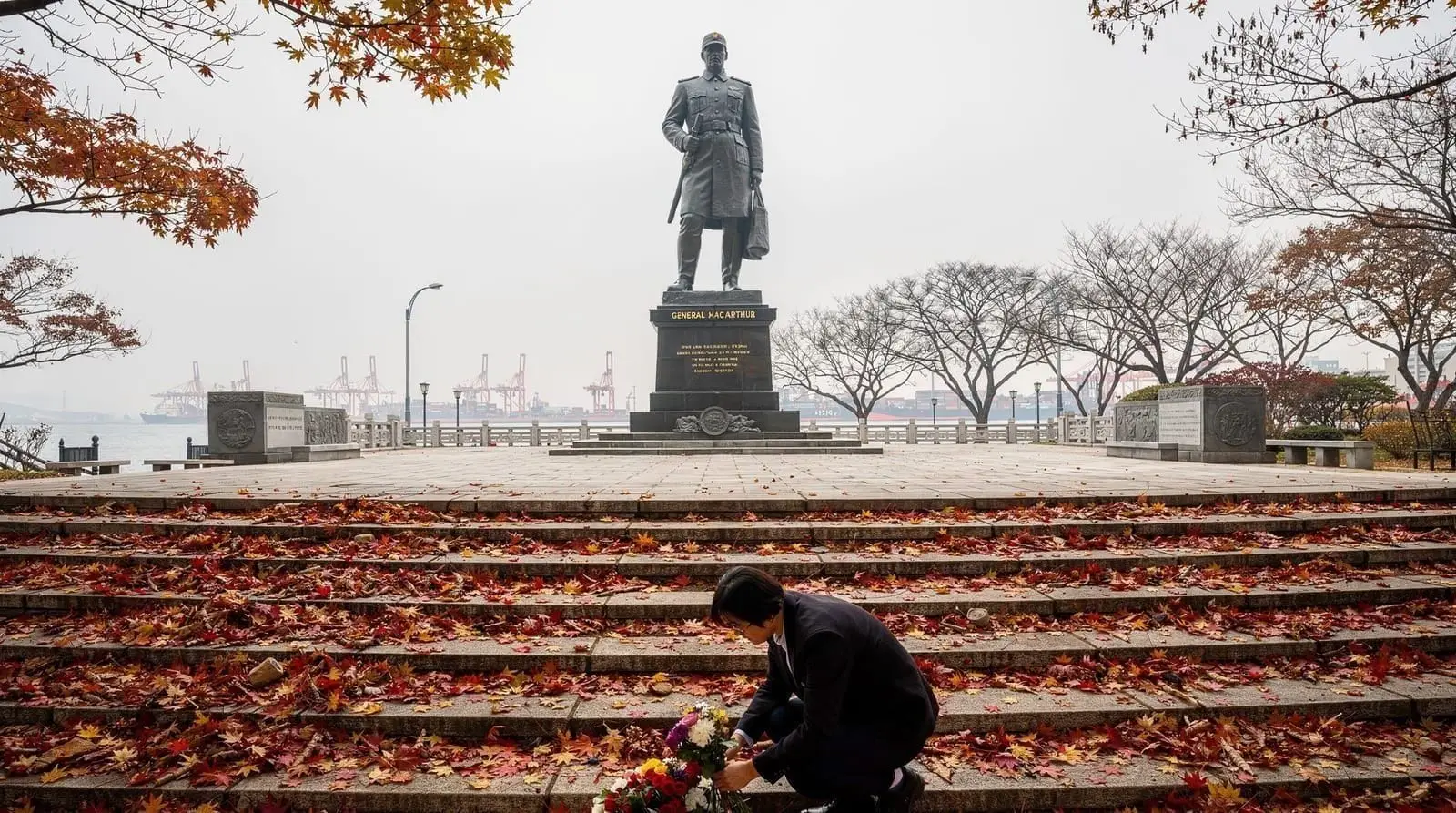
Jayu Park and the Incheon Landing: history, views, and MacArthur's monument
Is Jayu Park free to enter and how do you get there from Chinatown?
Yes, free and open 24 hours. From the Paeruimun Gate at the top of Chinatown, it's a 10-minute uphill walk via stairs. From Incheon metro station it's about 15 minutes on foot or a short taxi ride for around 4,000 KRW.
Jayu Park (자유공원) sits on a low ridge above Incheon’s waterfront, high enough to see the harbor entrance where one of the most consequential military operations of the 20th century took place in September 1950. The park is quiet on weekdays, free to enter, and takes about an hour to walk properly. Most visitors come for the MacArthur statue and the view. The people who linger tend to be Korean military veterans, history students, and the occasional foreigner who has done enough reading to understand why this particular hillside matters.
The statue of General Douglas MacArthur — 9 meters tall, cast in bronze, facing the sea — stands at the center of the park. It was erected in 1957, seven years after the Incheon Landing it commemorates. MacArthur is a polarizing figure in Korea, more than many foreign visitors realize, and understanding that complexity makes a visit to this park considerably more interesting than simply photographing a large monument.
| Where | Jayu Park, Jung-gu, Incheon — hilltop above Chinatown |
| Cost | Free, 24 hours, no tickets |
| Time needed | 45–60 minutes, longer with the Chinatown walk-up |
| Getting there | 10–15 min uphill walk from Incheon Station/Chinatown, or ~4,000 KRW taxi |
| Best time | Late afternoon for statue photography; weekday mornings for solitude |
Korea’s first Western-style public park
Jayu Park predates the Korean War by more than six decades. It was established in 1888 by the foreign concession communities that had taken root in Incheon after the port was forced open in 1883. British, American, Japanese, and Chinese residents each held designated territory around the port, and the hilltop was developed as a shared green space — a pocket of imported 19th-century European park design on a Korean ridge, with paths, benches, and plantings laid out in the style that concession communities replicated across East Asian treaty ports from Shanghai to Yokohama.
The park was then called Manggukgongwon (만국공원), which translates roughly as “All Nations Park” — a name that reflected the multinational character of the concession zone at its base. After 1945 and Korean independence, it was renamed Jayu Park (Freedom Park). The current name carries different weight depending on which freedom it’s understood to refer to: liberation from Japanese colonial rule in 1945, or the freedom defended and contested during the Korean War five years later.
The concession-era traces in the park are subtle — a few stone markers, the basic layout of the paths — but the surrounding Open Port district at the base of the hill preserves far more. The Incheon Open Port heritage guide covers the customs house, the former Japanese bank buildings, and the surviving consulate structures in detail.
The Korean War and why Incheon matters
To understand Jayu Park’s significance you need the war’s context, compressed into a few facts.
North Korea invaded South Korea on June 25, 1950. Within three days Seoul had fallen. By August, UN forces — predominantly American, fighting under a UN mandate — had been pushed back to a small defensive perimeter around the southern port city of Busan. The perimeter held, but only barely. The war appeared to be going extremely badly for the South.
General Douglas MacArthur, commanding the UN forces, proposed an amphibious landing far behind enemy lines at Incheon. The plan was considered reckless by most military planners. Incheon’s harbor has one of the largest tidal ranges in the world — approximately 9 meters between high and low tide. At low tide the harbor approaches become mud flats impassable by landing craft. The windows of navigable water were extremely short — a few hours per day on specific dates. If the operation slipped, or if it met significant resistance, the landing force would be stranded in shallow water or on open beach with no cover.
MacArthur argued the risk was precisely the point: the Koreans and Chinese would consider Incheon impossible and therefore leave it lightly defended. He was largely right.
On September 15, 1950, approximately 75,000 UN troops landed at Incheon in Operation Chromite. The Marine assault seized the key terrain by the afternoon of the first day. Seoul was recaptured on September 28, 1950 — two weeks after the landing. The operation reversed the course of the war, at least temporarily, cutting off North Korean supply lines and forcing a rapid retreat northward.
What followed is more complicated: the subsequent push north toward the Chinese border provoked China’s entry into the war in October 1950, leading to a full reversal and a years-long grinding conflict along the 38th parallel that ended not with a peace treaty but an armistice in 1953. The armistice line is still the border today, meaning the Korean War is technically not over. The DMZ that resulted is visible on any map of the peninsula, and understanding Incheon 1950 helps explain why the DMZ exists where it does.
For those wanting to visit the DMZ itself, the DMZ day tour from Seoul guide covers the practical logistics of organized tours from Seoul, which remains the most accessible way for most visitors to see the Joint Security Area and the tunnel systems.
Seoul: National Museum & War Memorial Korea Small Group TourThe MacArthur Statue
The bronze MacArthur stands on the park’s main viewing platform, left hand resting on his belt, right hand raised holding binoculars — gazing westward over the harbor from which his landing force came. The pose is deliberate and theatrical, which fits MacArthur’s historical personality accurately. He was, by most accounts, intensely conscious of how he appeared in photographs and newsreel footage.
The statue is 9 meters tall, erected by Korean veterans’ organizations in 1957 with American support, four years after the armistice and two years after MacArthur’s death. The inscription at the base honors Operation Chromite and the UN forces who participated.
A note on complexity: MacArthur’s legacy in Korea is genuinely contested, and the statue is sometimes a site of protest. South Korean progressive and nationalist groups have periodically called for its removal, citing MacArthur’s role in decisions — including his push toward the Yalu River that triggered Chinese intervention — that prolonged the war and caused enormous casualties. Veterans’ groups and conservative Korean political factions defend the statue strongly. The debate surfaces publicly every few years and reflects deeper South Korean conversations about the war, the American alliance, and national sovereignty.
None of this makes the statue less worth seeing. If anything, knowing that a 9-meter bronze in a quiet hilltop park is a site of ongoing political contention makes it more interesting than a simple memorial. Approach it with the same historical attention you’d bring to contested monuments anywhere in the world.
For visitors who want the specific numbers behind the operation: Operation Chromite involved roughly 261 ships in the invasion fleet, the largest amphibious force assembled since the Second World War at that point. The tidal window that made the landing so risky gave commanders as little as two to three hours of navigable water on the critical dates of September 15, meaning the entire first wave had to land, unload, and secure a beachhead before the tide turned again.
Casualties in the initial assault were comparatively light — a few hundred UN dead and wounded against a lightly defended garrison — which is part of why the operation is studied in military academies as a case study in calculated risk paying off, distinct from the much bloodier and more contested decisions that followed it further north.
Incheon Landing Operation: History Tour with Col VINCEROWhat to see in Jayu Park
The main viewing platform directly in front of the MacArthur statue looks west and southwest over the harbor. On a clear day you can see the Incheon Bridge — the cable-stayed bridge connecting the mainland to Yeongjongdo Island — and on exceptionally clear days the islands of the outer bay. The view is best in the late afternoon when the light falls on the harbor from the west.
Jayu Pavilion (자유정) is a traditional Korean wooden pavilion positioned on a slightly elevated point north of the MacArthur statue. It was built as a viewing structure and functions well for that purpose — the lines of its tiled roof against the harbor behind it make for a photogenic composition. The pavilion is used as a rest point by elderly Koreans who walk the park in the mornings.
Memorial plaques and historical markers are scattered along the main paths, in Korean and English. They document Operation Chromite with maps, photographs, and unit designations. The English translations are workmanlike rather than polished, but they’re accurate enough to follow.
The park’s tree canopy is worth noting separately. The ridge has mature zelkova, pine, and ginkgo trees that are several decades old. In early April the cherry blossoms at the lower edges of the park bloom alongside those in Chinatown below, making the walk from the Paeruimun Gate up to the park particularly scenic. The Incheon cherry blossom spring itinerary maps out the best viewing sequence through the area.
In autumn — October through early November — the ginkgos turn yellow and the park takes on a completely different character: quieter than spring, with fallen leaves on the paths and a lower angle of afternoon light across the harbor. Neither season requires anything other than comfortable shoes and about an hour.
The other Incheon Landing memorials worth knowing about
Jayu Park’s MacArthur statue is the best-known Incheon Landing memorial, but it is not the only one, and understanding how they relate helps put the park in context. Wolmido Island, a short bus ride west of Chinatown, was a key initial objective of the landing — Marine units seized it hours before the main assault on the mainland — and carries its own scattered plaques, covered in the Wolmido Island guide.
The Incheon Landing Operation Memorial Hall, further from the city center, holds a more extensive collection of artifacts, uniforms, and a diorama of the operation, and is the better stop if you want depth beyond what Jayu Park’s outdoor markers provide. Jayu Park remains the most accessible and most symbolically loaded of the three, since it is the site where the commemorative statue itself stands, overlooking the actual harbor where the landing happened.
Getting to Jayu Park
From Incheon metro station (Line 1, Exit 1): Walk uphill through Chinatown — through the Paeruimun Gate and along the main restaurant corridor — and continue up the staircases at the far end. The walk takes 15 minutes at a normal pace. It is uphill throughout, but the gradient is manageable. The staircase sections have handrails.
From the Chinatown main area (Paeruijang Gate): Once you’re in Chinatown, the park is a 10-minute walk up the stairs at the north end of the main street. You cannot miss the signs in English.
By taxi from Incheon Station: Approximately 4,000 KRW ($3) and 5 minutes. Useful if you have mobility constraints or heavy luggage. Tell the driver “자유공원” (Jayu Park).
Entry and hours: Free entry, open 24 hours. There are no gates. The park is lit at night at the main statue area but the surrounding paths are dark; a daytime visit is strongly recommended.
Parking: A small lot exists at the road approach on the north side of the park, but the walk from Chinatown below is more logical for most visitors arriving by metro.
Photography notes
The MacArthur statue faces west. This means afternoon light — from around 2pm onward — falls directly on the face and front of the statue, while morning visits produce backlit shots or deep shadows in the face. For portraits in front of the statue, late afternoon is significantly better.
The harbor panorama from the viewing platform photographs well in all light conditions. Haze is the main variable: on humid summer days the visibility drops and the Incheon Bridge disappears in mist. Spring and autumn offer the clearest air.
The Jayu Pavilion photographs cleanly with the harbor as background if you stand to the northeast of the structure. The photogenic angle from inside the pavilion looking out toward the harbor is the most common framing visitors use.
Seoul: War Memorial of Korea Guided TourCombining Jayu Park with the surrounding area
The park works best as part of a half-day circuit that includes Chinatown and the Open Port district below. A logical sequence:
Arrive at Incheon Station around 11am. Walk into Chinatown, eat jjajangmyeon at one of the main restaurants (more detail in the where to eat in Incheon Chinatown guide). Walk up through the Chinatown streets to Jayu Park — 45 minutes to an hour in the park is enough to read the markers, see the statue, and take in the harbor view. Descend on the north side of the hill to the Open Port district, visit the Incheon Open Port Museum (free, closed Mondays), and walk the heritage trail along the waterfront before catching the metro back.
Total time: 4–5 hours. This is the recommended sequence in the Incheon in one day itinerary for visitors coming from Seoul on a day trip.
For the Incheon Chinatown walking tour, Jayu Park is the endpoint of the uphill walk, with the descent leading through the Open Port heritage zone.
Travelers with a specific interest in Korean War history may want to combine this visit with a DMZ tour. The DMZ day tour from Seoul explains how to book organized tours that visit Panmunjeom, the Joint Security Area, and the third tunnel — all of which extend the narrative that begins at the Incheon harbor in September 1950. The two sites are about 90 kilometers apart and work well as separate days on a Seoul-based itinerary.
For those arriving by air, the Incheon airport layover itinerary covers how much time Jayu Park and Chinatown realistically require relative to AREX journey times and airport check-in windows.
Seasonal considerations
Spring (late March–early April): Cherry blossoms at the park’s edges and in Chinatown below bloom simultaneously, making the uphill walk from the gate to the park particularly scenic. This is the most popular time to visit; expect more visitors on weekends but the park is large enough that it never feels crowded.
Summer (June–August): Humid and hot. The tree canopy provides some shade on the park’s paths, but the main viewing platform is exposed. Morning visits before 10am are most comfortable. Visibility on summer haze days can reduce the harbor view significantly.
Autumn (October–early November): The ginkgo trees in and below the park turn yellow. Autumn light on the harbor in the late afternoon is the most photogenic condition for the statue and panorama. The Incheon autumn foliage hiking itinerary builds a longer route that includes the park as a starting point.
Winter (December–February): Cold and usually clear — the harbor views are at their sharpest in winter when the air is dry. The park is quiet, the cherry blossom tourists are gone, and you can stand at the MacArthur statue in near-solitude on a weekday. Worth the cold.
Practical information summary
- Address: 3 Jayu Park-gil, Jung-gu, Incheon (자유공원길 3, 중구, 인천)
- Nearest metro: Incheon Station, Line 1, Exit 1
- Entry: Free, 24 hours
- Time needed: 45–60 minutes
- Best photography: late afternoon (west-facing statue)
- Nearest food: Chinatown below (10-min walk)
- Accessibility: Staircase approach; a road approach from the north is accessible by taxi for visitors with mobility constraints
For broader context on navigating the Incheon metro and bus network to reach this and other sites, the getting around Incheon guide has route details. The where to stay in Incheon guide covers accommodation options in the Chinatown and Jung-gu area if you want to be within walking distance of the park.
Frequently asked questions about Jayu Park and the Incheon Landing
What is Jayu Park in Incheon?
Jayu Park is a hilltop public park in Jung-gu, Incheon, established in 1888 as Korea’s first Western-style public park. Today it is primarily known for the 9-meter bronze statue of General Douglas MacArthur, erected in 1957 to commemorate the Incheon Landing of September 1950. The park is free to enter and open 24 hours.
What happened at the Incheon Landing in 1950?
On September 15, 1950, approximately 75,000 UN troops under General MacArthur’s command landed at Incheon in Operation Chromite. The amphibious landing, considered highly risky due to the harbor’s extreme 9-meter tidal range, succeeded in breaking North Korean supply lines. Seoul was recaptured on September 28. The landing is widely regarded as a pivotal turning point in the Korean War, though subsequent decisions pushed the conflict north and triggered Chinese intervention.
Why is the MacArthur statue controversial in Korea?
MacArthur is honored by veterans’ groups for leading the operation that saved South Korea from occupation. However, his decision to push UN forces toward the Chinese border after the landing is credited by critics with provoking China’s entry into the war, prolonging the conflict and causing enormous additional casualties. South Korean progressive and nationalist groups have periodically called for the statue’s removal; conservative and veterans’ groups defend it strongly. The statue is occasionally a protest site.
How long does a visit to Jayu Park take?
Forty-five minutes to an hour covers the MacArthur statue, the Jayu Pavilion, the harbor panorama, and the memorial markers. If you combine it with the walk from Chinatown below, add 15–20 minutes each way. Most visitors include it as part of a half-day Chinatown and Open Port circuit rather than visiting the park alone.
When are the cherry blossoms at Jayu Park?
Cherry blossoms in and around Jayu Park typically peak in late March to early April, timing that varies by roughly one to two weeks depending on the year. They bloom simultaneously with cherry trees in Chinatown below, making the uphill walk from the metro station particularly scenic during peak bloom. For specific annual bloom timing, check Korea Meteorological Administration forecasts in mid-March.
Can you see the harbor from Jayu Park?
Yes. The main viewing platform in front of the MacArthur statue looks west and southwest over Incheon’s inner harbor. On clear days the Incheon Bridge connecting the mainland to Yeongjongdo Island is visible. Visibility is best in autumn and winter; summer humidity and haze can reduce the view significantly. Late afternoon provides the best light on the harbor surface.
Is Jayu Park worth visiting if I’m not interested in the Korean War?
Yes, for two reasons: the harbor view is genuinely good, and the park’s history as Korea’s first Western-style public park — dating to 1888, built by foreign concession communities — is interesting independently of the war memorial aspect. The park also pairs well with Chinatown below and the Open Port heritage buildings, which tell a different layer of Incheon’s 19th-century story. If Korean War history is your specific interest, combining Jayu Park with a DMZ tour creates a more complete picture of the conflict’s arc.
What is the best time of day to photograph the MacArthur statue?
The statue faces west, toward the harbor. Afternoon light from roughly 2pm onward falls on the front of the statue and produces the best results for photography. Morning visits result in backlit conditions with the face in shadow. Late afternoon in autumn or winter, when the sun is lower and the air is clearer, gives the best combination of light quality and harbor visibility.
Are there other Incheon Landing memorials besides Jayu Park?
Yes. Wolmido Island, west of Chinatown, was seized in the opening hours of the landing and has its own scattered markers, covered in the Wolmido Island guide. The Incheon Landing Operation Memorial Hall holds a more detailed artifact collection for visitors who want to go beyond the outdoor statue and plaques at Jayu Park.
Is Jayu Park suitable for visitors with limited mobility?
The main approach from Chinatown involves stairs and a sustained uphill gradient, which is not ideal for wheelchair users or visitors with significant mobility limitations. A taxi to the road approach on the park’s north side is the practical alternative — tell the driver “자유공원” (Jayu Park) — though even from there some walking within the park is required to reach the statue and viewing platform.
DMZ tours from Incheon on GetYourGuide
Top-rated tours and activities


