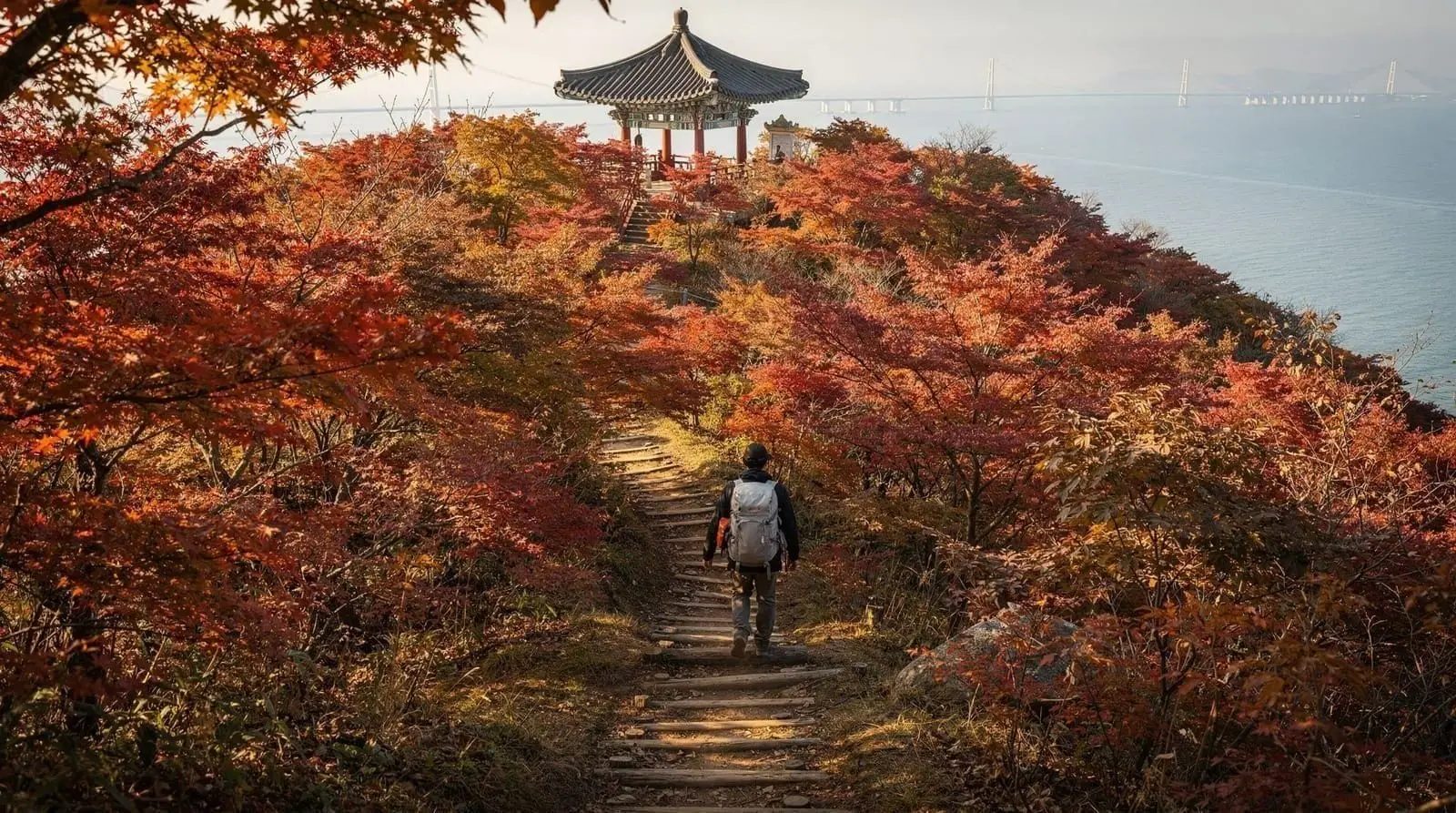
Incheon autumn foliage and hiking — 3-day October itinerary
October in Incheon — the quiet season that rewards hikers
Spring gets the blossom headlines, but autumn is the season that Korean hikers and photographers actually plan around. October brings cooling temperatures (14–20°C by day), low humidity, reliably clear skies, and a foliage sequence that starts in the mountain highlands in late September and moves steadily southward through October, reaching the Incheon coast by mid-month.
This three-day itinerary uses Incheon as a base and fans out to two destinations that autumn transforms completely: Nami Island in Gapyeong, where the famous metasequoia and ginkgo avenues turn deep red and gold, and Ganghwa Island, where 14th-century Buddhist temples sit inside hillside fortresses draped in maple and oak. Day three stays closer to Incheon for coastal trail hiking and an urban foliage loop.
The pace throughout is moderate — comfortable walking distances with genuine elevation gain only on Ganghwado’s Jeondeungsa trail. No special gear is required beyond comfortable hiking shoes and layers for the morning chill.
| Where | Nami Island (Gapyeong), Ganghwa Island, Incheon coastal trails |
| Best time | October 10-20 for peak foliage |
| Cost | roughly ₩190,000-275,000 per person for 3 days |
| Difficulty | Moderate; steepest section is Jeondeungsa’s fortress wall |
| Getting there | Public transport throughout — metro, ITX train, ferry, bus, taxi |
When does autumn foliage peak in the Incheon area?
Foliage timing in Korea follows elevation and latitude. Mountains north of Seoul (Seoraksan, Dobongsan) peak in late September. Seoul city parks follow in early to mid-October. Incheon and its islands, which sit at lower elevation and near the tempering influence of the Yellow Sea, typically see peak foliage in the second and third weeks of October.
Rough timeline for the Incheon region:
- Late September: mountain foliage begins; Gapyeong highlands at peak
- October 1–10: Nami Island’s metasequoia begins turning; ginkgo trees in Seoul and Incheon going yellow
- October 10–20: best window for this itinerary across all three destinations
- October 20–31: late foliage; some trees past peak, others still holding; fewer crowds
- Early November: bare branches, but atmospheric clear skies and very few visitors
As with spring blossoms, exact timing varies by 2–3 weeks between years. Korean weather apps (Naver Weather, Accuweather Korea) publish seasonal foliage progress maps from September. The National Institute of Forest Science also releases annual foliage forecast maps, available in English via the Korea Forest Service website.
Day 1: Nami Island — the golden metasequoia avenues
Morning — transit to Gapyeong
Nami Island sits in the North Han River near Gapyeong, approximately 2–2.5 hours from Incheon by public transport. The route from Incheon Station:
- Metro line 1 from Incheon Station toward Seoul, then transfer at Cheongnyangni Station (청량리역) — approximately 70–75 minutes, ₩2,500–3,000
- ITX-Cheongchun train from Cheongnyangni to Gapyeong Station (가평역) — 50–55 minutes, ₩5,100–5,600. Book this in advance via the Korail app; morning weekend trains in October foliage season sell out.
- Local taxi or bus 33-1 from Gapyeong Station to the Nami Island Ferry Terminal — 10–15 minutes
- Ferry to Nami Island — ₩22,000 round-trip including island entry
Leave Incheon Station by 7:30–8am to arrive at Nami Island by 10am, before the peak mid-day crowds arrive.
Seoul: Namiseom, Petite France, & Garden of Morning CalmAfternoon — walking the island’s autumn avenues
The two primary foliage experiences on Nami Island are distinct and worth treating separately:
The metasequoia avenue runs along the island’s central spine. Metasequoia (water dawn redwood) turn a deep terracotta-red in mid-October, and the straight corridor of mature trees — some reaching 20 metres — creates a cathedral-like passage on calm days. The colour is most intense in the second week of October; by the third week petals begin dropping and the light through the near-bare canopy changes quality.
The ginkgo avenue runs parallel and slightly north. Ginkgo trees (은행나무) turn a vivid uniform yellow that often peaks a few days after the metasequoia. The fallen ginkgo leaves on the path create the carpet-of-gold scenes that appear on every Korean autumn travel post. Note: mature female ginkgo trees produce strong-smelling seeds in autumn — an acquired characteristic that is part of the seasonal texture.
Both avenues are at their best in morning or late-afternoon light. The island is compact enough to walk end-to-end in under 2 hours at a relaxed pace; the round circuit adding the riverside path and the southern tip takes about 3–3.5 hours total.
Cycling is available on the island at ₩10,000/hour — a good option for covering more ground, though the avenues are best experienced at walking speed. Cafes near the ferry terminal serve American coffee and Korean snacks; a restaurant inside the island grounds serves set meals from ₩12,000–18,000.
Evening — overnight in Gapyeong or return to Incheon
Gapyeong has a small cluster of guesthouses and pensions near the river that make a pleasant overnight base — considerably quieter than Incheon hotels in the evening. Prices run ₩60,000–120,000/night. Alternatively, return to Incheon via the same route (about 2.5 hours). If staying in Gapyeong, the night market near Gapyeong Station is worth an hour for dinner — grilled river fish and Korean BBQ stalls, ₩8,000–15,000 per plate.
Day 2: Ganghwa Island — temples, fortress walls, and maple trails
Morning — bus from Incheon to Ganghwa
Ganghwa Island is about one hour by bus from Incheon. The main public transport route starts at Bupyeong Station Bus Terminal (부평역 버스터미널), adjacent to Bupyeong metro station on line 1. Buses 700 and 3000 run to Ganghwa Bus Terminal throughout the day; the journey takes approximately one hour and costs around ₩2,200.
From Ganghwa Bus Terminal, a taxi to Jeondeungsa Temple (전등사) costs ₩8,000–12,000 and takes about 15 minutes. If you plan to visit multiple sites across the island in one day, negotiating a day-hire taxi at the terminal for ₩80,000–120,000 is worthwhile for a group — the island’s sites are spread across a wide area and local bus connections between them are infrequent.
Arrive at Jeondeungsa by 10am for the best morning light on the fortress walls.
Morning — Jeondeungsa Temple and Samnanseong Fortress
Jeondeungsa is Korea’s oldest continuously operating Buddhist temple, founded in 381 AD according to temple records (the current buildings are primarily Joseon-era reconstructions). The temple sits inside Samnanseong Fortress — Iron Age stone walls rebuilt in the Goryeo period — and the layered combination of fortress, temple, and forested ridges becomes particularly striking in October, when maples on the hillsides above the walls turn red and orange.
The main worship hall, Daeungjeon (대웅전), dates from 1621 and is a fine example of Buddhist architecture from that period: restrained external decoration, intricate bracket systems under the eaves, and interior murals depicting scenes from the life of the Buddha. Take time to walk the fortress wall sections accessible from the temple grounds — the views out over the island’s coastal plain and toward the Yellow Sea are best in the clear air of October.
Temple admission is ₩3,000 for adults (₩1,000 for children). The temple and fortress grounds are open daily from 8am to 6pm (7pm in summer).
Incheon Stopover: City Highlights Tour for K-culture FansAfternoon — Goryeo Palace ruins and the UNESCO dolmens
After Jeondeungsa, two further historical sites complete the Ganghwado picture:
Goryeo Palace ruins (고려궁지): The site of the Goryeo court’s exile capital, used during the Mongol invasions of the 13th century. Little remains of the original structures — the palace was destroyed after the Mongol peace and rebuilt by later administrations — but the grounds are well maintained and the historical weight of the place is palpable. In October, the maple trees across the palace grounds match the historical gravity with vivid autumn colour. Admission is ₩900 for adults. Located near Ganghwa-eup town centre.
Ganghwa Dolmen Park (고인돌공원): One of the three UNESCO World Heritage dolmen sites on the Korean peninsula. These megalithic burial structures — some weighing over 50 tonnes — were constructed during the Bronze Age (approximately 1000–300 BC). The largest dolmen on the island, at Bugeun-ri, is one of the biggest in the world. The park is accessible by taxi from the town centre; admission is free, though a small parking fee applies for vehicles.
These two sites can be combined with Jeondeungsa in a single day using a hired taxi. If visiting by taxi hired at the bus terminal, discuss the full circuit with the driver at the start of the day.
Evening — Ganghwa market and dinner
Return to Ganghwa-eup town before taking the bus back to Incheon. The Ganghwa market area near the bus terminal is worth 30–45 minutes — a traditional-style market selling goryeo ssukcha (mugwort tea, a Ganghwa specialty), local honey, and fall season produce. Dinner at one of the restaurants near the terminal before catching the 700 or 3000 bus back to Bupyeong.
Day 3: Incheon coastal trails and foliage in the city
Morning — Ara Waterway bike trail
The Gyeong-in Ara Waterway is a man-made canal connecting Incheon’s western coast to the Han River near Seoul. Its bicycle path runs 18km from Ara Maru Observatory in Gyeyang to the sea lock near Incheon Port. In October, the canal-side trees turn yellow and gold along the full length, making it one of the better urban foliage cycling experiences in the Incheon area.
Start at Ara Maru Observatory (아라뱃길), accessible from Gyeyang metro station on line 1. The path is entirely flat, well-maintained, and suitable for casual riders. Bike hire at the trailhead runs ₩3,000–4,000/hour for standard bikes. The full out-and-back ride to the sea lock and back is about 36km — allow 3–4 hours at a leisurely pace. Alternatively, ride 9km one-way to a midpoint and return, which takes 1.5–2 hours.
The Ara Waterway bike tour guide covers the full route with GPS waypoints and key landmarks.
Afternoon — Sorae Ecology Park and coastal marsh
Sorae Ecology Park is a tidal wetland reserve on Incheon’s south coast, best known as a migratory bird staging area — October is peak migration season, with large numbers of waders and wildfowl moving through from Siberian breeding grounds. The park’s observation platforms and reed-lined boardwalks are calm and genuinely remote-feeling despite being within the city limits.
From the Ara Waterway, take metro line 1 from Gyeyang south to Incheon and then local bus to Sorae. The park has no entry fee. Birdwatchers should bring binoculars; the park does not have hire equipment. The boardwalk circuit takes about 45 minutes. Combine with a walk along the adjacent coastal path for views of the Yellow Sea and the distant island chains.
From Sorae, return to central Incheon for a final evening: a meal in Sinpo International Market, where the covered stalls serve dakgangjeong (crispy fried chicken in sweet sauce), Sinpo-style clam soup, and the full range of Korean street food. Budget ₩10,000–20,000 per person for a market meal.
Photography tips for autumn foliage
Korean autumn light is at its clearest and most saturated in October, and a few adjustments make a real difference to results without needing specialist gear. At Nami Island, shoot the metasequoia avenue looking down its length rather than across it — the repeating trunks create depth that a side-on shot loses. Early morning (before 9am) and the last hour before sunset give the warmest, most even light and the fewest people in frame; midday sun on a clear October day is harsh and flattens the colour.
At Jeondeungsa, the fortress wall sections catch good side light in the mid-morning, and a wide-angle view from the eastern wall segment takes in both the temple roofline and the surrounding maples in one frame. A polarising filter, if you carry one, cuts glare on wet stone and boosts foliage saturation noticeably — useful given October’s occasional showers. None of this requires more than a phone camera and a bit of patience with timing; the destinations do the work.
Is this itinerary suitable for non-hikers?
Despite “hiking” in the title, this is closer to an active sightseeing itinerary than a demanding trek. The longest continuous walk is the Jeondeungsa fortress circuit, which covers roughly 1.5-2km of uneven stone path with modest elevation change — manageable for most reasonably fit travelers without hiking-specific fitness. Nami Island’s avenues are flat and can be shortened at any point. The Ara Waterway route is flat cycling, not walking, and can be reduced from 36km to a 9km out-and-back. If mobility is a concern, Day 1 (Nami Island) and the Goryeo Palace and dolmen park portions of Day 2 are the most accessible; the fortress wall section at Jeondeungsa is the one part worth skipping if steps and uneven ground are a genuine obstacle.
Practical information
Getting around
- AREX from Incheon Airport to Seoul Station: ₩9,500 (express), 43 minutes
- Between Incheon Station and the airport: all-stop AREX to Gyeyang, then Incheon metro line 1 (check duration and fare live on Naver Map or Kakao Map)
- Metro line 1 Incheon to Cheongnyangni: ₩2,500–3,000, 70–75 minutes
- ITX Cheongnyangni to Gapyeong: ₩5,100–5,600, 50–55 minutes
- Nami Island ferry + entry: ₩22,000 round-trip
- Bus 700/3000 Bupyeong to Ganghwa: ₩2,200, 60 minutes
- Taxi Ganghwa Bus Terminal to Jeondeungsa: ₩8,000–12,000
- Day-hire taxi on Ganghwa Island: ₩80,000–120,000
All metro and bus fares payable by T-money card. Top up at any metro station or convenience store.
Accommodation
Incheon Station area is a practical base for all three days: metro line 1 connects to Cheongnyangni for Nami Island, and to Bupyeong for Ganghwa. Mid-range hotels near Incheon Station run ₩70,000–150,000/night. Budget guesthouses in the Chinatown-adjacent streets run ₩40,000–70,000/night.
If staying in Gapyeong overnight after Day 1 (preferred for beating crowds on Day 2), pensions near the river are available from ₩60,000–120,000/night.
Packing for October hiking
- Day temperature: 14–20°C
- Morning temperature: 8–12°C (can drop to 6°C after mid-October)
- Rain: possible but less frequent than summer; October averages 45–50mm (about half of August)
- Essentials: layered clothing, light waterproof jacket, walking shoes with grip (Ganghwado’s fortress trails have uneven stone sections)
- Optional: binoculars for Sorae birdwatching, camera with a zoom for foliage detail
Budget breakdown (per person, 3 days)
- Transit (all connections): ₩50,000–65,000 (~$38–50)
- Nami Island ferry + entry: ₩22,000 (~$17)
- Jeondeungsa admission: ₩3,000 (~$2.50)
- Goryeo Palace admission: ₩900 (~$0.70)
- Ara Waterway bike hire: ₩6,000–8,000 (~$5–6)
- Accommodation (2 nights shared): ₩40,000–75,000 per person (~$31–58)
- Food (3 days, market + restaurant mix): ₩70,000–100,000 (~$54–77)
- Estimated total: ₩191,900–273,900 (~$148–211)
What to do if the weather turns
October is generally reliable, but a rainy or overcast day can still land on your window. Nami Island’s avenues photograph well even in soft, diffused light — arguably better than harsh midday sun — so light rain is not a reason to cancel that day. Ganghwado’s fortress trail gets slippery on the stone sections when wet; if rain is heavy, prioritise Jeondeungsa’s temple halls and the Goryeo Palace ruins, which are covered or low-effort, and save the fortress wall walk for a drier moment. The Ara Waterway bike path is exposed with no shelter for long stretches, so check the forecast the night before Day 3 and swap in Sinpo International Market or an indoor option if a downpour is forecast.
Frequently asked questions about Incheon autumn foliage hiking
When is the best week to visit Incheon for autumn foliage?
The window from October 10 to October 20 covers the most reliable peak for the Incheon region, Nami Island’s ginkgo and metasequoia avenues, and Ganghwado’s maple trails. In a warm year, peak may shift one week later; in a cold year, one week earlier. Check the Korea Forest Service foliage forecast map from early October.
Is Nami Island worth visiting in autumn even if cherry blossoms are my main interest?
Autumn Nami Island offers a completely different and equally impressive visual experience. The metasequoia avenue’s deep red-orange combined with the ginkgo carpet of gold is more visually complex than the spring cherry blossom corridor. Both seasons are worth visiting if your schedule allows; if you can only choose one, autumn is marginally better for photography due to the varied colour palette.
How difficult is the hiking on this itinerary?
Moderate overall. The most demanding section is the Samnanseong Fortress wall trail at Jeondeungsa, which has uneven stone steps and some uphill sections, but nothing that requires specialist equipment. Guksabong Peak on Muuido (covered in the island hopping itinerary) is more straightforward. The Ara Waterway is entirely flat cycling. Comfortable walking shoes with grip are the minimum; full hiking boots are not necessary.
Can I combine Ganghwado and Nami Island in the same day?
Not comfortably on public transport. Nami Island (2.5 hours from Incheon) and Ganghwado (1 hour from Incheon) are in completely opposite directions from the city. Doing both in a single day would require 7+ hours of transit alone. Keeping them on separate days, as this itinerary does, allows each location a full half-day or more. Travelers with a rental car can theoretically link them faster, but neither route benefits much from driving compared to the train and ferry combination for Nami Island, and Ganghwado’s narrow town-centre roads and limited parking near Jeondeungsa make the bus-plus-taxi approach just as practical.
Are Ganghwado’s historical sites accessible without Korean language skills?
The main sites — Jeondeungsa, Goryeo Palace ruins, and the dolmen park — all have English signage at key points, and the taxi drivers working the island day-hire circuit are experienced with foreign visitors. Having the site names in Korean characters on your phone is helpful for showing to taxi drivers. The Jeondeungsa temple complex has English-language informational boards at the entrance and on the main structures.
What is the templestay experience like at Jeondeungsa?
Jeondeungsa’s templestay programme is one of the most accessible in Korea for first-time participants. The standard overnight programme includes a monk-guided tour of the temple, an evening meditation session, 4am morning prayers (participation optional), and breakfast with the monastic community. The experience is conducted in Korean but translated support and English signage is available. Cost is approximately ₩70,000–100,000 for an overnight stay. Book at least two weeks ahead via the Korean Templestay website (templestay.com), which has a full English interface.
Is October a good time to visit Incheon if I am not specifically interested in foliage?
Yes, October is arguably the best all-round month to visit Incheon. Temperatures are mild and comfortable for walking (14–20°C by day), rain is relatively infrequent compared to the summer monsoon, and the air quality is significantly better than spring when yellow dust events can reduce visibility. The foliage is a bonus rather than a prerequisite; all of Incheon’s year-round destinations — Chinatown, Wolmido Island, Songdo Central Park, the Chinatown and Open Port district — are at their most pleasant in this season.
Incheon islands on GetYourGuide
Top-rated tours and activities


