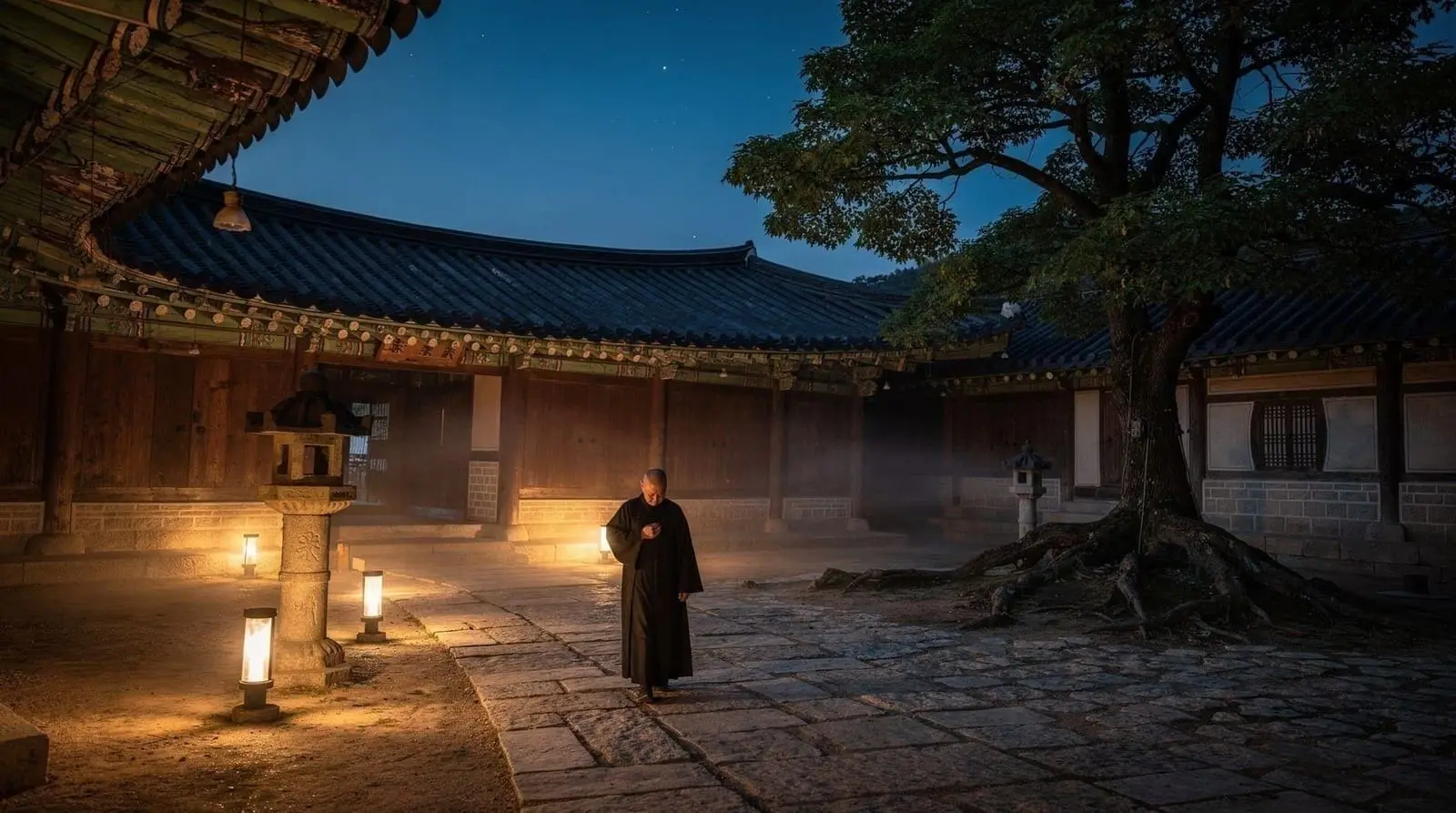
Ganghwa Island temples and templestay: a day trip into Korean Buddhist heritage
How do you get to Ganghwa Island from Incheon?
Take bus 700 or 3000 from Bupyeong Station Bus Terminal (Incheon metro line 1) to Ganghwa Bus Terminal — approximately 1 hour, ₩2,200. No train service exists to Ganghwa.
| Where | Ganghwa Island, ~1 hour from Incheon by bus |
| Cost | Jeondeungsa ₩3,000; templestay ₩70,000–100,000 |
| Time needed | Full day trip; overnight for templestay |
| Getting there | Bus 700/3000 from Bupyeong Station to Ganghwa Bus Terminal |
| Best time | Autumn foliage or spring blossoms; templestay Fri/Sat nights |
Ganghwa Island (강화도) occupies a peculiar place in Korean history. It is where the Goryeo court retreated in 1232 when the Mongol armies swept across the peninsula, governing from a makeshift capital for nearly four decades while the mainland burned. It is where the country’s largest concentration of Bronze Age dolmens — megalithic burial chambers, some weighing dozens of tonnes — were placed more than three thousand years ago, now a UNESCO World Heritage Site. And it is where Korea’s oldest continuously operating Buddhist temple, Jeondeungsa, has maintained an unbroken monastic community since 381 AD.
All of this sits about one hour from Incheon by public bus, on an island connected to the mainland by bridge and ferry. For visitors who want to understand something of Korean history beyond the well-worn Seoul palace circuit, Ganghwado offers a depth and a quiet that the capital cannot.
This guide focuses on the temple and templestay experience at Jeondeungsa, with practical information on the island’s other main historical sites. If you are planning to stay overnight, the templestay programme at Jeondeungsa is one of the most accessible in the country for first-time participants.
The island rewards a slower pace than most Incheon day trips. Unlike Chinatown or Songdo, where a few hours cover the essentials comfortably, Ganghwado’s sites are spread across a genuinely large island connected by infrequent public transport, and each site — the temple, the dolmens, the palace ruins — asks for time to absorb rather than a quick photo stop. Visitors who arrive expecting a compressed half-day generally leave feeling they rushed it; those who allocate a full day, or better, an overnight templestay, come away with the deeper impression the island is capable of giving.
Ganghwado also fits neatly into a longer stay. If you are still deciding how it sits alongside the rest of your trip, the Incheon in one day itinerary shows what the city itself offers on a compressed schedule, while the island-hopping itinerary places Ganghwa among the other islands off the coast. Timing matters too: the best time to visit Incheon explains how the seasons change the mood of a temple visit. The Ganghwa Island destination page gathers the wider overview in one place.
Getting to Ganghwa Island
No train line reaches Ganghwa. The only public transport option is the bus, which runs regularly from several points in Incheon and Seoul.
From Incheon, the most practical starting point is Bupyeong Station on Incheon metro line 1 (the same line as Incheon Station). The Bupyeong Station Bus Terminal (부평역 버스터미널) is adjacent to the metro exit. Bus 700 and bus 3000 both run to Ganghwa Bus Terminal. The journey takes approximately one hour. Fare is around ₩2,200. Buses depart regularly throughout the day; check the current schedule at the terminal.
From Seoul, intercity buses run from Sinchon Bus Terminal (신촌버스터미널) to Ganghwa, taking approximately 1.5 hours and costing around ₩3,500. This is a reasonable option if you are travelling directly from Seoul without going through Incheon first, and is the route covered in the 2–3 day Incheon and Seoul itinerary.
At Ganghwa Bus Terminal, taxis are available for reaching specific sites around the island. Getting from the bus terminal to Jeondeungsa costs approximately ₩8,000–12,000 and takes 15 minutes. For visiting multiple sites in a day — Jeondeungsa, the Goryeo Palace ruins, the dolmen park, and the Ganghwa market — having a taxi or rental car is significantly more efficient than piecing together local connections. Some visitors hire a taxi for the full day at a negotiated flat rate of around ₩80,000–120,000, which is economical for small groups.
Before you set out, it helps to know how the bus network behaves on the Incheon side. The getting around Incheon guide covers the metro line, station exits and everyday transport habits that make the Bupyeong connection easier. Since few drivers on the island speak English, the Incheon safety and language tips are worth a skim for simple phrases and practical reassurance before you hand a taxi driver a destination written in Korean.
Jeondeungsa: Korea’s oldest functioning Buddhist temple
Jeondeungsa (전등사) is the centrepiece of any Ganghwado visit. Founded in 381 AD according to temple records — making it one of the earliest Buddhist temples in Korean history — it has been destroyed and rebuilt multiple times over fifteen centuries and the current structures are primarily from the Joseon era. The age claim refers to the site’s continuous use rather than the specific buildings, a distinction worth understanding.
The temple sits inside Samnanseong Fortress (삼랑성), a mountain fortress with stone walls dating to the Iron Age and rebuilt in the Goryeo period. The combination of the fortress walls and the temple complex within them creates an unusual layered landscape — you walk through sections of the ancient stone wall to reach the temple grounds, with forested ridges on all sides.
Admission is ₩3,000 for adults, ₩1,000 for children. The temple is open daily from 8am to 6pm, extended to 7pm in summer. The entry fee covers both the temple and access to the fortress walls.
Seoul: Bongeunsa Temple and Gourmet Night Tour in GangnamThe main hall and its peculiar carving
The Daeungjeon (대웅전), the main worship hall, is the most significant structure on the temple grounds. Built in 1621 and reconstructed over subsequent centuries, it is a fine example of Joseon-era Buddhist architecture — restrained in external decoration, with intricate bracket systems under the eaves and interior murals depicting scenes from the life of the Buddha.
The detail that most visitors remember is a carved wooden figure on the corner of the roof eave: a small naked female figure supporting one of the roof brackets. The temple’s official explanation involves a local legend about a young woman who deceived the carpenter who built the hall, after which he carved her likeness into the structure to bear the weight of the roof for eternity. This story is almost certainly apocryphal, but the carving exists and is genuinely unusual in Korean Buddhist temple architecture, where this kind of figurative embellishment is rare.
The fortress wall walk
The stone walls of Samnanseong Fortress can be walked from inside the temple complex. The circuit is approximately 2.5 kilometres and takes about one hour at a relaxed pace. The walls run along a forested ridgeline with views down over the Ganghwa estuary and the mainland coast to the east. It is an understated but genuinely pleasant walk, particularly in autumn when the surrounding woodland turns colour.
The walls are in good condition and the path is maintained, though some sections involve moderate climbing. Proper walking shoes are appropriate; sandals are not ideal.
Templestay at Jeondeungsa
The templestay programme at Jeondeungsa runs regular one-night programs, typically on Friday and Saturday nights. This is one of the most approachable templestay programmes in Korea for foreign visitors — the temple has experience with international participants and the programme is structured to explain each activity as it happens.
A typical one-night programme includes:
Dinner on arrival (temple cuisine, vegetarian, eaten in silence). An evening orientation. A night tour of the temple grounds under low lighting. Morning wake-up by wooden percussion board (목탁) at 4am or 5am depending on season. The dawn chanting ceremony (새벽예불), which takes place in the main hall and lasts about 30 minutes. Walking meditation (포행) through the temple grounds and fortress area. Breakfast. A tea ceremony. Lotus lantern making or another craft activity. A formal closing session in the afternoon.
The cost is approximately ₩70,000–100,000 per person depending on the season and specific programme dates. This covers accommodation, all meals, and all activities.
Booking must be done through templestay.com, which has an English interface. Reservations should be made at least one week in advance for weekend programmes; popular dates fill weeks ahead. Cancellation policies apply after confirmation.
What to bring: comfortable, loose-fitting clothing (provided temple robes are sometimes available but not always); no alcohol is permitted on temple grounds; mobile phones should be kept silent during ceremonies. You do not need to identify as Buddhist or have any prior meditation experience. The programme is genuinely open to all faiths and all backgrounds, including complete sceptics who are simply curious about how Korean monastic life is structured.
The experience is not luxurious by any measure. Accommodation is simple (shared dormitory-style rooms, sleeping on floor mats), the wake-up time is early, and the schedule is structured around the temple’s own rhythms rather than visitor convenience. That is, in a sense, the point. If you want a spa weekend, this is not it. If you want a 24-hour window into a living monastic tradition that has been operating on this particular hill for over sixteen centuries, it is one of the more efficient ways to do it in Korea.
What to pack for the templestay
Beyond the general guidance above, a few specifics make the overnight programme more comfortable:
- Layers, not just one warm item — the temple sits in a forested valley that cools noticeably after dark, even in summer; dawn ceremony at 4–5am is genuinely cold outside of high summer.
- Socks you don’t mind wearing indoors — you remove shoes throughout the temple buildings, and floor-sitting for meditation and meals is standard.
- A small torch or phone light — the night tour and early wake-up happen in low or no lighting along uneven fortress-adjacent paths.
- No strong perfume or cologne — shared dormitory spaces and close-quarters meditation make strong scents unwelcome.
- An open mind about the 4am wake-up — this is the one element past participants most often underestimate; treat it as part of the experience rather than an inconvenience to minimise.
Bomunsa: the cave temple on Seongmodo
For a second temple on Ganghwado, Bomunsa (보문사) on adjacent Seongmodo Island (석모도) is worth the additional detour if you have a full day or are staying overnight.
Seongmodo is reached by a short ferry from the Choji-jin Ferry Terminal on Ganghwa’s west coast. The ferry crossing takes about 10 minutes and costs ₩4,000 for the return trip. Buses run from Ganghwa Bus Terminal to Choji-jin, or a taxi from Jeondeungsa to the ferry terminal costs approximately ₩12,000–15,000.
Bomunsa is built into a hillside cave formation and is famous for a large rock relief carving of a seated Buddha (마애석불좌상), cut into the cliff face above the main temple buildings. Reaching it requires climbing 400 stone stairs up the hillside. The climb takes about 20 minutes and is steep in places, but the view from the top — over the Yellow Sea islands and the tidal channels — is extensive and worth the effort.
The temple itself is atmospheric in a way different from Jeondeungsa: where Jeondeungsa sits inside a fortress in a mountain forest, Bomunsa clings to a coastal cliff with the sea visible through the trees. Admission is free; a small donation is customary.
Seoul: Full-Day Guided Tour to Changdeokgung, Bukchon & MoreThe UNESCO Dolmens
Ganghwa Island has the highest concentration of Bronze Age dolmens in Korea — over 2,500 megalithic structures, ranging from small field dolmens to massive capstone formations weighing tens of tonnes. They were designated a UNESCO World Heritage Site in 2000, together with dolmen clusters in Gochang and Hwasun.
The most accessible and impressive single dolmen is at Bugeun-ri (부근리 지석묘), a large table-type dolmen on the north side of the island. The capstone is estimated to weigh around 53 tonnes and rests on two vertical support stones roughly 2.6 metres high. It is thought to be a burial marker for a high-status individual from the late Bronze Age, probably between 1000 and 300 BC. Access is free. The site has a small car park and information panels in Korean and English.
Other dolmens are scattered across the island in open fields, hillsides, and near road margins. They are not always signposted. A good English-language map from the Ganghwa Tourism Office (available at the bus terminal) shows the main clusters.
Ganghwa Goryeo Palace ruins
When the Goryeo court fled Mongol invasions in 1232, they established a temporary capital on Ganghwa that functioned for 38 years until the court’s return to Kaesong in 1270. The Goryeo Palace site (고려궁지) is now a public park with reconstructed Joseon-era administrative buildings on the foundations of the original Goryeo structures, and some pleasant formal gardens.
It is not a dramatic or visually overwhelming site by Korean standards — there is less standing architecture here than at Seoul’s main palaces, and the reconstruction is relatively modern. The value is historical: this is the specific ground where the Goryeo court managed the longest sustained resistance to Mongol conquest in East Asian history, negotiating and resisting from an island the Mongols could never effectively reach.
Admission is ₩900. The palace park is 15 minutes on foot from Ganghwa Bus Terminal, making it a natural start or end point for the day if you arrive by bus.
What to eat on Ganghwado
Ganghwa Island has a food specialty that is worth seeking out: soonmu kimchi (순무김치), made from a locally grown variety of turnip (soonmu, which grows particularly well in Ganghwa’s coastal soil) rather than the baechu (napa cabbage) used in standard kimchi. The result is milder, less sour, and has a different texture — firmer and slightly more peppery at the root end. Most restaurants on the island serve it as a banchan side dish without extra charge.
The Ganghwa Traditional Market (강화 풍물시장), located near the bus terminal, is a good place to buy soonmu kimchi packaged for travel, along with local dried seafood, ginseng products (Ganghwa is also known for its ginseng), and agricultural produce. The market operates daily but is busiest on market days (every 2 and 7 of the month in the traditional Korean cycle).
Restaurants near Jeondeungsa include several that serve Buddhist-influenced temple cuisine (사찰음식) — vegetarian, with no garlic or onion, seasoned with fermented sauces and wild greens. This is worth trying if you are already at the temple, as it is genuinely representative of the temple kitchen tradition rather than a tourist approximation.
Standard Korean lunch options at restaurants near the bus terminal run ₩8,000–15,000 per person for bibimbap, doenjang jjigae, or seafood stews. Ganghwa is not a dining destination in the way that some parts of Incheon and Seoul are, but it is adequately fed for a day trip.
For historical context on the kinds of cultural sites that pair well with Ganghwado — particularly if you are building a multi-day Incheon itinerary — the Incheon Open Port Heritage guide covers the 19th-century port history that forms the other major thread of Incheon’s past, and the Jayu Park Korean War history guide addresses the 20th-century layer.
Taken together, these three sites — Ganghwado’s Goryeo-era and Bronze Age past, the Open Port district’s 19th-century treaty history, and Jayu Park’s 20th-century Korean War history — give a visitor with several days in Incheon a genuine chronological arc through Korean history, from three millennia ago to the modern era, without ever needing to enter Seoul. Few single cities anywhere offer that kind of layered historical range within an hour’s public transport of each other.
Seasonal planning for a Ganghwado visit
Weather and crowd levels shift the experience meaningfully across the year:
- Spring (April–May): Cherry blossoms and azaleas on the hillsides around Jeondeungsa; comfortable temperatures for the fortress wall walk and the Bomunsa stair climb.
- Summer (June–August): Hot and humid, with the forest canopy providing partial shade at Jeondeungsa; the 400 steps at Bomunsa are demanding in peak heat — start early.
- Autumn (September–November): The most visually rewarding season; the forested fortress ridge turns orange and red, and cooler temperatures make both the wall walk and the templestay’s outdoor elements more comfortable.
- Winter (December–February): Quiet and atmospheric, with fewer visitors and a starker landscape; the templestay’s 4–5am wake-up is genuinely cold, so pack accordingly.
If the blossoms are your main reason for travelling, pair the island with the Incheon Grand Park cherry blossoms guide and the Incheon cherry blossom spring itinerary. For colour in the hills, the Incheon autumn foliage hiking itinerary is a natural companion to a templestay night, since both reward the same cool, clear weather.
Comparing Jeondeungsa and Bomunsa
| Jeondeungsa | Bomunsa | |
|---|---|---|
| Setting | Mountain fortress, forest | Coastal cliff, cave shrine |
| Access | Direct taxi from Ganghwa Bus Terminal | Ferry to Seongmodo + taxi/climb |
| Signature feature | 1621 main hall, fortress wall walk | Rock relief Buddha, 400-step climb |
| Time needed | 2 hours | 1.5–2 hours including transfers |
| Templestay | Yes, regular programme | No |
If you only have time for one temple, Jeondeungsa is the more complete visit — historically deeper, with the fortress wall walk and templestay option. Bomunsa rewards visitors with a full day or an overnight stay who want the coastal contrast.
For accommodation planning around a templestay night or a longer Ganghwado stay, the where to stay in Incheon guide covers options in the wider area, though note that Ganghwa itself has limited hotel-style lodging outside the templestay programme — most visitors base themselves in central Incheon and day-trip out.
Suggested full-day itinerary
This schedule assumes a day trip from Incheon by public bus:
9am: Depart from Bupyeong Station by Bus 700 or 3000 toward Ganghwa Bus Terminal.
10am: Arrive at Ganghwa Bus Terminal. Take a taxi to Jeondeungsa (₩8,000–12,000).
10:30am: Jeondeungsa temple visit and fortress wall walk. Allow 2 hours.
12:30pm: Lunch at a restaurant near the temple or taxi back toward the bus terminal area for more options.
2pm: Taxi or bus to Bugeun-ri Dolmen Park. Free access. Allow 30 minutes.
3pm: Return to Ganghwa Bus Terminal area. Visit Goryeo Palace Park (₩900, 30–45 minutes) and browse Ganghwa Market.
4:30pm: Board Bus 700 or 3000 back toward Bupyeong Station.
5:30pm: Arrive at Bupyeong.
This leaves no time for Bomunsa or Seongmodo. If Bomunsa is a priority, either start earlier (8am from Bupyeong) or focus the day on Seongmodo and Bomunsa and skip the dolmens. Trying to cover everything in one day produces a rushed itinerary without time to absorb any of it.
If a day on Ganghwa leaves you wanting more of the coast, other islands make good follow-ups: the Sindo and Modo islands guide and the Muuido island day trip each offer a different, slower side of Incheon’s archipelago. Travelling on a tight budget? The Incheon on a budget guide helps you weigh a taxi day against the bus, and the Incheon Chinatown walking tour is an easy, low-cost way to fill the day before or after your return.
For travel documentation requirements before your trip, the K-ETA and visa guide for Korea 2026 has current information on entry requirements.
Frequently asked questions about Ganghwa Island temples and templestay
Do I need to be Buddhist to participate in the Jeondeungsa templestay?
No. The templestay programme at Jeondeungsa, like most Korean templestay programmes registered with the government system, is explicitly open to people of all faiths and no faith. Participants are expected to follow temple rules (no alcohol, mobile phones on silent during ceremonies, respectful dress) but there is no religious requirement. Many participants are non-religious travellers who are curious about the experience.
Is one night enough for the templestay, or should I book longer?
The standard one-night programme at Jeondeungsa runs from late afternoon on day one to early afternoon on day two. This is sufficient to experience the main elements: evening orientation, dawn ceremony, morning meditation, breakfast, and a craft activity. Some people find it leaves them wanting more; others find the 4am wake-up sufficient to form a clear impression. Extended multi-night programmes are sometimes available — check templestay.com for current options.
How far is Ganghwa Island from Seoul?
From Sinchon Bus Terminal in Seoul, the bus to Ganghwa takes approximately 1.5 hours. From Bupyeong in Incheon (accessible via Seoul metro line 1), the journey is about 1 hour. Ganghwa is not convenient enough for a quick afternoon detour from Seoul, but works as a full day trip or an overnight templestay destination.
What is the best time of year to visit Jeondeungsa?
Autumn (October to early November) is the most visually striking period — the forested ridges around the fortress walls turn orange and red, and the temperature is cool without being cold. Spring (April to May) is also excellent, with cherry blossoms and azaleas on the hillsides. Summer visits are entirely feasible but hot and humid; the forest canopy provides some shade. Winter is cold and quiet; the temple is less crowded but the landscape is bare.
Can I visit both Jeondeungsa and Bomunsa in the same day trip?
It is logistically possible but requires planning. Allow about 2 hours at Jeondeungsa, then taxi to Choji-jin ferry terminal (about 30 minutes), ferry to Seongmodo (10 minutes), taxi to Bomunsa (10 minutes), 1.5 hours at Bomunsa including the stair climb, ferry and taxi back, and the bus home. This is a full day with minimal slack. If you want to include the dolmens or Goryeo Palace as well, you will need either a car or to cut one site. Hiring a day taxi from Ganghwa Bus Terminal for a negotiated flat rate (₩80,000–120,000) makes this kind of multi-site day significantly more manageable.
Are the dolmens at Bugeun-ri accessible without a car?
Yes. Local buses connect Ganghwa Bus Terminal to the Bugeun-ri area, though the schedule is infrequent. Checking the current schedule at the Ganghwa Bus Terminal information board on arrival is the most reliable method. Alternatively, a taxi from Ganghwa Bus Terminal to Bugeun-ri Dolmen Park costs approximately ₩8,000–12,000 one-way. The dolmen site itself is in an open field with free access and no opening hours.
Is there English signage at Jeondeungsa and the other sites?
Jeondeungsa has English-language information boards at the main temple structures, and the templestay programme staff typically speak enough English to run the activities. The Goryeo Palace ruins have bilingual panels. The Bugeun-ri dolmen site has English information. Bomunsa has less English signage than the others, but the visual experience does not require interpretation. Most taxis on Ganghwa do not have English-speaking drivers — show your destination written in Korean characters or use a Korean map application for navigation.
Gyeongbokgung & palace tours on GetYourGuide
Top-rated tours and activities


