Incheon and Seoul in 2-3 days — the complete itinerary
Why Incheon and Seoul work well together
Most first-time visitors to South Korea skip Incheon entirely, catching the AREX train to Seoul as fast as possible. That is understandable, but it means missing Korea’s only officially designated Chinatown, a surprisingly intact cluster of 1880s colonial architecture along the Open Port waterfront, and the easy seaside atmosphere of Wolmido — all within walking distance of each other and about 55 minutes from central Seoul by metro.
This itinerary treats Incheon as a proper destination for day one, then moves to Seoul for two days covering the highlights: Gyeongbokgung Palace, Bukchon Hanok Village, the food streets of Insadong and Myeongdong, and optionally the Han River parks or a day trip on day three.
How to use this guide for 2 days vs 3 days: If you only have two days, follow Days 1 and 2 and skip Day 3 entirely. The core itinerary is fully satisfying in 48 hours. Day 3 options are genuinely additive — not just padding — so if you have the time, pick the one that interests you most.
| Where | Incheon Chinatown/Open Port/Wolmido, then Seoul palaces and markets |
| Cost | around 53,000-258,000 won per person per day |
| Time needed | 2-3 days |
| Getting there | AREX from ICN, then metro line 1 between cities |
| Best time | Spring (March-May) or autumn (September-November) |
Getting from the airport
Incheon International Airport (ICN) is on Yeongjongdo island, not in Incheon city itself. Two rail options connect it to central Incheon and Seoul.
AREX all-stop train: Stops at several stations including Geomam, Gyeyang, and Incheon City Air Terminal before continuing to Seoul Station. Useful if you want to reach Seoul directly without changing trains. Journey to Seoul Station takes about 59 minutes from Terminal 1 (about 66 from Terminal 2) and costs 4,150 won from Terminal 1 (4,750 won from Terminal 2) with a T-money card. Trains run every 12 minutes during peak hours.
AREX express train: Non-stop to Seoul Station in 43 minutes from Terminal 1 (51 from Terminal 2), 9,500 won. Worth paying for if you are arriving late or carrying heavy luggage.
To reach Incheon city first (Day 1 start): Take the AREX all-stop to Gyeyang, then change to Incheon Metro Line 1 for Incheon Station. The airport railway does not run to Incheon Station directly, so check the live journey time in Naver Map or Kakao Map. From Incheon Station, the Chinatown gate is a 3-minute walk from exit 1.
Buy a T-money card at the airport at any convenience store (CU, GS25). A 4,000-won deposit covers the card; load what you need and top up at any metro machine. It works on all metro lines, buses, and some taxis across Incheon and Seoul.
For K-ETA exemptions (passport holders of the 25 listed countries/regions, e.g. US, UK, Germany, France, Italy, Spain — not Portugal or Ireland — through 31 December 2026) and the mandatory e-Arrival Card, see K-ETA and visa rules for Korea.
Seoul: Customizable Private Tour with DriverDay 1 — Incheon: Chinatown, the Open Port, and Wolmido
Spend the morning in Incheon Chinatown and the Open Port area, then head to Wolmido in the late afternoon for sunset and seafood.
Morning — Chinatown and the Open Port area
Take metro line 1 (dark blue) to Incheon Station, the final stop on the line, exit 1. The ornate Chinatown gate is directly ahead.
Incheon Chinatown is not a themed attraction. It has been here since 1884, when Chinese merchants from Shandong settled in Incheon following Korea’s first trade treaties. The main street is lined with restaurants serving jjajangmyeon — the black bean noodle dish that was essentially invented here and is now one of Korea’s favourite comfort foods. A decent bowl costs around 8,000-10,000 won. Side streets have older family-run restaurants that the tour groups miss.
Walk uphill past the Chinese restaurants to reach Jayu Park, the oldest Western-style park in Korea (1888). The hilltop gives views over the port and the bay. On clear days you can see as far as Yeongjongdo island. The park is free and takes about 20 minutes to walk through properly.
Coming back down, cross into the Open Port heritage district. The streets immediately east and south of Chinatown contain some of the best-preserved 1880s-1910s buildings in Korea — a Japanese-era bank, a former Japanese consulate, the Custom House, all built in the years after Incheon opened to foreign trade. The Incheon Open Port Modern History Museum is housed in a former Japanese bank building and charges 2,000 won. It is worth the 45 minutes to understand what you are looking at in the streets outside.
From the Open Port area, Songwol-dong Fairytale Village is about a 10-minute walk. The murals are painted by local artists on the walls of a working residential neighbourhood, not a set piece built for visitors — a good 20-minute detour.
Incheon Stopover: City Highlights Tour for K-culture FansAfternoon — Songdo (optional detour) or rest before Wolmido
If you have energy and curiosity for modern urban planning at scale, Songdo is 20 minutes from Incheon Station by metro. The Central Park canal is free to walk; the G-Tower observation deck on the 33rd floor is also free and gives the best aerial view of the city grid. There are several cafes and restaurants nearby if you need lunch.
If Songdo feels like too much for day one, skip it. The Chinatown and Open Port morning already covers a lot of ground.
Evening — Wolmido
Wolmido is a small peninsula reachable from Incheon Station by bus (routes 2, 12, 16) or a 2,500-3,000 won taxi ride — about 10-15 minutes.
The Wolmi Sea Train is a small monorail along the waterfront. A single loop (6.1 km) takes 42 minutes and costs around 11,000 won on weekdays or 14,000 won on weekends (adult). Not essential, but the late-afternoon light looking west can be very good; check seasonal hours on the operator’s official site.
The seafood restaurants along the promenade serve hoe (raw fish platters), steamed crab, and grilled shellfish. An evening meal for two with soju runs about 40,000-70,000 won. See Wolmido seafood dining for specific recommendations.
Day 2 — Seoul: palaces, hanok alleys, street food
Move to Seoul in the morning. If you stayed overnight in Incheon, take metro line 1 from Incheon Station to Seoul Station — about 55 minutes, 1,650 won with a T-money card.
Morning — Gyeongbokgung Palace
Gyeongbokgung is the largest of Seoul’s five Joseon-dynasty palaces, first built in 1395 and substantially restored after Japanese-era destruction. It is best visited early: the grounds are large enough that early arrivals can explore without the crowding that arrives by 11am.
Seoul: Gyeongbokgung Palace, Jogyesa Temple, and CheongwadaeGetting there: Take metro line 3 (orange) to Gyeongbokgung station, exit 5. The main gate (Gwanghwamun) is a 5-minute walk.
Admission: 3,000 won (about 2.30 USD). Under-24s and over-64s enter free.
Changing of the guard: 10am and 2pm daily except Tuesdays. About 20 minutes, free to watch. Arrive 10-15 minutes early for a clear view.
If you plan to visit the palace and want to wear hanbok (traditional Korean dress), rental shops line the streets just outside the east gate. Wearing hanbok grants free entry to Gyeongbokgung and several other Seoul palaces.
Seoul: Hanbok Rental with Gyeongbokgung Palace EntryMid-morning — Bukchon Hanok Village
From Gyeongbokgung’s east gate, Bukchon Hanok Village is a 15-minute walk northeast, or one stop on metro line 3 to Anguk station, exit 2.
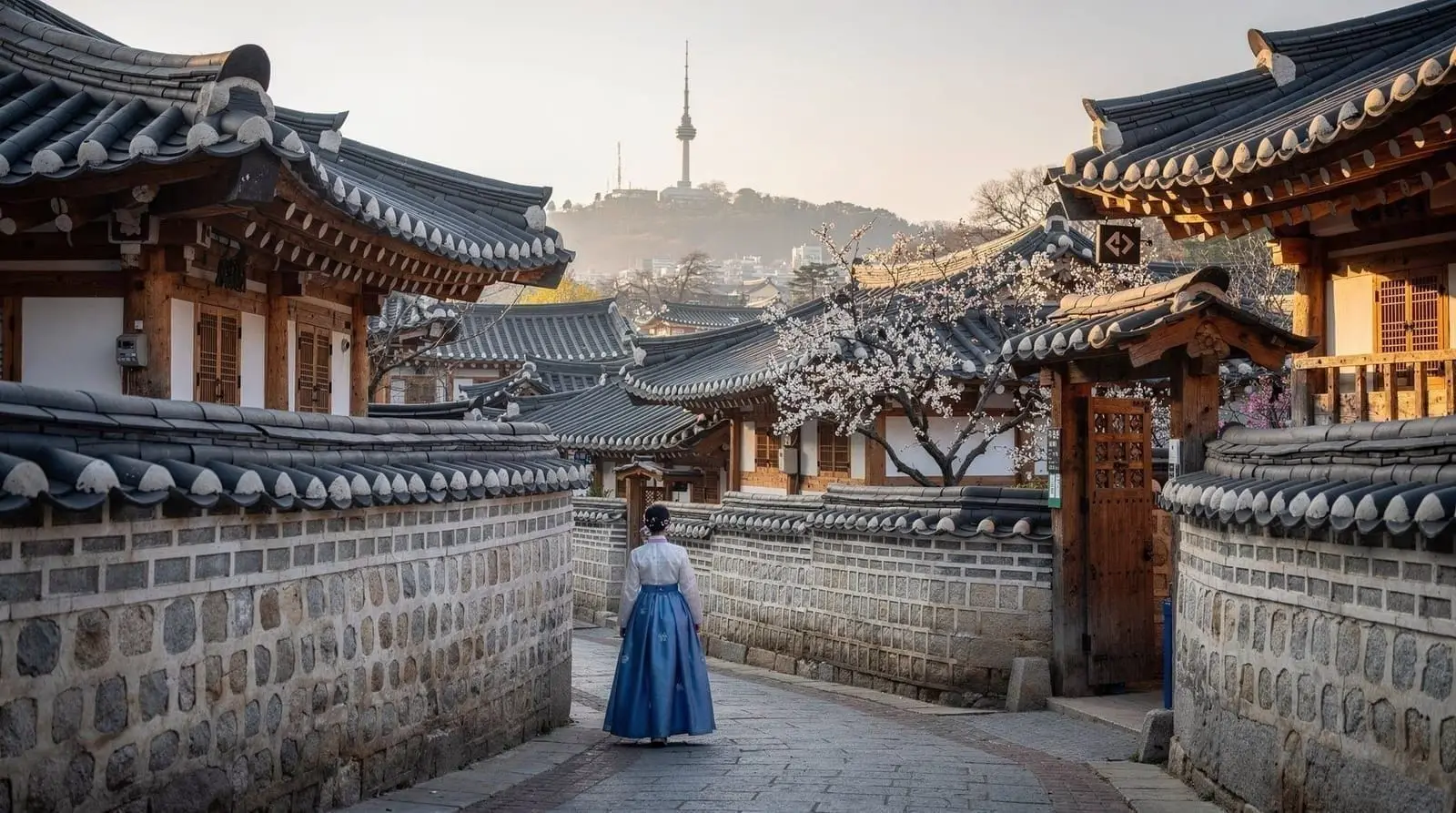
Bukchon is a residential neighbourhood of traditional Korean hanok houses — wooden frames, curved tile roofs, internal courtyards — many of them 100 to 600 years old. The main walking route climbs through narrow alleys with views south over the modern city skyline. It is free to walk.
Go before 11am if you can. The light is better and the crowds are thinner. Bukchon’s residents have posted notices asking visitors to keep noise down on the residential streets — follow them; this is an active neighbourhood, not a theme park.
The walk takes about an hour at a relaxed pace. There are several small cafes in converted hanok buildings along the route if you need a break.
Seoul: Bukchon Hanok Village Walking TourLunchtime — Insadong
Insadong is a 10-minute walk south of Bukchon, or exit 6 from Anguk station. The main street is lined with tea houses, traditional craft shops, and street snack stalls. It is touristy — intentionally so — but the surrounding side streets have quieter galleries and small Korean restaurants at reasonable prices. A bowl of doenjang jjigae (fermented soybean soup with tofu and vegetables) with rice runs about 9,000-12,000 won.
Ssamziegil is a small courtyard mall inside Insadong with independent design shops and a casual rooftop. Worth 15 minutes.
Afternoon — toward Namsan and Myeongdong
From Insadong, take metro line 3 to Anguk then transfer to line 4 toward Myeongdong. The journey takes about 20 minutes.
Namsan Tower (N Seoul Tower) is worth an hour if the skies are clear. The cable car from Myeongdong Cable Car station costs about 1,000 won per way; the observation deck is about 18,000 won. On overcast days it is not worth it — check the weather before committing.
Evening — Myeongdong
Myeongdong at dusk is a different experience from Myeongdong in daylight. The street food stalls set up fully from around 5pm: tteokbokki (spicy rice cakes, about 3,000-4,000 won per portion), tornado potatoes, hotteok (sweet filled pancakes, about 2,000 won), skewered meats. Eat as you walk. The K-beauty shops are open until 10pm or later and give out samples readily — this is the place to buy skincare if that is on your list.
The streets around Myeongdong station (line 4, exits 5 or 6) are pedestrianised in the evenings during busy periods. Budget 3-4 hours to eat properly and look around without rushing.
Day 3 options — go deeper or go further
Day 3 is optional and depends heavily on your interests. Three realistic directions:
Option A — Seoul parks and markets
Gwangjang Market (metro line 1 or 2 to Jongno 5-ga) has operated since 1905. The food section is the main draw: bindaetteok (mung bean pancakes, 4,000-6,000 won), mayak gimbap (small rice rolls, sesame soy), and raw beef yukhoe for the adventurous. Go at lunchtime when it is busy but manageable.
Han River parks (Hangang): Seoul’s riverside parks are a Korean institution. Yeouido Hangang Park (metro line 5 or 9 to Yeouinaru) is the most accessible, with convenience store kiosks, fried chicken delivery, and cycling paths. In the evening it becomes a casual outdoor gathering spot. Bring snacks from a nearby GS25 or CU.
Seoul: Han River Rainbow Bridge Yacht TourHongdae (metro line 2 to Hongik University station) is the university-area neighbourhood for indie music, street performers, cheap food, and nightlife. By late afternoon the covered market streets and surrounding cafes are active — good for an evening if you want to see where young Seoulites actually spend time.
Option B — Suwon Hwaseong Fortress day trip
Suwon is about 30 minutes south of Seoul by metro line 1. The UNESCO-listed Hwaseong Fortress is an 18th-century defensive wall encircling part of the city, largely intact, walkable along the full 5.7-kilometre perimeter. Admission is 1,500 won. The folk village outside the east gate adds another hour of context. This is a comfortable day trip that fits easily into day three without rushing.
Option C — DMZ tour
The Korean Demilitarized Zone is about 60 kilometres north of Seoul. Organised DMZ tours run daily and are the most practical way to visit — independent access requires permits that are difficult to arrange on short notice. Tours typically take 8-9 hours and include the Third Tunnel of Aggression, Dora Observatory, and Dorasan Station. This is a significant experience but not a light sightseeing option — reserve it for day three only if you are specifically motivated by the history.
Korea DMZ Tour from SeoulNote on Nami Island: Nami Island (Gapyeong) is a popular day trip — tree-lined paths, outdoor art, the famous poplar avenue. The journey from Seoul takes about 1.5-2 hours each way. It works as a full day if you are specifically interested, but is less essential than the Seoul city options above for a first visit.
Choosing between the Day 3 options
If you are unsure which Day 3 option fits, work backward from what you already have planned. Option A (Seoul parks and markets) suits travellers who want a lower-effort day after two days of walking-heavy sightseeing — Gwangjang Market and a Hangang Park evening are relatively relaxed by comparison.
Option B (Suwon) suits history and architecture enthusiasts who enjoyed the Open Port district on Day 1 and want more of that texture, with the bonus of being a genuinely comfortable half-day trip that leaves the afternoon free. Option C (the DMZ) is the most singular experience of the three and the one people most often regret skipping, but it requires the most advance planning and commits your full day — only choose it if the history specifically interests you, not as a default “since I’m here” add-on.
From Seoul: Suwon Hwaseong Fortress TourHow this compares to a Seoul-only itinerary
Most 2-3 day Korea guides skip Incheon and spend the entire time in Seoul, and it is worth being honest about the trade-off. A Seoul-only version of this trip gets you more time at any single palace, more neighbourhoods (Gangnam, Itaewon, additional markets), and slightly less transit overhead. What it loses is the Open Port district’s 1880s-1910s architecture — genuinely unlike anything in Seoul, since Seoul’s equivalent treaty-port history is far less physically preserved — and the relaxed, unhurried pace of Wolmido’s seafood and sunset scene, which contrasts usefully against Seoul’s density.
If you have done Seoul before and want to add something different on a return trip, Day 1 in Incheon is the more valuable addition than a fourth Seoul neighbourhood. If this is a first Korea trip and palaces and markets are the priority, a Seoul-heavy version with only a half-day Incheon stopover is a reasonable alternative — see the Incheon in one day itinerary for how to compress the Incheon portion.
Where to stay
For 2 days: Base yourself in Seoul. Myeongdong is central for Day 2 and metro connections are excellent. Insadong and Anguk are quieter and closer to Gyeongbokgung and Bukchon. Hongdae suits travellers who want to be near nightlife and the AREX airport link.
For 3 days (with 1 night in Incheon): Spend night one near Chinatown or Songdo, then move to Seoul on day two morning. Incheon accommodation is generally cheaper and staying one night keeps the pace more relaxed.
Budget: Hostels from 20,000-35,000 won per person per night; private rooms in mid-range guesthouses 60,000-100,000 won; comfortable hotels 120,000-200,000 won. Full breakdown in where to stay in Incheon.
Whichever base you choose, book at least a few days ahead for spring cherry blossom season and autumn foliage weekends — both push occupancy and prices up noticeably across Seoul and Incheon alike, and last-minute availability in the most convenient neighbourhoods (Myeongdong, Anguk) thins out fast.
Approximate budget per person per day
| Category | Budget traveller | Mid-range |
|---|---|---|
| Accommodation | 25,000-35,000 won | 80,000-150,000 won |
| Meals (3 meals) | 20,000-30,000 won | 40,000-70,000 won |
| Transport (metro/bus) | 3,000-5,000 won | 3,000-8,000 won |
| Admissions and activities | 5,000-10,000 won | 15,000-30,000 won |
| Total per day | 53,000-80,000 won | 138,000-258,000 won |
Prices in Korean won. 1 USD is approximately 1,200-1,300 KRW at mid-2026 rates. For more detail see Incheon on a budget.
Getting a SIM or eSIM sorted before Day 1
Reliable data matters more on this itinerary than most, since you are navigating two cities’ transit systems and switching between Google Maps, KakaoTaxi, and Naver Map depending on what works best for each leg. Airport kiosks in the arrivals hall sell physical SIM cards and eSIM options, and some also bundle a T-money function onto the same card, which simplifies carrying one fewer item.
South Korea: eSIM Data PlanFrequently asked questions about the Incheon and Seoul 2-3 day itinerary
Is it better to stay in Incheon or Seoul for a 2-day trip?
For two days, Seoul is the better base. The metro connection between the two cities is straightforward — 55 minutes on line 1, 1,650 won — and basing in Seoul keeps you closer to the larger cluster of Day 2 attractions. If you are on a tight budget, Incheon accommodation is cheaper, and some travellers prefer starting in Incheon on arrival day and moving to Seoul on day two.
How long does the AREX train take from the airport to Seoul?
The all-stop AREX takes about 59 minutes from Terminal 1 to Seoul Station (about 66 from Terminal 2) and costs 4,150 won from Terminal 1 (4,750 won from Terminal 2) with a T-money card. The express train does it non-stop in 43 minutes from Terminal 1 (51 from Terminal 2) for 9,500 won. Both trains run from Terminal 1 and Terminal 2.
Do I need to speak Korean to follow this itinerary?
No. Seoul’s metro system has English signage throughout. Google Maps works reliably for directions and transit times across both cities. KakaoTaxi, the dominant taxi-booking app, has an English-language interface. At restaurants without English menus, pointing at what nearby diners are eating usually works.
Is the T-money card worth buying for a short trip?
Yes. It gives a discount over single-journey tickets — typically 100-200 won per trip — and works on every metro and bus in both cities. Buy one at the airport at any convenience store (CU, GS25) for 4,000 won deposit, load what you need, and top up at any metro station machine.
Is Gyeongbokgung worth visiting without a guide?
The palace grounds are easy to navigate independently — good English signage throughout, and the free audio guide app (Visitkorea, iOS and Android) covers the main structures. Joining a guided tour adds historical depth that the signage alone does not fully convey, and the changing of the guard ceremony is self-explanatory and free to watch.
Can I do the DMZ as a day trip from Incheon?
Technically yes, but the DMZ is most logically accessed from Seoul, and all organised tours depart from Seoul. A DMZ tour added to the end of this itinerary — as Day 3 — works well. Starting from Incheon adds unnecessary travel time. Book through a licensed tour operator; the DMZ guide linked above covers the booking process and what to expect.
What is the best season for this itinerary?
Spring (March-May) and autumn (September-November) are the most comfortable. Spring brings cherry blossoms to Incheon Grand Park and Seoul’s riverside parks in late March to mid-April. Autumn has clear skies and the best light for photography. Summer (June-August) is hot and humid with a monsoon period in July; possible but tiring for extended walking. Winter (December-February) is cold but very clear, and some cultural sites are less crowded.
Incheon city experiences on GetYourGuide
Top-rated tours and activities


