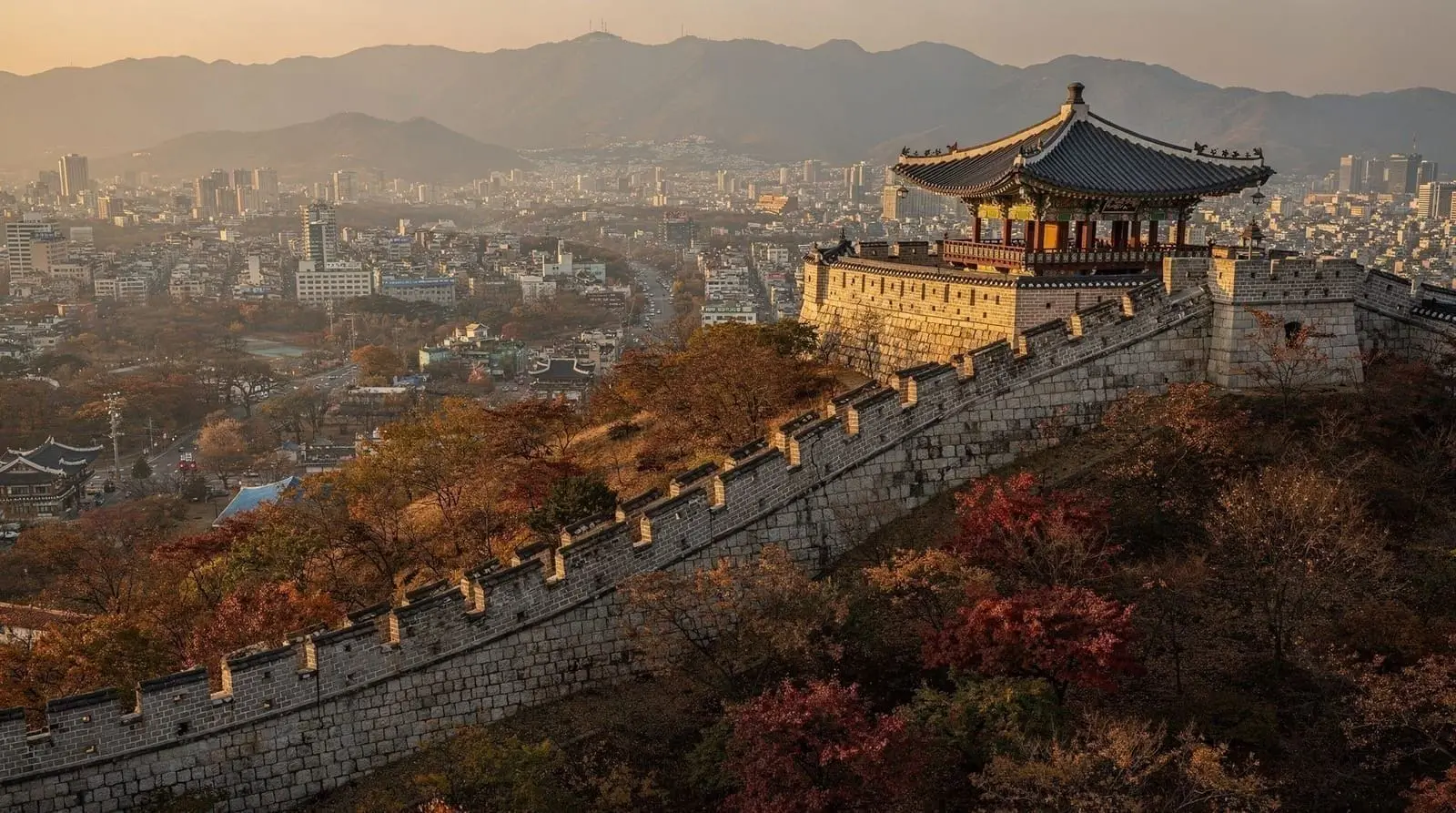
Suwon (수원) is the capital of Gyeonggi Province, 30 km south of Seoul — close enough to reach by subway, substantial enough to deserve a full day if you’re interested in Joseon-era Korea. Its UNESCO World Heritage-listed Hwaseong Fortress is the defining attraction: a 5.7 km stone wall encircling the original city center, built between 1794 and 1796 under King Jeongjo as a showcase of 18th-century military engineering. The nearby Korean Folk Village is a full-scale reconstruction of a traditional Korean village — not a museum but a working demonstration site with craft workshops, performances, and traditional food. Together they form the strongest historical day trip from Seoul.
| Where | Gyeonggi Province, 30 km south of Seoul |
| Cost | 1,500 KRW fortress; 22,000 KRW Folk Village |
| Time needed | Half a day (fortress only) to a full day (both) |
| Getting there | Subway line 1 from Seoul Station, about 45 min |
| Best time | April–May for blossoms, October for foliage |
Hwaseong Fortress
The fortress wall circles Suwon’s Paldal district on a continuous 5.7 km circuit. Walking the full wall perimeter takes about 2–3 hours at a moderate pace. The trail is well-maintained with paved paths on top of the walls at most sections. There are four main gates (the most intact being Janganmun in the north and Paldalmun in the south, which is now a traffic circle), four command posts, several watchtowers, and the excellent Hwaseong Haenggung royal palace at the center.
Entry fee: 1,500 KRW for adults, 1,000 KRW for youth (7–18), free under 7. The ticket covers the full fortress including Haenggung palace. A separate 3,000 KRW ticket covers the royal carriage ride (hwaseong local shuttle) that runs between the gates during the day.
Hwaseong is notable in Korean architectural history because its original construction documents survived — the Hwaseong Seongyeok Uigwe — which allowed post-war reconstruction to be remarkably accurate. The fortress was damaged during the Korean War and rebuilt in the 1970s based on these records.
From Seoul: Suwon Hwaseong Fortress TourKorean Folk Village
The Korean Folk Village (한국민속촌) is located in Giheung, about 20 minutes by bus from Suwon station. It is a 245-hectare open-air site with over 260 traditional buildings from different regions and eras of Korea — a functioning blacksmith, a pottery kiln, a paper-making workshop, a traditional rice wine brewery, and performances of equestrian acrobatics and tightrope walking throughout the day.
Entry: 22,000 KRW adults, 17,000 KRW youth, 15,000 KRW children. The entry fee is high by Korean standards but the village is large and takes 3–5 hours to explore properly. A combo ticket with seasonal events (winter snow village, spring flower festival) sometimes bundles additional entry for 25,000–28,000 KRW.
The folk village has featured in numerous Korean dramas including Jumong, Dae Jang Geum (Jewel in the Palace), and more recently Rookie Historian. If you’re a K-drama fan, this is the real setting for many palace-era scenes.
Seoul: Suwon Hwaseong Fortress & Korean Folk Village TourHwaseong Fortress vs Korean Folk Village — which to prioritize
| Hwaseong Fortress | Korean Folk Village | |
|---|---|---|
| Cost | 1,500 KRW | 22,000 KRW |
| Time needed | 2–3 hours (full circuit) | 3–5 hours |
| What it is | Real UNESCO-listed 18th-century fortress | Reconstructed village with craft demos, performances |
| Best for | Architecture, history, walking, tight budgets | Families, K-drama fans, hands-on culture |
If you can only pick one, choose Hwaseong Fortress — it’s the authentic UNESCO site and costs a fraction of the Folk Village. With a full day, doing both is the standard and most rewarding combination.
Getting to Suwon
From Seoul by subway: Take line 1 from Seoul Station (Sincheon direction) to Suwon station. About 45–55 minutes depending on the train. Fare around 1,750 KRW with T-money. Suwon station is 15 minutes on foot or a short taxi ride from Paldalmun (the south gate of the fortress).
From Incheon by subway: Take line 1 from Incheon station toward Seoul, then continue south to Suwon. Total time from Incheon station: about 1 hour 40 minutes. One transfer may be needed at Guro.
From ICN Airport: AREX to Seoul Station, then line 1 to Suwon. Total: about 1 hour 30 minutes.
Organized tour from Seoul: Several tour operators run combined fortress + folk village day trips with English-speaking guides, leaving from Seoul in the morning. The advantage is having a guide explain the fortress engineering and Joseon history. An organized tour from Seoul typically costs 50,000–80,000 KRW including transport and guide.
Seoul: UNESCO Heritage Suwon Hwaseong Fortress, Folk VillageCombining Hwaseong and the Folk Village in one day
The standard sequence: arrive at Suwon station by 9:30 a.m., walk to Paldalmun gate and start the fortress wall clockwise, reaching Haenggung palace for lunch (there’s a traditional food court inside, 8,000–13,000 KRW per dish). Afternoon: bus or taxi to the Korean Folk Village (last entry 5 p.m.). Depart by early evening.
Seoul: Suwon Hwaseong, Folk Village, & Starfield LibraryThe Suwon Hwaseong fortress day trip guide maps this circuit with precise timing and the best sections of the wall for photos.
Where Suwon fits in an Incheon and Seoul trip
Suwon works best as one chosen day inside a longer stay rather than as an add-on squeezed between flights. If you are building a first itinerary, the Incheon and Seoul 2–3 day itinerary shows how to place a day away from the capital without exhausting yourself, and Incheon in one day is the better pick when time is truly short. Suwon sits on the opposite side of the region from the harbor districts, so treat it as a separate outing from your Incheon days.
Travelers who land at the airport and wonder whether a fortress visit is realistic should read the Incheon airport layover itinerary and the 6-hour layover plan first. The honest answer is that Suwon needs more slack than a short transit allows. The same goes for a late arrival: the walls and the village both reward a rested morning, not a tired evening.
If you are still deciding between bases, Incheon vs Seoul explains how the two cities differ, and where to stay in Incheon helps you choose a neighborhood from which line 1 is easy to reach. Staying near a subway station matters more than staying near a sight, because the trip to Suwon is mostly a rail journey.
Planning the day around the weather and the crowds
The fortress is a walking day, so the season shapes how it feels. Spring brings blossoms along the stone wall and autumn brings color on the slopes, while summer middays can be punishing on an exposed wall with little shade. If you travel in warm months, start early, carry water and save the long stretches of wall for the cooler hours. The best time to visit Incheon covers the wider seasonal picture for the region, and the same patterns apply here.
Weekends and public holidays bring more local families, especially at the Folk Village, where performances can draw a crowd. A weekday morning gives you quieter paths, easier photos on the ramparts and shorter waits at the food court. If rain is forecast, the fortress is still walkable, but the stone steps become slick, so the shoes advice in the mistakes box matters even more.
Between the two sites, pace yourself. Many visitors try to see every watchtower and every gate and arrive at the village already tired. It is perfectly reasonable to walk only part of the circuit, take a rest at the palace and save energy for the afternoon. The wall rewards slow looking: the masonry, the loopholes and the view over the modern city below tell the story of a planned fortress town better than any signboard.
Budget, families and getting by in English
Suwon is one of the cheapest serious heritage days near the capital, and the fortress entry is a small part of the total. The real spending is food and transport, so the tips in Incheon on a budget transfer well: use the subway, eat set meals at local restaurants and keep the galbi splurge for one meal. For help moving around the region, getting around Incheon explains the card system, the lines and the habits that make rail travel painless.
Families will find the Folk Village easier than the wall, because children can wander between workshops and watch performances instead of walking a single long path. Incheon with kids gathers more ideas for younger travelers, and it is worth reading before you decide how much of the circuit to attempt with a stroller or tired legs.
Language is rarely a barrier at the main sights, but menus and small restaurants may be Korean only. The Incheon safety and language tips cover useful phrases, apps and etiquette. If you are arriving from abroad, check the K-ETA guide for 2026 before you fly so that entry rules do not surprise you.
More day trips to pair with Suwon
A single Suwon day often leaves people wanting a different landscape. For a quiet, green contrast, Ganghwado’s temples and templestay offer a slower pace, and Nami Island suits a scenic outing, though it belongs on another day. History fans might also consider the DMZ day tour from Seoul, which shows the same dynastic-to-modern thread from a very different angle. For a broader menu of ideas, top things to do in Incheon lists more, and what to eat in Incheon helps you plan meals for the days around your fortress visit.
What to eat in Suwon
Suwon is famous for galbi (grilled beef short ribs) — considered the best in Korea. The Suwon Galbi Street (수원갈비거리) near Paldalmun has been operating since the 1950s. A full galbi set for 2 people: 60,000–80,000 KRW. It’s a splurge but a legitimate one for meat-eaters.
Budget option: dakgalbi (spicy stir-fried chicken) at restaurants near Suwon station, 12,000–15,000 KRW per portion.
Plan your meal around the walk rather than the other way around. Eating a heavy galbi lunch before the second half of the wall makes the inclines feel steeper, so many visitors prefer a lighter meal at the palace food court and a proper barbecue dinner once the sightseeing is over. Galbi is usually cooked at the table and shared, which makes it a good evening for a group, while solo travelers will find the stir-fried chicken and simpler set dishes easier to order.
Practical information
- Tourist info center: At Suwon station and near Paldalmun gate. English maps available; staff speak limited English.
- Fortress hours: 9 a.m. – 6 p.m. The walls are also open at night (7–10 p.m.) in summer; check the schedule.
- Korean Folk Village hours: 9 a.m. – 6 p.m. (varies by season). Closed Tuesdays in winter.
- Cash vs card: Fortress and folk village accept cards. Restaurants near the walls often prefer cash.
- Best shoes: The fortress wall path is paved but has steps and inclines. Comfortable walking shoes are important.
- Tourism helpline: 1330 (English, 24/7).
Frequently asked questions about Suwon
Is Hwaseong Fortress one of the UNESCO World Heritage sites in Korea?
Yes — Hwaseong Fortress was inscribed on the UNESCO World Heritage List in 1997, recognized for its significance in Korean military architecture and its well-preserved construction records. It was built in the late Joseon dynasty (1794–1796) under King Jeongjo.
How long does it take to walk the full Hwaseong Fortress wall?
The full 5.7 km circuit takes 2–3 hours at a leisurely pace. You can walk just the most scenic northern section (from Janganmun gate to the command post at Bukseohjangdae) in about 1 hour. The wall is continuous except at the road intersections where you descend and re-ascend.
Is the Korean Folk Village worth 22,000 KRW?
For most visitors who enjoy traditional culture, yes — the village is large, the performances are genuine (not just costume photo-ops), and the craft demonstrations are hands-on. If you’re short on time or budget, prioritize Hwaseong Fortress, which costs only 1,500 KRW and is architecturally more significant.
Can I visit Suwon on the same day as Nami Island?
Technically possible but not recommended — Nami Island is northeast of Seoul, Suwon is south. Combining them involves crossing Seoul twice and would mean 4+ hours in transit. Better to do each on a separate day.
What is the best way to get from Suwon to Seoul without a tour?
Subway line 1 from Suwon station to Seoul Station is direct and runs every 5–10 minutes during the day. Total fare: 1,750 KRW. Last trains from Suwon to Seoul run around midnight. The line 1 express service (급행) saves about 10 minutes.
Are there English-speaking guides at Hwaseong Fortress?
Volunteer English-speaking guides are sometimes available at the main gate; check with the tourist information center near Paldalmun. Official guided tours in English can be booked in advance. See the Suwon Hwaseong day trip guide for current booking options.
Is Suwon worth visiting if I’ve already seen Seoul’s palaces?
Yes — Hwaseong Fortress is architecturally distinct from Seoul’s royal palaces, built as a fortified planned city rather than a royal residence, and its scale (a full walkable 5.7 km wall) offers a different kind of experience than Seoul’s Gyeongbokgung.
Can I visit Suwon directly from Incheon Airport without going through Seoul?
Yes, via AREX to Seoul Station then transferring to subway line 1 south to Suwon — about 1 hour 30 minutes total. There’s no direct airport-to-Suwon route, so this transfer is unavoidable.


