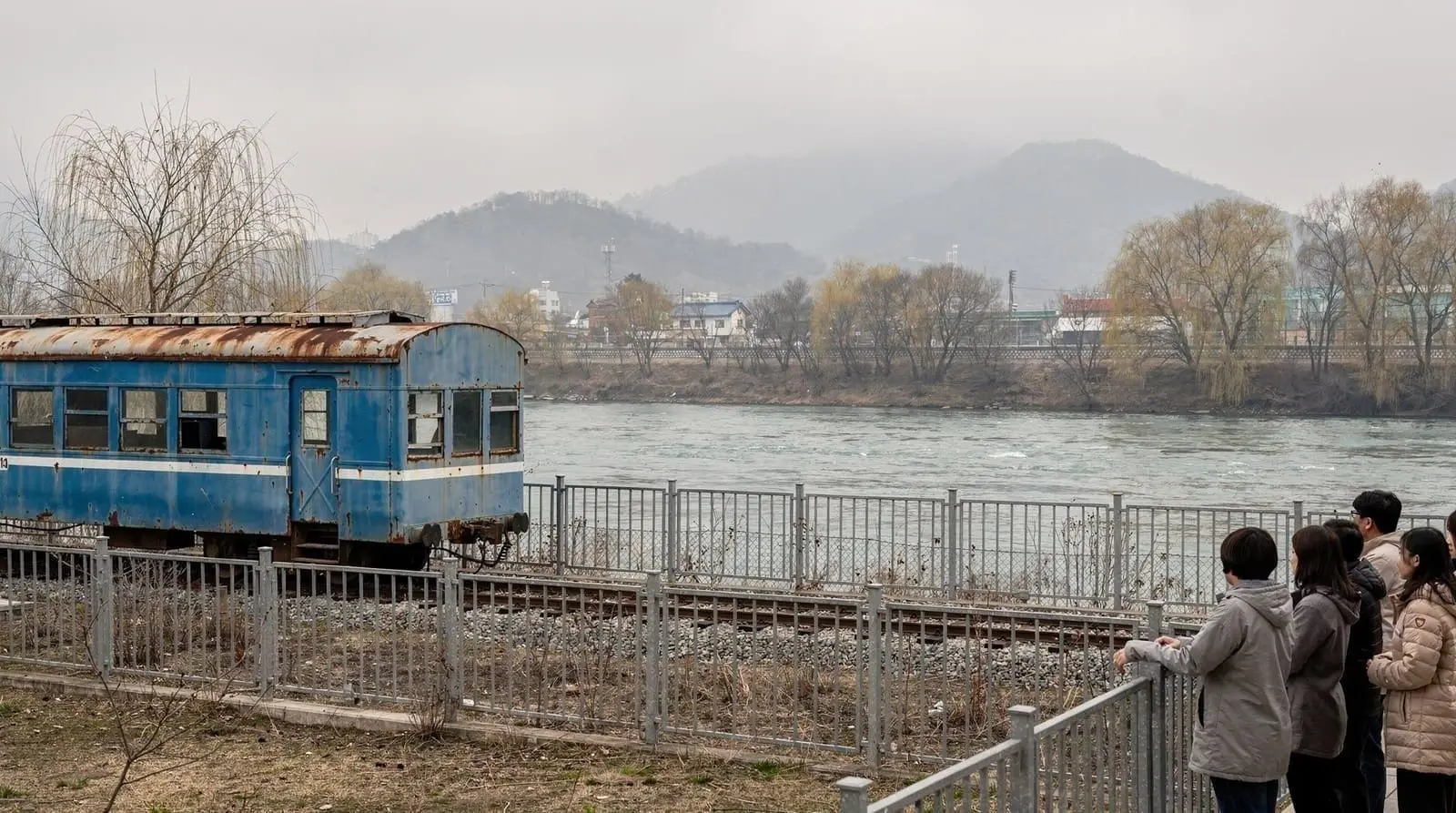
The Korean Demilitarized Zone (DMZ, 비무장지대) is a 4 km-wide, 248 km-long strip of land crossing the Korean peninsula at roughly the 38th parallel — the division line established by the 1953 Armistice that ended the fighting (not the Korean War itself, which has never formally ended). It’s the most heavily militarized border in the world: an estimated 2 million landmines, multiple layers of fencing, armed guards every few hundred meters, and a UN-administered Joint Security Area at Panmunjom where North and South Korean soldiers stand meters apart. Visiting the DMZ from Seoul is one of the most viscerally unusual experiences in travel — and it’s entirely safe for organized tour participants.
| Where | Paju, Gyeonggi Province — 60–90 min north of Seoul |
| Cost | 40,000–100,000 KRW depending on tour type |
| Time needed | Full day, typically 8–10 hours including transport |
| Getting there | Organized tour only — no independent access to most sites |
| Best time | Spring or autumn for clear skies over the observatory |
What to see on a DMZ tour
Third Tunnel of Aggression
The Third Tunnel (제3땅굴) is one of four tunnels dug by North Korea under the DMZ in the 1970s, presumably intended for surprise military incursion. This one was discovered in 1978 after a North Korean defector alerted the South. Visitors enter the tunnel via a 73-degree incline railway (or walkway) and walk to the granite wall that marks the actual border. The tunnel is low (you stoop for most of the 400 m walk to the border) and cold. This is the most physically memorable part of any DMZ visit.
Most tours visit the Third Tunnel. Hard hats are provided. Photography is not permitted inside the tunnel.
DMZ Insider Tour: Defector Q&A, 3rd Tunnel & BridgeDora Observatory
Dora Observatory (도라전망대) is the southernmost observation post open to civilians, with a view over the DMZ into North Korea. On clear days you can see Kaesong Industrial Complex, Gijungdong village (with its enormous North Korean flag), and North Korean agricultural land. Binoculars are available for rent (500 KRW). Photography is permitted from the observation deck but only with a permit at designated spots.
From Seoul: DMZ & JSA Museum with Optional NK Defector TalkJoint Security Area (JSA / Panmunjom)
The Joint Security Area at Panmunjom is the only point where the two Koreas share ground-level contact — UN soldiers from the South and KPA soldiers from the North stand in the same small zone. Visitors enter the blue conference buildings (where the armistice was signed) and briefly stand on North Korean territory. This is the most emotionally charged site of any Korea trip.
JSA access requires a separate booking from a standard DMZ tour. Currently, JSA visits are managed through Camp Bonifas (the US Army/UN Command base nearby). Availability changes with the political situation — there have been periods of closure following incidents. Check current availability when booking.
Korea DMZ Tour from SeoulImjingak Park and the Bridge of Freedom
Imjingak Park (임진각) is the first stop on most DMZ tours and the only major DMZ site accessible without a security escort. It contains the Bridge of Freedom (자유의 다리) — originally used for prisoner-of-war exchanges after the armistice — and a memorial park where Korean families separated by the division tie wishes to the fence. The emotional weight here is real and not performative; visitors are asked to be respectful.
Unification Village and Daeseongdong
Daeseongdong (대성동) is the only South Korean civilian village within the DMZ, home to about 200 residents who live under strict military curfews but also receive exceptional subsidies and exemptions in exchange. Not all tours visit this village; those that do require UN escort.
North Korean defector-led tours
A small number of tours in the Paju area are led by North Korean defectors (탈북자) who have settled in the South. These tours add a layer of personal testimony that no standard military briefing can match. The defector-led experience typically combines a Paju DMZ visit with a visit to the exhibition hall at the Freedom Bridge and a Q&A session. These tours book up weeks in advance.
Seoul: DMZ Tour with Optional Bridge & Exhibition HallSome operators now combine the Third Tunnel with the newer Imjingak suspension bridge attraction and a defector Q&A into a single itinerary, which is a good option if your time in Seoul is limited to one DMZ day.
DMZ: NK Defector, 3rd Tunnel, Suspension Bridge, Hotel PickupChoosing the right DMZ tour type
Not all DMZ tours cover the same ground, and picking the wrong one is the most common regret travelers report. Here’s how the three main formats compare:
| Tour type | Duration | Typical cost | Includes | Best for |
|---|---|---|---|---|
| Standard DMZ tour | 4–5 hrs | 40,000–80,000 KRW | Third Tunnel, Dora Observatory, Imjingak | First-time visitors, tight budgets |
| DMZ + JSA tour | 7–9 hrs | 80,000–150,000 KRW | Standard sites + Panmunjom/JSA | Those wanting the border encounter itself |
| Defector-led tour | 5–6 hrs | 60,000–100,000 KRW | Paju sites + personal testimony + Q&A | History-focused travelers wanting context beyond a military briefing |
The JSA add-on requires booking further in advance (2–3 days minimum, sometimes weeks in high season) and carries the strictest ID and dress-code rules, so decide early if it matters to you rather than assuming you can add it later.
Why the DMZ still matters
The DMZ isn’t a historical relic — it’s an active, monitored border between two states still technically at war. Roughly 28,500 US troops remain stationed in South Korea partly because of this unresolved status, and the JSA has been the site of real incidents, including defections under fire as recently as 2017. Standing at the Third Tunnel or the JSA conference row gives a visceral sense of a conflict most visitors only know from headlines — which is why guides consistently rate it among the most memorable single day trips from Seoul, ahead of more conventional sightseeing.
Getting to the DMZ
Independent travel is not possible to most DMZ sites — the buffer zone requires military escort, and civilians cannot enter without a registered tour group.
Organized tour from Seoul (standard): Most DMZ tours depart from major Seoul hotels or from Gwanghwamun (Seoul city center). Buses leave around 7:30–8 a.m. and return by 2–4 p.m. depending on the itinerary. Cost: 40,000–80,000 KRW including transport and guide. The DMZ day tour from Seoul guide compares the main tour operators.
From Incheon: Most tours do not depart from Incheon. Take subway line 1 to Seoul Station or take the AREX to Seoul Station (43 min by Express from Incheon Airport Terminal 1), then join a Seoul-based tour. Alternatively, some operators pick up at Incheon hotels by arrangement.
If you are still working out how to move between the airport, your hotel and the Seoul pickup point, the getting around Incheon guide explains the options. Travelers on a long stopover can also look at the Incheon airport layover itinerary before deciding whether a full DMZ day fits their schedule at all.
JSA-specific tours: Require a separate booking and sometimes a background check. Booking must be made at least 2–3 days in advance; US and Korean dual citizens face additional restrictions. Check the current UN Command instructions.
What to expect on tour
DMZ tours run on military time — buses are punctual, sites have strict schedules, and you should not wander from your group. The atmosphere is not oppressive; guides are experienced at making the context accessible, and most tours have 15–25 minutes of free time at each site for photos and reflection. The full visit covers about 5–6 km of walking across multiple sites.
Photography rules vary by site. The Third Tunnel: no photos. Dora Observatory: permitted at designated points. Imjingak: permitted throughout.
Paju city — the Heyri Art Village
If you have energy after the DMZ tour, Paju is also home to Heyri Art Village (헤이리 예술마을) — a purpose-built art colony with 400+ studios, galleries, bookshops, and cafes housed in architect-designed buildings. It’s very different in atmosphere from the DMZ (calm, photogenic, creative) and makes a meaningful contrast to end the day.
The DMZ works best as one anchor day inside a longer plan rather than a stand-alone trip. The Incheon and Seoul in 2–3 days itinerary shows how to place a full-day excursion between city days, and the Incheon in one day itinerary is a good companion for a rest day on the coast after the long bus ride north.
Practical information
- What to bring: Passport or photo ID (required for entry to secured areas). Comfortable walking shoes. Light jacket (the tunnels are cool year-round).
- What not to bring: Shorts or overly casual clothing may not be permitted at some military sites. Follow tour operator dress code guidelines.
- Photography: Ask your guide before pointing a camera at any military installation. Violations can result in the whole group being asked to leave.
- Language: Most organized tours run in English and Korean. Some operators offer German, Chinese, or Japanese.
- Age restrictions: Some tunnel sections have height restrictions; young children may not be permitted in the Third Tunnel.
- Tourism helpline: 1330 (English, 24/7).
- Before you go: The safety and language tips for Incheon cover useful phrases and basic precautions, and the best time to visit Incheon page helps you pick a season with clear views from the observatory.
Frequently asked questions about the DMZ and Paju
Is the DMZ dangerous to visit?
No — for organized tour participants, the DMZ is entirely safe. The security presence is high but the risk to civilians is negligible. Tours have operated continuously (with occasional brief closures during political tensions) since the 1970s. Treat it like visiting any militarized historic site.
Can I visit the DMZ without a tour?
Imjingak Park can be reached independently by taking the Gyeongui-Jungang Line to Munsan station and then a local bus (about 90 min from Seoul). The park and its memorials are accessible without escort. The Third Tunnel, Dora Observatory, and JSA all require organized tour registration.
What is the Joint Security Area and is it safe?
The JSA (Panmunjom) is the only point of ground-level contact between the two Koreas. It is guarded by UN Command soldiers on the South side and KPA soldiers on the North side. Visitors enter under UN military escort and must follow strict protocols. It is safe — no tourist has been harmed in the history of civilian visits — but the protocols must be followed.
What is the difference between a DMZ tour and a JSA tour?
Standard DMZ tours cover Imjingak, the Third Tunnel, Dora Observatory, and related sites south of the MDL (Military Demarcation Line). A JSA/Panmunjom tour includes the conference buildings at Panmunjom, where you briefly enter North Korean territory. JSA access requires separate booking and occasionally carries restrictions by nationality.
Can citizens of all countries visit the DMZ?
Most nationalities can visit. There have been historical restrictions for US citizens at the JSA specifically (due to the 1976 Axe Murder Incident). Current rules for all nationalities are published by the tour operators. Check when booking.
How does the DMZ relate to the Korean War history at Incheon?
The Korean War’s most famous Incheon moment is the 1950 Incheon Landing led by General MacArthur, commemorated at Jayu Park in Incheon Chinatown. The DMZ marks the eventual 1953 ceasefire line — a separate chapter of the same conflict. Together they form a coherent historical narrative of the war’s beginning and frozen end.
Can I combine a DMZ tour with Nami Island or Seoul in one day?
Not comfortably. A DMZ tour alone runs 8–10 hours including transport, and Nami Island is a full-day trip in the opposite direction with its own 90-minute train journey. Treat the DMZ and Nami Island and Gapyeong as separate days if both are on your list — trying to combine them leaves too little time at either.
Is a DMZ tour a good use of time for travelers based in Incheon rather than Seoul?
Yes, with one adjustment: build in extra transit time. Most tours depart from central Seoul hotels or Gwanghwamun, so factor in the roughly 1-hour AREX or subway ride from Incheon to the pickup point, or ask about the small number of operators offering Incheon hotel pickup by arrangement.


