Incheon airport 6-hour layover itinerary
Is 6 hours enough to leave Incheon Airport?
Yes — with one firm condition: your bags are checked through to your final destination. If you need to collect and re-check luggage, subtract 30-40 minutes from usable time and reconsider. With bags checked through, a 6-hour stopover gives you roughly 3.5 hours on the ground in Incheon before you need to head back.
The logic is simple. The trip from Terminal 1 to Incheon Station is the AREX all-stop train to Gyeyang, then Incheon Metro Line 1 (check the live journey time in Naver Map or Kakao Map). You need to be back at the airport security checkpoint 90 minutes before departure — 60 minutes minimum for immigration and security, plus a 30-minute buffer for delays. That leaves a real window of around 3 hours and 30 minutes to walk, eat, and explore the Incheon Open Port and Chinatown area.
If your layover is under 5 hours, this itinerary does not work. If you have 7 hours or more, you gain time and can add Wolmido Island or slow down considerably at the Open Port museums.
Which plan fits your layover length
| Layover length | Ground time (approx.) | Recommended plan |
|---|---|---|
| Under 5 hours | Not enough | Stay airside; eat in the transit zone |
| 5-6 hours | ~2.5-3.5 hours | Chinatown + Open Port core route only, skip both optional stops |
| 6-7 hours | ~3.5-4.5 hours | Full route as below, add Songwol-dong or Jayu Park (not both) |
| 7-8 hours | ~4.5-5.5 hours | Full route plus both optional stops, or extend to Wolmido Island |
| Over 8 hours | 5.5+ hours | Consider the fuller Incheon in one day itinerary instead |
What you need: Passport (you are leaving the international zone). A T-money card or cash in won. Comfortable shoes — this is a walking itinerary with moderate hills near Jayu Park.
Key timings at a glance
| Stage | Duration | Notes |
|---|---|---|
| Airport to Incheon Station (AREX to Gyeyang + Incheon Metro Line 1) | Check live (Naver Map / Kakao Map) | AREX departs roughly every 15 min from B1 of T1 |
| Station to Chinatown gate on foot | 3 min | Exit 1, walk straight |
| Chinatown + Open Port exploration | ~2 hr 30 min | Flexible; see route below |
| Incheon Station to airport (Incheon Metro Line 1 + AREX from Gyeyang) | Check live (Naver Map / Kakao Map) | Allow a few minutes to buy ticket or top up T-money |
| Airport: immigration + security + walk to gate | 60-90 min | ICN is efficient but large; do not cut this short |
| Total time from gate to gate | ~5 hr 30 min | For a 6-hour layover this is tight; 7 hours is comfortable |
Use these numbers as your anchor. When you are on the ground, keep checking the clock.
Sample hour-by-hour timeline (6-hour layover, landing at 10:00)
| Time | Activity |
|---|---|
| 10:00 | Land, clear immigration, collect any carry-on essentials |
| 10:30 | Top up T-money or buy AREX ticket, board the all-stop AREX train |
| Late morning | Change at Gyeyang, arrive Incheon Station, walk to Chinatown gate |
| 11:05 | Enter Chinatown, walk the main street |
| 11:45 | Lunch — jjajangmyeon at a sit-down restaurant |
| 12:30 | Walk north into the Open Port heritage area |
| 13:15 | Optional: Songwol-dong or Jayu Park |
| 13:40 | Head back toward Incheon Station |
| 14:00 | Metro Line 1 to Gyeyang, then AREX back to the airport |
| Mid-afternoon | Arrive airport, begin re-entry through departures |
| 16:00 | Departure (6 hours after landing) |
Shift every step earlier or later depending on your actual landing time, but keep the spacing between stages roughly the same.
The itinerary
Getting out of the airport
At the airport (allow 20-25 minutes before boarding AREX)
Clear immigration on arrival first — at Incheon International this usually takes 10-20 minutes outside peak hours, longer if several international flights arrived at the same time. Once through, head to the arrivals hall and find a convenience store: GS25, CU, or 7-Eleven all stock T-money cards and can top them up. Load at least 10,000 won onto the card to cover the AREX ride each way plus a small metro margin.
If you do not want to handle a T-money card, the AREX sells single-journey tickets at vending machines at the station platform level (B1). It takes a few extra minutes and the machines have an English interface.
If you prefer to have your SIM or data connectivity sorted before leaving the airport, pick up a travel SIM at the airport counters in arrivals before heading to the train. Some travelers combine this with a pre-arranged SIM that includes a T-money function.
Incheon Airport: Traveler SIM & T-money Transportation CardAREX to Gyeyang, then Incheon Metro Line 1 to Incheon Station
The AREX platforms are on level B1 of Terminal 1. Follow signs for “Airport Railroad” — they are prominent and in English. Board the all-stop local service (not the express, which goes non-stop to Seoul Station and costs 9,500 won). The AREX does not run to Incheon Station: ride it to Gyeyang, then change to Incheon Metro Line 1 (the transfer is valid within 30 minutes of exiting the fare gate, 1 hour after 9 pm). For the exact journey time and fare, check Naver Map or Kakao Map or the official timetables.
Sit on the left side of the train for a brief view of the tidal flats and Yeongjongdo island as you cross the causeway — one of the few scenic moments on the line.
If you are arriving at Terminal 2, take the inter-terminal connector train to T1 first (free, ~10 minutes), then board the AREX.
At Chinatown and the Open Port
Incheon Station → Chinatown gate (3 minutes on foot)
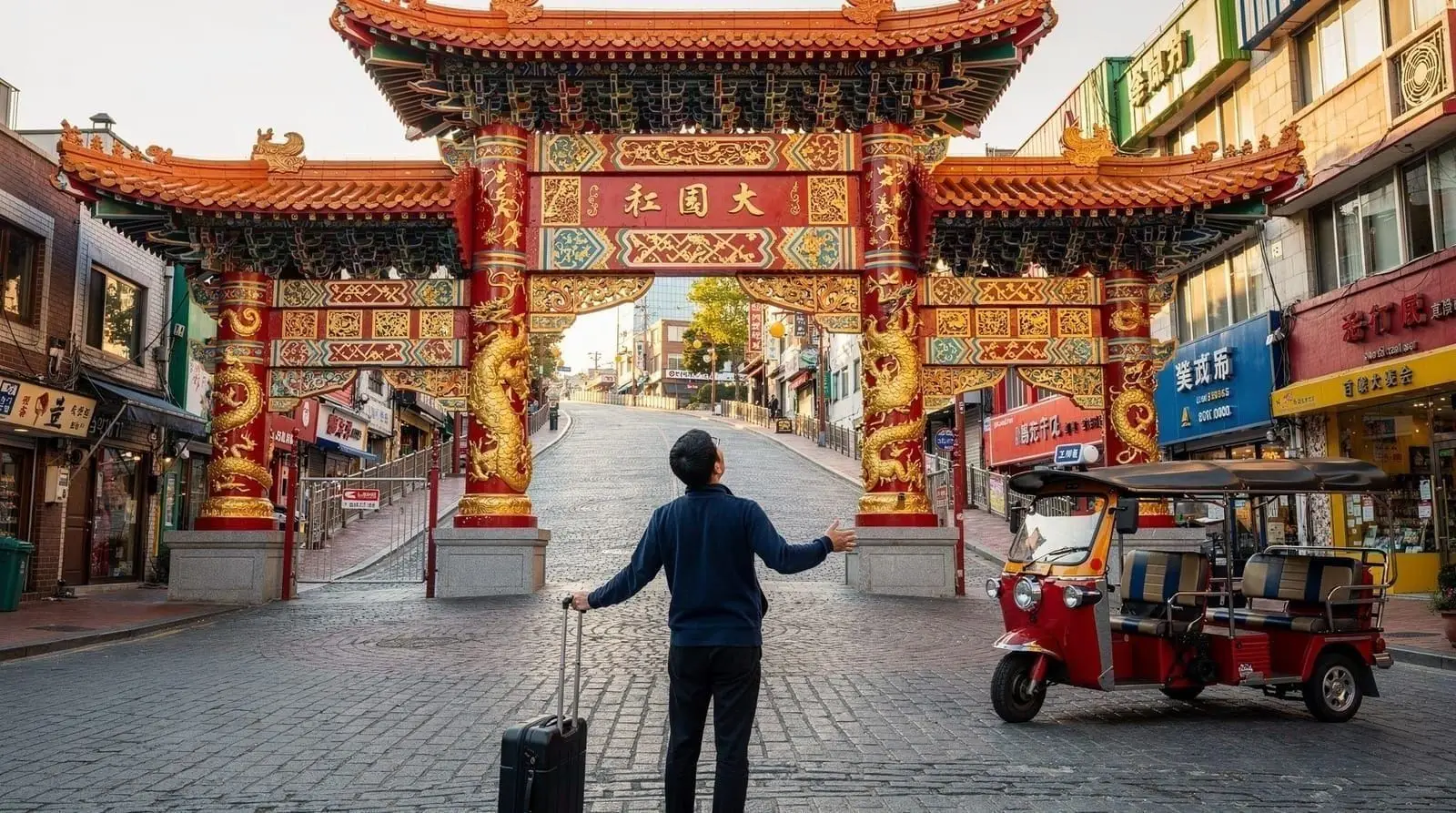
Exit through gate 1 at Incheon Station. Walk straight ahead — you will see the traditional Chinese-style gate with red columns within two or three minutes. This is the entrance to Incheon Chinatown.
Korea’s only officially designated Chinatown has been here since 1884, when the Qing Dynasty established a concession in the area following the opening of Incheon port. The buildings are a mix of restored and original structures. It is a functioning neighborhood, not a theme park — the restaurants, shops, and small temples are all active.
Chinatown: 40-50 minutes
Walk the main street (Chinatown-ro) north from the gate. The street is dense with restaurants serving jjajangmyeon — the black bean noodle dish that became a Korean staple largely because of Incheon’s Chinese community. If you are eating here, do it now while restaurants are open and before the mid-morning or lunch rush depending on your arrival time. A bowl of jjajangmyeon costs roughly 8,000 to 12,000 won at a sit-down restaurant.
The Incheon Chinatown walking route covers the main food stops and historical markers in detail. For a layover, focus on the main street and the two or three restaurants with queues — they are popular for a reason.
At the far (north) end of Chinatown, cross the small plaza and you reach the start of the Open Port heritage area.
Open Port area: 45-60 minutes
The Open Port district is a short walk north of Chinatown. This is where foreign concessions were established after 1883 — Japanese, Western, and Chinese trading houses lined what is now Jung-gu’s heritage zone. Many of the original early 20th-century buildings survive and have been converted into coffee shops, galleries, and small museums.
Key stops if time is short:
- Incheon Open Port Museum (inside a restored Japanese bank building from 1883): Entry is a few hundred won and the building itself is the exhibit.
- Japanese Concession street (Jemulpo-ro): A row of low brick buildings in various states of restoration. The street is photogenic and usually quiet in the morning.
- Korea Development Bank building (now the Incheon Open Port Modern Architecture Museum): Another 1890s building; free to walk past, small fee to enter.
For more depth on the buildings and their history, see the Open Port heritage guide.
Songwol-dong Fairytale Village (optional, add 20-25 minutes)
If you have time after the Open Port, Songwol-dong Fairytale Village is a 10-minute walk inland — a neighborhood of alleyways painted with murals originally created to address urban decay. It is colorful and worth seeing if you have the window. Skip it if you are already short on time.
Jayu Park (optional, add 20-30 minutes)
Jayu Park sits on the hill above Chinatown and is a steep 10-minute walk up from the gate area. At the top there is a statue of General Douglas MacArthur and views over the port and sea. The park is significant for its Korean War memorial context and the view alone justifies the climb if you have 20 minutes to spare. If you are on a tight clock, skip it and spend the time in the Open Port instead.
Getting back to the airport
Incheon Station departure
Start heading back to Incheon Station 3 hours and 20 minutes before your flight departure at the absolute latest — preferably 3 hours and 30 minutes. That gives you the train ride (AREX plus Incheon Metro Line 1, check the live journey time), a few minutes to buy a ticket or top up T-money if needed, and a full 90 minutes at the airport from arrival at the terminal to gate.
Do not rely on the 60-minute minimum. Incheon is a large airport and the time from the AREX platform to your gate — including immigration if you are exiting Korea, security, and the walk or shuttle to your gate — can stretch to 45 minutes on a busy day.
At Incheon Station, take Incheon Metro Line 1 to Gyeyang, then change to the AREX to the airport. Check the departure boards for the next service.
At the airport
Re-enter through departures on level 3 of Terminal 1 (or the correct terminal for your airline). Have your passport and boarding pass ready. If you used a T-money card, the remaining balance stays on the card and can be used on future trips to Korea.
Practical tips
Passport and immigration
You must carry your passport. You are leaving the international transit zone and formally entering Korea, even briefly. At immigration on re-entry, you will go through standard departure procedures. Keep your boarding pass accessible throughout the day.
Bags
Only attempt this itinerary if your bags are checked through to your final destination. Chinatown and the Open Port area have no practical bag storage. The airport has left-luggage facilities (level 1 of T1) if your bags were not checked through and you still want to attempt the outing — but add 15-20 minutes to your airport time on both ends.
What to eat
Incheon Chinatown is one of the best places in Korea to eat jjajangmyeon. It also serves jjamppong (spicy seafood noodle soup, 9,000-13,000 won) and tangsuyuk (sweet-and-sour pork or beef, 15,000-25,000 won for a sharing plate). Street food along the main street includes steamed dumplings (mandu) and small snacks for 1,000-3,000 won.
For a broader guide to eating in the area, see where to eat in Incheon Chinatown.
Weather and what to wear
Incheon’s climate swings hard by season, and a layover gives you no flexibility to wait out bad weather. Summer (June-August) is hot and humid with a real chance of sudden downpours during the monsoon window in July — a compact umbrella is worth the bag space. Winter (December-February) is cold and dry, with wind off the water near the Open Port waterfront making it feel colder than the temperature suggests; a proper coat matters more than layers here. Spring and autumn are the most comfortable for this walking-heavy itinerary, with mild temperatures and generally lower rain risk. Whatever the season, wear shoes you can walk several kilometers in — the Open Port streets are cobbled or uneven paving in places.
Cash vs card
Most restaurants in Chinatown accept credit cards, but some smaller stalls and street food vendors are cash only. Withdraw or exchange a small amount — 20,000-30,000 won is plenty for a layover — at the airport before leaving. ATMs in the arrivals hall accept international cards; look for machines marked “Global ATM” or ones operated by KEB Hana Bank or Woori Bank.
Transport helpline
If you get confused on the AREX or metro, call 1330, the Korea tourism helpline. It operates 24 hours and has English-speaking staff.
Budget breakdown for this layover
| Item | Cost |
|---|---|
| AREX + Incheon Metro Line 1, round trip | check live (Naver Map / Kakao Map) |
| T-money card (if buying new) | around 4,000-5,000 won, refundable |
| Jjajangmyeon lunch | around 8,000-12,000 won |
| Street snacks | around 2,000-5,000 won |
| Open Port Museum entry | a few hundred won |
| Total for a self-guided layover | roughly 20,000-30,000 won per person |
That is a modest budget for filling a stopover with real sightseeing rather than an airport lounge. Keep a little extra in cash for smaller stalls that do not take cards.
Left-luggage and lockers
Even with checked-through bags, some travelers carry a day bag with a laptop or camera gear they would rather not lug through Chinatown. Incheon Station itself has small coin lockers near the exits, though availability varies and they cannot be relied on for larger items — the airport’s own left-luggage counter on level 1 of Terminal 1 is the safer option if you are unsure.
Pre-booked options
If you prefer a guided experience that handles the logistics and includes cultural context, a stopover tour is available that covers the Chinatown and Open Port highlights with an English-speaking guide.
Incheon Stopover: City Highlights Tour for K-culture FansSome travelers on longer layovers prefer a local walking guide who can navigate the area and give context to what they are seeing — particularly useful in the Open Port district where the buildings need explanation to make sense.
Incheon: Walk and Eat with Local Walking BuddyConnected guides
If this layover turns into a longer trip, see Incheon in one day for a fuller itinerary, or Incheon and Seoul over 2-3 days if you want to combine both cities. The general Incheon airport layover guide covers alternative options including shorter 3-hour windows and longer 8-hour stopover scenarios.
Seoul Layover Tour: Seoul Highlights with ICN Airport PickupFor first-time visitors, getting around Incheon has transport detail beyond the AREX, and Incheon safety and language tips covers practical basics for navigating without Korean.
Frequently asked questions about a 6-hour Incheon layover
Do I need a visa to leave Incheon Airport for a layover?
Most Western passport holders do not need a visa for a short visit. Citizens of the EU, the United States, the United Kingdom, Canada, Australia, and many other countries can enter Korea visa-free for stays up to 30 or 90 days depending on nationality. However, you must complete the mandatory e-Arrival Card before landing — this replaced the paper arrival card and is required even for visa-exempt visitors. Check the K-ETA and e-Arrival Card guide for 2026 for current requirements. If your nationality requires a visa, do not leave the international zone without one.
What if my bags are not checked through?
If you need to collect your bags on arrival and re-check them for your onward flight, you face two options: leave your bags in airport left-luggage storage (level 1 of Terminal 1, open 24 hours, fee per bag per day) before exiting, or skip the layover outing entirely. Carrying luggage through Chinatown and the Open Port on foot is impractical, and the added time at the airport — bag collection, re-check-in, security — eats significantly into the usable window.
How long does it take to get from the airport to Chinatown?
Take the AREX all-stop train from Terminal 1 to Gyeyang, then Incheon Metro Line 1 to Incheon Station; check the live journey time in Naver Map or Kakao Map. Add 5-8 minutes to walk from your arrival gate to the AREX platform (B1, follow signs for “Airport Railroad”), and 3 minutes on foot from Incheon Station exit 1 to the Chinatown gate.
Is the AREX different from the Seoul subway?
Yes, they are separate systems that connect at a few interchange points. The AREX (Airport Railroad) runs between Incheon Airport and Seoul Station. For this layover itinerary, you only use the AREX — you board at the airport, ride to Gyeyang, change to Incheon Metro Line 1 for Incheon Station, and return the same way. A T-money card works on both systems, which is why it is the recommended option.
Can I do this itinerary with children?
Yes. The walk is flat from Incheon Station through Chinatown and the Open Port district. The only hilly section is Jayu Park, which is optional and can be skipped entirely. Chinatown’s street food and colorful murals in Songwol-dong Fairytale Village tend to appeal to younger travelers. Keep the time buffer in mind — getting back to the airport late with children is more stressful than with adults.
What is there to eat near Incheon Station during a layover?
Chinatown is the primary eating destination. The main dish is jjajangmyeon (black bean noodle soup), which has its Korean roots in this neighborhood. Jjamppong (spicy seafood noodles) and tangsuyuk (sweet-and-sour pork) are also widely available. Street food stalls sell steamed dumplings, fried snacks, and small sweets for 1,000-3,000 won per item. Most restaurants open by 10:00 and operate through the afternoon. For recommendations, see the Incheon Chinatown food guide.
What happens if my outbound flight is delayed and I am still in the city?
If your departure is delayed and you are already on the ground in Incheon, you have more time — check your airline’s app or the 1330 tourism helpline for updates. If your inbound flight was delayed and your layover is now shorter than planned, reassess immediately: if you have under 5 hours from landing to your next departure, do not attempt this itinerary. Stay at the airport, eat in the transit zone, and be at your gate early.
Airport transfers & layover tours on GetYourGuide
Top-rated tours and activities


