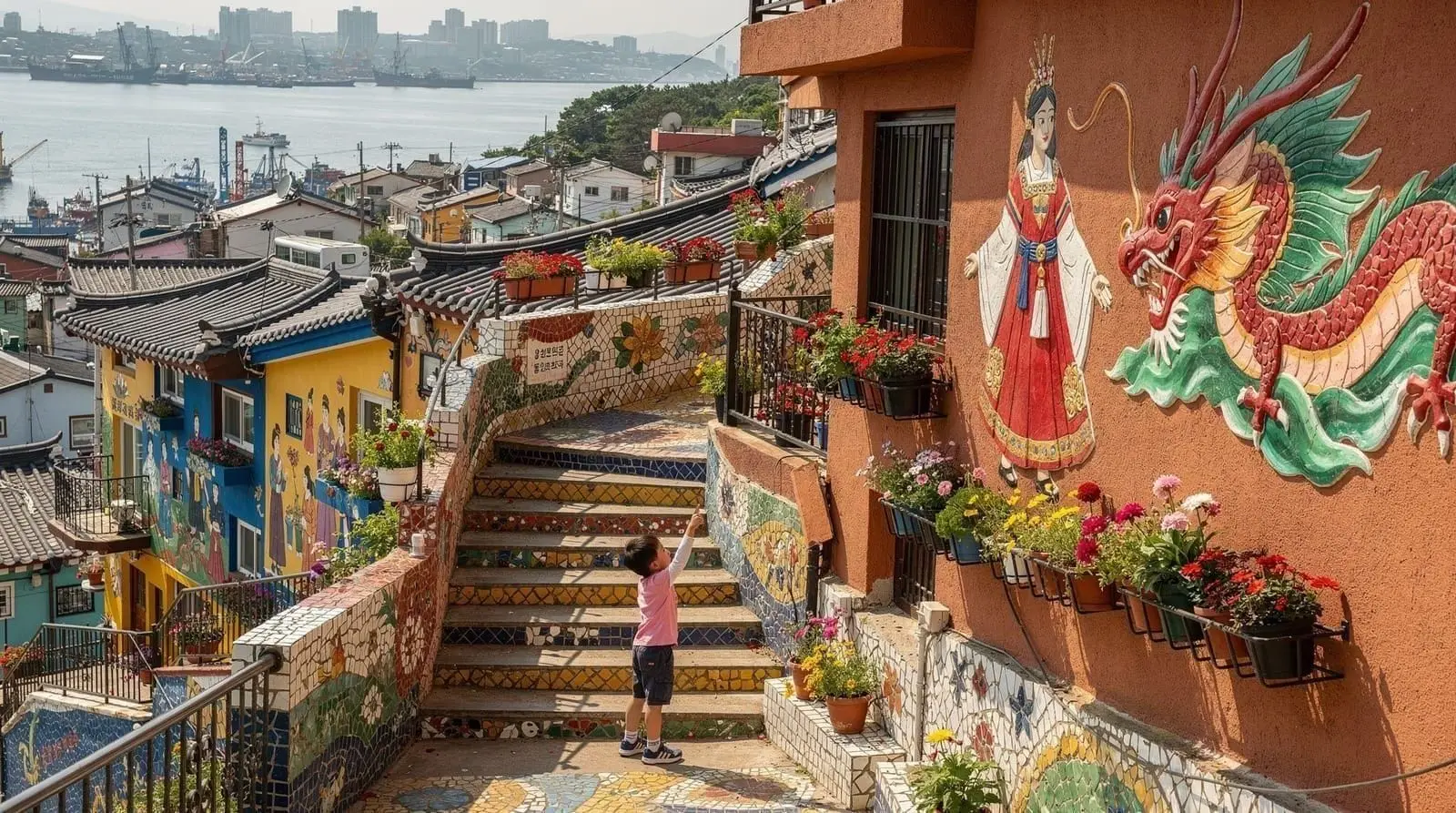
Songwol-dong Fairytale Village: Incheon's outdoor mural art district
Is Songwol-dong Fairytale Village free to visit?
Yes, the entire village is free — it is an outdoor mural district on public streets. Budget 1–1.5 hours for photos. Small cafes and gift shops inside charge normally for what you buy.
| Where | Hillside above Incheon Chinatown, near Incheon Station |
| Cost | Free entry; snacks/gifts extra |
| Time needed | 1–1.5 hours |
| Getting there | Metro line 1 to Incheon Station, then 18–20 min walk uphill |
| Best time | Weekday mornings (8–10am) for light and quiet |
What Songwol-dong actually is
Songwol-dong Fairytale Village (송월동 동화마을) is a hillside residential neighborhood in Incheon that was transformed into an outdoor mural district beginning in 2013. The project was driven by a practical problem: the neighborhood had been losing population for years as younger residents moved to newer parts of the city, leaving a cluster of older houses looking increasingly empty and run-down. The local government commissioned artists to paint fairy tale murals across building exteriors, reasoning that foot traffic from visitors would bring some economic life back to the area.
The strategy worked. The village now draws a consistent stream of Korean domestic tourists, mostly day-trippers from Seoul and the wider Incheon metro area, and has become one of the more photographed spots in the city. The murals depict a mix of European fairy tales (the Little Prince, Hansel and Gretel, Alice in Wonderland, Cinderella, Snow White) and Korean folk tales (Heungbu and Nolbu, Kongjwi and Patjwi). The combination is slightly incongruous but genuinely charming, particularly in the most-visited lanes where the painting quality is high.
The key facts you need before deciding whether to include it in a Chinatown half-day: entry is free, the whole circuit takes 1–1.5 hours, and it pairs well with Incheon Chinatown and Jayu Park as a morning or afternoon loop from Incheon Station.
Incheon: Walk and Eat with Local Walking BuddyThe murals: what to see lane by lane
The Little Prince lane
The most photographed section of the village runs along the lane known informally as “어린왕자길” (Little Prince Road). Antoine de Saint-Exupery’s characters — the prince himself, the fox, the rose, the baobab — are spread across an entire building facade in a style that references the original book illustrations closely enough to be immediately recognizable, while being large enough that the whole scene works as a backdrop for photos.
This lane is usually the most crowded part of the village, which means the best light for photos (morning) and the worst crowds (midday on weekends) often coincide with each other. Arrive as close to 9am as possible on weekends if you want the lane relatively clear. Weekday mornings are substantially quieter.
Hansel and Gretel house
The Hansel and Gretel building (헨젤과 그레텔) takes a more three-dimensional approach than the flat murals: candy-colored paint is combined with sculptural elements — faux candy decorations, oversized gingerbread house features — attached to the building facade. It reads as explicitly playful and child-friendly, and is popular with families. The 3D elements photograph differently depending on the angle; walk around the building rather than just shooting from the street.
Alice in Wonderland murals
The Alice in Wonderland section illustrates several scenes from Lewis Carroll’s books, including the Cheshire Cat, the Mad Hatter’s tea party, and the Queen of Hearts. The color palette runs heavy on blues and purples. The quality varies by wall — some panels are well-executed, others show their age more (murals painted in 2013 have had mixed maintenance over the past decade). The main panels near the signage have been retouched and are in good condition.
Korean folk tale murals
One of the more interesting aspects of the village is the decision to include Korean fairy tales alongside the European ones. Heungbu and Nolbu (흥부와 놀부) — the story of two brothers, one generous and one greedy, and the magical gourd that rewards or punishes each — is illustrated in a traditional painting style that contrasts noticeably with the European story panels. Similarly, Kongjwi and Patjwi (콩쥐팥쥐), a Korean analogue to the Cinderella story, appears in a section that rewards visitors who take the time to read the accompanying text panels.
These Korean folk tale sections tend to be less crowded than the European fairy tale areas, partly because they are not associated with globally recognized IP. That makes them worth seeking out if you want photos without strangers walking through the frame.
Cinderella pumpkin carriage sculpture
A free-standing sculpture of Cinderella’s pumpkin carriage sits at one of the main intersections in the village. It functions as a photo prop and is almost always occupied — there is an informal queue on busy days. The carriage is large enough for two adults to sit in the “seats,” and the proportions are good for photos. If this is important to your itinerary, the wait is usually five minutes or less on weekdays and up to 20 minutes on busy weekend afternoons.
Peter Pan and Tinker Bell lane
One of the longer continuous mural sections in the village follows the Peter Pan story across a street-level wall that runs most of the length of a residential block. The flying sequence — Peter Pan and Tinker Bell over a nighttime London skyline — is the standout image. The London skyline detail, including Big Ben, is more carefully painted than some of the other European-story sections.
Snow White and the Seven Dwarfs house
The Snow White section doubles as a small retail space — one of the houses along this lane operates as a gift shop selling fairy-tale-themed goods: illustrated postcards, small figurines, and themed candy. It is worth stepping in briefly. The dwarfs are painted with individual personalities clearly differentiated, which makes the panel readable even from a distance.
Practical information for your visit
Getting there
The most natural approach is through Incheon Chinatown. Take metro Line 1 to Incheon Station (the last stop) and use Exit 1. Walk straight ahead into Chinatown for about 8 minutes, then look for signs reading “동화마을” or “Fairytale Village” pointing uphill to the left. The walk from the end of Chinatown’s main street to the village entrance is about 10 minutes. Total from Incheon Station: around 18–20 minutes on foot.
You can also approach from Jayu Park: the park’s lower gate near the Russian consulate building is a 5-minute downhill walk from the top of the Fairytale Village. This approach gives you a cleaner view of how the village sits between the park (hilltop) and Chinatown (lower ground), and it is the natural route if you are visiting Jayu Park first and moving down to the village before heading into Chinatown.
There is no parking inside the village — it is a residential neighborhood with narrow streets. Do not attempt to drive in. The metro is the right approach.
Entry and costs
The murals are painted on public buildings on public streets. There is no gate, no ticket, and no required entry fee. The entire circuit is free. Small gift shops in the village charge market rates for what they sell (postcards 1,000–3,000 won / 0.80–2.30 USD; small figurines 5,000–15,000 won / 3.85–11.50 USD). Cafes charge 3,000–6,000 won (2.30–4.60 USD) for coffee and 4,000–7,000 won (3–5.40 USD) for tea and light snacks.
How long to spend
One to one-and-a-half hours is enough to walk the main lanes, take photos at the key stops, and look inside the gift shops. If you are visiting with children who want time at each mural and the carriage prop, budget closer to two hours. If you are doing a straight photo circuit, 45 minutes is possible but feels rushed at the best sections.
Best time to visit
Weekday mornings are the optimal combination of light and crowd levels. The village faces mostly northeast and northwest, which means direct sunlight hits different walls at different times of day. Morning light (8–10am) is generally softer and better for photos than midday. Weekend afternoons from noon to 3pm are the busiest period — Korean tour groups and family outings converge, and the main lanes can feel genuinely crowded.
Avoid rainy days. The murals are entirely outdoors with no shelter between sections. Rain affects photo quality (murals look washed out and wet, puddles in foreground), and the walking surfaces between lanes become slippery. If there is a chance of rain in the afternoon, do Chinatown lunch first and the village second so you have something to retreat to.
Seasonal notes
Spring (March–May) is the busiest season overall, particularly cherry blossom season in late March to early April when Jayu Park and the surrounding area draw large crowds. If you visit during this period, the Fairytale Village is packed on weekends; plan for a weekday or very early morning arrival. The Incheon cherry blossom spring itinerary covers the season in detail.
Autumn (September–November) is the second-busiest season and arguably the best for photography — the light is good, temperatures are comfortable, and foliage from the park and neighborhood trees adds color around the murals. The Incheon autumn foliage hiking itinerary covers the wider season.
Summer (June–August) is hot and humid, with afternoon heat that makes the uphill walk unpleasant. Visit in the morning. Winter (December–February) is cold and clear — light is good for photography, crowds are thin, and the murals look clean against grey winter skies. Some cafes reduce hours or close on weekday winters.
The residential reality and visitor etiquette
Songwol-dong is still a functioning residential neighborhood. People live in the houses that have murals painted on their exterior walls. This creates an occasionally odd dynamic: you are photographing buildings that are also someone’s home, and the presence of large numbers of visitors has not been universally welcome among longer-term residents.
Practical guidelines that matter:
The murals face the street and are intended to be photographed. The street side of any mural-painted building is fair ground. What to avoid: pointing cameras at windows, stepping into enclosed courtyards to get a different angle, or lingering in front of private entrances in a way that blocks access. Most of the village’s photographed sections have clear visual boundaries between the mural (exterior, public-facing wall) and the private residence. Use these as your guide.
Volume matters in a residential setting. The village is not loud by Incheon standards, but large tour groups that arrive and immediately begin taking group photos while talking loudly disrupt the neighborhood in ways that individual visitors do not. If you are visiting with a group, keep noise levels consistent with a quiet residential street.
Some of the side streets off the main mural lanes have older, less-maintained murals and are clearly more private in character. These are interesting to see but require more judgment about where to point a camera.
Combining the Fairytale Village with a Chinatown half-day
The most natural itinerary for a half-day around Incheon Station:
Start at Incheon Station (Exit 1) and walk into Chinatown. Spend 30–45 minutes on Chinatown’s main street: walk through the ceremonial gates, look at the jjajangmyeon restaurants (eating here for lunch fits naturally), and check the boundary markers between the former Chinese and Japanese concession areas. The Chinatown walking tour guide covers this section in full.
After lunch (allow 45 minutes for a proper jjajangmyeon or jjamppong meal at around 9,000–13,000 won / 7–10 USD per bowl), follow the signs uphill to Songwol-dong Fairytale Village. Spend 1–1.5 hours on the village circuit. From the top of the village, continue a short distance uphill to Jayu Park — the 5-minute walk is covered in the Jayu Park guide, which explains the Korean War memorial and the views over the port.
After Jayu Park, walk back down toward Incheon Station via the Open Port heritage district — the area between Jayu Park and the waterfront has several restored late-19th-century concession-era buildings that are interesting context for what you saw in Chinatown. The Open Port heritage guide covers this. Total circuit from Incheon Station: 4–5 hours, including lunch.
If you are building a one-day Incheon itinerary, the one-day guide integrates the Chinatown/Fairytale Village morning with a Songdo or Wolmido afternoon.
Incheon: One Day Guided City Tour with Hotel PickupEating near Songwol-dong
The Fairytale Village itself has a few small cafes and snack vendors, but serious dining is in Chinatown at the base of the hill.
Jjajangmyeon (자장면) — black bean sauce noodles — is the obvious choice in Chinatown. The dish has a specific Incheon origin story (or at least a strong claim to one), and restaurants in this neighborhood have been serving it since before most of the current buildings were constructed. A bowl runs 8,000–10,000 won (6–8 USD) at most restaurants. Jjamppong (짬뽕, spicy seafood noodle soup) is the alternative; order whichever sounds better because both are consistently good along Chinatown’s main street.
The full Chinatown eating guide covers specific restaurant recommendations, prices by dish, and how to navigate the menus at Korean-Chinese restaurants in the district.
Inside the Fairytale Village, a few small cafes serve coffee (3,000–6,000 won, 2.30–4.60 USD) and fairy-tale-themed snacks — cartoon-shaped cookies and candy packaged with storybook designs. These are worth trying as novelty items, not as serious food. The coffee quality is variable.
Getting from Songwol-dong to other Incheon destinations
After the Fairytale Village and Jayu Park, the most common next stops:
- Wolmido Island: 15–20 minutes by taxi (around 7,000–10,000 won / 5.40–7.70 USD) or a 25-minute walk plus bus combination. The Wolmido guide covers the seafront amusements and seafood restaurants.
- Songdo: Take metro Line 1 from Incheon Station toward Bupyeong or Seoul, then transfer at Bupyeong Station to Line 1 toward Incheon National University of Education Station. Total transit time about 35–40 minutes.
- Incheon Grand Park: Take metro Line 1 from Incheon Station toward Seoul (Suwon direction) to Juan Station, then transfer to Line 2 (Incheon Subway) to Grand Park Station. About 30 minutes total. The Incheon Grand Park guide is useful if you visit in spring.
- Back to Seoul: Metro Line 1 from Incheon Station to Seoul Station or Hongik University Station. About 55 minutes to Seoul Station.
For broader planning, the getting around Incheon guide covers the metro lines, bus options, and taxi logistics in more detail. The where to stay in Incheon guide is useful if you are staying overnight.
Photo tips beyond the obvious lanes
Most visitors shoot the same handful of spots — Little Prince, the pumpkin carriage, Peter Pan’s flying scene — because they are the easiest to find and the most heavily signposted. A few less obvious tips make a real difference to the photos you come away with:
Shoot wide and low on the Little Prince lane. Crouching to shoot upward exaggerates the scale of the building-sized mural and reduces how much of the crowd appears in frame, since most visitors stand at normal height.
Use the side streets for portrait backdrops without strangers. The Korean folk tale murals (Heungbu and Nolbu, Kongjwi and Patjwi) draw far fewer visitors than the European sections, making them the best bet for a clean shot without photobombers.
Overcast days are underrated here. Flat, diffused light avoids the harsh shadows that direct sun casts across the uneven, textured mural surfaces — a genuine advantage over the “golden hour” advice that applies to most other Incheon sights.
Value comparison: Songwol-dong vs. other Incheon photo spots
If mural photography and Instagram-worthy backdrops are your priority, here is how Songwol-dong stacks up against Incheon’s other photogenic stops:
| Spot | Cost | Time needed | Best for |
|---|---|---|---|
| Songwol-dong Fairytale Village | Free | 1–1.5 hrs | Mural art, fairy tale themes |
| Incheon Chinatown | Free | 1–2 hrs | Historic gates, street scenes |
| Songdo Central Park | Free | 2–5 hrs | Canal reflections, modern architecture |
| Wolmido sea trail | Free | 45–60 min | Industrial harbor, sunset silhouettes |
Songwol-dong is the most reliably “cute” and colorful of the four, and the shortest time commitment — a natural fit for slotting into a half-day Chinatown itinerary rather than a standalone trip.
Frequently asked questions about Songwol-dong Fairytale Village
Do I need to buy a ticket to enter Songwol-dong Fairytale Village?
No. The entire village is free to enter. It is an outdoor mural art district on public residential streets — there is no gate, no ticket booth, and no admission charge. You pay only for what you buy inside (coffee, snacks, gifts from the small shops).
How do I get to Songwol-dong from Incheon Airport?
Take the Airport Rail Express (AREX) or Airport Bus to Incheon City, then metro Line 1 to Incheon Station (the final stop). For the exact route and journey time from the airport, check Naver Map or Kakao Map. Alternatively, the AREX connects to Seoul Station, from where you can take metro Line 1 directly to Incheon Station (about 55 minutes). The Incheon Airport layover itinerary covers the airport-to-city journey in detail for those with limited time.
Can I visit Songwol-dong and Incheon Chinatown in the same half-day?
Yes — this is the natural combination. Both are within walking distance of each other and Incheon Station. Allow 4–5 hours for a comfortable visit that includes Chinatown lunch, the Fairytale Village mural circuit, and a brief stop at Jayu Park. See the half-day route described in this guide above.
Are the murals still well-maintained?
The most popular lanes — Little Prince, Peter Pan, Hansel and Gretel — are retouched regularly and remain in good condition. Some of the less-visited side streets have murals that have faded since 2013 and show cracking or weathering. If you stay on the main circuit (clearly signed), you will see the maintained sections. Wander further and the quality drops off. The map available at the entrance sign near the village helps identify the key stops.
Is Songwol-dong Fairytale Village suitable for children?
It is a good fit for younger children (roughly 4–12): the fairy tale themes are recognizable, the pumpkin carriage is a popular prop, and the circuit is short enough that attention spans are not tested. The walking is mostly on residential streets with moderate inclines — manageable with a stroller but with some uphill sections. There is nowhere to sit and rest for extended periods, so bring water and plan the visit around the child’s energy level rather than the adult’s sightseeing agenda.
What happens if I visit during a Korean holiday?
Major Korean holidays (Chuseok in September/October, Lunar New Year in January/February) bring large numbers of domestic tourists to Incheon’s Chinatown area — jjajangmyeon is a traditional Lunar New Year food and Chinatown gets very busy. The Fairytale Village itself is less of a specific holiday draw but shares the increased foot traffic from the Chinatown crowds. Avoid midday on public holidays if possible; early morning is manageable.
Are there guided tours of Songwol-dong Fairytale Village?
Most guided tours of the Chinatown and Open Port area include the Fairytale Village as part of a wider circuit rather than as a standalone stop. A local walking buddy or small-group city tour can provide historical context for both Chinatown and the village that you would not get on a self-guided walk — useful if the broader history of Incheon’s concession-era neighborhoods interests you.
Is Songwol-dong worth visiting if I’ve seen mural villages elsewhere in Korea?
If you’ve already seen a well-known mural village such as Busan’s Gamcheon Culture Village, Songwol-dong will feel familiar rather than groundbreaking — smaller in scale, but with a distinctly fairy-tale theme rather than Gamcheon’s general street art. It is still worth the short detour if you are already in Chinatown, since it costs nothing and adds only about an hour, but it is not worth a special trip on its own if you’ve done a similar village before.
Can I skip Songwol-dong and still have a complete Chinatown day?
Yes. The village is an optional add-on, not a core part of the Chinatown experience. If your time is tight, prioritizing Chinatown’s food and gates and Jayu Park gives you the essential Incheon Station-area circuit; the Fairytale Village is the first thing to cut if you need to shorten the day.
Seoul experiences on GetYourGuide
Top-rated tours and activities


