Sindo and Modo Islands: cycling and slow travel near Incheon Airport
How do you get to Sindo Island from Incheon Airport?
Take bus 201 or 222 from Airport Terminal 1 to Samseo Ferry Terminal (20 min, ₩1,200), then a 15–20 minute ferry to Sindo Port (₩1,500 one-way). Total journey is under 45 minutes.
Sindo and Modo are two small islands tucked off the northwest coast of Yeongjongdo — the airport island — and they are among the least visited spots within easy reach of Incheon International Airport. While nearby Muuido Island draws the beachgoers and Eurwangni Beach attracts the sunset crowd, Sindo and Modo see mostly Korean cyclists, birdwatchers, and the occasional slow-travel devotee who has done their research. If you want an authentic Korean island experience without tour groups, instagrammed landmarks, or overpriced cafes, this is where to go.
| Where | Sindo & Modo Islands, off Yeongjongdo, near Incheon Airport |
| Cost | Around ₩29,000–40,000/person ($22–31) for a full day |
| Time needed | Half to full day; 1.5–3 hours for the cycling loop alone |
| Getting there | Bus 201/222 from Airport T1 to Samseo Terminal + 15–20 min ferry |
| Best time | April–October, with September–October the standout month |
What makes Sindo and Modo worth the effort
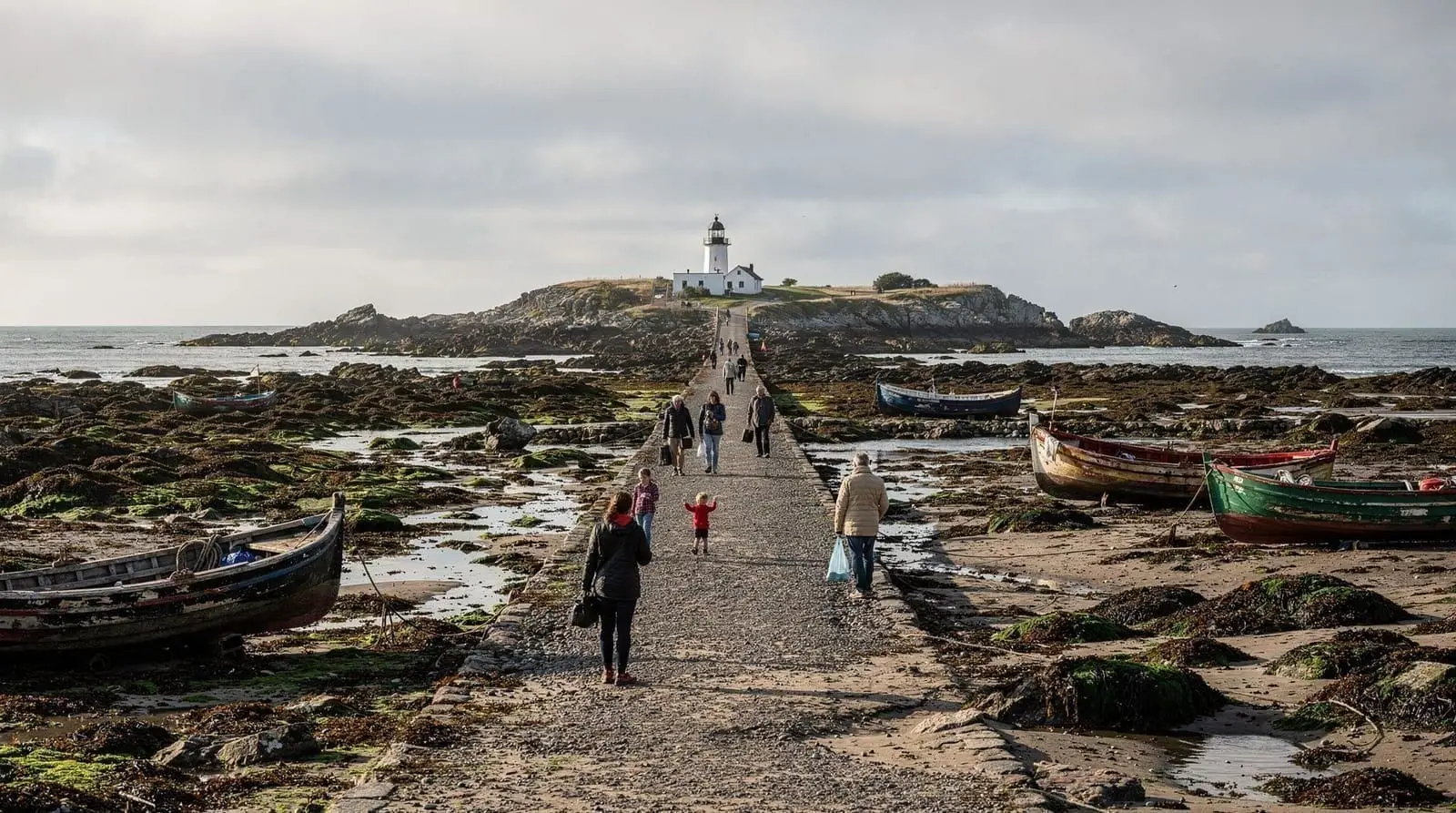
The appeal here is not dramatic scenery or impressive attractions. Sindo is a flat, agricultural island with traditional salt flats, a small fishing village, and a 14km cycling circuit that takes you around the entire perimeter with Yellow Sea views on three sides. Modo is even smaller — barely a hamlet — and sits across a tidal causeway that becomes passable only at low tide. Crossing it on foot or by bicycle is one of those small-scale adventures that feels disproportionately satisfying.
The combination of slow pace, genuine local character, and almost no foreign visitors makes Sindo and Modo feel more like the Korea of 20 years ago than anything you will find in Seoul or even central Incheon. Elderly residents dry fish on the roadside. Salt harvesters work the pans in high rubber boots. The restaurants serve whatever came in on the morning boats.
It is not for everyone. There is no ATM, no convenience store on Modo, and no safety net of English signage. But if that sounds appealing rather than alarming, read on.
Getting to Sindo from Incheon Airport
The journey from Airport Terminal 1 to Sindo takes under 45 minutes and costs almost nothing.
From Terminal 1 (arrivals level or bus stops outside departures), board bus 201 or 222 toward Yeongjongdo. You want Samseo Ferry Terminal (삼서선착장, also written as 삼목선착장 on some signs and schedules). The ride takes approximately 20 minutes and costs ₩1,200 by T-money card. If you are coming from Terminal 2, take the inter-terminal connector bus first, then board at Terminal 1.
At Samseo Ferry Terminal, the ferry to Sindo departs roughly every 30–60 minutes. The crossing takes 15–20 minutes. Adult fares are approximately ₩1,500 one-way (₩3,000 return). If you are bringing a bicycle, add ₩800 per bike each way. Children receive a discount; confirm exact fares at the ticket window as they are revised periodically.
The ferry typically runs from around 7:00am to 7:00pm, with the last return from Sindo around 7pm. This is the most important number to fix in your mind before you board. Missing the last ferry is not a minor inconvenience — there is no bridge and no alternative route back to Yeongjongdo after sunset.
Check the current schedule at the terminal before boarding. Seasonal adjustments are common, and printed schedules posted online are not always up to date.
If you are coming from central Incheon rather than the airport, you will need to reach Yeongjongdo first — take the Airport Railroad (AREX) to Airport Terminal 1 station, then pick up the bus from there.
Because the bus and ferry both work best with a transit card and a working phone for translation and tide checks, it helps to sort out connectivity before you leave the terminal. A prepaid SIM bundled with a T-money card is the simplest way to cover both, and many visitors pick up a SIM card with a transit card included at the airport. The getting around Incheon guide explains how the buses, subway, and AREX fit together if this is your first time using them.
Cycling Sindo: the island loop
The main reason to come to Sindo is cycling. The island has a paved loop road of approximately 14km that circles Sindo’s perimeter and can be extended onto Modo when the tide permits. The terrain is flat, the traffic is minimal, and the route alternates between sea views, salt fields, and farmland.
Bike rental is available near the Sindo ferry terminal. Expect to pay ₩10,000–15,000 per day for a basic city bicycle. Electric bicycles may be available at a higher rate; ask at the rental stand. There is no app, no reservation system, and no credit card — cash only. The rental operators are used to tourists; pointing at a bicycle and gesturing works well enough.
The loop takes 1.5–2.5 hours to complete at a relaxed pace, depending on how many stops you make. There are no marked cycling lanes, but the road is narrow enough that vehicles move slowly and drivers are accustomed to cyclists.
The western coast offers the most open water views — standing on Sindo’s west side on a clear day, there is nothing between you and China but Yellow Sea. The light in late afternoon turns the water a deep copper-gold, and the salt flats in the foreground complete a scene unlike anything you will find closer to the city.
The salt flats of Sindo
Sindo’s southern shore hosts traditional salt harvesting fields (염전, yeomjeon) — rectangular shallow pans where seawater is channeled in and allowed to evaporate under the sun. Workers scrape the crystallized salt into mounds at the pan edges, and the geometry of the fields, the white salt against dark mud, and the reflections in standing water make this one of the more photographically distinctive landscapes near Incheon.
Salt production has been declining across Korea as younger generations move to cities, and Sindo’s fields are worked mainly by older residents. You can observe from the road without entering the fields. Early morning or late afternoon gives the best light, and the texture and color of the salt mounds change dramatically across the day.
This is not a tourist facility — there is no entrance fee, no guided tour, no gift shop. It is simply a working farm that happens to be visually arresting.
Modo Island: the tidal crossing
Modo (모도) sits off Sindo’s northern tip, connected by a tidal causeway — a concrete and stone path approximately 430 meters long. At high tide, the causeway is fully submerged. At low tide, it is exposed and can be crossed on foot in 10–15 minutes, or by bicycle in under five.
The crossing window is roughly 2–3 hours around low tide. Before crossing, check the Korean tide table (물때표, mul-ttae-pyo). There are several free apps and websites — search for “인천 물때” (Incheon tide) and look for the low tide window on the day you are visiting. The tidal range around Incheon is substantial, often exceeding 6–8 meters, which means the causeway can go from dry to thigh-deep in under an hour once the tide turns.
Do not attempt the crossing if you are not confident about your timing. Locals will sometimes gesture or shout warnings if they see visitors heading toward the causeway near high tide.
Modo itself is smaller than Sindo — a handful of houses, a few fishing boats, coastal bluffs on the far side. There is nothing to “do” on Modo in the tourist-attraction sense, but the walk from the causeway landing to the island’s western edge takes about 15 minutes and delivers views of open Yellow Sea from a rocky coastline that feels genuinely remote. Birdwatchers will want to bring binoculars: the tidal mudflats around both islands host significant seasonal populations of migratory shorebirds.
Return to Sindo on the same causeway before the tide rises.
Birdwatching on the tidal mudflats
The mudflats and tidal channels around Sindo and Modo are part of the broader West Sea tidal flat ecosystem — a globally significant habitat for migratory birds on the East Asian–Australasian Flyway. Spring (April–May) and autumn (August–October) bring the highest diversity, including Far Eastern curlew, bar-tailed godwit, dunlin, red knot, and various species of plover and sandpiper.
You do not need to be a dedicated birder to appreciate this. Watching a flock of thousands of shorebirds lift off a mudflat simultaneously and wheel against a grey sky is the kind of spectacle that stays with you. Bring binoculars if you have them; the birds are most active around the tide edges.
The island hopping itinerary covers several sites in this wider tidal flat area.
The fishing village and local food
The main village on Sindo sits near the ferry terminal — a compact cluster of houses, a small community building, and a handful of restaurants that serve whatever the boats brought in that morning.
Options are limited but genuine. Expect seafood stew (매운탕, maeuntang) at around ₩12,000–18,000 per bowl — a spicy, red-broth fish stew that warms you up in all weather. Grilled fish (생선구이) runs ₩15,000–20,000 for a full plate. Portions are large and usually served with a spread of small side dishes (banchan) at no extra charge.
Do not arrive expecting variety. There are two or three restaurants; all serve similar menus. If the sea has been rough and the boats have not gone out, options shrink further. The restaurants keep irregular hours by city standards — they open when they open and close when the food runs out or the last customer leaves.
There is no convenience store on Modo, and Sindo’s village has minimal snack options. If you are cycling the full loop and crossing to Modo, bring water and a packed lunch. Most cyclists coming from the airport will find it easiest to buy snacks at the airport convenience store or at a GS25 on Yeongjongdo before boarding the ferry.
Incheon: Coastal Rail Bike, Sorae Park and Fairytale VillageSindo/Modo vs Muuido: a quick comparison for deciding
| Sindo & Modo | Muuido | |
|---|---|---|
| Character | Rural, agricultural, minimal infrastructure | Beach-focused, more developed |
| Main activity | Cycling + tidal causeway crossing | Beach, mudflats, hiking |
| Cost for the day | ₩29,000–40,000 | ₩28,000–46,000 |
| English signage | None | Limited but present |
| Best for | Cyclists, birdwatchers, solitude seekers | Families, first-time visitors, beachgoers |
| Facilities | Minimal — no ATM, no store on Modo | Seasonal beach facilities, restaurants |
If you want a genuine escape from anything resembling tourist infrastructure, Sindo and Modo deliver that more completely than any other island near the airport. If you want a beach day with some comfort built in, Muuido is the better fit.
Why so few foreign visitors make it here
Part of what keeps Sindo and Modo quiet is simple friction: no English signage, no international booking platforms for the minbak guesthouses, and a ferry schedule that requires checking a Korean-language terminal board rather than an app with English support. None of this is a real barrier once you know what to expect — it just filters out visitors who want everything pre-arranged. The islands also sit slightly off the main “airport day trip” narrative that guidebooks and blogs repeat, which tends to funnel first-time visitors toward Muuido or Eurwangni Beach by default rather than by comparison. For visitors specifically seeking out quieter, less-mediated travel experiences, that obscurity is the actual selling point.
Overnight on Sindo: minbak guesthouses
Sindo has one or two minbak (민박) — traditional Korean home-stay guesthouses where a room is let out of a private residence. Facilities are basic: a heated ondol floor, a shared bathroom, no wifi, no English. Rates are around ₩40,000–60,000 per night for a room.
This is for travelers who genuinely want the experience of sleeping on a quiet Korean island rather than those who need creature comforts. Call ahead (Korean only) to confirm availability — there is no booking platform and no English-language reservation system. Ask at the ferry terminal or village if you arrive without a reservation; someone will usually point you toward whoever has a room.
Most visitors — especially those based in Seoul or near the airport — will find that a day trip is sufficient and that returning to Incheon or the airport for the night is more practical.
Fitting Sindo and Modo into a bigger trip
Sindo and Modo work best as a slow, unhurried counterweight to busier days elsewhere. If you are arriving or departing through the airport, the islands pair naturally with the Incheon airport layover itinerary and the 6-hour layover itinerary, although the fixed ferry timetable means you should treat them as an option only when your connection leaves plenty of slack. Travelers with a long wait who would rather have someone else handle the logistics can look at a private layover tour that starts and ends at the airport as a lower-effort alternative.
Other quiet corners of the region sit well alongside this one. Yeongjongdo is the gateway island and has its own coastline to explore, Muuido offers a sandier contrast, and the longer island hopping itinerary strings several of them together. If your days are split between countryside and city, the one day in Incheon itinerary and the Incheon and Seoul itinerary show how to balance an island day with more urban sightseeing.
For a gentler way to enjoy the coast on two wheels, the Sorae Ecology Park guide and the Wolmi Sea Train guide cover easier options for people who want scenery without the logistics of a ferry. And if the tidal flats here make you curious about the cultural side of the region, the Incheon open port heritage guide and the Ganghwado destination page are good next stops. Practical reminders about language, etiquette, and staying safe are collected in the safety and language tips.
Food-minded visitors who find the village menus limited can make up for it back on the mainland: Wolmido seafood dining and the Incheon Chinatown eating guide both offer far more choice. If you decide an overnight on the islands is not for you, the where to stay in Incheon guide lists easier bases, and the blog’s hidden beaches roundup has more off-the-radar coastal ideas.
Planning your budget
Sindo and Modo are among the cheapest day trips you can take from Incheon Airport, precisely because there is almost nothing to spend money on.
- Bus from Airport Terminal 1 to Samseo Terminal: ₩1,200
- Ferry return: ₩3,000
- Bicycle rental: ₩10,000–15,000
- Lunch at a village restaurant: ₩15,000–20,000
- Total: approximately ₩29,000–40,000 ($22–31 USD at current rates)
Compare that with a similar day at Muuido Island, which adds slightly more in transport costs but offers more in the way of facilities, or the Yeongjongdo Seaside Rail Bike, which costs ₩25,000–35,000 for the rail bike alone.
If you are traveling on a tight budget and want to see more island options in the area, the budget travel guide has a full breakdown of the cheapest transport and food options across Incheon’s islands.
Trip traps and honest warnings
The last ferry is non-negotiable. The last return from Sindo to Samseo Terminal runs around 7:00pm. If you miss it, you are sleeping on Sindo. Plan your cycling and Modo crossing with at least 90 minutes of buffer before the last ferry departure.
No ATM on Sindo. Bring enough cash for the ferry, bike rental, and food. There is no cash machine on the island. The nearest ATM is on Yeongjongdo before you board.
The tidal crossing requires homework. Do not assume you can walk to Modo at any time. Look up the tide table for your specific date and note when low tide occurs. Give yourself a 30-minute safety margin on either side of the window.
Ferry cancellations happen. In rough weather, strong winds, or heavy fog, the Samseo–Sindo ferry may be suspended. Check conditions on the day before making the trip, especially in winter and during typhoon season (July–September). There is no refund procedure; ferries simply do not run.
Language. No English is spoken on Sindo. Restaurant menus, ferry schedules, and signage are Korean only. A translation app on your phone handles most situations. Downloading the Google Translate app with Korean offline support before you leave the airport is recommended.
Best time to visit
April through October covers the comfortable cycling window. Spring (April–May) brings mild temperatures and the best birdwatching for northbound migrants. Early summer is green and pleasant but can be humid. Autumn (September–October) is arguably the best month: cooler air, low humidity, golden light on the salt flats, and southbound migratory shorebirds on the mudflats.
Winter visits (November–March) are possible but cold, windy, and quiet to the point of emptiness. Some village restaurants close in winter. The ferry still runs, but cycling in January winds off the Yellow Sea requires serious cold-weather gear.
Avoid visiting on Korean public holidays if you prefer solitude — the island gets noticeably busier on Chuseok and Seollal weekends as urban Koreans seek out quiet escapes. Even then, “busy” on Sindo means dozens of visitors rather than hundreds.
If you are still choosing dates, the best time to visit Incheon guide puts the island seasons in the context of the whole year, and the autumn foliage hiking itinerary is a good companion if you come in the colder months of the cycling window.
For more island options in the area, the island hopping itinerary and the Muuido Island guide are worth reading before you finalize your plans.
Frequently asked questions about Sindo and Modo Islands
How long does the full Sindo cycling loop take?
The 14km perimeter road can be completed in 1.5 hours at a brisk cycling pace, but most visitors take 2.5–3 hours when including stops at the salt flats, the fishing village, and the western coast viewpoints. Add another 30–40 minutes if you cross to Modo and back during the low tide window.
Do I need to book the ferry in advance?
No advance booking is needed. The Samseo–Sindo ferry runs as a scheduled service and you buy tickets at the terminal window. On weekdays and outside peak summer weekends, you will have no trouble getting on the first or second departure you want.
Can I bring my own bicycle on the ferry?
Yes. The ferry accommodates bicycles for an additional ₩800 per bike each way. There is no guarantee of space if the ferry is very busy, but in practice this is rarely an issue on the Samseo–Sindo route.
Is the tidal causeway to Modo safe to cross?
Yes, when crossed at the right time. Check the tide table before you go, cross during the window centered on low tide, and leave Modo with at least an hour before the next high tide peak. The causeway is concrete and visible, not a muddy path — if you can see it fully exposed, it is safe to walk.
Are there toilets on Sindo and Modo?
There are public toilets near the Sindo ferry terminal and in the village. On Modo, there are no public facilities — plan accordingly before crossing the causeway.
Is Sindo suitable for children?
It depends on the children and the parents. The flat cycling route is manageable for older children who can ride a bike. The tidal crossing to Modo is straightforward if adults supervise carefully and timing is correct. The lack of facilities, ATMs, and English signage makes Sindo a better fit for experienced independent travelers with children than for first-time visitors to Korea.
How does Sindo compare to Muuido Island for a day trip?
Muuido has more visitor infrastructure — more restaurants, clearer signage, a proper beach. Sindo is quieter, cheaper, and more authentically rural. Muuido suits beach-focused visitors and families wanting lifeguarded swimming; Sindo suits cyclists, birdwatchers, and travelers who find “nothing much to do” an attractive selling point.
Can I visit Sindo and Modo on a layover between flights?
Yes, if your layover is at least 6–7 hours, since the journey each way from Terminal 1 is under 45 minutes. Build in extra buffer for immigration, security on return, and the fact that ferry timing is fixed rather than on-demand — missing a sailing by a few minutes means waiting up to an hour for the next one.
Is it better to visit Sindo or Modo first, or does it matter?
Start on Sindo, since that’s where the ferry lands and where the bike rental, food, and toilets are. Cross to Modo only once you’ve confirmed the tide window, ideally mid-loop so you’re not backtracking. Treat Modo as a short extension of the Sindo visit rather than a separate destination.
Incheon islands on GetYourGuide
Top-rated tours and activities


