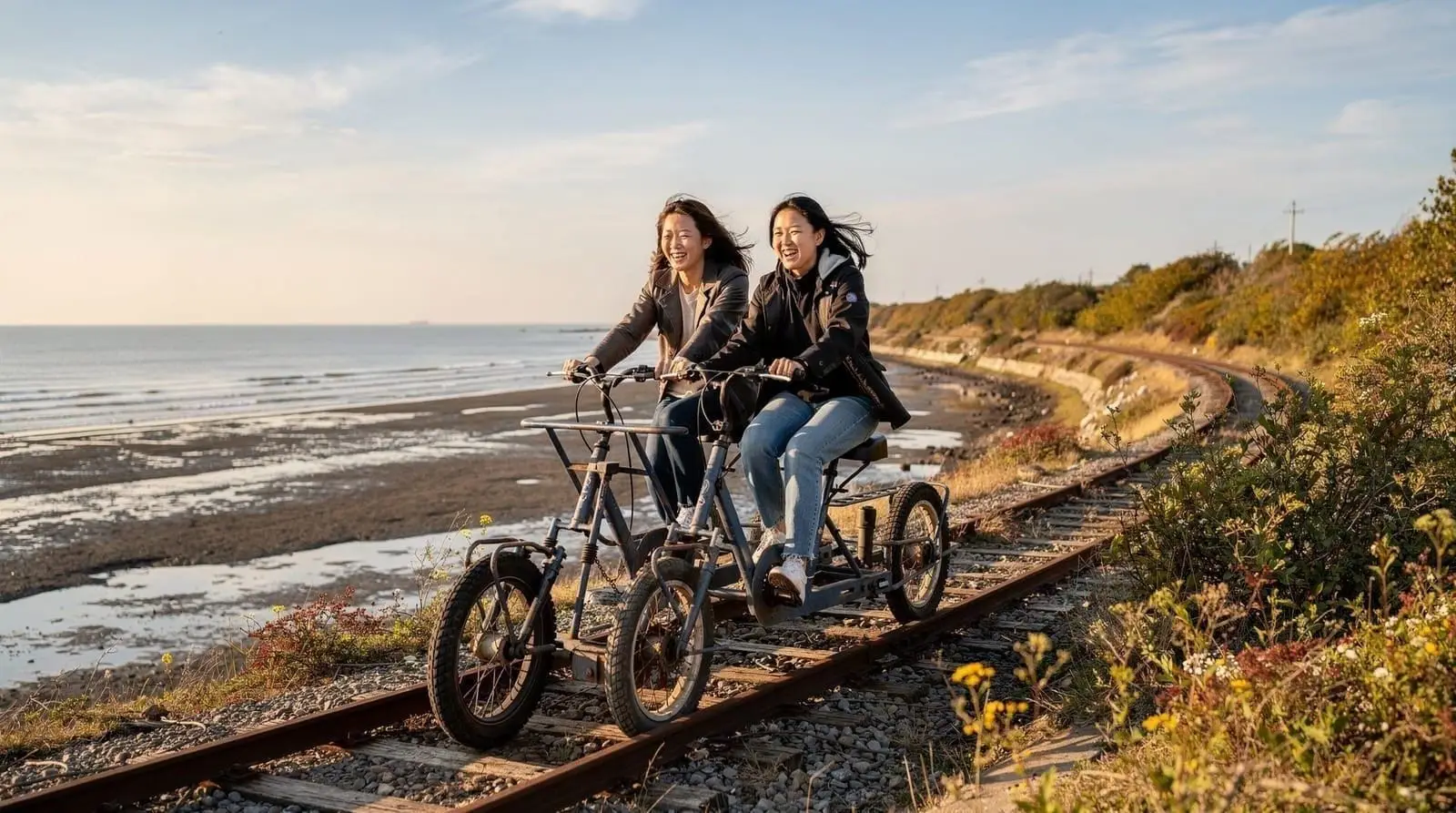
Yeongjongdo Seaside Rail Bike: riding along the Yellow Sea coast
How much does the Yeongjongdo Seaside Rail Bike cost?
₩25,000 per 2-seat cart or ₩35,000 per 4-seat cart (fixed price per cart, not per person). The ride covers 5.6km one-way and takes 40–60 minutes.
Twenty minutes by public bus from Incheon International Airport, on the same island that hosts the terminal itself, there is a 5.6-kilometre rail bike track that runs along the Yellow Sea shoreline with unobstructed views of tidal mudflats, distant islands, and the occasional silhouette of a cargo vessel heading into Incheon port. This is not a theme park ride. The rail bike is slow, human-powered (with electric assist available), and runs on an actual disused railway track — which is part of what makes it feel less manufactured than most waterfront tourist attractions in Korea.
Yeongjongdo Island (영종도) is known primarily for the airport. Most passengers who land at Incheon pass through the island without registering that it is, in fact, an island with its own beaches, temples, fishing villages, and mountain trails. The seaside rail bike is the quickest way to experience the non-airport part of Yeongjongdo, and it pairs naturally with a few hours at Eulwangni Beach, which sits a five-minute walk from the rail bike terminal.
| Where | Near Eulwangni Beach, Yeongjongdo Island |
| Cost | Around ₩25,000 (2-seat cart) or ₩35,000 (4-seat cart), per cart |
| Time needed | 90 minutes total (ride + shuttle return) |
| Getting there | Bus 302 from Airport Terminal 1, around 20 minutes |
| Best time | Weekday mornings; book ahead for weekends |
What the Yeongjongdo Seaside Rail Bike actually is
A rail bike is a four-wheeled pedal cart that runs on a narrow-gauge railway track. The Yeongjongdo version runs on a coastal track along the western edge of the island, with the Yellow Sea on one side and low hills on the other. The track goes one way — riders pedal to the far end and then take a shuttle bus back to the start. There is no option to pedal back in the opposite direction.
Bike configurations are either a 2-seat cart (two riders pedalling side by side) or a 4-seat cart (two rows of two seats, with pedals for all four). Carts also have an electric assist mode, which is useful uphill or when tired children or less fit riders are aboard. The electric assist does not eliminate pedalling — it supplements it.
Prices are per cart, not per person:
- 2-seat cart: ₩25,000
- 4-seat cart: ₩35,000
This means the cost per person drops significantly if you fill a cart. A couple sharing the 2-seat option pays ₩12,500 each. A family of four on a 4-seat cart pays ₩8,750 each — less than a cinema ticket. Solo travellers are typically paired with other solo riders to fill a 2-seat cart, or you pay for the cart yourself.
Operating hours are 9am to 6pm daily, with the last departure at 5pm. The attraction closes in severe weather — wind and rain on an exposed coastal track is an obvious problem — but this is a judgment call made on the day rather than a policy you can confirm in advance.
Incheon: Coastal Rail Bike, Sorae Park and Fairytale VillageGetting there from Incheon Airport
Yeongjongdo is the airport island, so there is no ferry involved. The rail bike terminal is near Eulwangni Beach on the island’s west coast, which takes about 20 minutes from Airport Terminal 1 by bus.
From Terminal 1, go to the basement level (지하 1층) bus stop area. Bus 302 runs to Eulwangni Beach. The journey takes approximately 20 minutes and costs ₩1,200 with a T-money card. The bus runs regularly during daytime hours; check the departure schedule for current first and last bus times before planning a late return.
Alternatively, a taxi from Terminal 1 to the rail bike area costs ₩8,000–12,000 and takes 15 minutes, or slightly less with no traffic. Taxis are worth considering if you are travelling with luggage, have a specific departure time to work around, or are in a group where the cost splits reasonably.
From central Incheon, Bus 302 also serves the route from Incheon City via the Yeongjongdo bridge. From Seoul, the most efficient approach is taking the AREX express train from Seoul Station to Incheon Airport (43 minutes), then connecting to Bus 302.
Booking: the Korean-only website problem
Advance booking for the Yeongjongdo Seaside Rail Bike is strongly recommended for weekends and Korean public holidays. Walk-ups are accepted on weekdays and less popular periods, but on busy weekend days, showing up without a reservation means joining a queue that can stretch to 1–2 hours before your cart is ready.
The booking website is almost entirely in Korean and does not have a usable English interface. This is a genuine logistical hurdle. Several practical workarounds:
The most reliable option is to ask a Korean-speaking hotel concierge to book for you, either in person or by phone. Provide them with the date, time, preferred cart type, and number of riders, and they can complete the booking within a few minutes. This works particularly well if you are staying at one of the hotels on Yeongjongdo or in Incheon City.
Naver Translate (the Korean version of Google Translate, but more accurate for Korean context) can be used directly on the rail bike booking website via a mobile browser. The form fields become navigable with machine translation, though you will need a Korean mobile number for the SMS confirmation — another obstacle for visitors without Korean numbers.
A Korean friend or local contact can book on your behalf if you message them the details in advance.
If none of these options work, simply aim for a weekday visit when walk-up availability is generally fine.
What booking actually involves once you get through
Once past the language barrier, the booking process itself is simple: select a date, a time slot, cart type (2-seat or 4-seat), and number of carts, then pay online or reserve for pay-on-arrival depending on the option shown. Confirmation typically arrives by SMS to a Korean mobile number, which is the main sticking point for visitors — if you do not have one, ask whoever books on your behalf to forward the confirmation details or simply note the date, time, and reference name, since the terminal staff can usually verify a booking by name and phone number at the counter. Arrive 10–15 minutes before your slot; carts depart on a schedule, and late arrivals may lose their slot to walk-ups.
The ride: what to expect
The rail bike departs from the terminal near Eulwangni Beach and follows the coastal track northwest. The Yellow Sea is visible for most of the route — on the left side of the track depending on direction — and the tidal mudflats are particularly dramatic at low tide when the water retreats and the flat expanse of grey mud reflects the sky.
The ride takes 40 to 60 minutes for the 5.6-kilometre track, depending on how much effort you put in and whether you use the electric assist. Most riders settle into a relaxed pace and stop occasionally for photographs rather than racing to the end. There are two or three official photo stops along the route where all carts pause briefly for pictures. The staff facilitating these stops are efficient but the stops are welcome — the coastal views frame well and the light over the water shifts as you go.
At the far end of the track, a shuttle bus returns riders to the starting terminal. The shuttle is included in the ticket price. Factor in about 20 minutes for the shuttle return.
There is no shade on the track. In summer (June to August), this matters: the exposed coastal position means full sun from above and reflection from the water. Bring sunscreen, a hat, and ideally sunglasses. In spring and autumn, the lack of shade is irrelevant and the conditions are ideal. Winter rail biking is available on non-freezing days and is surprisingly pleasant with clear cold air and often dramatic low winter light.
| Season | Conditions | Crowds | Notes |
|---|---|---|---|
| Spring (Mar–May) | Mild, comfortable | Moderate, busier on weekends | Ideal shoulder-season riding |
| Summer (Jun–Aug) | Hot, full sun exposure, humid | Highest, especially weekends | Bring sunscreen and hat; beach season overlaps |
| Autumn (Sep–Nov) | Mild, clear skies | Moderate | Best light for photos |
| Winter (Dec–Feb) | Cold but dry, low light | Lowest | Closes in severe wind; check ahead |
What to bring and wear
Beyond sunscreen and a hat for summer visits, a few practical items make the ride more comfortable. Closed-toe shoes are strongly preferable to sandals — the pedals and cart floor are metal, and loose sandals can slip. A light windbreaker is worth carrying even in warm months, since the coastal wind on the exposed track is more noticeable than the air temperature on shore would suggest. If you plan to walk Eulwangni Beach afterward, a change of shoes or a towel for sandy feet is useful. Bags can generally be kept on your lap or at your feet in the cart — there is no dedicated storage, so pack light for the ride itself.
South Korea eSIM for Incheon Airport arrivalCombining the rail bike with an airport layover day
For travelers with a longer layover or a pre-flight day free, the rail bike and Eulwangni Beach can anchor a half-day plan that never strays far from the airport. A workable sequence: land or check out of your hotel by 9am, Bus 302 to the rail bike terminal (20 minutes), ride and shuttle return (90 minutes), lunch at one of the beach-road seafood restaurants (45 minutes), an hour on the sand at Eulwangni, then Bus 302 back to the terminal with a buffer before check-in.
This whole loop fits comfortably inside a 6-hour window and returns you to the terminal without ever needing to cross the Yeongjongdo bridge into central Incheon. The Incheon Airport 6-hour layover itinerary lays out this kind of same-island planning in more detail, including bag storage options at the terminal.
Seoul: Nami Island and Garden of Morning Calm opt RailbikeAfter the rail bike: Eulwangni Beach
The rail bike terminal is a five-minute walk from Eulwangni Beach, making the combination of both activities a natural pairing for a half-day trip. The beach faces west over the Yellow Sea and is one of the better sunset-watching spots in the Incheon area from April to October, with the sun dropping directly over the water rather than behind a headland or urban skyline.
Eulwangni is approximately 800 metres long, sandy, and relatively calm. It is a family-oriented beach rather than a surf beach — the water is shallow and the wave action is minimal. The sand is the brownish-grey characteristic of Yellow Sea beaches rather than white tropical sand, and the water clarity is modest. Swimming is officially open with lifeguards from July 1 to August 31; outside this period the beach is accessible but unstaffed.
The restaurant row along the beach road has 20 or more seafood places serving grilled shellfish, sashimi plates, and seafood ramyeon. For detail on the beach and eating options there, the Eurwangni Beach guide covers the full range. For a comparison with other nearby island options, see the Muuido Island day trip guide, which offers a wilder, less developed experience about 30 minutes further from the airport.
Other things to do on Yeongjongdo
The island has more on offer than the rail bike and Eulwangni Beach, though most visitors do not explore beyond those two.
Wangsan Beach (왕산해수욕장) is about 3 kilometres north of Eulwangni, slightly larger and with more facilities. It is less crowded than Eulwangni on weekdays and has a calmer atmosphere outside peak season. A taxi between the two beaches costs around ₩4,000.
Jamjindo (잠진도) is a small fishing community on the east coast of Yeongjongdo, best known as the departure point for the Muuido Island ferry. The harbour itself is worth a brief visit if you are interested in working fishing ports — small boats, net repair, the functional chaos of a small Korean fishing operation. The Yeongjongdo Lighthouse is a short walk from the Jamjindo harbour and gives views back over the tidal inlet.
Hyoryeongsan (효령산, 233 metres) is the island’s main hiking peak, with a forested trail system and views of the airport, the Yellow Sea, and the Incheon Bridge on clear days. The trail from the base takes about 90 minutes return. It is a less dramatic hike than the Guksabong route on Muuido, but accessible and free.
For island hopping that extends beyond Yeongjongdo, the Incheon island hopping itinerary maps out a logical sequence of nearby islands including Muuido, Sindo, Modo, and Ganghwado that can be combined over several days.
Budget for the day
A straightforward rail bike and beach day from Airport Terminal 1:
- Bus 302 (return): ₩2,400
- Rail bike (2-seat, split between 2 people): ₩12,500/person
- Beach lunch (mid-range seafood restaurant): ₩15,000–25,000/person
Total per person: approximately ₩30,000–40,000 ($23–31), assuming a shared cart and a single sit-down meal. Eating from convenience stores or the cheaper end of the beach restaurants would bring this to around ₩20,000.
If you are visiting on a tighter layover budget, the Incheon on a budget guide has further cost-reduction strategies across the Incheon area.
Fitting this into a layover
The Yeongjongdo rail bike is among the better layover options from Incheon Airport precisely because it is on the airport island and requires no ferry or significant transit. The round trip to the rail bike terminal and back to the airport takes about 45 minutes in total. The rail bike itself is 40–60 minutes plus 20 minutes for the shuttle return.
A minimum viable layover for this activity: 4 hours. That allows transit to the terminal (20 minutes), the rail bike ride with shuttle (90 minutes), 30 minutes for lunch or a beach walk, and transit back (20 minutes), with a 30-minute buffer before re-entering the terminal.
A 6-hour layover is comfortable and allows you to add Eulwangni Beach time or a walk along the beach road. For the full layover logistics breakdown, the Incheon Airport layover guide covers bag storage, transit times, and what to prioritise at each layover length.
Practical notes
Dress in layers if visiting in shoulder season — the coastal wind on the track is more pronounced than you might expect from the air temperature on shore. In summer, the sun exposure is the main issue; there is genuinely nowhere to shelter for the 40–60 minutes on the track.
The rail bike handles most physical fitness levels without difficulty. The electric assist means that riders who cannot or do not want to pedal the full track can still complete the route comfortably. There is no particular strength or endurance requirement.
Children are welcome. Minimum height requirements apply for safety harnesses — confirm with the operator when booking, as these can change. Most children above about 110 cm are fine.
Photography on the track is easy and safe — the cart moves slowly enough that one rider can pedal while the other photographs, and the views are consistently good for the middle section of the track where the sea comes closest.
Getting to and from the airport on your return
One detail that catches some visitors off guard: after the shuttle bus drops you back at the rail bike terminal, there is no automatic connection back to the airport. Bus 302 stops at Eulwangni Beach, and the stop is close to the terminal, but the departure frequency is not high. In the early afternoon on a weekday, you might wait 20–30 minutes for the next bus. Taxis are available near the beach road on most days, but less reliably in the off-season when demand is lower.
The practical solution is to confirm the bus schedule before you board the shuttle, and to have a taxi app (Kakao T, which works in English) installed on your phone as a backup. Kakao T taxis are reliable on Yeongjongdo and reach the airport terminal area without difficulty.
For visitors with a specific flight to catch, add a 45-minute buffer to your transit time from the rail bike terminal back to the airport check-in desk. The distance is short but the bus frequency is the variable.
Frequently asked questions about Yeongjongdo Seaside Rail Bike
Do I need to book in advance for the Yeongjongdo rail bike?
On weekdays and outside public holidays, walk-up access is usually fine. On weekends, Korean public holidays, and during peak summer (July–August), advance booking is strongly recommended — queues of 1–2 hours are common for walk-up visitors on busy days. The booking website is in Korean; ask a hotel concierge to help, or use Naver Translate to navigate the site.
Can I ride the rail bike alone?
Solo riders are typically paired with another solo rider to fill a 2-seat cart, unless you prefer to pay for the whole cart yourself. Staff at the terminal manage the pairing informally. If you want guaranteed privacy, pay for the full 2-seat cart (₩25,000) and ride alone.
What happens if it rains?
The operation closes in severe weather and strong wind. Light rain is less predictable — call ahead or check the operator’s social media on the day. There is no refund policy for weather cancellations that applies to walk-up visitors; advance bookings have specific cancellation terms. If your visit coincides with Typhoon season (August–September), have a backup plan.
Is the rail bike suitable for people with limited mobility?
The carts have electric assist, which reduces physical exertion, but boarding and disembarking the cart requires stepping up and swinging legs over the side. The shuttle bus for the return journey involves similar movement. The operator’s staff are generally helpful, but there is no formal accessibility accommodation. Call ahead to discuss specifics if mobility is a concern.
What is the difference between the Yeongjongdo rail bike and the Ara Waterway bike tour?
The Yeongjongdo rail bike is a fixed-cart experience on a dedicated track — you ride a pedal cart on rails, with no steering or route-finding involved. The Ara Waterway bike tour is a conventional cycling experience on a riverside path along the Ara Canal. The rail bike is more of an attraction; the Ara route is more of an exercise in urban cycling infrastructure. Both have Yellow Sea-adjacent scenery.
Is there parking at the Yeongjongdo rail bike terminal?
Yes, there is a parking area at the terminal. Day parking costs ₩3,000–5,000. If driving from the airport, the Eulwangni Beach access road is straightforward and well-signed from the main Yeongjongdo road network.
Can I combine the rail bike with Muuido Island in the same day?
It is possible but slightly rushed. The rail bike takes a morning (9am to noon including bus transit from the airport), and the Muuido ferry from Jamjindo runs until 9pm. In practice: morning rail bike and Eulwangni Beach, early afternoon bus to Jamjindo, afternoon ferry to Muuido and back with time for a brief beach walk. This works as a day but leaves little time to hike Muuido or do mudflat activities properly. Better to dedicate a full day to each.
Is the rail bike worth doing if I have a very short layover?
For a layover under 4 hours, it is genuinely too tight once you account for airport re-entry buffers and possible bus waits. A shorter layover is better spent closer to the terminal — the Incheon Airport layover guide has options scaled to how much time you actually have. Save the rail bike for a 5-hour-plus window.
Incheon islands on GetYourGuide
Top-rated tours and activities


