Eurwangni Beach guide: Incheon's easiest beach from the airport
How do you get to Eurwangni Beach from Incheon Airport?
Take Bus 202 or 302 from Airport Terminal 1 basement level (지하 1층) to the Eulwangni Beach stop — 20 minutes, ₩1,200 with a T-money card.
Eurwangni Beach sits on the western coast of Yeongjongdo Island, 20 minutes by public bus from Incheon International Airport. That is not a rough estimate or an optimistic measurement — it is the actual journey time on Bus 202 from Terminal 1, in light traffic, with a T-money card tap on and tap off. For a beach this close to a major international airport, that proximity is genuinely unusual.
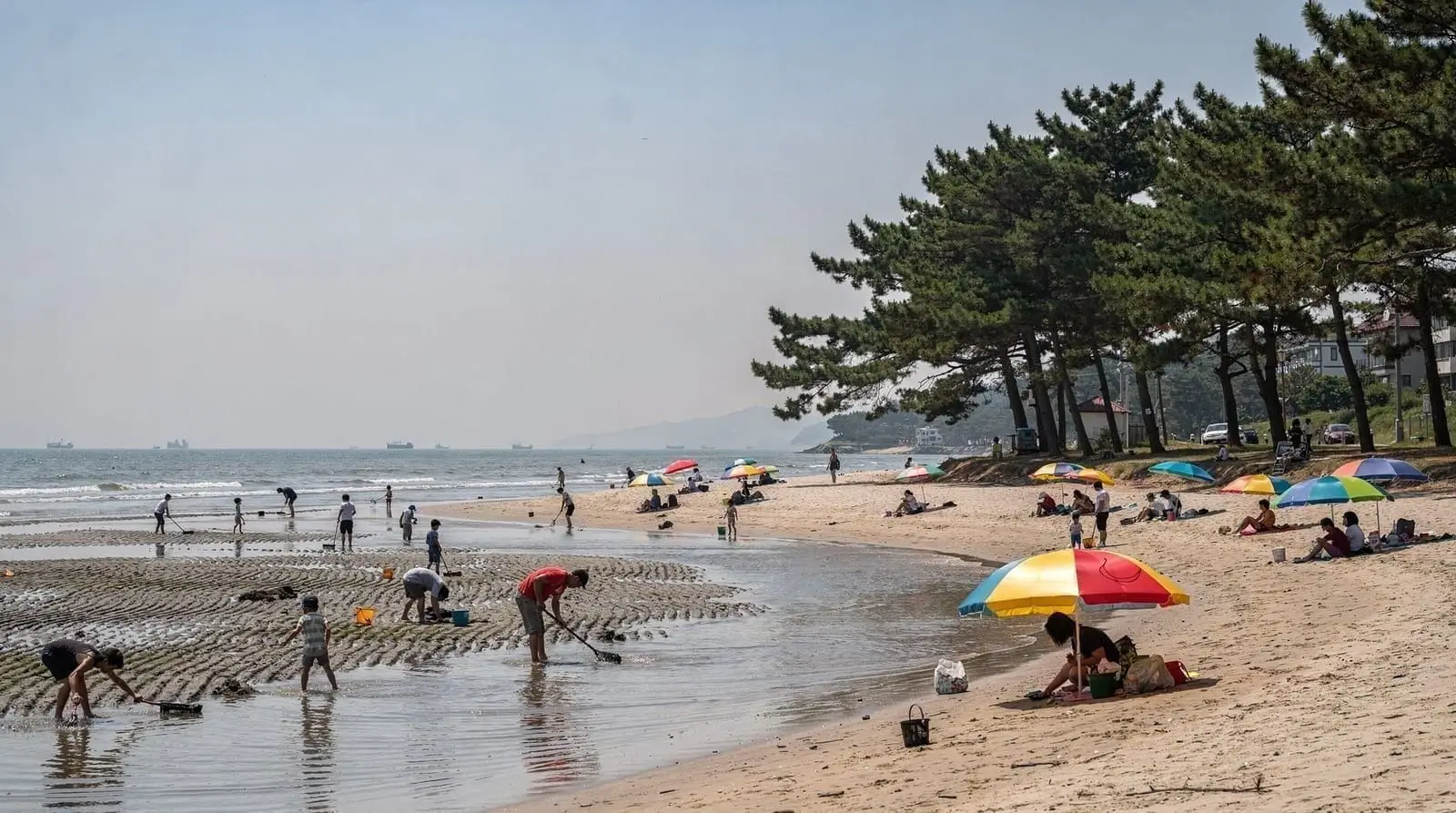
The beach is not a tropical paradise. Yellow Sea beaches never are. The water is not transparent blue, the sand is not white, and the wave action is minimal. What Eurwangni offers instead is an 800-metre sweep of sand facing due west, where the setting sun drops directly into the Yellow Sea on clear evenings between April and October, producing the kind of orange-and-pink horizon that makes beach restaurants fill up fast. There is fresh seafood along the beach road — decent grilled shellfish, honest sashimi, and cold beer from a convenience store — and a rail bike attraction five minutes’ walk away that gives the area more to offer than a single afternoon at the water.
This guide covers the beach itself, the food options, the sunset timing, and the logistics for both day trippers from Incheon and travellers with a long airport layover.
| Where | Yeongjongdo Island (airport island), west coast |
| Cost | Free entry; bus ₩1,200 each way from the airport |
| Time needed | 2–4 hours for beach + lunch, half-day with rail bike |
| Getting there | Bus 202/302 from Airport Terminal 1, ~20 min |
| Best time | Sunset, April–October; official swim season Jul 1–Aug 31 |
Location and how to get there
Eurwangni Beach (을왕리 해수욕장) — sometimes romanised as Eulwangni — is in the Jung-gu district of Incheon, on the western coast of Yeongjongdo Island. Since Yeongjongdo is the airport island, there is no ferry involved in getting here from the terminal. You are already on the right island.
From Airport Terminal 1, go to the basement level (지하 1층) bus stop. Bus 202 and Bus 302 both stop at Eulwangni Beach. Bus 202 is more direct; Bus 302 takes a slightly longer route via additional stops. Either will get you to the beach in approximately 20 minutes. Fare is ₩1,200 with a T-money card. T-money cards are available at any convenience store inside the airport terminal.
From Airport Terminal 2 (the separate terminal used by Korean Air and Delta, connected to Terminal 1 by an underground rail shuttle), take the shuttle to Terminal 1 first, then board Bus 202 or 302. Add about 10 minutes for the shuttle transfer.
Taxis from Terminal 1 to Eurwangni cost ₩8,000–12,000 and take 15 minutes in average traffic. A taxi is worth considering if you are travelling with luggage, if the group size makes it economical, or if you are on a tight layover timetable where the flexibility of a taxi over a scheduled bus matters.
From Seoul, the most efficient route is the AREX express train from Seoul Station to Incheon Airport Terminal 1 (43 minutes), followed by Bus 202 or a taxi. Total journey time from Seoul Station to the beach is approximately 65–75 minutes.
From central Incheon, Bus 302 also serves the route. Check current schedules at the Incheon city bus website, as services adjust seasonally.
The beach: realistic description
Eurwangni is an 800-metre arc of sand in a shallow bay protected by headlands on both sides. The bay orientation faces west-southwest, which is what makes the sunset views work.
Sand colour is brownish-grey — the characteristic colour of Yellow Sea beaches, which are fed by the silt-heavy rivers draining the Korean and Chinese mainland rather than the coral or quartz sediments of tropical coasts. This is not a flaw in the beach so much as a property of the sea it borders. If white tropical sand is important to you, Yeongjongdo is not the destination.
Water clarity is moderate. The Yellow Sea has relatively low visibility compared to the East Sea (Sea of Japan) or the South Sea due to suspended sediment, tidal mixing, and high marine productivity. Swimming in Eurwangni means swimming in greenish-grey water that you cannot see through below about 50 centimetres. The experience is fine but the aesthetics are different from what most marketing photographs suggest.
Tidal range on the Yellow Sea is among the highest in the world — the difference between high and low tide here can be 6–9 metres, which means the beach footprint changes dramatically throughout the day. At low tide, the exposed tidal flat extends far beyond the main sand, and the beach becomes much wider. At high tide, the water comes up to the beach edge and the tidal flat disappears. Neither state is inherently better for visitors, but the wide low-tide beach has a different character — more space, more texture, more interesting to photograph.
Swimming is officially open from July 1 to August 31 with lifeguards on duty. Outside those dates, the beach is accessible but there are no safety staff, and shower and changing facilities may be reduced or closed. The water temperature in July and August reaches about 22–24°C, which is warm enough for comfortable swimming. Jellyfish are occasionally present in late summer; ask at the beach or check local reports.
Incheon: Coastal Rail Bike, Sorae Park and Fairytale VillageSunset: why this beach is worth it in the evening
Eurwangni’s strongest card is its sunset exposure. The beach faces west into open sea, with no significant landmass interrupting the horizon. On clear evenings from April through October, the sun sets directly over the Yellow Sea and the light turns the water copper and orange for 20–30 minutes before dropping below the horizon. On evenings with scattered cloud, the colours become more complex and the effect can be dramatic.
Sunset times vary significantly by season. In midsummer (late June to late July), sunset is around 7:30–8pm. In autumn (October), it shifts to 6–6:30pm. The beach restaurants fill up on clear evenings from about an hour before sunset, particularly on weekends. If you want a table with a sea view at sunset, arrive early.
Beach photography at sunset is generally good from the water’s edge, looking west. Silhouettes of fishing boats and cargo vessels on the horizon add scale. The rail bike terminal to the north of the beach creates some visual interest in the background of compositions looking northwest.
Wangsan Beach (왕산해수욕장), 3 kilometres north by road, faces the same direction and gets equivalent sunsets with typically fewer people, particularly on weekdays. A taxi between the two beaches costs around ₩4,000. There is also a coastal walking path connecting them, though the distance and surface quality varies seasonally.
Eating on the beach road
The restaurant row running parallel to Eurwangni Beach road has more than 20 establishments of varying quality. The offer is predominantly seafood and Korean comfort food. Here is an honest account of what you are likely to find.
Grilled shellfish (조개구이) is the most common order and the most appropriate meal for this setting. A selection of clams, oysters, mussels, and other bivalves arrives raw on a charcoal grill set into the centre of your table; you cook them yourself while eating and drinking. A serving for two people costs ₩20,000–35,000 depending on the shellfish type and quantities. Quality varies by restaurant — places with visible turnover and fresh stock are preferable to those with slow business, for obvious reasons.
Sashimi (회) is available at most restaurants, typically as a whole fish plate with banchan side dishes. Expect to pay ₩20,000–40,000 for a plate serving two. The fish is locally caught and reasonable in season; it is not destination-grade sashimi but it is honest seaside fish.
Seafood ramyeon (해물라면) is the budget option — a packet of spicy ramyeon noodles with shellfish and vegetables added, cooked tableside, costing ₩8,000–12,000. It is better than it sounds and works well as a late-night meal.
Summer beach tents (포장마차) set up on the sand during July and August selling cold beer, soju, and dried squid (오징어) for ₩5,000–8,000 per round. These are the most atmospheric option on a warm evening — plastic chairs on the sand, paper plates, direct beach access, and the kind of casual social energy that Korean beach towns do well.
Two or three GS25 or CU convenience stores operate near the beach entrance year-round. They have everything: snacks, drinks, instant noodles, sunscreen, small beach toys, and ice cream. For a cheap beach day, a convenience store lunch of kimbap, onigiri, and a cold drink costs under ₩5,000.
The Seaside Rail Bike next door
The Yeongjongdo Seaside Rail Bike terminal is a five-minute walk north of Eurwangni Beach. The rail bike runs a 5.6-kilometre coastal track one-way along the Yellow Sea shoreline, taking 40–60 minutes, with a shuttle return included. Carts seat 2 or 4 people and have electric assist. Prices are ₩25,000 for a 2-seat cart and ₩35,000 for a 4-seat cart (per cart, not per person).
Combining the rail bike in the morning with beach time in the afternoon is a natural pairing for a full half-day or full-day trip from the airport. Do the rail bike first (it operates from 9am and books out by midday on weekends), then head to the beach for lunch and afternoon relaxation. The Yeongjongdo Seaside Rail Bike guide has booking instructions and a full description of the route.
Incheon: Luge & Railbike & Purple Azalea FestivalPlanning a layover trip to Eurwangni
Eurwangni Beach is one of the better short-escape options from Incheon Airport specifically because it is on the airport island. No bridge crossing, no ferry, no complex transit — just a bus from the basement of Terminal 1.
For a 6-hour layover, the sequence is:
- Arrive at Terminal 1, clear immigration (if on an international connection with time to re-enter): allow 40–60 minutes for immigration
- Store luggage at Terminal 1 baggage storage, floor B1 (₩3,000–8,000 per bag depending on size)
- Bus 202 to Eulwangni Beach: 20 minutes
- Beach time: 1.5–2 hours
- Lunch at a beach restaurant: 45 minutes
- Bus 202 back to Terminal 1: 20 minutes
- Re-clear security: 30–45 minutes
This works with a 6-hour layover if immigration is smooth. A 4-hour layover is feasible as a transit-only visit (no immigration) for some airlines and routes, but this depends on your carrier’s policies on leaving the transit zone. Confirm with your airline before exiting the terminal.
For a 5–8 hour layover with more structure, the Incheon Airport layover guide covers decision trees by layover length. The dedicated 6-hour layover itinerary maps out minute-by-minute timing if you want to remove the guesswork.
Wangsan Beach: the quieter alternative
Wangsan Beach (왕산해수욕장) is 3 kilometres north of Eurwangni by road, larger by approximately 200 metres, and consistently less crowded on weekdays and shoulder season. It has the same sunset exposure and similar seafood restaurant options. The main differences: Wangsan has slightly more developed infrastructure (a larger parking area, more facilities in season), is a couple of minutes farther by taxi (add ₩2,000–3,000 to the airport fare), and has less of the casual beach-bar atmosphere that Eurwangni develops in summer evenings.
For families with children who need more space and calmer conditions, Wangsan is worth considering over Eurwangni. For solo travellers and couples who want the beach-restaurant-sunset combination, Eurwangni’s more concentrated atmosphere works better.
Getting to Wangsan follows the same logic as Eurwangni: Bus 202 and 302 both pass close by, or a short taxi ride from either the airport or Eurwangni itself covers the distance in a few minutes. There is no need to plan the two as separate trips from the airport — many visitors simply walk or taxi between them once on the ground, treating the two beaches as one flexible stretch of coastline rather than fixed, separate destinations.
Comparing Eurwangni and Muuido Island
The most common comparison for visitors choosing between Incheon’s accessible beach options is Eurwangni on Yeongjongdo versus Hanagae Beach on Muuido Island, which requires an additional 15-minute ferry.
Eurwangni is easier and faster: 20-minute bus from the airport, no ferry, more developed facilities, better restaurant selection, and easily combined with the rail bike. If your time is limited or you are on a layover, Eurwangni is the practical choice.
Muuido offers more variety: 2 kilometres of beach versus 800 metres, tidal mudflat digging, a full ridge hike, the Sopoodo tidal crossing, and a significantly wilder feel. The island sees fewer visitors and has less tourist infrastructure, which is either a strength or a limitation depending on what you want. The Muuido Island day trip guide covers those options in full.
For a broader view of how to structure time across multiple islands, the Incheon island hopping itinerary maps out logical sequences for visitors with 2–4 days to explore the archipelago.
Three beach options compared
| Eurwangni | Wangsan | Muuido (Hanagae) | |
|---|---|---|---|
| Distance from airport | 20 min bus, no ferry | ~25 min, no ferry | ~35–40 min incl. ferry |
| Beach length | 800 m | ~1 km | 2 km |
| Crowd level | Moderate–busy in summer | Quieter | Quietest, least developed |
| Best for | Layovers, sunset, food | Families, more space | Full day, hiking, tidal flats |
| Restaurant density | High | Moderate | Low |
Checking tides before you go
Because the Yellow Sea’s tidal range at Eurwangni can reach 6–9 metres, the beach looks genuinely different depending on when you arrive. At low tide, the sand extends far out and the exposed tidal flat is interesting to walk on (wear shoes you don’t mind getting muddy); at high tide, the water sits close to the restaurant row and the swimmable area is smaller.
Neither is wrong for a visit, but if your priority is photography or walking the flats, aim for a visit within 1–2 hours of low tide. Korean tide tables (물때) are published by the Korea Hydrographic and Oceanographic Agency and are also posted informally at some beachfront businesses; if precise timing matters to your plans, check before you leave the airport rather than relying on the beach itself to tell you.
A half-day plan: rail bike, beach, sunset
For visitors with a free afternoon rather than just a layover, this sequence uses the area efficiently:
- Late morning: Ride the Yeongjongdo Seaside Rail Bike before it books out — arrive close to the 9am opening on weekends.
- Early afternoon: Walk five minutes south to Eurwangni for lunch — grilled shellfish or seafood ramyeon at one of the beach-road restaurants.
- Mid-afternoon: Relax on the sand or walk toward Wangsan Beach if you want a quieter stretch; check the tide table if the flats interest you.
- Evening: Stay for sunset (check the season-specific time below) and a beach-tent beer before heading back to the airport or your accommodation.
This sequence works equally well split across a layover with enough hours, or as a relaxed half-day for anyone based in Incheon or Seoul who wants sea air without a full day trip.
Budget breakdown
A straightforward Eurwangni Beach day from Airport Terminal 1:
- Bus 202 return: ₩2,400
- Beach entry: free
- Parking (if driving): ₩3,000–5,000
- Lunch (grilled shellfish, two people sharing): ₩20,000–35,000 — so ₩10,000–17,500 per person
- Convenience store snacks: ₩3,000–5,000
- Sunset beer at a beach tent: ₩5,000–8,000
Total per person for a beach and lunch day: approximately ₩16,000–27,000 ($12–21). Adding the rail bike brings this to approximately ₩28,000–40,000 per person.
For budget planning across the wider Incheon area, the Incheon on a budget guide covers cost benchmarks and money-saving strategies. For seasonal considerations that affect when Eurwangni is worth visiting — peak summer versus spring and autumn — the best time to visit Incheon guide addresses this in detail.
If the weather doesn’t cooperate
A grey or rainy day doesn’t have to sink a layover or day-trip plan built around Eurwangni. The seafood restaurants along the beach road operate regardless of weather, and grilled shellfish under a covered awning with rain on the window has its own appeal. If wind and rain rule out the beach itself, the rail bike terminal is partially covered and some operators reduce rather than fully cancel service; check locally before writing off the plan. For a fully indoor backup with no weather dependency at all, treat the Incheon Airport layover guide as your fallback — it lists options that don’t require leaving shelter, useful to have in mind if the forecast looks uncertain when you land.
Practical notes
Bag storage: if visiting on a layover with luggage, the Terminal 1 baggage storage is on floor B1. Prices are ₩3,000–8,000 per bag depending on size. Do not attempt the beach with wheeled suitcases — the beach road surface is manageable but sand is not, and the restaurants are not set up for luggage-laden travellers.
Showers and changing facilities: open July 1 to August 31. Outside this window, basic toilets are usually available but showers may not be.
Parking: a parking area near the beach entrance charges ₩3,000–5,000 per day. On summer weekends, this fills by mid-morning.
Last bus: the last Bus 202 departure from Eulwangni back toward the airport area is approximately 10pm. Confirm the current schedule at the bus stop before going, as timetables adjust seasonally.
Frequently asked questions about Eurwangni Beach
Is Eurwangni Beach safe for swimming?
During the official swimming season (July 1 – August 31), lifeguards are on duty and the beach is considered safe for average swimmers. The water is shallow and calm in the sheltered bay. Outside the official season, there are no safety staff and no posted safety measures; swimming is at your own risk. Water quality varies; the Incheon city environmental office publishes seasonal water quality reports.
What time does the sun set at Eurwangni Beach?
Sunset times vary significantly: around 7:30–8pm in late June and July, dropping to around 6:30pm in September and 6pm in October. In winter (December to February), sunset is around 5:30pm. The beach’s west-facing orientation means the sunset is visible directly from the shoreline on clear days. Heavy cloud or haze, which is common in summer, can reduce the effect significantly.
Can I leave my luggage at the airport and visit Eurwangni on a layover?
Yes. Terminal 1 has a baggage storage facility on floor B1 that operates approximately 24 hours. Cost is ₩3,000–8,000 per item depending on size. This is the recommended approach for any layover beach visit — bring only what you need for the day and leave rolling luggage in storage.
Are there ATMs or exchange services near Eurwangni Beach?
There is no currency exchange at the beach. The convenience stores near the beach accept cards for purchases, and some seafood restaurants accept credit cards, but the beach tent operations and smaller stalls are cash only. Exchange currency or withdraw Korean won at the airport before departing — the terminal has multiple bank ATMs and exchange counters with competitive rates.
How does Eurwangni compare to other Incheon beaches?
Eurwangni is the most accessible beach from the airport but not the most varied experience. Hanagae Beach on Muuido Island (30 minutes total via bus and ferry) is longer, wilder, and has tidal mudflat activities and a hiking trail. Wangsan Beach, 3 kilometres north, is quieter and slightly larger. For a proper beach escape with more to do, Muuido is the better destination if you have a full day. For a quick layover swim or sunset, Eurwangni wins on convenience every time.
Is the beach area walkable from the rail bike terminal?
Yes. The Yeongjongdo Seaside Rail Bike terminal is a 5-minute walk north of Eurwangni Beach along the beach road. After completing the rail bike ride (which ends at the starting terminal via shuttle), you can walk to the beach in a few minutes. Doing both activities in a morning is easy and does not require additional transport.
What is the best month to visit Eurwangni Beach?
For swimming: July and August, with August being the peak of Korean domestic beach season. For sunset photography and pleasant temperatures without crowds: late September and October. For combining with the rail bike with comfortable conditions: April to June, and September to October. Avoid weekends in July and August if crowds are a concern — the beach fills quickly on Korean summer weekends and parking becomes congested.
Incheon islands on GetYourGuide
Top-rated tours and activities


