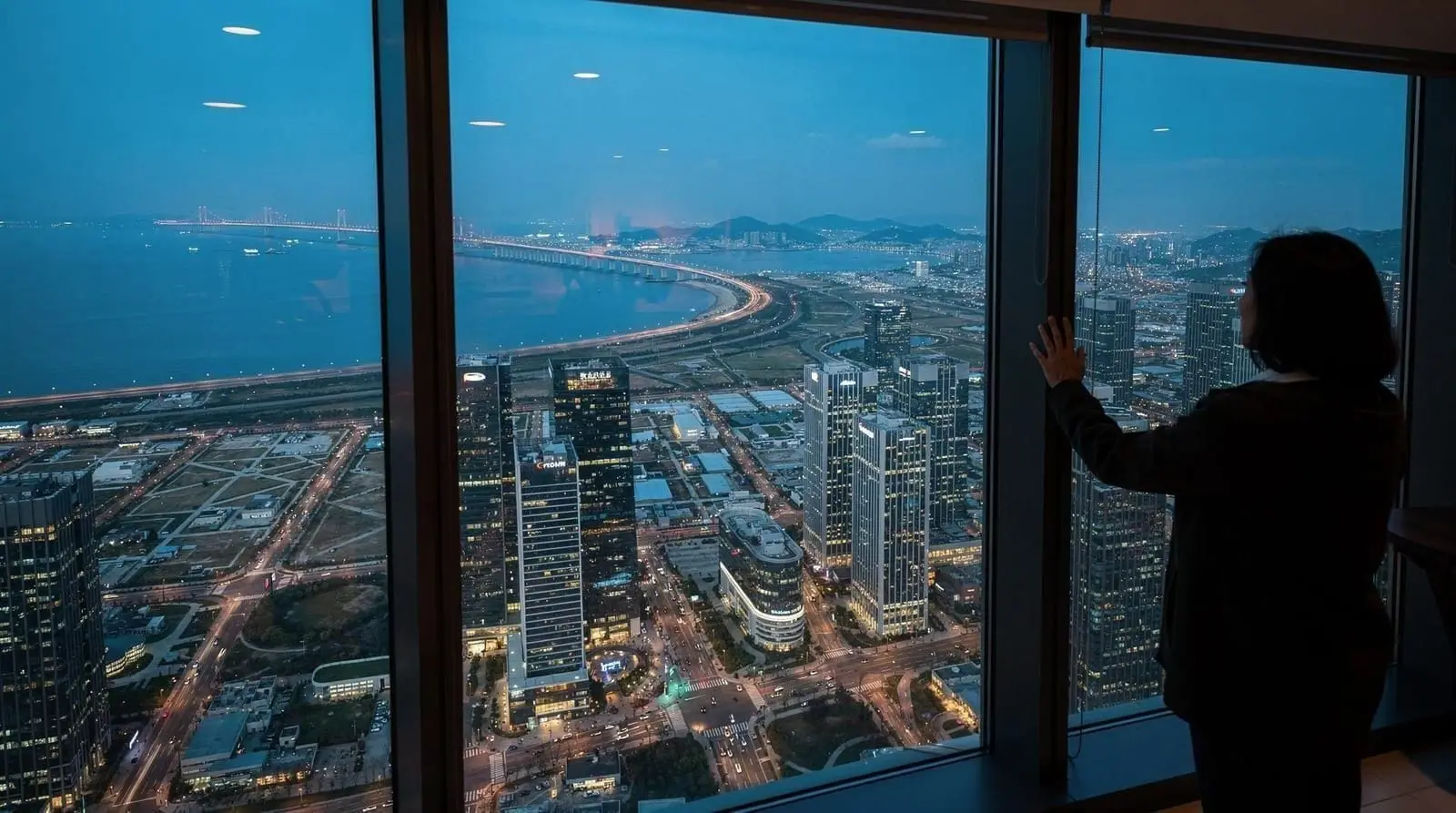
G-Tower observation deck, Songdo: free views over Incheon and the Yellow Sea
Is the G-Tower observation deck free?
Yes, entry to the 33rd-floor observation deck is free. It is open Tuesday to Friday, 10am–9pm (last entry 8:30pm), closed on Mondays and major public holidays, with reduced hours at weekends. Confirm hours on the official IFEZ site before visiting.
| Where | 33rd floor, G-Tower, Songdo (Yeonsu-gu, Incheon) |
| Cost | Free |
| Time needed | 30–45 minutes, longer combined with Songdo Central Park |
| Getting there | Line 1 to Incheon National University of Education Station, Exit 3 |
| Hours | Tuesday–Friday 10am–9pm (last entry 8:30pm); reduced hours at weekends; closed Mondays & major holidays |
The most important thing to know before you go
The G-Tower observation deck is free to enter and the views are genuinely good. But the opening days are worth checking: the observation deck is open Tuesday to Friday, 10am–9pm, with reduced hours at weekends, and it is closed on Mondays and on major Korean holidays (New Year, 1 March, 15 August, 3 October, 9 October, Seollal, Chuseok).
This information is not prominently displayed in most tourist summaries of Songdo, which is why it keeps tripping people up. If you are planning to visit specifically for the views — and it is worth doing — aim for a Tuesday-through-Friday visit. The last entry is at 8:30pm, weekend hours are shorter, and the IFEZ (Incheon Free Economic Zone Authority) office inside the building controls access. Checking the IFEZ official website before visiting is worth doing, particularly around Chuseok, Lunar New Year, and the string of May public holidays when the building may close outside its standard schedule.
With that said: if you can visit from Tuesday to Friday, the G-Tower is one of the best free viewpoints in the greater Incheon area, and it pairs naturally with a visit to Songdo Central Park immediately below.
What is the G-Tower?
The G-Tower — also referred to in various sources as the POSCO Tower-Songdo or the Songdo Smart Tower — stands 33 stories at 175 Art Center-daero, Yeonsu-gu, Incheon. It is the headquarters of IFEZ, the administrative body that governs the Incheon Free Economic Zone, and the building also houses offices, a café on the lower floors, and assorted corporate tenants.
The observation deck occupies the 33rd floor. Entry is through the main building lobby; take the elevator to 33 and walk through a short corridor to the viewing area. There is no ticketing booth, no queue management, and no fee. You sign in at a reception desk and proceed to the floor.
The building is not a tourist attraction in the conventional sense — it is a functioning office tower. The atmosphere inside is corporate and quiet on weekday mornings. Dress respectfully (no strict rule, but sleeveless tops and shorts are unusual in this kind of government-linked building). Security staff at the lobby desk are generally helpful even if English is limited; showing a translation of your purpose on your phone works fine.
This dual identity — functioning IFEZ headquarters first, public viewpoint second — explains almost everything unusual about visiting: the limited opening days, the lack of ticketing infrastructure, the corporate lobby you walk through to reach the elevator, and the absence of any gift shop or café dedicated to visitors. It is a byproduct of Songdo’s origin as a planned economic zone rather than a tourism district, and understanding that context makes the visit make more sense than expecting it to behave like a purpose-built attraction.
Who runs it and why entry is free
IFEZ — the Incheon Free Economic Zone Authority — is a South Korean government body responsible for administering the special economic zone that includes Songdo, Yeongjongdo, and Cheongna. The observation deck exists as a public-facing amenity of the IFEZ headquarters rather than a commercial venture, which is the direct reason it costs nothing to enter: there is no profit motive requiring a ticket price, and opening hours that follow the office schedule rather than a tourist one.
This is a genuinely different model from commercial towers like N Seoul Tower, which exist specifically to sell views and therefore invest in extended hours, ticketing systems, and visitor amenities. The trade-off for visitors is straightforward: no fee, but also no flexibility on when you can come.
What you can see from the 33rd floor
The observation deck has floor-to-ceiling windows on multiple sides, giving views in a 360-degree sweep with a few structural interruptions from support columns.
Looking directly down and north: The Songdo Central Park canal is visible below, its 2.7-kilometre seawater channel clearly legible from this height. The scale of the park — which can feel modest at ground level — becomes more apparent from above. You can see the Tri-Bowl pavilions at the western end of the park and the canal bridge that most visitors photograph from ground level. The surrounding Songdo SIBD grid is visible in its entirety, showing just how comprehensively this district was planned and built.
Looking west and northwest: The Yellow Sea horizon is visible on clear days. Incheon Bridge — one of the longest cable-stayed bridges in Asia at 21.4 kilometres — spans the water between Songdo and Yeongjongdo Island. The bridge is particularly striking in late afternoon when the low sun catches the suspension cables.
Looking northwest: On a clear day you can see Incheon International Airport on Yeongjongdo Island, roughly 15 kilometres away across the water. Planes can be seen in their approach and departure paths, which gives the view an unusual layer of movement. The island itself is flat and visible as a distinct land mass from this height.
Looking east: The Incheon cityscape extends inland — older residential towers, industrial port facilities to the north, and the wooded hills of the inland parts of Incheon visible on the horizon.
On exceptionally clear days — which do occur, most reliably in October and November — visibility extends well beyond Yeongjongdo. Some sources claim China is theoretically visible at 200 kilometres distance, but this is not a realistic expectation for a typical visit. What you will reliably get on a clear autumn morning is a panorama that takes in the airport, the bridge, the Yellow Sea, and the Songdo grid below — which is already more than sufficient.
Haze warning: Incheon suffers from significant air quality problems, particularly in spring (March–May) when yellow dust (황사, hwang-sa) from China is carried east by seasonal winds. On bad air days, visibility from the G-Tower can drop to a few kilometres, and the bay views disappear entirely. Check the Air Korea app or AirVisual before making the G-Tower a specific destination — if the AQI is above 100, you may find the views underwhelming. October and November have the most reliably clear skies.
Getting to the G-Tower
The two most practical metro options:
Incheon National University of Education Station (인천대입구역), Line 1, Exit 3 → approximately 15-minute walk south along the canal path toward the tower, or a short taxi ride (₩4,000–5,000, under 5 minutes). This is the same station used for the main Songdo Central Park entrance.
Songdo Moonlight Festival Park Station (송도달빛축제공원역), Line 1 → approximately 10-minute walk to the G-Tower from this station. This station is one stop further south on Line 1 and may save a few minutes of walking depending on which exit you use.
Bus: The Songdo BRT lines stop at multiple points in the district, and the Art Center-daero corridor near the G-Tower is served by local buses. The NAVER Maps app (or Kakao Maps) will give live routing from wherever you are starting — both apps are available in English.
From Incheon Station (near Chinatown and the Open Port area), allow 40–50 minutes by metro. From Seoul (Hongik University), plan 50–60 minutes including any transfers.
Taxi from Incheon Airport: approximately 20–25 minutes, ₩22,000–28,000. The G-Tower is worth combining with other Songdo stops on a layover if the opening days suit you — see the airport layover guide for a timed itinerary.
Photography at the G-Tower
The viewing floor is large enough that you can move between angles without competing with other visitors on a typical weekday. A few practical notes:
Best light for the canal view (north): The canal runs roughly north-south, and the light on it is best in the mid-morning (10–11am) when the sun is east of the building and illuminating the water. At midday the light is flat. In late afternoon the western views toward the Yellow Sea improve as the sun drops.
Sunset timing: The deck stays open until 9pm (last entry 8:30pm) from Tuesday to Friday, so you can stay for sunset and the first evening lights over the bay. Arrive in the late afternoon, depending on the season, if you want warm light on the western views.
Tripod: Allowed, and useful if the light is low or you want long exposures of the canal below. The glass is generally clean but check for smudging at your chosen window before setting up.
Camera gear: A standard zoom in the 24–70mm range covers most compositions here comfortably; the canal and park views work well at wider focal lengths, while the airport and bridge across open water reward a longer lens if you have one packed. A phone camera performs perfectly well for the canal-and-park shot directly below, which is the single most reliably good composition on a clear morning.
Through-glass photography: You will be shooting through the window glass, which means you need to position your lens close to the glass to eliminate reflections. Press a lens hood or your free hand against the glass to block room light behind you. Polarising filters help but are not essential.
Combining G-Tower with other Songdo stops
The natural sequence for a half-day or full-day Songdo visit:
Start at the G-Tower observation deck in the morning — arrive at opening (10am, Tuesday to Friday) for the clearest light and fewest people. After the views, walk five minutes to Songdo Central Park via the eastern canal path. Spend the mid-morning walking the canal loop or renting a bike. If it is between May and October, add a kayak or paddleboat session before noon. Walk south to Tri-Bowl (10 minutes from the park’s western edge) for architecture photos. Lunch at NC Cube Canal Walk (10–15 minutes from the Tri-Bowl, southeast of the park) with Korean set meals in the ₩9,000–14,000 range.
For shopping and the broader neighbourhood, the Songdo shopping and dining guide covers the main retail and food clusters in the district.
If you are visiting on a weekday and have the afternoon free, the Sorae Ecology Park is 25–30 minutes by bus from Songdo and offers a very different environment — tidal mudflats, migratory birds, and a traditional fishing port rather than glass towers and canal promenades. It is a surprisingly effective contrast to the engineered perfection of Songdo SIBD.
Incheon: One Day Guided City Tour with Hotel PickupEating near the G-Tower
The G-Tower itself has a café on the lower floors, typically open during office hours, with coffee and light snacks at standard Korean café prices (₩4,000–6,000 for an Americano).
Along Art Center-daero, the main boulevard running past the tower, there are Korean restaurants serving lunch sets and a few bakery-café chains. Prices are pitched at the office-worker crowd rather than tourists, which usually means better value: soup-and-rice sets at ₩8,000–10,000, bibimbap around ₩9,000–12,000.
The largest concentration of food options is at NC Cube Canal Walk, about 15 minutes’ walk south of the tower (or a short taxi). This mall has everything from Korean fast food to sit-down meat restaurants and Western chain cafés.
For budget visitors, the GS25 and CU convenience stores near the tower stock good prepared food — triangle kimbap at ₩1,500, cup ramen at ₩1,200, and coffee from the machine at ₩1,000. The Incheon on a budget guide has more detail on eating affordably throughout the city.
Who benefits most from this visit
The G-Tower observation deck makes the most sense for:
- Layover visitors from Tuesday to Friday who want to orient themselves to the geography of Incheon before moving on. Seeing the airport, bridge, and city from above in 20 minutes is an efficient orientation.
- Photographers looking for an elevated perspective on Songdo’s canal and architecture at no cost.
- Architecture and urban planning enthusiasts — the view from the 33rd floor makes the extraordinary scale of the reclaimed land project legible in a way that ground-level walking does not.
- Budget travellers who want a skyline-style view without paying the ₩15,000–20,000 typical of commercial observation decks like those in Seoul.
It is less useful for:
- Visitors who can only come on a Monday, when the deck is closed.
- Anyone prioritising atmospheric Old Incheon neighbourhoods — the historic areas around Chinatown and the Open Port heritage district are in a completely different part of the city and represent a contrasting aesthetic. See the Incheon 2–3 day itinerary if you want to cover both.
How it compares to other Incheon-area viewpoints
| Viewpoint | Cost | Access | Best for |
|---|---|---|---|
| G-Tower (Songdo) | Free | Tue–Fri 10am–9pm, reduced weekend hours, closed Mon | Canal, bridge, airport panorama |
| Wolmido hillside park | Free | Daily | Sunset over the harbour, lower elevation |
| Commercial towers in Seoul | ₩15,000–20,000 | Daily | Open every day, no Incheon geography |
For visitors who specifically want a free, elevated view and can only travel on a Monday, G-Tower simply is not an option — plan around Wolmido or a ground-level Songdo Central Park walk instead, and save the tower for another day if your schedule allows a return visit.
Seoul: Lotte World Tower Seoul Sky Observatory TicketUnderstanding Songdo from above
One thing the G-Tower does particularly well is make Songdo’s design logic legible. From the ground, the district can feel disorienting — wide boulevards, identical tower blocks, a certain absence of the chaos that makes Korean cities feel characteristically Korean. From the 33rd floor, the plan makes sense: the canal acts as a green axis, the park is the centrepiece, the towers are clustered in defined zones, and the whole thing is bounded on two sides by water.
Songdo was designed as a “smart city” — one of the early iterations of that concept in the 2000s, with sensors in street infrastructure, centralised waste management through pneumatic tubes, and networked traffic management. Most of this is invisible to visitors, but the overall sense of deliberate order is palpable both on the ground and from above. Whether this appeals depends on your tastes. Plenty of visitors find it impressive and novel; others prefer the layered urban texture of older Korean neighbourhoods.
What the G-Tower observation deck cannot give you is a sense of what the broader Songdo district feels like at street level — for that you need to walk it. The Songdo Central Park guide covers the ground-level experience in detail, including water activities, cycling, and the best picnic spots.
Incheon: Sunset Beach & China/Japan Town & Inspire ResortA full day itinerary using G-Tower as the anchor
If you can only make one day available for Songdo during your trip, structure it around the G-Tower’s open hours (Tuesday to Friday) rather than fitting it in as an afterthought:
- 10:00am — G-Tower. Arrive at opening for the clearest morning light on the canal view and the fewest other visitors. Budget 30–45 minutes.
- 10:45am — Songdo Central Park. Walk the canal loop, rent a bike if the weather suits, and see the park from ground level after having seen it from above.
- 12:00pm — Tri-Bowl. A 10-minute walk from the park’s western edge for architecture photography.
- 12:45pm — Lunch at NC Cube Canal Walk. Korean set meals or a wider food-court selection, 10–15 minutes from Tri-Bowl.
- Early afternoon — choose one: the Songdo shopping and dining district for a slower retail afternoon, or Sorae Ecology Park (25–30 minutes by bus) for a complete change of pace with tidal mudflats and birdwatching.
This sequence uses the G-Tower’s opening hours efficiently and avoids the common mistake of treating the tower as an isolated stop rather than the opening move of a fuller Songdo day.
Before you visit — a quick checklist
- Confirm it is not a Monday or a major Korean public holiday, and check weekend hours on the official IFEZ site.
- Check air quality on Air Korea or AirVisual — below AQI 50 is ideal; above 100 is disappointing for views.
- The observation deck is free, so no pre-booking is needed.
- Bring a lens cloth for photography through the windows.
- Allow 30–45 minutes for the G-Tower itself; combine with Songdo Central Park next door for a half-day or full-day programme.
The getting around Incheon guide covers T-money card setup, metro line maps, and taxi booking apps useful for this and other parts of the city.
Frequently asked questions about G-Tower observation deck
Is the G-Tower observation deck really free?
Yes. As of 2026, there is no entry fee for the 33rd-floor observation deck. You enter through the main lobby, sign in at the reception desk, and take the elevator up. The only cost is getting there. This is unusual for a high-floor city viewpoint, which makes it one of the better value stops in Incheon — provided you visit on a day it is open.
Why is the G-Tower closed on Mondays and shorter at weekends?
The G-Tower is primarily a functioning government and corporate office building — it houses the IFEZ headquarters and numerous tenants. The observation deck is a secondary facility that is open as a public amenity. Monday closure and reduced weekend hours are standard for this type of building access in Korea; check the official IFEZ site for the current weekend schedule. If you need views over Incheon on a Monday, the N Seoul Tower in Seoul remains the most accessible option, though that requires a separate trip.
How do I get to G-Tower from Incheon International Airport?
A taxi from ICN Airport takes 20–25 minutes and costs approximately ₩22,000–28,000. By public transit, take the AREX (all-stop) from the airport to Gyeyang and transfer to Incheon Line 1 towards Songdo; check the live journey time in Naver Map or Kakao Map. The airport layover itinerary has a timed version of this route that combines the G-Tower with other Songdo stops on a short layover, as long as it is not a Monday.
What are the best views from G-Tower — city or sea?
Both are good in different ways. The canal-and-park view directly below is the most striking because you can see the full 2.7-kilometre seawater canal from above, which contextualises the park in a way ground-level walking does not. The sea-and-bridge view to the west is more dramatic in scope — the Incheon Bridge and the Yellow Sea horizon are genuinely impressive. On a clear day the airport on Yeongjongdo Island adds an unusual dimension. Overcast or hazy days reduce the value of the sea view significantly, while the canal view holds up better regardless of weather.
Can I visit the G-Tower at night for city light views?
Yes, in the evening. From Tuesday to Friday the observation deck is open until 9pm (last entry 8:30pm), and it has been open to the public at night since March 2023, so you can see the sunset and the city lights. Weekend hours are reduced, so check the official IFEZ site first.
Is the G-Tower difficult to find?
Not particularly. It is a 33-storey building visible from most of the Songdo park and canal area. From Incheon National University of Education Station (인천대입구역), Exit 3, it is a 15-minute walk south or a ₩4,000 taxi. NAVER Maps and Kakao Maps both have it listed as G타워 or POSCO Tower Songdo. If you are navigating in English, searching “G Tower Songdo” in Google Maps also produces an accurate result.
Is there wheelchair access to the observation deck?
The building has elevator access, and the 33rd floor observation area is level and accessible. The lobby has a step-free entrance from the main street. If you have specific accessibility requirements, contact IFEZ ahead of your visit to confirm current arrangements — building access policies can change during renovation or security upgrades.
What should I do if the G-Tower is unexpectedly closed when I arrive?
It happens, particularly around holidays or when the building hosts a significant event. The backup option directly adjacent is Songdo Central Park itself, which is free, open all day, and a worthwhile destination in its own right. The Tri-Bowl architecture is a 10-minute walk from the tower. NC Cube Canal Walk is 15 minutes on foot. None of these give you elevated views, but they make for a full morning regardless. If you are specifically chasing high-level views over the bay, the Incheon one-day itinerary suggests combining Songdo with Wolmi Island’s less dramatic but still useful sea-facing hillside park as an alternative.
Incheon islands on GetYourGuide
Top-rated tours and activities


