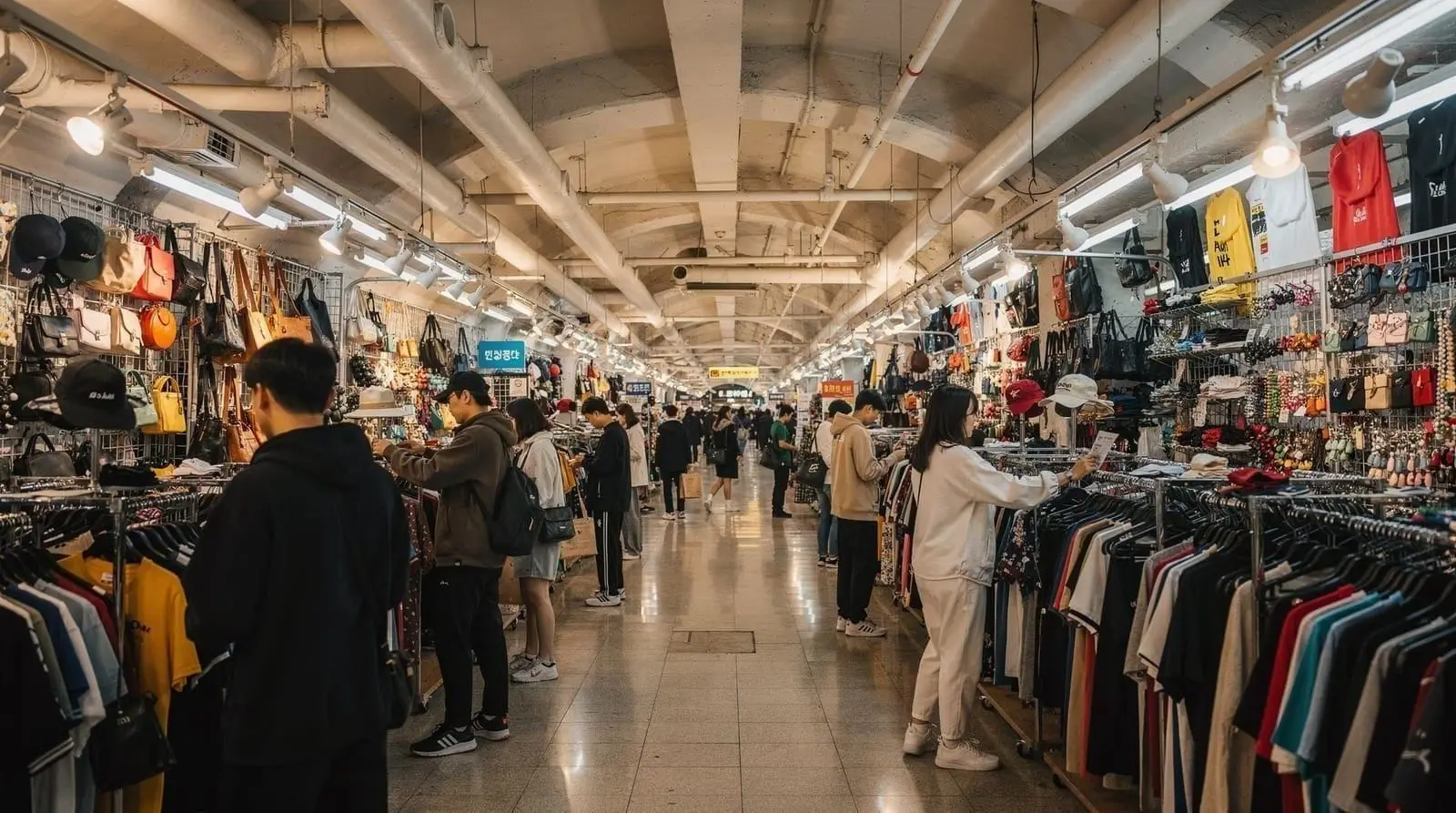
Bupyeong Underground Market: Asia's largest underground shopping mall
What is Bupyeong Underground Market?
Bupyeong Underground Market (부평지하상가) is a 1,400-shop underground shopping arcade beneath Bupyeong Station in central Incheon, stretching over a kilometre below street level. It is considered Asia's largest underground shopping market, selling clothing, accessories, shoes, food, electronics, beauty products, and everyday goods at competitive prices.
| Where | Below Bupyeong Station, metro line 1, central Incheon |
| Cost | Free to browse; items from ₩2,000 |
| Time needed | 1–2 hours to walk through, longer if shopping seriously |
| Getting there | Line 1 to Bupyeong, direct underground access |
| Best time | Weekday mornings (10am–noon) for quiet browsing |
The market that most Incheon visitors miss
When travel guides list Incheon attractions, they lead with Chinatown, Songdo, and Wolmido. Bupyeong Underground Market appears lower on the list or not at all — a significant omission for any visitor with an interest in Korean shopping culture.
Below Bupyeong Station, one of Incheon’s busiest transit hubs, lies more than a kilometre of connected underground shopping arcade, with approximately 1,400 individual shops ranging from fashion retailers selling the season’s Korean streetwear to tiny stalls selling phone cases, costume jewellery, military surplus, dried seafood, tteok (rice cakes), and imported cosmetics. The scale is genuinely surprising the first time you descend from the station concourse and find yourself in what amounts to an underground city of commerce.
This is not a tourist market. It is where Incheon residents buy their clothes, accessories, and everyday goods. The prices reflect that — competitive in a way that tourist-facing markets rarely achieve.
That local-first character is also what makes it worth the detour: almost nothing here is arranged for visitors, which means no pressure to buy, no English-language upsell, and no souvenir markup. You are simply shopping alongside Incheon residents doing their ordinary errands, which is a different kind of travel experience than the curated stalls of a tourist market.
Incheon: One Day Guided City Tour with Hotel PickupThe layout: how to navigate 1,400 shops
The market occupies multiple parallel underground corridors connected by cross passages, with exits to street level at intervals along Bupyeong’s main commercial street. The overall structure is long and linear rather than a single open floor, which means getting oriented requires either a visit to the information board near the main Bupyeong Station connection or simply walking and exploring.
Main entrance: The most direct access is via the underground passage from Bupyeong metro station exits 3 or 4. You will see the market begin immediately below the station concourse.
Sections by merchandise: The market broadly clusters merchandise types, though individual stalls mix across categories:
Fashion corridor (central and north sections): The largest category. Men’s and women’s clothing at Korean fast-fashion prices — typically ₩10,000–30,000 ($7.70–23) for tops, ₩25,000–50,000 ($19–38) for jeans and trousers. Korean fashion sizing runs small by European/US standards; check measurements before buying.
Shoes: Multiple dedicated shoe sections, particularly strong on sneakers, boots, and women’s heels. Prices run ₩20,000–60,000 ($15–46) for most styles.
Accessories and jewellery: Costume jewellery, bags, scarves, hair accessories, and phone cases fill the smaller stalls throughout the market. Prices start from ₩2,000 ($1.50) for basic accessories.
Beauty and skincare: Korean cosmetics at pharmacy prices — significantly cheaper than branded K-beauty products in international airports. The market has multiple stalls selling full skincare lines, sheet masks, BB creams, and toners. Look for Korean brands like Innisfree, Etude, and Nature Republic at competitive prices.
Food: Traditional Korean snacks and side dishes, tteok (rice cakes) in multiple flavours, dried goods, and packaged Korean foods. Not the most extensive food section, but worth a walk-through for food gifts.
Miscellaneous: Military surplus and outdoor gear, party supplies, stationery, small electronics accessories, and household goods fill sections of the market that are particularly popular with local residents rather than visitors.
What to buy at Bupyeong Underground Market
Korean streetwear and fashion
Bupyeong is excellent for Korean contemporary casual fashion — hoodies, co-ord sets, graphic tees, and the kind of oversized streetwear silhouettes that circulate through Korean fashion social media. The market tracks Korean trends more closely than it does international fashion, which makes it interesting for visitors who want to bring back something genuinely Korean in aesthetic rather than generic mall fashion.
Avoid buying anything you cannot try on without being sure of the fit — sizes are labeled S/M/L/XL but cut to Korean proportions, which typically means narrower shoulders and shorter lengths than European/US equivalents.
K-beauty products
Korean cosmetics have become globally recognised, but the prices in the Korean domestic market — particularly at a wholesale-adjacent underground market — are significantly lower than in Korean airport shops or international markets. Sheet masks (1–3 for ₩1,000–2,000), BB cream foundations (₩8,000–15,000), and toners (₩10,000–20,000) are all available at competitive prices.
The quality range varies. Stick to recognisable Korean brands (Tony Moly, Etude House, The Face Shop, Missha, Innisfree) at their designated stalls rather than unbranded products from very low-priced stalls.
Shoes
The shoe section delivers good value if you find the right stall. Both local brands and Korean interpretations of international styles are well-represented. Quality varies by stall — check construction and materials before buying.
Gifts and souvenirs
The market is not focused on tourist souvenirs in the way that Chinatown souvenir shops are. However, dried Korean foods, packaged tteok, Korean instant noodle varieties, and local snacks make excellent and genuinely local food gifts at prices well below airport duty-free.
Shopping tips
Bargaining: Bupyeong Underground Market is not primarily a haggling market — most stalls have fixed prices, particularly clothing and cosmetics vendors. At some accessories stalls and for multi-item purchases, asking politely for a small discount (이거 깎아 주실 수 있어요?, “Can you give me a small discount?”) sometimes yields a modest reduction. Don’t insist; take no as a firm answer.
Payment: Most stalls accept credit and debit cards. Small stalls selling food or accessories may prefer cash. Having some ₩10,000–20,000 in cash on hand for small purchases is advisable.
Fitting rooms: Many clothing stalls have small fitting rooms behind the rack. Ask to try something with a gesture toward the fitting area. Trying before buying is generally welcomed.
Receipts: Get receipts for anything you might want to return. Returns are generally possible within the day at most stalls but become complicated quickly — shop what you want to keep.
Tax refund: Purchases at registered vendors in the market may be eligible for VAT refund for foreign visitors spending over ₩30,000 at a single vendor. Look for the “Tax Free” or “Global Blue” sticker. The refund process is completed at the airport.
Budgeting a shopping trip
- Metro to Bupyeong from central Incheon: ₩1,400–2,000 (~$1.10–1.50) each way
- A few fashion items (2–3 tops): ₩30,000–70,000 (~$23–54)
- Skincare basics (sheet masks, toner, BB cream): ₩15,000–30,000 (~$12–23)
- Snacks and food gifts: ₩10,000–20,000 (~$8–15)
- Casual half-day budget: ₩60,000–120,000 (~$46–92), easy to spend far more or less depending on how much shopping you actually do
For a lower-spend visit, treat Bupyeong as a browsing and people-watching stop rather than a shopping list — the market itself is worth the walk even if you buy nothing beyond a snack. This pairs well with the budget guide to Incheon if cost is a major factor in your trip planning generally.
Getting to Bupyeong Underground Market
By metro: Bupyeong station is on metro line 1 and connects directly to the market via the underground passage. From Incheon Station, take line 1 north 3 stops to Bupyeong (approximately 10 minutes). From Seoul Station, take line 1 south approximately 35 minutes to Bupyeong. From Incheon Airport, the AREX all-stop service connects to Bupyeong via a transfer at Gyeyang (see below).
From Incheon Airport: Take the AREX all-stop service to Gyeyang, then transfer to Incheon metro line 1 toward Bupyeong. Check the exact time and fare with Naver Map or Kakao Map.
If you land at the airport with luggage and want to skip the transfer puzzle altogether, a private transfer from the airport is one option, and you can book an airport pickup and drop-off ahead of time. Most visitors who come specifically to shop do better leaving bags at their hotel first, since carrying them through long corridors gets tiring quickly. For help choosing a base, see where to stay in Incheon.
Navigating the arcade and the streets above is easier with data on your phone for maps and translation, so many visitors arrange an eSIM picked up before they reach the airport. For general language and etiquette basics, the safety and language tips guide is a useful companion.
Opening hours and timing
The market operates daily from approximately 10am to 10pm. Individual stalls set their own hours; some open earlier (9am) and a portion close earlier than 10pm. The market is busiest on weekends from noon to 7pm. Weekday mornings from 10am to noon are the quietest and most comfortable for browsing.
The market operates year-round, including national holidays (though some individual stalls close on major holidays such as Chuseok and Seollal/Lunar New Year).
Combining with nearby attractions
Bupyeong New Street (부평 먹자골목): Above ground and nearby, Bupyeong has a street-food and restaurant zone popular with students and young workers. Convenient for lunch before or after the market.
Sinpo International Market: The Sinpo International Market is accessible from Bupyeong by bus or short metro ride. Pairing Bupyeong Underground Market (shopping) with Sinpo (street food) makes a coherent half-day for market enthusiasts.
Incheon Chinatown: Incheon Chinatown is accessible via metro line 1 south from Bupyeong to Incheon Station (10 minutes). Bupyeong Underground in the afternoon and Chinatown for dinner is a satisfying Incheon day; for dinner specifically, see where to eat in Incheon Chinatown.
Gaehang Market: For a different, more traditional shopping atmosphere, the Gaehang Market near the Open Port district offers an above-ground contrast to Bupyeong’s underground scale — worth comparing if markets are a trip theme for you.
Wolmido and the waterfront: After a shopping session, the Wolmido island guide offers a very different, seaside change of pace, and Incheon in one day shows how markets, the Open Port district and the coast can be stitched together. Visitors interested in the older quarter can also read about Incheon Open Port heritage.
If you are weighing how much of your trip to give to shopping, Incheon vs Seoul helps you decide where your time is best spent.
If getting around by metro and bus feels unfamiliar, the getting around Incheon guide covers ticketing, transit cards, and how the line 1 corridor connects Bupyeong to the rest of the city.
Frequently asked questions about Bupyeong Underground Market
Is Bupyeong Underground Market really Asia’s largest?
The “Asia’s largest” claim refers to the number of shops in a single connected underground market — approximately 1,400 shops in continuous underground corridors. Comparable claims exist for several underground markets across Asia. Whether it holds the exact title is less important than the practical reality: it is a genuinely massive underground market that takes 1–2 hours to walk through even at pace.
What are the prices like compared to Seoul’s markets?
Prices are competitive and in most categories slightly lower than Dongdaemun market in Seoul. Korean streetwear items run ₩10,000–30,000 for tops and ₩25,000–50,000 for bottoms. Accessories start from ₩2,000. Quality varies by stall.
Is there food to eat in the market?
Yes — food stalls in the market itself sell tteok, Korean snacks, and packaged foods. For a full meal, the street-level area above Bupyeong station has restaurants in all price ranges. The Sinpo International Market is the better option for market street food specifically.
Can I use my credit card in the market?
Most clothing and cosmetics stalls accept credit and debit cards. Small stalls selling ₩2,000–5,000 items may prefer cash. Bring a mix.
Is it easy to get lost in the market?
The market can be disorienting at first due to its length and the repetitive visual pattern of stalls. The corridor layout is essentially linear with cross connections. If you lose your bearings, follow signs for Bupyeong station (부평역) which appear at intervals — you will exit at the station concourse where you started.
What size should I buy in Korean clothing?
Korean clothing runs small compared to European and American sizing conventions. An EU size 38 (UK 12, US 8) female is typically a Korean L or XL. For men, a EU/US size M corresponds to a Korean L. Always try on if possible, or check the measurements in centimetres posted at most stalls.
Korean street food tours on GetYourGuide
Top-rated tours and activities


