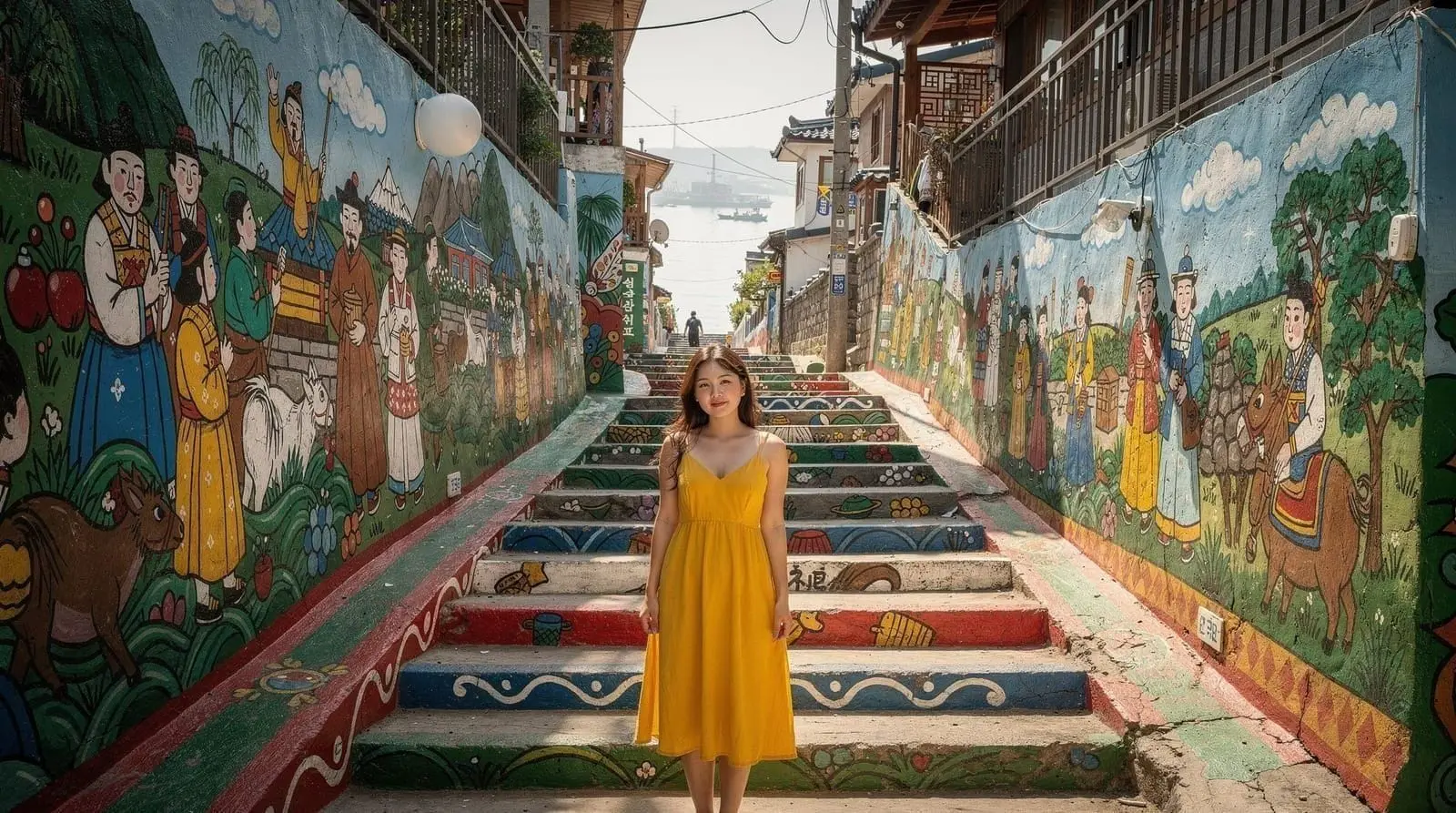
Best Instagram photo spots in Incheon — a photographer's guide
Incheon through a lens
Seoul gets photographed constantly. Every alley in Bukchon, every light installation in Dongdaemun, every Namsan Tower lock wall — photographed millions of times, the angles optimised and indexed. Incheon offers something different: visual material that is genuinely undershot, which means you can get compelling images without working around a crowd of other photographers in front of the same wall.
Seoul: Bukchon Hanbok Experience at HanboknamThe 15 spots in this guide cover the full spectrum of what Incheon offers visually — heritage architecture, costal light, painted streets, futuristic urbanism, island beaches, and the specific quality of light that the Yellow Sea coast produces at certain hours. The best time of day is included for each spot, because Incheon’s most photogenic locations are light-dependent in ways that matter.
You do not need a professional camera for most of these. Modern phones handle the conditions described well. A tripod is useful for the night shots at Wolmido and the Sea Train exposure. Otherwise, the main investment is timing.
| Where | 15 spots across Chinatown, Open Port, Songdo, Wolmido, islands |
| Cost | Free, aside from optional guided walks |
| Time needed | Full day for the core cluster; separate days for islands |
| Equipment | Phone camera fine for most; tripod for night/Wolmido shots |
| Best time | Golden hour and early morning for most spots |
1. Songwol-dong Fairytale Village murals
Best time: 8–10am (golden hour light on east-facing walls; minimal crowds)
Songwol-dong Fairytale Village is Incheon’s most recognisable Instagram location — painted facades, fairytale murals covering entire building frontages, and narrow lanes that compress the visual field into coherent frame compositions. The village sits on a hill above Chinatown and is walkable from Incheon Station in about 15 minutes.
The best images here are close-up detail shots of the murals rather than wide establishing shots, because the density of detail rewards tight framing. Look for the painted windows with trompe-l’oeil interiors, the staircase walls where the paintings run floor-to-ceiling, and the small courtyard sections that have been designed as photo backdrops with props and framed panels. Morning light hits the east-facing walls with warm directional light; by midday the village is in flat overhead sun that flattens the colours. The Songwol-dong Fairytale Village guide has the full walking loop.
Seoul: Professional Hanbok Photography at Gyeongbok Palace2. Incheon Chinatown ceremonial gate
Best time: Morning (7–9am) before crowds; the gate faces south and catches early light on its front face
The red and gold paeru gate marking the entrance to Incheon Chinatown is the most classically composed shot in the district — a formal Chinese archway structure at the end of a straight pedestrian approach from Incheon Station, with the red gate framing the lantern-hung street behind it. The challenge is crowds: this is the most photographed spot in Incheon and by 11am on a weekend it is dense with visitors.
Arriving before 9am means a near-empty approach and the ability to set up a clean composition with the gate fully visible. Shoot from the far end of the approach road for the classic frame. Move in close for detail shots of the carved eave brackets and green-glazed roof tiles. At night, the lanterns on the main restaurant street behind the gate are lit and give the district a completely different, warmer visual quality. The Incheon Chinatown walking tour guide covers the whole district.
3. Open Port heritage buildings
Best time: Overcast days reduce harsh shadows on the stone facades; afternoon light is warm on west-facing buildings
The former banks and consulates of the Open Port district provide a completely different visual vocabulary from Chinatown — Western classical architecture from the Japanese colonial period, thick stone walls, arched windows, and a streetscape that does not look Korean in any obvious sense. The Open Port heritage guide covers the buildings in detail.
The most photogenic section is the block around the former 18th Bank building and the Japanese Customs House. Frame the buildings from a low angle to emphasise the height of the masonry and the formality of the original design. Overcast light works well here — the stone facades are high-contrast and harsh midday sun creates problematic shadows in the window recesses.
4. Jayu Park harbor viewpoint
Best time: Late afternoon to sunset; the port faces west and the light is ideal from 4pm onward
Jayu Park sits on a hill above the Open Port and has a clear view across the port and the Yellow Sea from its western edge. The MacArthur statue in the foreground with the container port and water behind it is the main compositional option, but the more rewarding photography is from the railings at the park’s edge — looking out across the tidal flats and port infrastructure with the islands of the Yellow Sea on the horizon.
This is Incheon’s best viewpoint for long-lens photography of the port — the cranes, the vessels at anchor, the distant bridge silhouettes. Telephoto compression flattens the water and makes the ships look closer to the shoreline than they are. Arrive about an hour before sunset and stay through the blue hour. The Jayu Park guide has walking directions from the Open Port area.
5. Songdo Central Park canal
Best time: Morning (mist on the canal in autumn and winter); golden hour in late afternoon
The 100-acre seawater canal system at Songdo Central Park is a distinctive visual environment that reads clearly in photographs: modern glass buildings reflected in the canal, wide paths with no overhead clutter, and a designed landscape with consistent visual geometry. The best images are reflections — building facades in still canal water, particularly in early morning before wind disrupts the surface.
The canal banks have been planted with seasonal displays that change through the year. Spring brings forsythia and cherry blossom along the path edges; autumn has red-orange maple. The G Tower at the north end of the park is visible from the southern sections of the canal and provides a focal point for long shots across the water. The Songdo Central Park guide has the paths that give the best canal angles.
6. G Tower observation deck looking down
Best time: Late afternoon for warm light across the park; dusk for the city lights beginning to come on
The view from the G Tower’s 33rd floor observation deck is the highest free viewpoint in the Incheon area. Shooting downward from the observation deck gives a bird’s-eye view of the Songdo Central Park canal system that is unique — you can see the full geometric design of the park in a single frame that is impossible to capture from ground level.
The glass on the observation deck is clean enough for phone cameras pressed against it to get acceptable images. A polarising filter reduces reflections if you are shooting on an interchangeable-lens camera. Shoot in the late afternoon when the low sun angle emphasises the shadows of the trees along the canal paths and gives the park depth and texture. The G Tower guide has entry details.
7. Wolmido Ferris wheel at night
Best time: 8–10pm when the Ferris wheel is fully illuminated
The Wolmido Ferris wheel is lit with coloured LEDs at night and visible from the causeway approaching the island as a rotating colour wheel reflected in the dark water. The best photograph is from the causeway itself — wide enough to set up a tripod without blocking foot traffic — with the Ferris wheel reflected in the water and the amusement park lights behind it.
This is a long-exposure shot: 2–4 seconds at low ISO captures the Ferris wheel as a ring of light with the car positions blurred into a smooth circle. On a calm night the reflection in the water doubles the visual impact. The Wolmido island guide covers transport to the island by evening.
Incheon: Sunset Beach & China/Japan Town & Inspire Resort8. Muuido Hanagae Beach
Best time: Low tide, mid-morning for beach portraits; late afternoon for golden light on mudflats
Muuido is the most photogenic island accessible from Incheon, and Hanagae Beach has the key visual elements: clean white sand, a forest backdrop, and the Yellow Sea in a shade of green that does not match any Instagram preset because it is the actual tidal colour of shallow water over a mudflat base. The beach is wide and relatively free of development.
At low tide, the exposed mudflat to the south of the beach creates a mirror surface — sky reflected in a thin film of water over dark mud, with the shoreline buildings as a background layer. This is the shot that most Muuido photographers come for. Timing it requires checking the tide chart (low tide on the day you visit may fall outside ideal light hours, so plan ahead). The Muuido Island day trip guide has ferry times and tide context.
9. Incheon Art Platform
Best time: Overcast afternoons reduce contrast on the red-brick facades; early morning for clean empty streets
The Incheon Art Platform occupies a cluster of early 20th-century warehouse and factory buildings in the Open Port area, now used as artist studios and gallery spaces. The exteriors — red brick, iron-frame windows, wide loading bay doors, cobbled courtyards — are some of the most cleanly preserved industrial heritage in Korea.
The cobbled courtyard at the centre of the complex, with its brick walls on all sides and the original factory signage still visible at roof height, is a good architectural portrait location. The buildings do not have the decorative complexity of Chinatown but reward documentary-style photography — architectural detail, texture, material.
10. Eurwangni Beach at sunset
Best time: 30 minutes before sunset to blue hour; the beach faces west across the Yellow Sea
Eurwangni Beach on Yeongjongdo island (the airport island) faces west across open water and gets unobstructed Yellow Sea sunsets. The beach itself is sandy and backed by pine forest, and the combination of silhouetted trees on one side and open water on the other gives strong compositional options.
The sunset at Eurwangni is genuinely spectacular on clear days — the Yellow Sea turns amber and pink and the sky above the horizon stays lit long after the sun has set, giving an extended blue hour. The beach is accessible by bus from Incheon Airport (about 30 minutes) or by taxi from the AREX Unseo station. The Eurwangni Beach guide has the exact access routes.
11. Wolmi Sea Train in motion
Best time: Morning runs with the sea visible on the right side of the train; low afternoon sun for the coast side
The Wolmi Sea Train presents a specific photography challenge: you are inside the train, shooting through glass, in motion. The best shots are from the seaward side of the carriage — the glass is clean, the view is unobstructed, and shooting in bright conditions with a fast shutter speed eliminates most motion blur.
For exterior shots of the train, position yourself on the causeway or waterfront path before the train departs and time the shot as it passes — the coloured carriages against the yellow-grey sea give clean colour contrast. The Wolmi Sea Train guide has the timetable and helps you plan which side of the carriage to sit on.
12. Cherry blossom avenue at Incheon Grand Park
Best time: Early April, first two weeks; 7–9am before families arrive for the day
The cherry blossom avenue at Incheon Grand Park is the shot that defines Incheon’s spring visual identity: a wide path canopied with white-pink blossom, petals drifting in still morning air, and the park’s lake visible at the far end. The avenue is wide enough to use a long lens from the path’s start and compress the canopy into a tunnel of blossom.
Peak bloom depends on the year — the best time to visit Incheon guide tracks the blossom calendar — but typically falls in the first two weeks of April. Early morning is essential: by 10am on a weekend, the avenue is packed with families and the clean visual line of the path is broken by umbrellas and picnic blankets. The full Incheon cherry blossom spring itinerary covers the best days for this shot.
13. Songdo at night from the canal
Best time: 30 minutes after sunset when building lights are on and sky is still blue
Songdo’s modern architecture is best photographed at night, when the glass towers reflect in the canal and the designed lighting of the buildings creates a geometric light show. Shoot from the south bank of the canal looking north toward the cluster of high-rises — the reflection doubles the height of the buildings in the image.
A tripod and a 4–8 second exposure at ISO 400 gives clean results with the water reflection sharpened by the longer exposure and the building lights bright without overexposing. The blue hour window is about 20 minutes long — work efficiently. The surrounding paths in Songdo Central Park are well lit and accessible at night.
14. Ganghwado temple gates and pavilions
Best time: Morning light (before 10am) for side-lit temple architecture; autumn for red-orange foliage backdrop
Ganghwado island has several Buddhist temples and historical pavilions in settings that photograph beautifully in autumn and spring — old stone pavilions in forested hillside clearings, red-painted wooden gates against green or amber hillsides, and the wide views from the island’s west coast across to North Korea visible on the clearest days.
The island requires more travel time than other Incheon locations — approximately 60–90 minutes from Incheon by bus — but the visual quality is a different tier from the urban spots listed above. The temples have minimal visitor infrastructure and very low tourist density compared to equivalent sites in the Seoul area. The Ganghwado temples guide covers the main temples and the access routes.
15. Incheon Chinatown lantern street at dusk
Best time: 6–8pm in winter, 7–9pm in summer, when lanterns are lit and ambient light still present
The main restaurant street in Incheon Chinatown is hung with red paper lanterns for the full length of the block, which at dusk create a red-lit corridor that looks nothing like the daytime version of the same street. The lanterns glow orange-red, the restaurant signs contribute additional neon, and the surrounding buildings recede into darkness in a way that gives the lantern corridor strong visual definition.
Shoot from ground level at the far end of the street looking along the lantern ceiling toward the Chinatown gate. A wide aperture at ISO 1600–3200 handles the mixed lighting conditions on a modern camera or phone. Arrive at dusk when there is still enough ambient sky light to give the buildings at the edges of the frame some detail; full dark makes the shot flat. The where to eat in Incheon Chinatown guide covers the best restaurant options for dinner after the photography.
Incheon: One Day Guided City Tour with Hotel PickupClustering these spots for an efficient photography day
Spots 1, 2, 3, 4, and 15 (Songwol-dong, Chinatown gate, Open Port, Jayu Park, lantern street) are all within a 20-minute walk of each other and can be covered in a single day starting at 8am — morning light for Songwol-dong and Chinatown, afternoon at the Open Port and Jayu Park, dusk and evening for the lantern street.
Spots 5 and 6 (Songdo canal and G Tower) are a natural half-day excursion to the new city district.
Spots 7 and 11 (Wolmido Ferris wheel and Sea Train) work best as a combined Wolmido day, shooting the Sea Train in motion during the day and staying for the illuminated Ferris wheel at night.
Spots 8 (Muuido) and 10 (Eurwangni Beach) require separate travel days due to ferry logistics and travel time. Spot 14 (Ganghwado) is a full-day excursion.
The Incheon in one day itinerary covers the core Chinatown-Open Port-Wolmido circuit and can be adapted for a photography focus with the timings in this guide.
Best time of day, at a glance
| Time | Best spots |
|---|---|
| 7–9am | Chinatown gate, Songwol-dong, cherry blossom avenue (in season) |
| Late morning | Open Port heritage buildings (overcast), Incheon Art Platform |
| Afternoon | Jayu Park, Songdo canal, G Tower |
| Sunset / blue hour | Eurwangni Beach, Muuido Hanagae, Jayu Park harbor |
| Night | Wolmido Ferris wheel, Songdo canal reflections, Chinatown lanterns |
Frequently asked questions about Instagram photo spots in Incheon
What is the single most photogenic spot in Incheon?
Songwol-dong Fairytale Village in morning light is the answer most photographers give — the painted murals, the narrow lanes, and the absence of crowds at 8am make it the most reliable spot for images that look immediately distinct. Chinatown at dusk under the lanterns is the highest-drama shot but requires the right lighting conditions.
Do you need a guide for photography locations in Incheon?
Most of the spots in this guide are accessible independently. A local walking companion is useful for the Open Port heritage area if you want to understand the history behind the buildings you are photographing, and some guided tours specifically include photography time at the main visual spots. The Incheon in one day itinerary gives a usable self-guided framework.
What camera equipment works best for Incheon photography?
A phone camera with a 2x or 3x telephoto mode handles most of the spots listed here well. A wide-angle lens is useful in the narrow lanes of Songwol-dong and Chinatown. For the night shots at Wolmido and the evening lantern street, a camera with manual exposure control and a tripod gives substantially better results than a phone in automatic mode.
Are there any photography restrictions in Incheon attractions?
The Open Port heritage buildings that are now museums have standard no-tripod policies in some interior spaces. Temple sites on Ganghwado ask visitors not to photograph religious ceremonies. Otherwise, Incheon is unusually permissive for urban photography — street shooting, architecture, markets, and public spaces are all unproblematic.
When is the best time of year for photography in Incheon?
Spring (cherry blossoms, April) and autumn (foliage, October–November) give the most visually distinct seasonal conditions. The Yellow Sea produces striking light at sunrise and sunset year-round. Winter (December–February) has the clearest air, which improves long-distance shots from Jayu Park and the G Tower but makes outdoor photography cold.
Can you photograph inside the Wolmi Sea Train?
Yes. The carriages have large windows and no photography restrictions. Shoot from the seaward side in bright conditions with a fast shutter speed (at least 1/500s) to minimise motion blur. The train moves slowly enough that through-glass photography is feasible in good light.
How many days should I set aside for a full Incheon photography trip?
Two to three days covers all 15 spots comfortably: one day for the walkable Chinatown-Open Port-Songwol-dong-Jayu Park-lantern street cluster, a half day for Songdo, and separate days for Wolmido and the islands (Muuido, Ganghwado). One focused day is enough if you only want the highest-impact urban spots.
Which Incheon photo spots work best on a rainy or overcast day?
The Open Port heritage buildings actually photograph better overcast, since harsh sun creates problematic shadows on the stone facades. Songdo’s covered walkways and the Incheon Art Platform’s courtyard also hold up well in light rain, while beach and sunset spots are the ones to reschedule.
Incheon city experiences on GetYourGuide
Top-rated tours and activities


