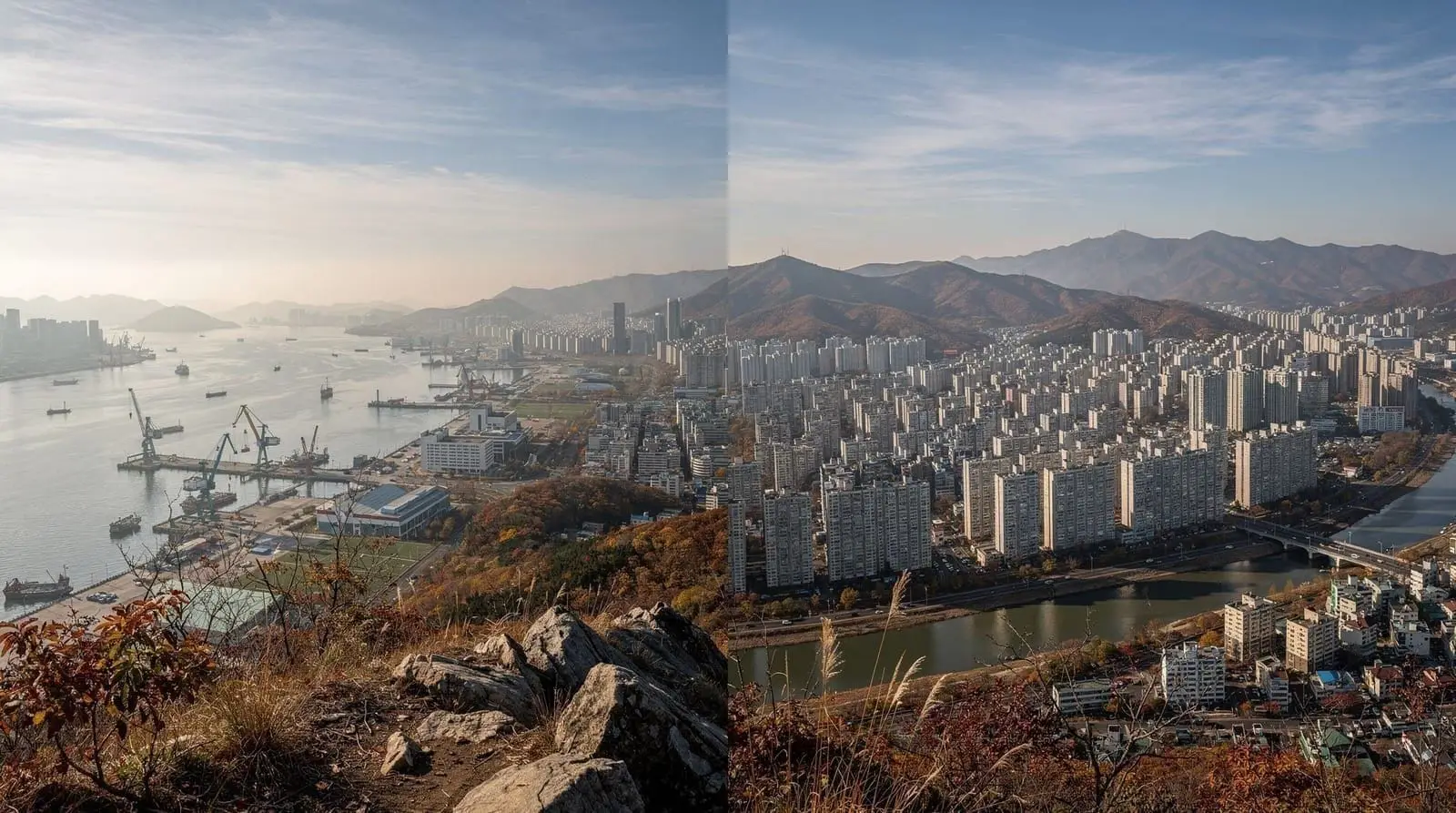
Incheon vs Seoul — which city should you visit first?
Two cities, one trip — deciding where to focus
Most international visitors to Korea arrive at Incheon Airport and take the AREX express train to Seoul without a second thought. Seoul gets the itinerary, the hotel bookings, the blog posts. Incheon gets the taxi ride from the terminal.
That pattern makes sense for many trips. Seoul is one of the great cities of East Asia — enormous, layered, inexhaustible. But the question of Incheon vs Seoul is more interesting than it first appears, because the two cities are genuinely different in character, not just in scale. They happen to be connected by a 43-minute train ride that costs around ₩9,500.
This guide is for anyone planning their first Korea trip who wants to understand those differences before committing to an itinerary — whether you will stay in one city and day-trip to the other, split your nights between both, or simply spend a layover afternoon making a first-pass assessment.
| Distance | 30 km / 43 minutes by AREX express |
| Cost to travel between | Around ₩9,500 (AREX) or ₩1,550 (metro line 1) |
| Accommodation | Incheon typically 20–30% cheaper than central Seoul |
| Best base for 4 days or fewer | Incheon, day-trip to Seoul |
| Best base for 5+ days | Seoul, day-trip to Incheon |
Location and transport between Incheon and Seoul
Incheon sits on the western coast of the Korean peninsula, roughly 30 kilometres west of central Seoul. The two cities are effectively linked at the hip by two train lines: the AREX express, which runs non-stop from Incheon Airport to Seoul Station in 43 minutes (₩9,500), and metro line 1, which connects Incheon Station in the city centre to central Seoul in about 55–70 minutes depending on your destination (₩1,550 from Incheon Station to Seoul Station).
Both cities are also on the metropolitan subway network, which means moving between them is genuinely easy. A T-money card handles all the fares. If you are staying in Seoul, Incheon is a comfortable day trip. If you are staying in Incheon, most of Seoul’s major sights are reachable within an hour.
One practical point: Incheon International Airport is in Incheon, on Yeongjongdo island. The “Incheon” of the airport is not the same as the “Incheon” of Chinatown or Songdo — those are on the mainland, connected to the airport by the AREX line and Incheon metro line 1 (change at Gyeyang). When people talk about visiting Incheon, they mean the mainland city, not the airport island. The getting around Incheon guide explains this in full.
Vibe and character
Seoul is urban density taken to an extreme. Twenty-five million people in the greater metropolitan area, a skyline that stretches in every direction, and a pace that does not let up. The neighbourhoods are excellent — Bukchon Hanok Village for traditional architecture, Hongdae for youth culture, Itaewon for international food, Myeongdong for shopping — but moving between them takes time, and the city rewards travellers who have already done some planning.
Incheon feels different. The historic core around Chinatown and the Open Port is compact and walkable. Songdo, the newer district built on reclaimed land, has wide boulevards and a quietness that Seoul never manages. Even the islands — Wolmido, Muuido, and the more remote Ganghwado — are accessible within an hour from the city and have a distinctly coastal, unhurried atmosphere.
The shorter version: Seoul is overwhelming in the best sense. Incheon is manageable and has a strong sense of its own history. Visiting both gives you a much more complete picture of Korea than Seoul alone provides.
Seoul to Incheon: Urban & Cultural Highlights Private TourCost comparison
Seoul and Incheon are broadly similar in cost, but Incheon’s markets and street food strips tend to run slightly cheaper than equivalent Seoul options. A jjajangmyeon lunch at Incheon Chinatown costs ₩8,000–12,000. A similar meal in Seoul’s Chinatown in Yeonnam-dong runs ₩12,000–16,000. Street food at Sinpo International Market is priced at traditional market rates — ₩2,000–5,000 for snacks — while equivalent Seoul street markets like Gwangjang can trend higher due to tourist demand.
Accommodation tells a similar story. Budget guesthouses in Incheon run ₩30,000–60,000 per night; mid-range hotels in Songdo or the city centre are ₩80,000–150,000. Equivalent Seoul accommodation is typically 20–40% more expensive in central neighbourhoods like Myeongdong or Hongdae.
Transport costs are low in both cities. A T-money card covers all metro and bus travel. The only significant transport cost to budget for in Incheon is the AREX if you want to travel to or from the airport — the ₩9,500 express fare versus ₩1,550 on the slower metro line 1. Full budget breakdown is in the Incheon on a budget guide.
Incheon Stopover: City Highlights Tour for K-culture FansBest for different traveller types
| Traveller type | Better base |
|---|---|
| History and heritage | Incheon (genuine 19th-century townscape) |
| Food (broad diversity) | Seoul |
| Food (Korean-Chinese specialities) | Incheon |
| Families with young children | Incheon (slower pace, lower cost) |
| K-pop and pop culture | Seoul |
| Island and nature seekers | Incheon |
| Nightlife and live music | Seoul |
History and heritage travellers will find Incheon more rewarding than Seoul’s equivalent old-town districts. The Chinatown and Open Port area is a genuine 19th-century townscape, not a reconstruction. The Open Port heritage guide covers the architecture. Seoul’s equivalent — the Bukchon Hanok Village area — is excellent but more visited and more commercial.
Seoul Decoded: Bukchon Hanok, Korean Tea Ceremony & DessertFood travellers should split their time. Incheon has a distinct culinary identity centred on Korean-Chinese cuisine, fresh seafood from Wolmido’s waterfront restaurants, and the dense street food of Sinpo International Market. Seoul has greater diversity and an extraordinary range of international cuisines, but Incheon’s specialities are not replicated there. The where to eat in Incheon Chinatown guide is the starting point.
Families with young children may find Incheon more manageable. Incheon Grand Park has a zoo, Wolmido has fairground rides, and the pace is slower than central Seoul. The logistical simplicity of a smaller city reduces stress. Seoul’s theme parks — Lotte World, Everland — require a full day and significant planning.
K-pop and pop culture fans will want Seoul. The entertainment agencies, fan cafes, broadcast studios, and KCON-adjacent events are concentrated there. Incheon is not the place for that particular strand of Korean culture.
Island and nature seekers should prioritise Incheon. Muuido, Ganghwado, and the coastal trails around Yeongjongdo are all unique to the Incheon area. Seoul’s nature options — Bukhansan, the Han River parks — are good but are city parks, not coastlines and tidal islands.
When to choose Incheon as your base
Choose Incheon as your base if:
You are arriving and departing from Incheon Airport and want to minimise commuting. Basing yourself in Incheon means the airport is 28–35 minutes away by metro, compared to 43–55 minutes from central Seoul.
You want a calmer pace. Incheon has less nightlife and fewer high-density tourist areas than Seoul, which can be a genuine advantage if you are travelling with children or want evenings that do not involve navigating subway crowds.
You are specifically focused on Incheon’s sights — the islands, the heritage districts, Songdo — and plan only one or two days in Seoul as a side trip.
Your budget is tighter and mid-range hotels in Songdo at ₩80,000–120,000 per night look better than equivalent Seoul prices.
The where to stay in Incheon guide covers the best neighbourhoods for different types of visitors.
When to choose Seoul as your base
Choose Seoul as your base if:
You have 5+ days in Korea and your primary goals are the major historical sites (Gyeongbokgung, Bukchon, Namsan), the food scene in its full diversity, or the entertainment and pop culture districts.
You want maximum flexibility for day trips. Seoul’s central location makes day trips to Suwon, Nami Island, the DMZ, and the ski resorts considerably easier to organise than from Incheon.
You prioritise nightlife, live music, or the concentrated buzz of a major global city.
Your itinerary is heavily weighted toward the east or south of Korea — Gyeongju, Busan, the southern coast — and Incheon would take you in the wrong direction.
For reference, guided day tours from Seoul to Suwon’s UNESCO Hwaseong Fortress and Nami Island are easy to book and leave from central Seoul stations.
Seoul: Gyeongbok Palace, N Tower, & Local Market City TourThe verdict
For a first-time visitor to Korea with 7–10 days, the optimal approach is to base yourself in Seoul and do Incheon as a full-day excursion. This gives you the depth of Seoul while still experiencing Incheon’s distinct character.
For visitors with 4 days or fewer, or those with a specific interest in the port city’s heritage and coastal areas, basing in Incheon and doing Seoul as a day trip is perfectly viable and often more relaxed.
The most compelling version of a Korea trip includes both in a genuine way. The Incheon and Seoul 2–3 day itinerary shows exactly how to structure that split.
Whatever your base, the Incheon in one day itinerary is worth reading before you arrive — it makes the case for giving the city real attention rather than just a morning in Chinatown.
What most first-timers get wrong
The most common mistake is treating Incheon purely as an airport transfer point and never returning to it, which means missing a genuine 19th-century townscape that Seoul has nothing equivalent to. The second most common mistake runs the other way: travellers with only 3–4 days who try to split nights evenly between both cities end up losing half a day to repeated transfers and luggage logistics. Pick one base, day-trip to the other, and you avoid both problems. A third pattern worth flagging — visitors assume Incheon has nothing beyond Chinatown, and end up skipping Songdo, Wolmido, and the islands entirely, which are arguably more distinctly “Incheon” than Chinatown itself.
Frequently asked questions about Incheon vs Seoul
Can you visit both Incheon and Seoul in one day?
Yes, comfortably. The AREX and metro line 1 make the journey between the two cities under an hour. A typical approach is to spend the morning in Incheon — Chinatown, the Open Port, Wolmido — and arrive in central Seoul by early afternoon for museums, markets, or the Bukchon area. This works best if you start before 10am.
Is it cheaper to stay in Incheon or Seoul?
Incheon is generally 20–30% cheaper for accommodation in equivalent quality tiers. Street food and traditional market eating is also slightly cheaper. However, the difference is not dramatic — Korea is generally affordable for international visitors in both cities.
Is Incheon worth visiting without the airport?
Absolutely. Incheon is the most commonly overlooked major city in Korea, and the heritage areas, Songdo, Wolmido, and the surrounding islands are all genuinely worthwhile. Most visitors leave Korea wishing they had given Incheon more time.
How long does it take to get from Incheon to Seoul by train?
The AREX express takes 43 minutes from Incheon Airport to Seoul Station. Metro line 1 takes about 55–70 minutes from Incheon Station to central Seoul. Both lines are reliable and run frequently throughout the day.
What should I not miss in Incheon if I only have a few hours?
Incheon Chinatown, the adjacent Open Port heritage buildings, and Songwol-dong Fairytale Village can all be covered in 3 hours on foot. Add Wolmido for a Sea Train ride and seafood lunch if you have 5–6 hours. The 6-hour layover itinerary maps this out precisely.
Do I need a separate transit card for Incheon?
No. A single T-money card works on all metro lines, buses, and trains in both Incheon and Seoul. Top it up at any convenience store (GS25, CU, 7-Eleven) at any metro station in either city.
Should first-time visitors split their nights between Incheon and Seoul?
Generally no for trips under a week — the constant transfers and repacking cost more time than they save. Pick one city as your base and treat the other as a full day trip; the Incheon and Seoul 2–3 day itinerary shows how to structure a genuine split for longer stays.
Is Incheon or Seoul better for a first arrival with jet lag?
Incheon, if your flight lands in the morning or early afternoon. Staying near the airport for the first night avoids a tired commute into central Seoul, and Incheon’s slower pace suits a low-energy first day better than diving straight into Seoul’s density.
Incheon city experiences on GetYourGuide
Top-rated tours and activities


