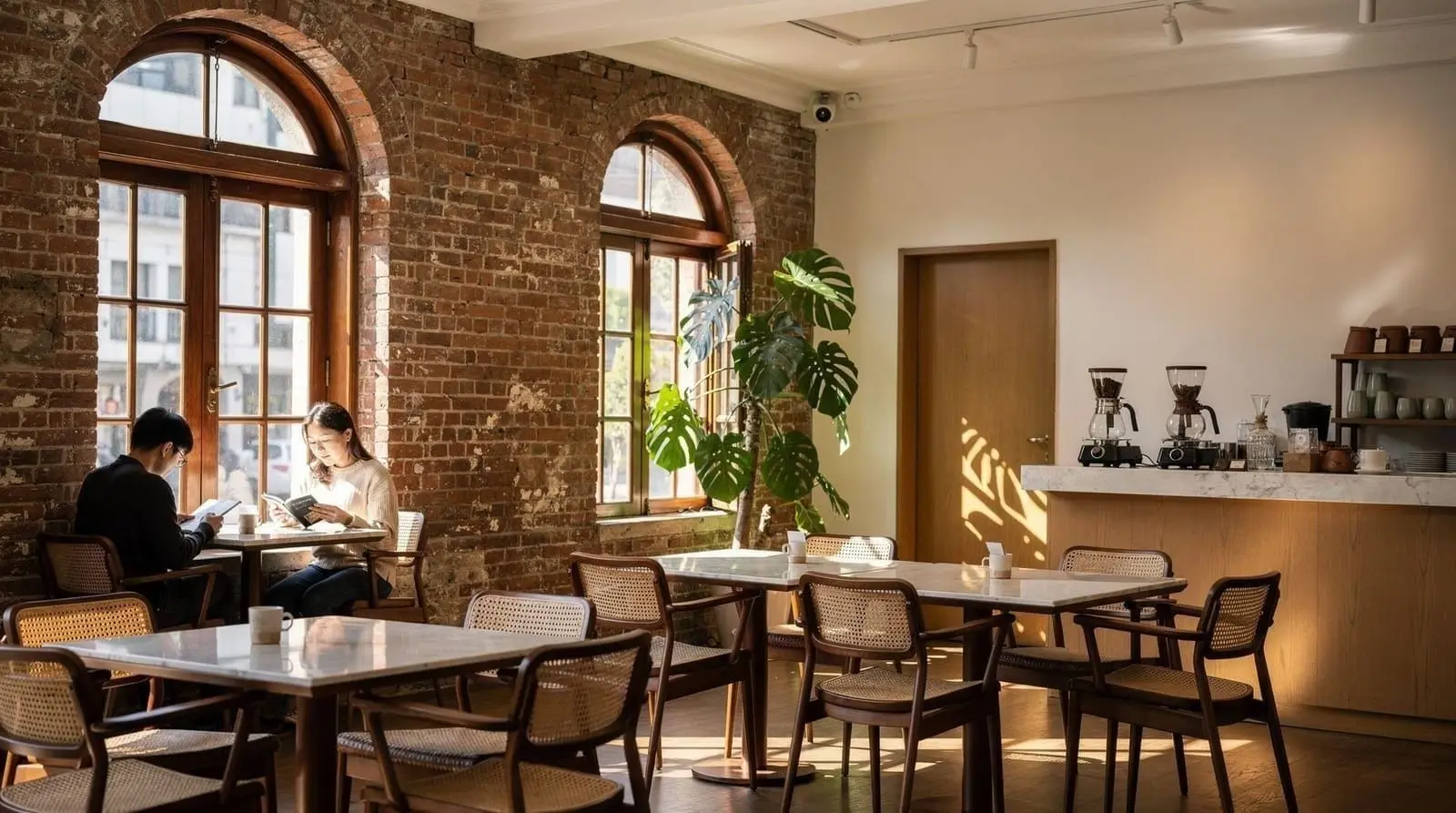
Best cafes in Incheon Open Port — coffee in historic buildings
Why the Open Port has become Incheon’s best cafe district
Korea’s third-city cafe culture does not get the coverage of Seoul’s Seongsu or Yeonnam neighbourhoods. That is the Open Port district’s advantage. It developed its cafe scene quietly, in the shadow of bigger-city attention, and the result is a concentration of independent specialty coffee shops in some of the most historically significant buildings in the country — Japanese colonial-era banks, Qing dynasty administrative offices, former customs warehouses — at prices that are noticeably lower than equivalent Seoul venues.
The Open Port area of Incheon was the first zone of foreign commercial activity after Korea signed modern trade treaties in 1883. Foreign consulates, trading companies, and banks built in a compressed stretch of hillside streets that survive today in remarkably good condition. Over the past decade, particularly as specialty coffee culture spread outward from Seoul, many of these buildings have been converted into cafes. The thick stone walls, original timber roof structures, and high ceilings that made them good administrative buildings also make them atmospheric places to drink coffee.
This guide covers what to look for and why, structured by the type of experience rather than by specific named venues — because the Open Port scene moves quickly and closures happen, but the types of spaces that define the district are consistent.
| Where | Open Port heritage district, near Incheon Station / Dongincheon Station |
| Cost | Around ₩5,000–9,000 espresso, ₩7,000–11,000 filter |
| Time needed | 2 hours for a proper cafe circuit |
| Getting there | Metro line 1 to Incheon Station (exit 1), 5-minute walk |
| Best time | Weekday late morning, before Seoul day-trippers arrive |
The atmosphere of restored colonial buildings
The defining quality of Open Port cafes is architectural. You are not sitting in a cafe that has been decorated to look historic — you are sitting in the actual 1920s or 1930s building, with the original masonry, the original floor tiles in many cases, and windows that look out onto streets of equivalent vintage.
Several of the buildings were Japanese-era banking institutions, built in a formal Western-classical style that was common for financial architecture of the period — arched windows, thick load-bearing walls, ornate cornices, timber panel interiors. Others are smaller-scale merchant buildings: two-storey brick structures with shallow shopfront facades and internal courtyards. A few are former warehouses with the high exposed-rafter ceilings that have become a standard aesthetic for coffee shops globally, except here they are original rather than salvaged.
Spend a morning wandering the streets between the Incheon Art Platform, Jemulpo Club, and the hillside running up toward Jayu Park and you will pass two dozen buildings that fit this description. Roughly half of them now house cafes, with the other half occupied by galleries, guesthouses, and administrative offices. The Open Port heritage guide maps the most significant buildings.
The specialty roaster scene
The most serious coffee in the Open Port comes from roaster-forward cafes that source directly or through Korean specialty importers and roast on-site or at a nearby facility. These spaces are typically minimal in fit-out, letting the original building do the work — a counter, a few bar stools, exposed walls — with a tight single-origin filter menu alongside espresso drinks.
Filter coffee is taken seriously in this style of cafe. Expect pour-over prepared to order, Kenya and Ethiopia lots at the lighter end, and Colombia or Brazil for the espresso. Staff at the better places speak enough English to discuss the coffee, and menus often include brief lot notes. Prices run ₩6,000–9,000 for espresso drinks and ₩7,000–11,000 for filter, which is standard for the Korean specialty market.
The best time to visit these roaster cafes is late morning on a weekday, when you can sit without rushing and the baristas have time to talk through the menu. Weekend afternoons fill up quickly with visitors from Seoul who have identified the district as a day-trip destination.
Rooftop and terrace cafes
The Open Port hillside generates a number of cafes with elevated outdoor seating — rooftops or second-floor terraces that look out over the tiled rooftops of the lower buildings toward the port and the Yellow Sea. This is a style of cafe experience that does not exist in the same form anywhere else in the Incheon area, and the combination of harbor views and historic streetscape below is consistently good.
Rooftop access in Korean cafes typically means a set staircase at the back of the building. Ask at the counter if there is a rooftop option. Some places reserve it for drinks of a certain price point. The best views are in the afternoon when the sun is behind you and the port lights up in warm light, though the tradeoff is that weekend afternoons can bring crowds.
These cafes tend to serve desserts alongside coffee — bingsu (shaved ice) in summer, sweet potato latte in winter, and a rotation of seasonal specials that track Korean dessert trends fairly closely.
Cafes with jjajangmyeon-adjacent heritage
Several cafes in the area have taken the food heritage of the Chinatown district — the Chinese-Korean culinary crossover that has been happening here for 140 years — and built it into their menu design. This means you might find a cafe that serves a coffee-house version of traditional Qing-dynasty desserts, or one that has restored a building that was once a Korean-Chinese restaurant and kept the original kitchen signage on the walls.
This strand of the cafe scene is more niche than the pure specialty coffee direction, but it is interesting precisely because it connects the beverage experience to the district’s history in a way that is difficult to find elsewhere. The menus in these places often run to teas and soft drinks alongside coffee, targeting a broader demographic.
The Incheon Chinatown walking tour guide and the cafe district overlap geographically, and it is natural to start or end the walking route at one of these historically-anchored cafes.
Dessert-forward cafes
Korean dessert cafe culture is well-developed, and the Open Port has its own version of the dessert-forward cafe concept. The spaces are typically brighter and more decorated than the specialty roaster cafes, with handmade cakes, traditional rice cake preparations adapted into modern presentations, and seasonal specials that attract a younger customer base — particularly on weekends when Seoul day-trippers arrive.
Strawberry season (January to April) brings strawberry cream sandwiches and strawberry tarts. Cherry blossom season in early April prompts pink-themed menus that lean heavily into visual presentation. Summer brings shaved ice variations — bingsu towers with condensed milk and fruit, black sesame bingsu, mango bingsu — served in bowls larger than most people expect.
These cafes are the busiest on weekend afternoons and are worth visiting on weekday mornings when you can actually get a seat and photograph the food without competing with five other cameras.
What to pair with your cafe visit
The Open Port cafe scene is best experienced as part of the broader heritage walk rather than a standalone destination. Budget two hours for the cafe circuit alone, which is enough to visit two or three places properly — a specialty filter coffee somewhere with good architecture, a terrace drink with the harbor view, and a dessert stop near Chinatown.
Songwol-dong Fairytale Village is a 10-minute walk uphill from the Open Port cafe area and makes a natural second stop after coffee. The Songwol-dong Fairytale Village guide covers the village itself. The Jayu Park guide is another easy 15-minute walk.
For a guided approach to eating and drinking in the area that goes beyond cafes, local walking food tours are available and are well-suited to the Open Port district.
Incheon: Sunset Beach & China/Japan Town & Inspire ResortPractical tips for visiting
Opening hours: Most Open Port cafes open at 10am or 11am. A handful open at 9am to catch early visitors. Closing time is typically 8pm–10pm. Monday closures are common among independent operators, so check before making a specific venue your primary plan.
Weekday vs weekend: Weekdays are significantly quieter. On Saturday and Sunday afternoons, the main Open Port streets fill with Seoul day-trippers and local families, and popular cafes develop queues for seating. If you have a choice, visit Tuesday through Friday.
Payment: Cards are universally accepted in the Open Port cafe area, including Visa and Mastercard. There is rarely a minimum purchase requirement.
Language: Menus in the specialty coffee cafes are usually bilingual. Staff English ranges from conversational to fluent at most places. In more traditional or dessert-forward cafes, the menu may be Korean-only, but pointing and numbers work fine for ordering.
Getting there: Take metro line 1 to Incheon Station (exit 1) or Dongincheon Station. The Open Port district is a 5-minute walk from either exit. If you are combining this with Chinatown, start at Incheon Station, walk through Chinatown, and continue into the Open Port area going uphill toward the heritage buildings.
The Incheon airport layover itinerary includes the Open Port as a viable stop for long layovers, and the Incheon in one day itinerary builds it into a full-day structure.
Open Port cafes vs. Seoul’s specialty scene
If you have already spent time in Seoul’s cafe neighbourhoods, it is worth knowing exactly how the Open Port compares before you decide whether the detour is worth it.
| Open Port (Incheon) | Seongsu / Yeonnam (Seoul) | |
|---|---|---|
| Building type | Original 1880s–1930s heritage buildings | Mostly converted warehouses or new-build |
| Crowd on weekdays | Quiet, locals and remote workers | Busy, tourist-heavy |
| Prices | ₩5,000–9,000 espresso | Often ₩6,000–10,000+ |
| Harbor/rooftop views | Yes, several terrace cafes | Rare |
| Queue culture | Minimal outside weekends | Common at flagship cafes |
Neither scene is objectively better — Seoul has more variety and more famous individual roasters — but the Open Port wins decisively on atmosphere-per-won, and it is the only place in the country where the building itself is as much the draw as the coffee.
A simple two-hour cafe route
If you only have one pass through the district, this order works well and avoids backtracking: start near Incheon Station with a specialty filter coffee in a converted bank building, walk uphill past the Open Port heritage buildings toward a rooftop or terrace cafe for the harbor view, then finish near Chinatown with a dessert stop that leans into the Qing-dynasty heritage angle. Budget 30–40 minutes per stop if you want to actually sit rather than rush. Doing this on a weekday morning avoids nearly all of the queueing that builds up by early afternoon.
Frequently asked questions about cafes in Incheon Open Port
What makes the Open Port cafe scene different from Seoul?
The buildings. Seoul has excellent specialty coffee, but the cafe spaces in Seoul are mostly purpose-built or in converted commercial units. The Open Port has 1880s–1930s colonial architecture that happens to contain cafes. The physical experience of drinking coffee in a stone-walled former customs bank is unique to this district.
Are Open Port cafes expensive?
No. Pricing is standard Korean specialty coffee — ₩5,000–8,000 for an Americano or latte, ₩7,000–11,000 for filter coffee, ₩8,000–15,000 for desserts. This is comparable to or slightly cheaper than equivalent Seoul venues.
Can you visit the Open Port cafes on a short layover?
Yes. From Incheon Airport, take the AREX (all-stop) to Gyeyang, change to Incheon Metro Line 1 for Incheon Station, then walk to the Open Port district; check the live journey time in Naver Map or Kakao Map. A 90-minute cafe visit is feasible on a 4-hour layover. The 6-hour layover itinerary builds this in alongside Chinatown.
Is the Open Port walking area suitable for rainy days?
The streets are not covered, but most cafes in the district have ample indoor seating. Rain can actually improve the atmosphere in the heritage buildings — the stone walls, dim interiors, and sound of rain on old tile roofs are part of the appeal. Bring an umbrella and allow extra time for browsing.
What else is near the Open Port cafes?
Incheon Chinatown is a 5-minute walk. Jayu Park and its harbor viewpoint are 10–15 minutes uphill. Songwol-dong Fairytale Village is 10 minutes in the same direction. Wolmido is a 20-minute bus or taxi ride west. The Incheon in one day itinerary covers how to combine these efficiently.
Do the cafes have good Wi-Fi?
Most Open Port cafes offer free Wi-Fi, typically shown on a small card at the counter. Connection quality is generally good. If you are working remotely for a few hours, the quieter weekday mornings at roaster-style cafes are the most suitable — enough ambient background without the weekend crowd noise.
How does the Open Port cafe scene compare to Seoul’s Seongsu or Yeonnam?
The buildings are the difference — the Open Port has original 1880s–1930s architecture rather than converted commercial units, prices run slightly lower, and weekday crowds are far thinner. Seoul still has more individual roasters and more variety if coffee quality alone is your priority.
Can I combine the Open Port cafes with a heritage walking route in the same visit?
Yes, and it is the natural way to experience the district. Start with coffee near Incheon Station, walk the Open Port heritage buildings and the Incheon Chinatown walking tour route, then loop back for a rooftop or dessert stop — the whole circuit fits comfortably into half a day.
Incheon city experiences on GetYourGuide
Top-rated tours and activities


